

Resources
Articles
Notes, guides, and editorial standards from the Approved Experiences team. Written for members, in the same voice we use everywhere else.
Resources
Notes, guides, and editorial standards from the Approved Experiences team. Written for members, in the same voice we use everywhere else.
Discover the best private jet membership programs, with clear comparisons of pricing, fleet access, and real-world value to help you choose.

When you start looking into private jet memberships, it's easy to get overwhelmed. The truth is, the "best" program isn't a one-size-fits-all solution. It all comes down to how often you fly, what you value most, and your budget. For most travelers, the choice narrows down to three main paths: jet cards for flexible, prepaid hours, fractional ownership for the frequent flyer who wants some of the perks of ownership, and subscription models for consistent access without the huge upfront cost.

Navigating the world of private aviation really boils down to finding the right mix of commitment, cost, and convenience for you. Private jet memberships have become a seriously attractive alternative to the massive financial and logistical headache of owning a plane outright, not to mention the wild price swings of on-demand chartering.
This isn't just a fleeting trend. It represents a real shift in how executives, entrepreneurs, and families are thinking about private travel. We've seen charter hours growing at a clip of 15-20% annually as more people opt for these smarter, more flexible ways to fly.
To zero in on the right program, you first need to get a handle on the three fundamental ways to get access. Each one is built for a different kind of traveler.
Jet Cards: The simplest way to think about a jet card is like a prepaid debit card for your flight time. You buy a block of hours—typically 25—on a certain class of jet, which locks in your hourly rate and guarantees you a plane when you need it. Actionable Insight: This is ideal for someone who needs guaranteed availability for 4-5 round trips from a city like Chicago to Naples, FL, per year and wants to budget for travel costs upfront.
Fractional Ownership: This is a much bigger commitment. You're literally buying a share (say, a 1/16th) of a specific aircraft. In return, you get an allotted number of flight hours per year, giving you a taste of ownership without having to manage the entire asset yourself. Actionable Insight: If you have predictable, monthly board meetings in different cities and require the exact same aircraft configuration for productivity, this model offers unmatched consistency.
Subscription or Deposit Programs: These models usually have a lower barrier to entry. Members pay a monthly or annual fee—or put down a deposit—to get access to a fleet at special member rates, which could be capped, fixed, or dynamic depending on the program. Actionable Insight: This fits a consultant who travels frequently but on short notice and can't commit to a 25-hour block. They pay a fee for access and then book flights as needed at a preferred rate.
The real decision here isn't just about picking a company; it's about picking the right access model for your life. A jet card is a fantastic fit if you fly between 25-50 hours a year. But fractional ownership? That only really starts to make financial sense if you’re consistently flying 50+ hours annually on predictable routes.
For travelers who are also mindful of their environmental footprint, keeping up with developments like Sustainable Aviation Fuel (SAF) regulations offers a glimpse into where the industry is heading.
To make things even clearer, let's break down these models side-by-side. This quick guide will help you instantly see which category feels right for your travel style.
A quick comparison of the main private aviation access models to help you identify which category aligns with your travel needs and commitment level.
| Model Type | Ideal for Travelers Who | Typical Commitment | Pricing Structure |
|---|---|---|---|
| Jet Card | Fly 25-50 hours/year and want predictable costs. | 1-2 year card term | Prepaid hours, fixed hourly rate |
| Fractional Ownership | Fly 50+ hours/year and seek asset-related benefits. | 3-5 year share term | Acquisition cost + monthly fees |
| Subscription/Deposit | Need flexible access with lower upfront investment. | Monthly/Annual fee | Membership fee + hourly flight cost |
Each of these models offers a unique value proposition. The key is to match the structure to your real-world travel patterns, not just the marketing pitch.
Choosing the right private jet membership can feel overwhelming. Every brochure promises the world, but the real value is hiding in the details. To cut through the marketing noise, you need a clear framework for comparing programs—a checklist that forces you to look beyond the glossy photos and into the operational realities.
Making a smart decision means analyzing any potential program through nine critical lenses. Think of it as your own personal due diligence. Each point reveals a different layer of cost, convenience, and value that will define your actual, real-world experience.
The advertised hourly rate is just the tip of the iceberg. The true cost of a program is buried in the fine print—the fee structures, fleet access rules, and operational policies that can dramatically inflate your final bill.
Pricing and Fee Structures: You have to scrutinize what’s included versus what’s an add-on. Practical Example: A program might offer a $9,000 hourly rate but charge extra for de-icing, a common necessity for winter flights from airports like Teterboro (TEB). An "all-inclusive" $9,500 rate from a competitor could end up being cheaper over a full year.
Fleet Access and Guarantees: This is a big one. Does the program guarantee you a specific jet, like a Gulfstream G450, or just a category, like a "super-midsize jet"? That distinction is everything. A guaranteed model means you always know the cabin size, speed, and amenities you're getting. Category access can mean a different aircraft every time. Actionable Insight: If you regularly travel with 6+ colleagues, a guaranteed model ensures you won't be downgraded to a smaller jet that can't accommodate your team.
Peak Day and Blackout Policies: Flying private is supposed to be about flexibility, but peak day policies can kill it. Find out exactly how many peak days are on their calendar—some programs have as many as 45-60 a year. Practical Example: If you plan to fly to Aspen the week before Christmas, check if this is a "peak day." It could mean your booking window extends from 24 to 72 hours, and a 25% surcharge is applied.
The single most important question to ask is about 'daily minimum flight time.' Many programs will charge you for a minimum of one or even two hours, even if your flight is only 30 minutes. For anyone taking frequent short-haul trips, this one policy can double your effective cost. For example, a 45-minute flight from Los Angeles to Las Vegas could be billed as two hours, turning a $7,000 flight into a $14,000 expense.
A program’s true worth is directly tied to where and when you can actually fly. You need to understand these boundaries upfront to avoid frustrating surprises later.
Geographic Service Areas: Get crystal clear on the program’s primary service area (PSA). Flying outside that zone—say, from the U.S. to Europe—can trigger massive surcharges or repositioning fees. Actionable Insight: Before signing, ask for a sample itinerary for a trip outside the PSA, like Miami to the Bahamas. This will reveal any hidden ferry fees that aren't in the primary rate structure.
Booking and Cancellation Windows: How far in advance do you need to book to get a guaranteed jet? The standard is often 8-24 hours, but that can easily stretch to 72 hours or more on peak days. Just as important, what are the cancellation terms? Practical Example: A program might allow you to cancel a non-peak flight up to 48 hours in advance for a full refund, but cancelling within 24 hours forfeits 100% of the flight cost.
Repositioning and Empty-Leg Policies: Are you on the hook for the cost of moving an aircraft to your departure airport? The best programs waive these fees within their PSA, which is a huge cost-saver. And while you're at it, ask about their empty-leg flight access. Flexible travelers can often find flights for 50-75% off the standard charter rate. Actionable Insight: Ask if the program has a mobile app or email list for empty-leg alerts. This is the most effective way to snag deals in real time.
Once you get past the plane itself, the quality of the service, the commitment to safety, and the extra perks are what truly separate a good program from a great one.
Concierge and Lifestyle Perks: The top-tier programs are more than just an airline. They function as a full-service travel partner, offering 24/7 concierge services for everything from ground transport and hotel bookings to securing last-minute event tickets. Practical Example: This could mean having a pre-stocked bar with your favorite whiskey on every flight and a pre-arranged SUV waiting on the tarmac upon arrival, all handled by a single point of contact.
Hourly Rate Calculations: It’s time to get granular. Ask them exactly how the hourly rate is calculated. Is it portal-to-portal (from the moment the plane leaves the hangar until it returns) or just wheels-up to wheels-down? The difference isn't minor—it directly impacts your final invoice on every single flight. Actionable Insight: A portal-to-portal rate can add 15-20 minutes of billable taxi time at busy airports like LAX, so a slightly higher wheels-up rate might be more cost-effective.
Safety Ratings and Standards: This is completely non-negotiable. Insist on seeing their third-party safety ratings—you're looking for ARG/US Platinum or Wyvern Wingman. Don't be afraid to ask about their pilot experience requirements and the maturity of their Safety Management System (SMS). It’s the clearest indicator of their commitment to getting you there safely. Actionable Insight: Ask for the specific minimum flight hours required for a Captain on the aircraft type you'll be flying. For a midsize jet, this should be at least 3,500 hours.
When you're ready to choose a private jet program, you have to look past the glossy brochures. On the surface, many providers sound the same, but the way they operate and a few critical differences in their models can completely change your flying experience. Let's compare the real-world offerings from industry heavyweights like NetJets, Flexjet, VistaJet, and Sentient Jet using the criteria that actually matter.
This is where the details make all the difference. A program might promise access to a super-midsize jet, but is it the exact same model every time, or will you be stepping onto a different aircraft layout with each trip? Getting this right is the key to a great fit versus a very expensive headache.
To see how they stack up, we'll dive into everything from the planes you'll fly on to the final price you'll pay. The goal here is a straightforward, honest look at what truly sets one elite program apart from the next.
The infographic below really boils it down to the three pillars of any good comparison: how you pay, what you fly, and where you can go.
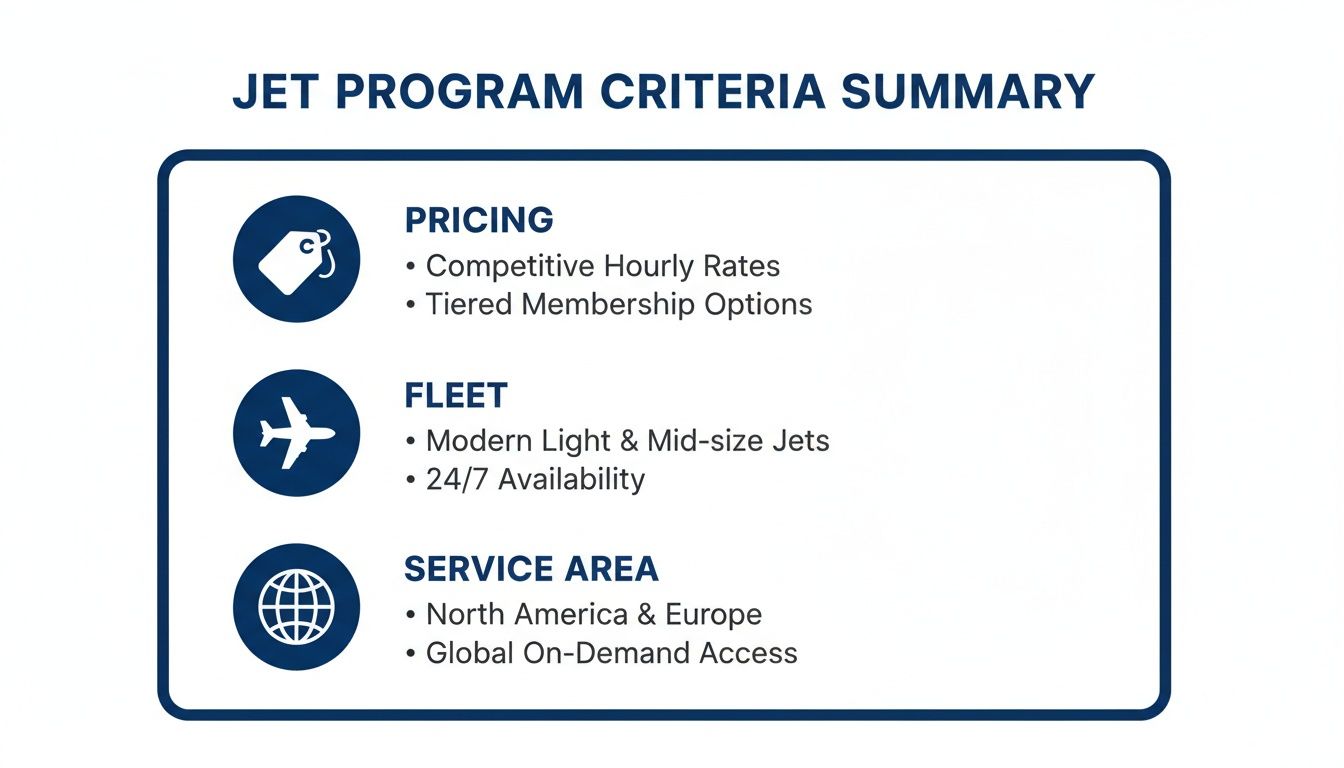
It’s a great reminder that you can't just look at the hourly rate. You have to consider the quality and availability of the fleet and whether any geographic limits will get in your way.
"Guaranteed access" is the cornerstone of any premium membership, but what that guarantee actually means is where the biggest differences lie.
NetJets & Flexjet (Fractional Ownership): These giants are built on a fractional model. When you buy a share, you're buying a piece of a specific aircraft, like a Bombardier Challenger 350. This means you're guaranteed that exact model or an equivalent, giving you incredible consistency in cabin size, layout, and performance flight after flight.
VistaJet (Subscription Model): VistaJet does things differently. They own their entire fleet of iconic silver and red jets. Your guarantee is access to their highly standardized fleet. It's an "asset-free" approach that delivers a consistent, top-tier product without you ever owning part of a plane.
Sentient Jet (Jet Card Broker): As the creator of the jet card, Sentient mastered the broker model. They guarantee access to an aircraft category (like "midsize") from a network of operators they've vetted to the highest safety standards. The specific plane might vary, but the quality and safety are always there.
So what does this mean for you? If having the exact same cabin for every business trip is non-negotiable, a fractional program like NetJets or a dedicated fleet like VistaJet is your best bet. But if you appreciate flexibility and don't mind slight variations, a premier broker card from Sentient can be a much more cost-effective choice.
That advertised hourly rate? It’s almost never what you actually pay. To do a real cost comparison, you have to know how each program builds its fees.
Let's run the numbers on a common scenario: buying a 25-hour jet card for a midsize jet with a listed hourly rate of $9,000.
But that's just the start. Here come the extras:
So, your real all-in cost is closer to $275,625. This pushes your effective hourly rate to $11,025, a far cry from the advertised $9,000. This is exactly why you must demand a fully loaded quote for a typical route before signing anything. Actionable Insight: Request a "pro forma invoice" for a sample trip, like a round-trip from Dallas Love Field to Eagle County, Colorado. This forces the provider to show you every single line item, from FET to crew overnight fees.
When you're doing this side-by-side analysis, it helps to understand the actual aircraft involved. You can find detailed aircraft comparisons that break down the capabilities of different jet models.
Fractional ownership and jet cards are a massive part of the private aviation world. In the first half of 2025 alone, there were 903 fractional share transactions, and that doesn't even count trades within programs. These models have opened up private flying to a much wider audience.
Your ability to fly when and where you want comes down to two things: the program's primary service area (PSA) and its rules for busy travel days.
NetJets and VistaJet are the true globetrotters here, with seamless global coverage. Flying from New York to Geneva is just another day at the office for them. In contrast, programs like Sentient Jet and Flexjet are powerhouses in North America and Europe, but trips to far-flung destinations might come with hefty repositioning fees because they may need to use partner networks.
Peak day policies can also be a deal-breaker. One program might have just 15-20 peak days with small surcharges, while another could have 45 or more days that require booking 72 hours in advance and come with steep premiums. VistaJet famously guarantees global availability with just 24 hours' notice—a game-changer if you need last-minute international flights. NetJets also shines here, offering its owners outstanding availability on peak days.
As you can see, there’s no single "best" program. The right choice is the one that aligns perfectly with your specific needs for aircraft consistency, cost predictability, and travel flexibility.
To make this easier, here’s a quick-glance matrix comparing the key features of these top programs.
| Program Feature | NetJets | Flexjet | VistaJet | Sentient Jet |
|---|---|---|---|---|
| Primary Model | Fractional Ownership | Fractional Ownership | Subscription / On-Demand | Jet Card (Broker) |
| Fleet Access | Guaranteed access to specific aircraft type owned | Guaranteed access to specific aircraft type owned | Access to a dedicated, branded global fleet | Guaranteed access to a category of vetted aircraft |
| Pricing | Capital investment + hourly rate + monthly fee | Capital investment + hourly rate + monthly fee | Fixed hourly rates based on subscription hours | Fixed hourly rates, sold in 25-hour blocks |
| Primary Service Area | Global | North America & Europe | Global | Primarily North America, with international options |
| Peak Day Policy | Excellent availability for owners, minimal restrictions | Structured peak days with advance booking requirements | Guaranteed availability, often with 24-hour notice | Capped peak days (around 45) with surcharges |
| Best For | Frequent, consistent flyers needing global reach | Travelers prioritizing new aircraft and consistency in NA/EU | Global travelers demanding ultimate flexibility and a branded experience | Those wanting price predictability without a long-term commitment |
This matrix highlights that your ideal choice really depends on what you value most—be it asset ownership, a consistent cabin experience, or maximum flexibility.
Let's cut to the chase. Choosing a private jet membership isn't about finding the "best" one on the market—it’s about finding the one that fits you like a glove. The right program for a CEO flying a predictable weekly route is worlds apart from what a family needs for a couple of incredible vacations each year.
Once you understand your own travel persona, you can slice right through the marketing fluff and zero in on the features that actually deliver value. This whole process stops being a complex analysis and becomes a simple matching game. You’ll avoid paying for perks you’ll never use and won't get stuck in a model that just doesn't fit your life.
For the executive logging 50-100+ hours a year, there’s no room for error. Consistency, reliability, and guaranteed access are everything. Their travel is often mission-critical, demanding the same aircraft layout for productivity on routes they fly over and over, like New York to L.A. or Chicago to Dallas.
For this profile, a fractional ownership program like NetJets or Flexjet is almost always the right move. The higher upfront cost is easily justified by the unmatched consistency and priority access—it functions more like a strategic business asset than a travel expense. A practical example: Buying a 1/16th share of a Challenger 350 ensures the executive always has a familiar "office in the sky" for their coast-to-coast flights.
This traveler lives for freedom and adventure, not rigid schedules. They’re the type to decide on a Thursday to fly to Aspen for the weekend or book a last-minute escape to the Caribbean. Flying maybe 15-30 hours a year, they care more about a great deal than a specific type of jet.
For this flyer, a traditional 25-hour jet card is often too restrictive and just plain overkill. They need a model built for flexibility.
Program Recommendation:
A deposit-based program or a hybrid travel membership like Approved Experiences Traveler is a perfect fit here. These programs open the door to private aviation—especially killer deals on empty leg charters—without the six-figure deposit of a typical jet card. The freedom to book one-off flights at preferred rates or snag an empty leg for up to 75% off standard prices is exactly what their spontaneous lifestyle demands.
Families and small groups have their own set of needs. Their trips are usually planned far in advance, built around school holidays or summer breaks. What matters most to them is cabin space, comfort, and a completely seamless travel experience from beginning to end.
Program Recommendation:
A 25-hour jet card from a well-respected provider like Sentient Jet is an excellent choice for this profile. It delivers predictable, locked-in pricing for a specific jet category, so they know they’ll always have the space they need. A practical example: A family of five can purchase a 25-hour midsize card knowing it will comfortably accommodate them, their luggage, and skis for two round trips to Jackson Hole and one to the Turks and Caicos, all at a fixed cost. This structure gives them guaranteed quality and safety for their family without the long-term commitment of fractional ownership.
Let's move beyond the old-school thinking of jet cards and fractional ownership for a moment. A smarter, more flexible approach to luxury travel is picking up serious steam, and it's not about choosing between private aviation and other premium travel. It’s about blending them.
This integrated strategy recognizes a simple truth: for most of us, the goal isn't just to fly private. It's to craft unforgettable end-to-end experiences that also happen to be a phenomenal value. This model sidesteps the massive six-figure checks typically required just to get in the door, treating private aviation as one powerful tool in a much larger luxury travel toolbox.

The concept behind a hybrid solution is brilliantly simple: pair opportunistic, deeply discounted private flights with exclusive wholesale rates on everything else your trip entails. Platforms like Approved Experiences Traveler are built on this model, giving members access to both empty-leg private jet charters and unpublished rates on a huge portfolio of luxury hotels, villas, and more.
This is how you build a high-end itinerary that would be almost impossible to justify financially if you booked everything separately.
The key advantages of this blended approach are clear:
This approach effectively cracks open a piece of the private aviation world, making it accessible without the intimidating financial barrier of a traditional jet card.
The real magic is in the aggregate savings. The money you save on a week-long stay at a luxury villa booked at a wholesale rate is often more than enough to cover the cost of an empty-leg flight. You’re essentially creating a private travel experience for a fraction of the retail price.
Let’s look at how this plays out in the real world. Imagine a family of four planning a spring break trip from Chicago to a luxury villa in Scottsdale, Arizona.
The Traditional Approach: If they booked each piece separately at retail prices, the numbers would stack up quickly.
The Hybrid Membership Approach: Using a platform like Approved Experiences Traveler, the family can build a much savvier itinerary.
In this scenario, the $7,000 they saved on the villa more than paid for their one-way private flight. They get the thrill and convenience of flying private for one leg of their trip and a stunning luxury stay, all while coming in at a total cost far below what they would have paid through conventional channels.
Meanwhile, the 24/7 concierge acts as the central nervous system for the entire trip, seamlessly weaving all the moving parts into one stress-free, high-value vacation.
Even after you've narrowed down the options, a few big questions always seem to pop up right before you sign on the dotted line. It's totally normal. Choosing the right private jet membership program means getting straight answers to these last few queries so you can move forward with complete confidence.
Think of this as the final checklist—clearing up the nuances between program types and understanding the real-world costs are the last steps before locking in a membership that actually fits your life.
The honest difference boils down to two things: commitment and ownership.
A jet card is your simplest way in. It works just like a prepaid debit card for flight hours. You buy a block of time, usually 25-50 hours, on a certain type of jet. This locks in your hourly rate and guarantees you a plane without the headaches of actually owning one. You're buying a service, not an asset. Actionable Insight: Choose a jet card if your annual travel needs fluctuate, as it doesn't lock you into a multi-year contract with monthly management fees.
Fractional ownership, on the other hand, is a serious investment. You're buying a deeded share (say, a 1/16th) of a specific, tail-numbered aircraft. This gets you a set number of flight hours each year. While the upfront acquisition cost is much higher and you'll pay monthly management fees, it feels a lot more like full ownership. You get benefits like potential tax advantages and better access on those super-busy peak travel days.
Empty legs are an incredible deal and a fantastic way to fly private for a fraction of the cost, but let's be clear: they are not reliable for primary travel. These are simply one-way flights an aircraft has to make to get into position for its next charter. Because the jet would be flying empty anyway, operators slash the price, often by 50-75% off the standard rate.
Here’s the catch: you have absolutely zero say over the schedule. The origin, destination, and departure time are all set in stone. This makes empty legs perfect for a spontaneous weekend getaway if you’re flexible, but a terrible idea for a must-make business meeting or a family vacation with non-negotiable dates. A practical example: If you see an empty leg from Miami to New York, you can't ask it to stop in Washington D.C. You must fly that exact route on that exact schedule.
Treat them as a brilliant perk or a supplemental tool in your travel arsenal, not as your go-to flight solution.
To figure out the true "all-in" cost, you have to look way past the advertised hourly rate. That number is just the beginning. A realistic budget means adding up several other fees—some mandatory, some situational—to see the full picture of what you'll actually spend.
Your All-In Cost Checklist:
And if you're looking at fractional ownership, don't forget to factor in the huge initial acquisition cost and those recurring monthly management fees. The best way to get a real number is to ask for a detailed quote for a route you fly often. Make them show you every single line item.
The short answer is yes, most major programs can get you overseas. But how they do it—and what it costs—varies dramatically.
Premier providers like NetJets and VistaJet have their own global fleets, which makes a trip from New York to Geneva feel seamless. But other programs, especially smaller ones focused on North America, often rely on partner networks for international legs. This can get complicated.
When you're evaluating a program for global travel, you have to nail down its primary service area (PSA). Flying outside this zone can trigger massive repositioning fees or completely different pricing. You need to ask point-blank: Does my fixed hourly rate apply internationally? What are the extra customs and handling fees? Getting this straight ensures your membership gives you the global reach you're paying for. Actionable Insight: If you plan frequent trips to the Caribbean, ensure it's included in the PSA to avoid paying ferry fees on every flight from Florida.
Ready to unlock a smarter way to travel? Approved Experiences Traveler offers a hybrid membership that combines the best of private and commercial luxury travel. Gain access to empty-leg charter flights and wholesale pricing on over a million hotels, resorts, and villas worldwide without the six-figure commitment of a traditional jet card.
Discover how you can elevate your entire travel experience today.