

Resources
Articles
Notes, guides, and editorial standards from the Approved Experiences team. Written for members, in the same voice we use everywhere else.
Resources
Notes, guides, and editorial standards from the Approved Experiences team. Written for members, in the same voice we use everywhere else.
Maximize your savings with our guide to business travel tax deductions. Learn what you can claim, how to document expenses, and avoid common IRS pitfalls.

Figuring out business travel tax deductions can feel like trying to solve a puzzle, but the core idea is refreshingly simple. If you incur costs while away from home for work, and those costs are both "ordinary and necessary," you can likely deduct them.
Think of it this way: the tax code is basically acknowledging that you had to spend that money to earn your income, and it's giving you a break for it. Getting this right can significantly lower what you owe at the end of the year.

Before you can claim a single dollar, your trip has to pass two fundamental tests from the IRS. Once you get these down, tracking and claiming your expenses becomes second nature.
Let's walk through it with a real-world scenario. Say you're a marketing consultant based in Chicago, and a major client in Austin needs you on-site for a three-day strategy session. This is a classic business trip, and it perfectly illustrates the two rules you need to know.
First up, every expense must be both ordinary and necessary. It sounds like jargon, but it's just common sense.
Ordinary simply means the expense is common and accepted in your line of work. For a consultant, flying to meet a client is completely ordinary. Necessary means it was helpful and appropriate for your business. Flying to Austin to secure a major contract is absolutely necessary.
Here's a practical example: Upgrading to first class for that flight might not be considered necessary by the IRS, even if it’s more comfortable. Stick to economy or business class to keep the expense reasonable. If you chartered a private jet for that Austin trip, they’d likely flag it as lavish and extravagant, putting the entire deduction at risk.
Second, your work has to take you away from your "tax home" (your main place of business) for longer than a standard workday. The key here is that the trip's duration must require you to stop for sleep or rest to properly handle your work duties.
Since your trip from Chicago to Austin spans three days, you'll obviously need a place to sleep. That overnight stay is what solidifies the trip as "travel away from home" in the eyes of the IRS, making your hotel and meal costs eligible for deduction. If you just drove two hours for a lunch meeting and returned the same day, that's not considered "away from home" travel, and your meal cost would be treated differently.
Key Takeaway: If your trip is standard for your industry (ordinary), helps your business grow (necessary), and requires you to sleep away from home, you've cleared the first major hurdles.
This simple framework is your starting point. A trip to a trade show, a visit to a client's office in another state, or travel for a professional development conference all generally fit these guidelines.
To make it even clearer, I've put together a quick reference table for the most common expenses.
Here's a snapshot of common travel expenses and whether they typically make the cut. Think of this as your cheat sheet before you book your next trip.
| Expense Category | Generally Deductible? | Key Consideration |
|---|---|---|
| Flights & Train Fare | Yes | The trip's main purpose must be business. |
| Lodging (Hotels, rentals) | Yes | Only for business days; can't be lavish or extravagant. |
| Meals | Yes (Usually 50%) | The 50% limit is standard unless a specific exception applies. |
| Taxis & Ride-shares | Yes | Covers transit between the airport, hotel, and work sites. |
| Laundry & Dry Cleaning | Yes | A practical necessity on longer, overnight trips. |
Keep this table in mind as you plan. Knowing what qualifies from the get-go makes tracking your expenses infinitely easier and ensures you're not leaving money on the table come tax time.
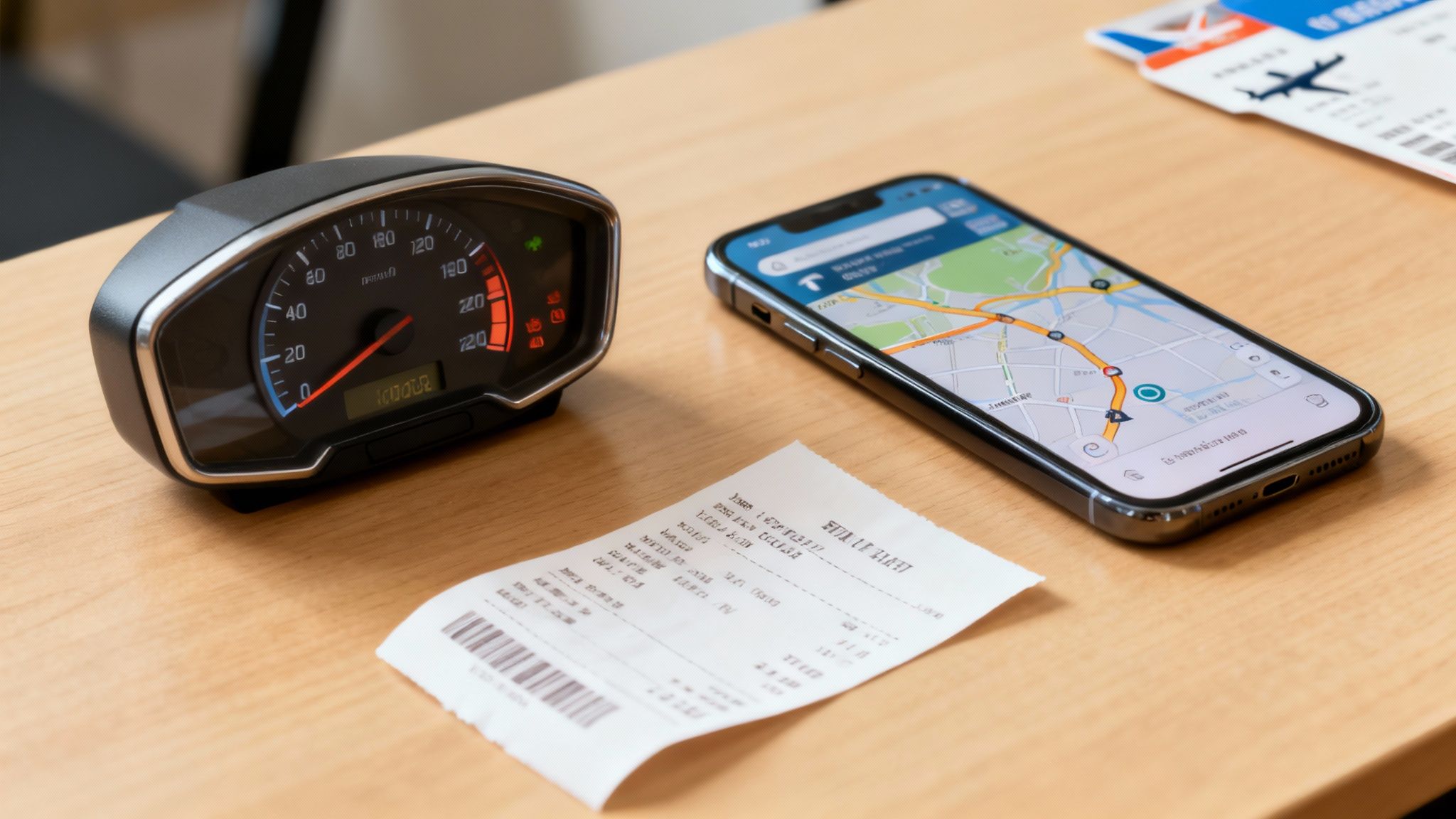
Transportation is usually the biggest number on any business travel budget. The good news? The IRS generally allows you to deduct 100% of the cost of getting to and from your business destination, as long as the trip's main purpose is work.
This covers the big-ticket items like your flight, train ticket, or bus fare. It even includes the rental car you use during the business portion of your trip. The logic is simple: if you fly from your home base to a client meeting and back, that plane ticket is a business expense.
The same rule applies once you're on the ground. That Uber from the airport to your hotel? Deductible. The taxi you grab to get to a business dinner? That’s deductible, too. An actionable tip: use a dedicated business credit card for these fares to make tracking them effortless.
What happens when you use your own car for a business trip? The IRS gives you a choice between two different ways to calculate your deduction: the Standard Mileage Rate or the Actual Expense Method.
Picking the right one can seriously impact your tax savings, so it pays to understand the difference.
The Standard Mileage Rate is the no-fuss option. Each year, the IRS sets a specific rate—for 2024, it’s 67 cents per mile. You just need to track your business miles, multiply by the rate, and you’re done. This is ideal if you want simplicity and don't have major car expenses.
On the other hand, the Actual Expense Method is exactly what it sounds like. You track every real dollar spent on operating your car for the year. This includes things like:
With this method, you figure out what percentage of your total driving for the year was for business, and then you deduct that same percentage of your total car expenses.
Let's walk through a real-world scenario. Imagine you're a freelance photographer driving from Phoenix to San Diego for a three-day wedding shoot. The round trip logs 750 miles on your odometer.
1. Standard Mileage Rate Calculation This one’s easy. You take your business mileage and multiply it by the 2024 rate.
2. Actual Expense Method Calculation This takes a bit more work. Let's say your total car expenses for the entire year (gas, insurance, a big repair, depreciation, etc.) added up to $8,000, and you drove a total of 15,000 miles that year.
First, you need your business use percentage:
Now, apply that percentage to your total expenses:
In this case, using the Standard Mileage Rate gets you a bigger deduction by more than $100. While the Actual Expense method can sometimes win out—especially if you have a high-value car or hefty repair bills—the standard rate is often the better and simpler choice.
Of course, a critical part of this is knowing what actually counts as a "business mile." Commuting from home to your main office doesn't count. To get the details, check out this great breakdown on Business Miles vs Commuting Miles Explained.
Pro Tip: Be strategic here. You generally have to stick with the method you choose in the first year you use your car for business. You can usually switch from the standard rate to actual expenses down the road, but you often can't go the other way for that same car. Choose wisely from the get-go.
Alright, you’ve made it to your destination. Now we need to talk about the costs that rack up once you're on the ground: your hotel, your meals, and all those little day-to-day expenses. These are the meat and potatoes of your travel deductions, but they come with some quirks you absolutely need to know. Your hotel bill is pretty straightforward, but meals? That’s where the rules get interesting.
First, the easy part. The cost of your hotel, motel, or even an Airbnb is 100% deductible for the nights you're away on business. This is a direct result of the "away from home" rule we talked about earlier. Since you had to shell out for a place to sleep just to get your work done, the IRS lets you write off the whole thing. The only catch is that the cost can't be "lavish or extravagant"—so maybe skip the presidential suite unless you've got a very good reason.
Now for the part that trips everyone up: meals. As a general rule, you can only deduct 50% of the cost of your food and drinks while traveling for business. It doesn’t matter if you’re eating alone, grabbing lunch with a coworker, or treating a client. The IRS only lets you write off half.
Why only 50%? The government’s logic is that eating is a personal expense—you'd have to eat anyway, whether you were on the road or at home. So, they split the difference. If you take a client out for a $100 dinner, including tax and tip, your deduction is just $50. It's a critical detail that can make a big difference in your total write-off.
When it comes to proving these daily expenses, you have two ways to go: the Actual Expense Method or the Per Diem Method. Your choice really boils down to a simple trade-off: do you want to maximize your deduction, or do you want to save yourself a ton of time and hassle?
1. The Actual Expense Method This is the old-school shoebox method. You keep every single receipt for everything—your hotel bill, every coffee, every meal, and every incidental like a tip for the bellhop or a dry-cleaning charge. It can be a pain, but if you're spending more than the standard government rates allow, it will almost always get you a bigger deduction.
2. The Per Diem Method Think of per diem as the shortcut. Instead of tracking every last penny, you use a standard daily allowance the government sets. The U.S. General Services Administration (GSA) publishes these rates, which change depending on the city to reflect local costs. The allowance gives you a set amount for your lodging and a separate amount for "meals and incidental expenses" (M&IE).
The beauty of the per diem method is that you can ditch the receipt-hoarding for small expenses. All you need to do is prove the time, place, and business purpose of your trip. For anyone who travels a lot, this can be an absolute game-changer.
Let's walk through a real-world example. Say you're a consultant from Chicago flying to San Francisco for a three-day client meeting. The GSA per diem rate for San Francisco at the time of your trip is $250 for lodging and $79 for meals and incidentals (M&IE).
Here's how you'd calculate your deductions using the per diem method for the three-day trip:
But wait! Don't forget the 50% limit still applies to the meals portion. So, you'd take that $237 for M&IE and cut it in half, giving you a deduction of $118.50.
Your total deduction for the trip would be $868.50 ($750 for lodging + $118.50 for M&IE).
The best part? No frantic search for that crumpled lunch receipt. Keep in mind, though, you can sometimes mix and match. If your actual hotel room cost $300 a night, you could use the actual expense method for your lodging to get a bigger write-off and still use the per diem for meals to keep things simple. You just have to be consistent and play by the IRS's rules.
Tacking a little vacation onto a business trip is one of the oldest and smartest travel hacks in the book. But when it comes to taxes, this is where things can get a little tricky. The moment your trip mixes work and play, the IRS expects you to draw a very clear line between what’s a business expense and what’s a personal one.
The whole game boils down to understanding which costs are fully deductible, which you have to split, and which you can’t touch at all.
Think about it in two parts: the cost to get there and back, and the costs you have on the ground. For your transportation—like your flight—the IRS has one big question: what was the primary purpose of the trip?
If you can honestly say the main reason you traveled was for business, you can usually deduct 100% of your transportation costs. That’s true even if you stick around for a few extra days of sightseeing. The IRS isn't a mind reader, so they figure this out by simply counting the number of days you spent on business versus personal stuff.
Let’s put this into a real-world scenario. Say you’re a consultant based in New York City, and you have to fly to Denver for a week of client meetings. You decide to fly out on a Monday but stay through the weekend to hit the slopes.
Here’s how your 7-day trip breaks down:
You’ve got five solid business days versus just two personal days. Because the trip was overwhelmingly for business, your round-trip flight from NYC to Denver is 100% deductible. Simple as that.
But your day-to-day costs are a different story. You can only deduct your hotel and meal expenses for those five business days. The hotel nights, dinners, and ski lift tickets from Saturday and Sunday? Those are on your own dime.
This little decision tree can help you visualize how to handle your daily expenses, whether you're tracking every receipt or using the simpler per diem rates.
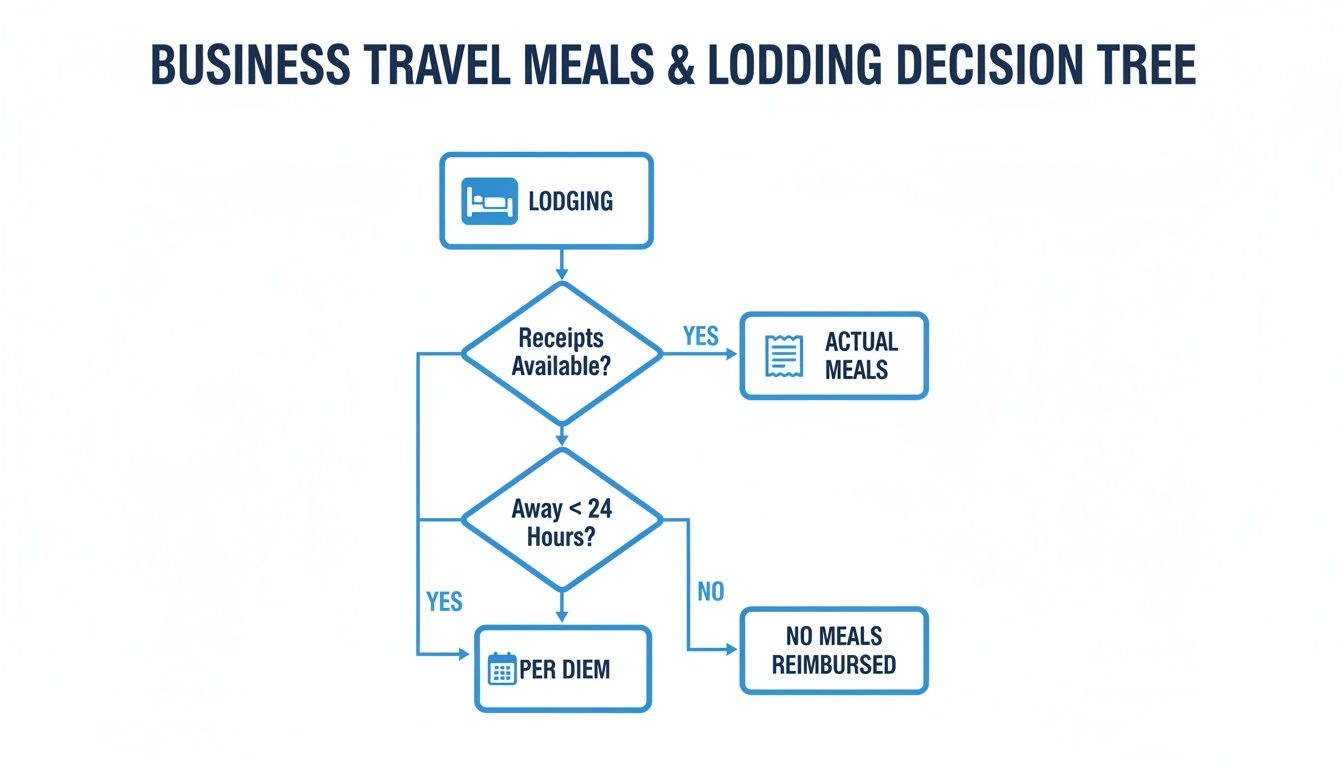
As the chart shows, it doesn’t matter if you claim the actual cost of your meals or use a per diem allowance—you still have to apply the 50% limit for meals. Your lodging, on the other hand, is fully deductible for the days you were working.
Once you cross a border, the rules get a lot tighter. For international trips that mix business with pleasure, you often have to prorate your transportation costs, even if the main point of the trip was work.
Let’s take that same 7-day itinerary but swap Denver for London. In this case, you can’t deduct the full cost of your flight. Instead, you have to do the math. Since 5 out of 7 days (about 71%) were for business, you can only deduct 71% of your airfare.
Key Takeaway: For trips abroad, you have to allocate your flight costs unless the entire trip is a week or less, or if less than 25% of your time was personal. This is a huge departure from the much more generous rules for domestic travel.
Want to bring your spouse or a family member on a business trip? This is an area where the IRS is notoriously strict. You generally can’t deduct their expenses unless you can prove their presence served a real, honest-to-goodness business purpose.
For a spouse's travel to be deductible, they need to be a bona fide employee of your business. And it’s not enough for them to be just helpful—their reason for being there must be essential. For example, if your spouse is the company’s official photographer and you need them to document a trade show, you might have a case. But just having them take notes at a dinner meeting won't cut it. Tread very, very carefully here to avoid raising a massive red flag.

Claiming your business travel deductions is one thing. Being able to defend them in an audit is a whole different ballgame. Your best defense isn't a clever argument—it's an unbreakable set of records.
A meticulous record-keeping system can turn a stressful IRS inquiry into a simple, straightforward review of the facts. The secret is to build documentation into your travel routine so it becomes an automatic habit, not a mad scramble at the end of the year. Thankfully, modern tools have made this easier than ever, so you can finally ditch that shoebox overflowing with faded receipts.
When you claim any business travel expense, the IRS is looking for four specific pieces of information. Think of these as the absolute non-negotiables for every single deduction. If you're missing even one, that deduction could be thrown out.
A vague note like "Client Dinner" just won't cut it. A strong business purpose sounds more like this: "Dinner with Jane Smith, CEO of Acme Inc., to finalize Q4 project scope." That simple addition provides the rock-solid context needed to justify the deduction.
Key Takeaway: Your goal is to create a record so clear that an auditor can understand the complete business context of your trip without asking a single question. Pretend you're explaining it to someone with zero knowledge of your business.
Gone are the days of manually scribbling every expense in a paper ledger. Today's tech makes it incredibly simple to capture all the required details right when they happen. Recording expenses in the moment is the single best way to guarantee accuracy.
To really get your system humming, an advanced text reader image tool can help automatically pull key data from your receipt photos, which cuts down on manual entry and eliminates silly mistakes.
To make sure your records are truly audit-proof, you need more than just a pile of receipts. You need a complete file for each trip that tells a clear and compelling story. Here's a quick checklist to follow for every trip.
| Expense Type | Information to Record | Example Document |
|---|---|---|
| Airfare/Train | Traveler name, dates of travel, destination, cost, and proof of payment. | E-ticket or booking confirmation email with full itinerary. |
| Lodging | Hotel name and location, dates of stay, and a detailed, itemized bill (folio). | The final checkout bill from the hotel, not just the booking confirmation. |
| Meals | Name and location of the restaurant, date, cost, and names of attendees if for business entertainment. | A detailed, itemized receipt (not just the credit card slip). |
| Car Mileage | Dates of travel, starting and ending locations, total miles driven, and the purpose of the trip. | A mileage log app (e.g., MileIQ) or a detailed spreadsheet. |
By consistently gathering these documents, you're building a fortress of proof around your deductions. This proactive approach doesn't just get you ready for a potential audit; it also gives you a crystal-clear financial picture of your travel, helping you budget smarter for the future.
Let’s be honest. One of the biggest pains of claiming travel deductions isn’t the IRS rules—it's the mountain of paperwork. Every flight confirmation, hotel folio, and rental car agreement is another scrap of paper you have to chase down and organize.
This is where a centralized booking strategy isn't just a nice-to-have; it's a massive advantage. When you use a single platform or travel membership for all your arrangements, you’re basically creating an automatic, perfectly organized paper trail. Instead of receipts scattered across a dozen different websites and email accounts, everything is consolidated in one clean, digital history. It’s a simple shift that pays huge dividends when tax season rolls around.
We’ve all been there. You need to find a hotel receipt from a business trip you took eight months ago. First, you dig through your inbox, then you start combing through credit card statements, and finally, you’re sifting through that crumpled pile of papers you swore you’d organize one day. It’s a huge waste of time and energy.
Now, picture this instead: you just log into your travel platform. Every booking—from the flight out to the hotel stay—is right there with a detailed digital receipt. It becomes your single source of truth for all major travel expenses, completely eliminating that frantic hunt for documents.
The Power of Consolidation: Centralized booking turns record-keeping from a reactive scavenger hunt into a proactive, organized system. You're not just making tax time easier; you're actively minimizing the risk of losing valuable deductions because of a misplaced receipt.
This streamlined approach is about more than just convenience. It’s about building a rock-solid set of records that will stand up to scrutiny. The detailed invoices and booking histories you get from a single platform are powerful primary documents for the IRS.
Here’s exactly how it strengthens your tax workflow:
At the end of the day, smart booking habits lead directly to easier, more accurate tax filing. By centralizing your travel arrangements, you build an efficient system that saves you time, reduces errors, and gives you the confidence to claim every single deduction you are entitled to.
Of course. Here is the rewritten section, crafted to sound human-written and match the expert tone of your examples.
Even when you know the rules, the real world has a way of throwing curveballs. Let’s tackle some of the most common questions that pop up for business travelers. Think of this as your go-to guide for those tricky "what-if" scenarios.
Absolutely, as long as you can clearly connect the convention to what you do for a living. The IRS wants to see that the agenda and sessions were directly related to your trade or business.
It's all about relevance. A freelance graphic designer heading to a major design conference? That’s a clear-cut deduction. But if that same designer tried to deduct a trip for a general investment seminar, the IRS would likely shut that down. Your best bet is to always keep the convention agenda and your registration papers—they’re your proof that the trip was all about work.
This one comes up all the time, and the answer is refreshingly simple: if you didn't pay for it with actual money, you can't deduct it. Credit card points and frequent flyer miles have a $0 tax basis, which is the IRS's way of saying they don't count as a real expense.
That said, you can still deduct any real money you did spend. Things like baggage fees or the taxes and surcharges on an award ticket are fair game. Just remember, if you used points to upgrade a flight your company already paid for, you can’t claim the value of that upgrade as a deduction.
The Bottom Line: The IRS only cares about actual cash leaving your (or your company's) bank account. No cash out, no deduction. It's as simple as that.
You bet. The key is that the primary purpose of the trip has to be business. As we covered earlier, for any travel within the U.S., if your business days outnumber your personal days, you can deduct 100% of your transportation costs, like your flight.
Imagine you're on a five-day business trip and decide to stay for the weekend to do some sightseeing. Your flight is still fully deductible because the main reason you traveled was for work. You can also deduct your hotel and 50% of your meals for those five business days. Naturally, the costs from your two personal days are on you. Just be diligent about splitting your expenses between business and personal time.
Ready to make booking and documenting your business travel easier than ever? With Approved Experiences Traveler, you can consolidate all your bookings in one place, creating a perfect digital paper trail for tax season while unlocking wholesale pricing on over a million hotels. Simplify your deductions and save on every trip. Discover how Approved Experiences Traveler can benefit you.
From this collection
From this collection
how to organize receipts
Learn how to organize receipts with a foolproof system for busy professionals. This guide covers digital capture, automation, tax rules, and delegation.