All Articles
The Journal
Understanding Car Rental Rates and How to Save Money
February 12, 202616 min readcheap car rentaltravel savings
Unlock the secrets behind car rental rates. Our guide explains the hidden fees and provides actionable strategies to help you book smarter and save money.

Ever looked at a car rental ad for, say, $25 a day and thought you'd scored an amazing deal? We've all been there. Then you get to the final checkout screen, and the total has somehow ballooned into a number that looks nothing like what you started with.
The hard truth is that the advertised daily price is just a teaser. Your final bill will almost always be 30-50% higher once all the mandatory fees, surcharges, and taxes are piled on.
What's Really in Your Car Rental Quote?
Think of a car rental quote like a concert ticket. You see the base ticket price, but then the service fees, facility fees, and taxes get tacked on. The appealing daily car rental rate works the same way—it's just the starting point, not the finish line.
The final price is a mix of that base rate plus a whole slew of other charges, many with confusing names. This is how that initial low price grows into the amount you actually pay.
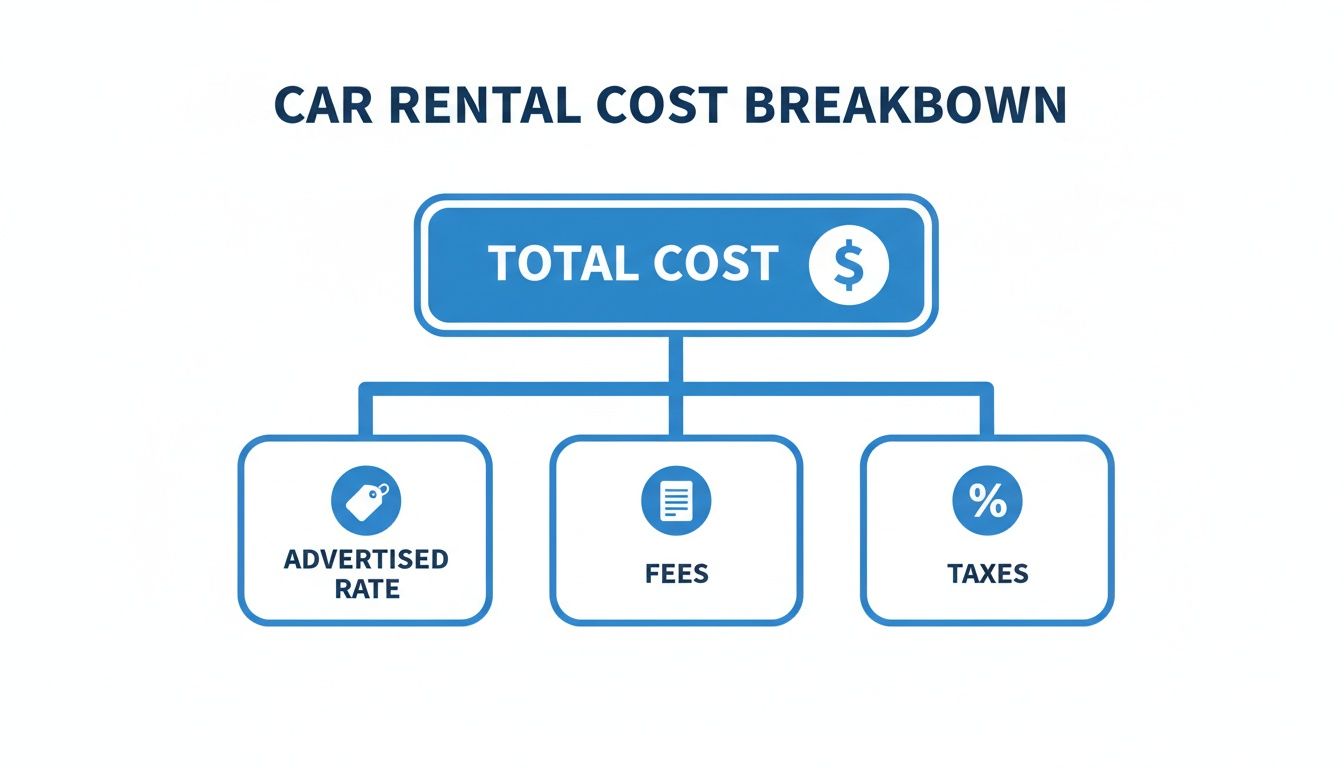
As you can see, the final cost isn't just one number; it's the base rate with several layers of fees and taxes stacked on top. Getting a handle on these components is the best way to avoid sticker shock when you get to the rental counter.
The Anatomy of a Rental Bill
So, what exactly are these mystery charges that inflate the price? While the specifics can change depending on where you're renting and which company you use, most rental bills include a predictable cast of characters that are easy to miss if you're only looking at the big, bold daily rate.
Actionable Insight: Before you click "book," always scroll past the bold daily rate and look for a link that says "Estimated Total," "View Total Price," or "Taxes and Fees." This is the only number that gives you a realistic idea of your final cost.
Let's look at how a seemingly great deal can quickly add up. This table breaks down a typical rental, showing the journey from the advertised rate to the real-world total.
Advertised Rate vs. Total Cost: A Realistic Breakdown
| Rate Component | Example Cost (Economy Car) | Description |
|---|---|---|
| Advertised Daily Rate | $35.00 | The low "sticker price" used to attract customers. |
| Concession Recovery Fee | $4.20 | A 10-12% fee passed on to you for renting at an airport location. |
| Vehicle Licensing Fee | $1.50 | A small daily charge to cover the car's registration and licensing costs. |
| State/Local Taxes | $3.60 | Standard sales taxes that vary widely by state and city. |
| Other Small Fees | $0.25 | Miscellaneous charges like tire or battery recycling fees. |
| Total Daily Cost | $44.55 | Your actual out-of-pocket cost per day—a 27% increase. |
As the example shows, that $35-a-day car actually costs over $44 once everything is included. It’s a significant jump, and it’s why understanding the individual fees is so important for accurate budgeting.
Common Fees and Surcharges to Watch For
Here are some of the most common line items you’ll find tucked away in the fine print. Knowing what they are helps you understand exactly what you’re paying for.
- Concession Recovery Fees: This is an airport-exclusive charge. Rental companies have to pay the airport for the privilege of operating there, and they pass that cost—usually 10-12% of the base rate—directly to you.
- Vehicle Licensing Fees (VLF): Companies have to register and license every car in their fleet. Instead of absorbing this cost, they pass it along to renters as a small daily fee.
- State and Local Taxes: Just like when you buy something at a store, standard sales taxes apply. Depending on the location, this can add a hefty percentage to your total.
- Tire and Battery Fees: In some states, rental agencies are allowed to charge a tiny per-day fee (often just a few cents) to cover the future cost of recycling tires and batteries.
The 7 Key Factors That Drive Your Rental Price
So you’ve got a handle on the sneaky fees and taxes. That's step one. Now for step two: figuring out why the base rental rate itself seems to change with the wind. The price you're quoted isn't just a number pulled out of thin air; it’s a direct response to a handful of predictable factors, much like how airline ticket prices swing based on where you're going and when.
Getting a feel for these seven drivers is what separates the savvy traveler from the one who overpays. It gives you the power to see price swings coming and tweak your plans to lock in a much better deal.
1. Location, Location, Location (It Matters More Than You Think)
Where you pick up the keys is one of the biggest levers on your final price. Grabbing your car right at the airport is incredibly convenient, no doubt about it. But you absolutely pay a premium for that convenience. As we touched on earlier, airports slap on concession recovery fees that can instantly inflate your base rate by 10-12% or even more.
The alternative? A downtown or neighborhood rental office, often just a short Uber ride away, will almost always offer a lower rate for the exact same car.
- Practical Example: A one-week economy car rental at Orlando International Airport (MCO) might total $450. That same car, from the same company's downtown Orlando branch, could be just $350. Even with a $25 Uber ride each way, you still save $50 and get a better rate.
2. The Rhythm of the Seasons (and Local Demand)
Car rental pricing is a textbook case of supply and demand. Rates skyrocket during peak travel seasons when everyone and their brother needs a car, then take a nosedive in the off-season. This whole dynamic is intensely local and can be completely different from one city to the next.
Actionable Insight: Before booking, do a quick search for "major events in [your destination city] [your travel dates]." A large convention, festival, or sporting event can double rental rates. If your dates are flexible, shifting your trip by a week could save you hundreds.
A holiday weekend, a massive conference, or even a local music festival can make prices spike without warning. A city hosting the Super Bowl, for instance, might see its rental rates triple overnight.
3. Your Choice of Wheels
This one sounds obvious, but it’s worth repeating: the type of car you choose has a massive impact on the price. Every step up the ladder—from a little economy car to a full-size sedan, an SUV, or a luxury vehicle—comes with a significant jump in the daily rate. The trick is to book the smallest car that comfortably gets the job done.
This isn't just a hunch; it's a huge industry trend. The global car rental market, valued around USD 140-150 billion in 2025, is set to grow quite a bit by the early 2030s. And what's the most popular category? Economy cars, which command the biggest market share at 35%. It's clear proof that most travelers are looking for affordability and good gas mileage. You can dig deeper into these numbers in this detailed car rental market report.
4. How Far in Advance You Book
Timing your booking is a bit of a balancing act. Book too far out (we're talking six months or more), and you might miss out on last-minute promotions. But wait until the final hour, and you're almost guaranteed to pay top dollar as the remaining cars become scarce.
The sweet spot for most trips is typically somewhere in the one-to-three-month window before you travel.
5. The Driver's Age
For rental agencies, age is more than just a number. Drivers under 25 are statistically seen as a higher risk, and the price reflects that. If you're in this age bracket, get ready for a daily "young driver surcharge" that can add anywhere from $25 to $40 per day right on top of your regular rate.
6. The Insurance Question
When you get to the counter, you'll inevitably be offered a Collision Damage Waiver (CDW) or a Loss Damage Waiver (LDW). This coverage can definitely give you peace of mind, but it can also add a hefty $15 to $30 per day to your bill. While simply saying "yes" to the rental company's insurance is easy, it's often the most expensive route.
7. Optional Extras That Pile Up Fast
Every little add-on comes with its own daily fee. That GPS unit, a child's car seat, satellite radio—each one can tack on another $10 to $15 per day. Over a week-long trip, these "small" extras can easily inflate your final bill by $100 or more.
Smart Moves to Lower Your Car Rental Bill
Knowing what goes into a car rental rate is half the battle. The other half? Using that knowledge to actually save some cash. With a few practical tactics, you can consistently chip away at your rental costs and make sure you're not leaving money on the table.
It’s all about being a savvy shopper instead of just taking the first price you're offered. A little bit of planning and a dash of flexibility can make a huge difference in your final bill.
Master Your Booking Timeline
When you book your rental car matters. A lot. But it's not quite like booking a flight, where locking it in months ahead is almost always the cheapest route. For car rentals, there’s a sweet spot. Book too early, and you might miss out on last-minute deals. Wait too long, and you're guaranteed to pay a premium.
For most trips, try to book your car about one to three months in advance. This timeframe usually hits the sweet spot between good vehicle selection and competitive pricing.
The best part? Most car rental bookings have free cancellation, which gives you a major advantage.
- Book and Re-Book: Go ahead and make a refundable reservation as soon as you know your travel dates. Then, set a calendar reminder to check the prices again one month out, two weeks out, and one week out. If you spot a better deal, just cancel your old booking and lock in the new, lower rate.
- Don't Wait on Holidays: For peak travel times like Thanksgiving or Christmas, book even earlier. Demand goes through the roof, and if you wait, you'll be stuck with whatever's left at a much higher price.
Always, Always Compare
Never, ever book directly with a rental company without seeing what else is out there. Comparison sites and travel aggregators are your secret weapon for finding lower rates. They pull prices from dozens of companies at once, giving you a quick snapshot of the entire market.
But don't get hypnotized by the low daily rate. What really matters is the "all-in" price—the total cost after they've tacked on all the taxes and mandatory fees. A great-looking deal can quickly turn sour once you see the final number.
Actionable Insight: When comparing sites, use a private or incognito browser window. Some rental and travel sites use cookies to track your searches and may increase prices if they see you're a repeat visitor. This tactic, called dynamic pricing, can cost you money.
Unlock Hidden Discounts and Perks
Beyond just comparing rates, there's a whole world of discounts out there waiting for you. Most of them are tied to memberships or credit cards you probably already carry in your wallet.
- Memberships and Loyalty Programs: Don't forget your AAA, AARP, or Costco card. Simply entering the discount code from one of these memberships can instantly save you 10-20% on your rental.
- Credit Card Benefits: Before you travel, call the number on the back of your primary travel credit card. Ask specifically, "Do you offer primary or secondary rental car insurance?" This simple question can save you from paying $15-$30 per day for the rental company's expensive Collision Damage Waiver (CDW). Some cards even have their own discount portals. To significantly lower your car rental expenses, actively seek out and compare special car rental deals that can offer substantial savings.
- Prepay for Fuel: If you're certain you'll use a full tank, prepaying is often cheaper than the per-gallon penalty for returning the car with less gas. However, the most cost-effective strategy is to fill it up yourself at a gas station near the rental office before returning it. You can learn more about finding great deals by checking out our guide on how to get discount car rentals.
How to Compare Car Rental Quotes Like a Pro
Trying to compare car rental quotes can feel like solving a puzzle with half the pieces missing. One company dangles a super-low daily rate but gets cagey about the fees, while another looks pricey upfront but lays out the total cost. The secret? Ignore the flashy daily price and laser-focus on the estimated grand total.
That "all-in" price is the only number that really matters. It’s the one that bundles the base rate with all the non-negotiable taxes, airport surcharges, and other fees you can't escape. To get a true side-by-side comparison, you have to calculate this final, fully-loaded figure for every single option.
Build Your All-In Cost Checklist
To truly compare apples to apples, you need a system. Before you book anything, run each quote through a quick checklist. This is your best defense against those nasty surprise charges that inflate your bill at the rental counter.
The goal here is to figure out the Total Cost of Rental for your entire trip, not just a single day. Think of it like you're building a mini-budget for each option to see the real bottom line.
Here’s a practical checklist to help you compare:
- Base Rate: What's the total for the entire rental period, before any extras?
- Mandatory Fees: Add up all the airport fees, concession recovery charges, and vehicle licensing fees.
- Taxes: Factor in every state, local, and tourism tax listed.
- Insurance Costs: Are you using your credit card’s free coverage, your own auto policy, or buying the rental company's waiver? That last one can add $15-$30 a day.
- Young Driver Surcharges: If anyone under 25 is driving, add that daily fee.
- One-Way Fees: Is there a drop-off charge for returning the car to a different city?
Don't Forget the Fine Print
Once you've tallied the main costs, a few policy details can turn a great deal into a bad one. These details often have hidden costs that aren't spelled out in the price breakdown but can sting you later if you're not paying attention.
For example, a restrictive mileage policy can be a budget-killer. Most big companies offer unlimited mileage on non-local rentals, but some budget brands or special deals might cap you at 100-150 miles per day. Exceed that, and you'll face steep per-mile charges.
Practical Example: A budget rental with a 100-mile daily cap might look cheap for a 5-day trip. But if your road trip covers 700 miles, you'll be 200 miles over your limit. At $0.25 per extra mile, that’s a surprise $50 charge on your final bill.
Finally, check the fuel and cancellation policies. A "Full-to-Full" policy is almost always the best value, as it lets you refuel the car yourself before returning it. Pre-paid fuel options might seem convenient, but you're paying for a full tank and won't get a refund for what you don't use. And make sure the cancellation policy gives you enough flexibility.
By using a checklist and digging into the fine print, you can confidently compare different car rental rates and pick the one that offers the best genuine value. If you want to make this whole process a bit easier, using one of the best discount travel websites can help you see the real costs much faster.
Unlock Wholesale Rates with Approved Experiences Traveler
The tips we’ve covered are great for shaving costs off the standard retail prices you see online. But what if you could skip those public prices entirely? That’s where a travel membership like Approved Experiences Traveler comes in, giving you direct access to wholesale car rental rates.
Think of it like buying your groceries at a wholesale club instead of a regular supermarket. Public booking sites are the retail stores—they get a base price from the rental companies and then add their own markup. A membership platform, on the other hand, lets you in on those pre-markup prices.
This means you can book the exact same car, from the exact same rental company, often for a massive discount. You’re not just finding a coupon; you’re accessing a completely different pricing tier. The savings can be significant, sometimes cutting the cost by up to 50%.
A Real-World Price Comparison
Let's put this into perspective with a common travel scenario: booking a standard SUV for a week-long family vacation in Orlando.
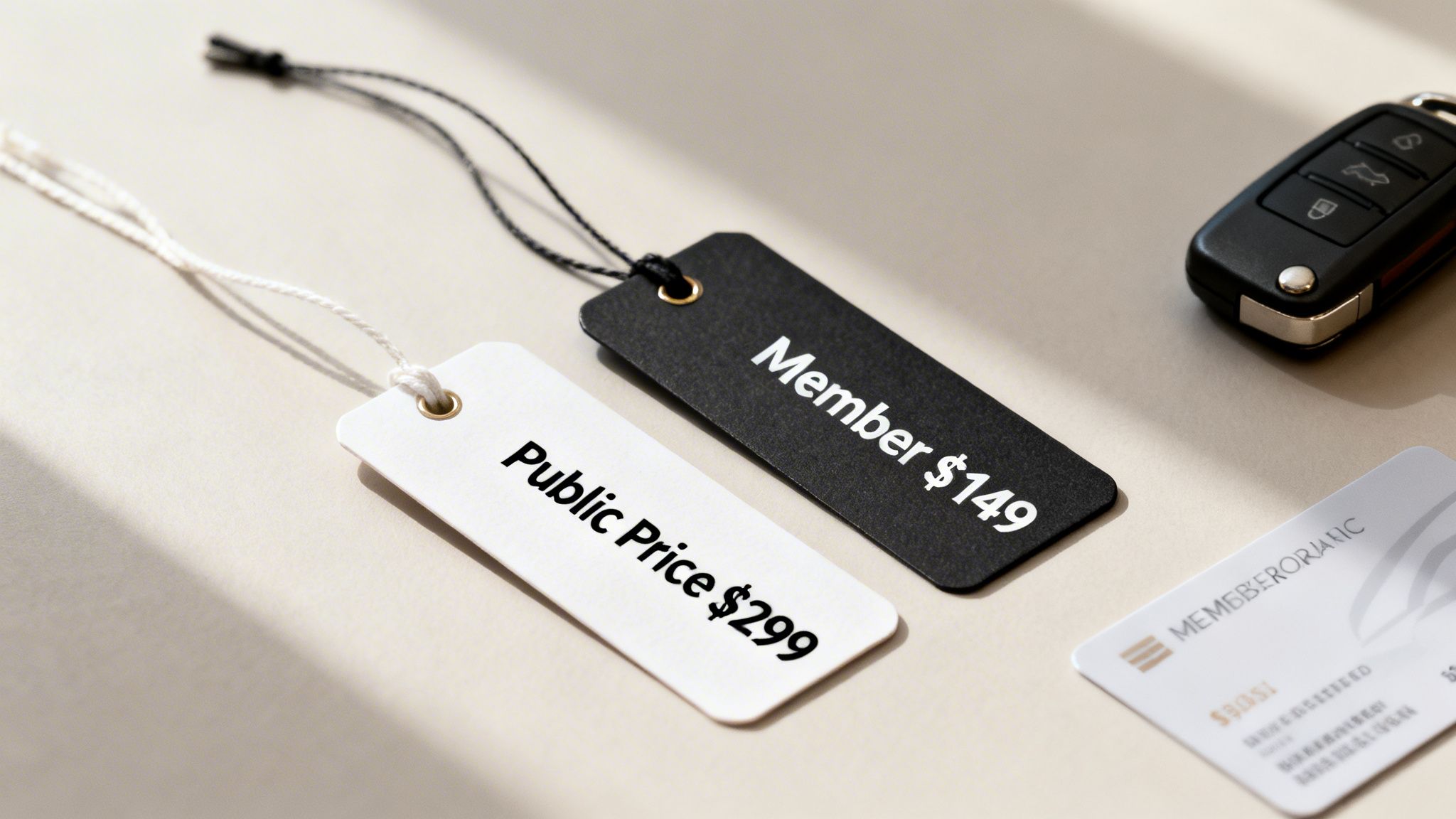
- Public Price: On a popular travel booking website, a Ford Escape or a similar vehicle totals $488 after all taxes and fees are tacked on.
- AET Member Price: Booking the very same SUV for the same dates through Approved Experiences Traveler costs only $262. That’s an immediate savings of $226.
Actionable Insight: With one single trip, the $226 you saved more than pays for the annual membership. For frequent travelers, this approach shifts savings from being an occasional win to a consistent strategy. Every other booking you make for the rest of the year—whether it's another car, a hotel, or a cruise—is pure savings.
This side-by-side example shows the real power of getting behind the curtain of retail pricing. For anyone who travels even once or twice a year, the numbers speak for themselves. You can start saving with our membership plans and see how quickly the value adds up.
Common Questions About Car Rental Rates
When you’re trying to rent a car, it feels like you're navigating a maze of fees and policies. It's totally normal to have questions. Getting straightforward answers is the key to booking with confidence and dodging those frustrating surprise charges at the counter.
We're going to break down some of the most common questions travelers ask. With a little insider knowledge, you can make smarter choices and feel good about the price you're paying.
Does The Price of a Car Rental Change After I Book It?
Yes, absolutely. Car rental rates are constantly in flux, and the price can definitely drop even after you've locked in your reservation. Think of it less like an airline ticket and more like a hotel room.
The great news is that most rental bookings come with free cancellation. This is a huge advantage. You can book a car well in advance to secure a vehicle, then keep checking prices as your trip gets closer. If you spot a better deal, just cancel your old reservation and book the new, cheaper one. It's a simple trick that can save you a bundle.
Is It Cheaper to Rent a Car at The Airport or an Off-Site Location?
Renting away from the airport is almost always the cheaper option. Airport locations have to pay hefty fees to operate on-site, and they pass those costs directly to you. You'll see this show up on your bill as a "concession recovery fee" or similar charge, which can easily inflate your total cost by 10% or more.
Actionable Insight: Before booking an airport rental, open a ride-sharing app and check the cost of a trip from the airport to the nearest off-site rental branch. If a one-way ride is less than half of your potential savings, the off-site option is a clear winner.
What Is a One-Way Rental Fee and How Can I Avoid It?
A one-way fee is what companies charge when you pick up a car in one city and drop it off in another. It’s meant to cover their cost of getting the car back to where it "belongs." This fee isn't small, either—it can add hundreds of dollars to your final bill.
The easiest way around it is to plan a round trip and return the car to the same place you started. If your itinerary demands a one-way rental, be sure to shop around. The size of this fee can vary dramatically from one company to the next, so comparing is crucial.
Do I Need to Buy The Rental Company's Insurance?
You probably don't, and it’s often an expensive add-on. The counter agent might present the company's Collision Damage Waiver (CDW) or Loss Damage Waiver (LDW) as essential, but you should always check your own coverage first.
Here’s where to look:
- Your Personal Auto Insurance: Many policies extend coverage to rental cars, especially for domestic travel.
- Your Credit Card: A lot of travel and premium credit cards offer rental car insurance as a perk, as long as you use that card to pay for the entire rental.
Before you leave for your trip, make a quick call to your insurance agent and credit card company. A few minutes of prep can save you from paying for expensive, redundant coverage at the rental desk.
Ready to stop overpaying for travel? With Approved Experiences Traveler, you gain exclusive access to wholesale car rental rates, saving you up to 50% on every booking. Join our community of savvy travelers and see the difference for yourself. Become a member today.
Want the wider view?
Ten categories. One report. Every quarter. The Approved List tracks what's rising and what's fading: data-backed signals, not opinions.
Free to join · Delivered by email