

Resources
Articles
Notes, guides, and editorial standards from the Approved Experiences team. Written for members, in the same voice we use everywhere else.
Resources
Notes, guides, and editorial standards from the Approved Experiences team. Written for members, in the same voice we use everywhere else.
Craft a stress-free trip with our family vacation budget planner. Learn to track expenses, find savings, and make unforgettable memories without overspending.

A family vacation budget planner is a tool—like a spreadsheet, app, or notebook—that helps you map out, track, and manage all the finances for your trip. It transforms the vague, "Can we afford this?" anxiety into a clear, actionable plan. This way, you can enjoy the dream getaway you've been talking about without the dreaded credit card bill waiting for you at home. A great planner covers everything from big-ticket items like flights and hotels down to the small-but-mighty costs of snacks and souvenirs.
Let's be real: planning a family trip can feel like a financial puzzle. You're trying to lock in plane tickets and lodging, all while guessing how much you'll spend on the million little things that pop up. A family vacation budget planner is more than just another spreadsheet; it's your roadmap to a trip where you can actually relax. It lets you map out your costs ahead of time so you can confidently say 'yes' to the experiences that truly matter to your family.
This kind of proactive planning is a game-changer. It eliminates last-minute money panics and dramatically reduces pre-trip stress. Instead of wincing every time you pull out your wallet, you have a clear framework that puts everyone on the same page about spending.
The real magic of a budget planner is how it flips your mindset from feeling restricted to feeling empowered. It’s not about cutting out fun; it’s about making smart choices so you can spend money on what you truly value. For example, by planning to eat breakfast in your vacation rental for five days, you might free up enough cash for that snorkeling tour the kids have been begging to do.
This strategic thinking is more important than ever. With travel costs on the rise, smart planning is non-negotiable. In 2024, the average American family spent about $8,052 on travel—a hefty 20% increase from the year before. And yet, affordability remains the top concern for 73% of parents. This pressure is pushing families to find clever ways to save, like booking places with kitchens (50%) or skipping expensive attractions (46%). You can dig into more of these stats in the 2025 Family Travel Survey from the Family Travel Association.
A budget doesn't limit your freedom; it gives you freedom. When you know exactly where your money is going, you gain the confidence to spend on what creates the best memories.
Ultimately, a well-thought-out budget turns a daunting task into an exciting part of the adventure. It helps you design a trip that fits both your dreams and your wallet, setting the stage for an incredible experience—without the financial hangover.
Okay, enough with the ideas—let's get our hands dirty and actually build your family vacation budget planner. Don't overcomplicate this. A simple Google Sheet or even a printable template you design yourself is all you need. The goal is to create a single, trustworthy spot where every dollar has a job.
The best way I've found to do this is by structuring the budget around five core spending pillars. Think of these as the absolute non-negotiables for your trip. Nail these down from the start, and you'll sidestep those nasty surprise costs that have a habit of popping up mid-vacation.
This isn't just about crunching numbers; it's about shifting your mindset from financial anxiety to genuine excitement. A solid plan is the bridge between the two.
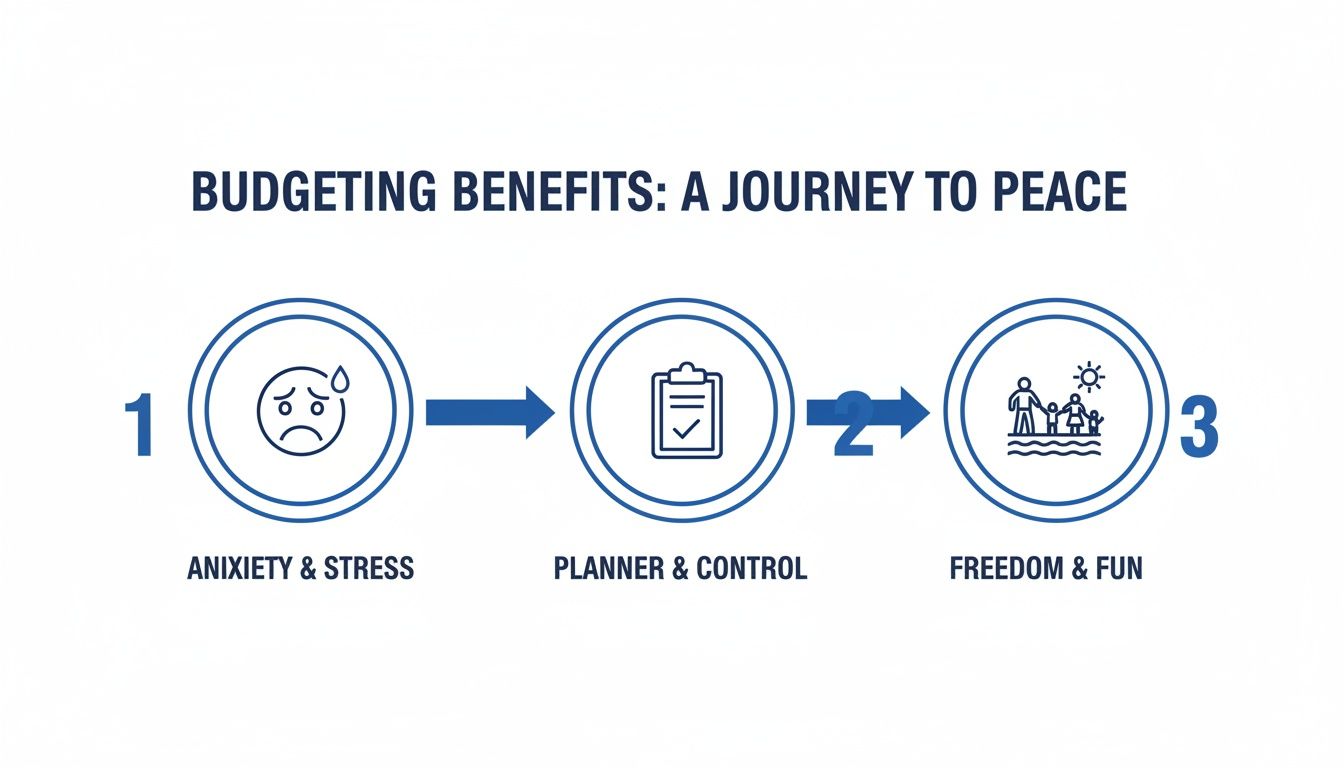
When you methodically lay out each spending category, you're not just budgeting—you're building confidence and removing the "what ifs" that cause so much pre-trip stress.
Your planner, whether it's digital or on paper, needs a dedicated section for each of these pillars. Organizing it this way makes estimating costs way easier and helps you track spending on the fly.
Transportation: This covers everything that gets you from Point A to Point B. We're talking flights, checked bag fees, rental cars, gas, and even ride-sharing fares from the airport. If you're road-tripping, don't just guess at the fuel cost. For example, use Google Maps to find the mileage for your 1,200-mile trip. If your car gets 30 MPG, you’ll need 40 gallons. At $3.50/gallon, that’s a real fuel cost of $140. It’s a surprisingly accurate way to get a real number.
Lodging: Your home away from home, be it a hotel, an Airbnb, or a campsite. Pro tip: always look past the advertised nightly rate. Hidden resort fees, cleaning charges, and parking can easily tack on hundreds of dollars. Using a platform like Approved Experiences Traveler can help you find wholesale pricing, which often shows you the all-in cost right from the start.
A huge mistake I see families make is just creating a generic "food" bucket. A truly effective budget breaks this down into how families actually eat on vacation.
A vague food budget is a guaranteed way to blow your spending plan. You have to be realistic. A smart approach is to plan for a mix of dining out and grabbing groceries.
For our family of four on a beach trip, we might budget $120 for a nice seafood dinner out, but then only $30 for a quick grocery run to cover breakfast supplies (cereal, milk, fruit) and car snacks (granola bars, juice boxes) for two days. That simple strategy alone can save you a small fortune over a week-long trip.
Finally, you need dedicated spots for the fun stuff and a critical safety net.
Activities: This is where you list every planned excursion—theme park tickets, museum admissions, snorkel rentals, you name it. Research these costs before you go. Nothing kills the vibe faster than sticker shock at the ticket window. A quick search can reveal that those four theme park tickets will cost $500, not the $300 you guessed.
The "Just-in-Case" Fund: This is non-negotiable. Think of it as your financial safety net. I recommend setting aside 10-15% of your total trip cost for the unexpected—a flat tire, a forgotten swimsuit, or a rainy-day movie marathon. Having this fund means a small hiccup stays a small hiccup, instead of turning into a major financial headache.
Once you move past throwing around vague numbers, your family vacation budget planner starts to really shine. To build a plan you can actually count on, you have to get into the weeds of your biggest expenses. This is where we shift from pure guesswork to solid estimates for transportation, lodging, and food—the big three that will eat up most of your funds.

This isn't about being restrictive; it’s about getting crystal clear. When you know the real costs, you can make smart choices that match what your family truly values, making sure no ugly financial surprises pop up halfway through your trip.
First things first: how are you getting there? The choice between driving and flying is a massive fork in the road for your budget, and the cheapest route isn't always what you think. You need to compare them head-to-head.
If You’re Hitting the Road: Don't just guess at your fuel cost. Map your entire route with a tool like Google Maps to get the total mileage. From there, it's simple math:
(Total Miles / Your Car’s MPG) x Average Gas Price Per Gallon = Your Real Fuel Cost
Just doing this one calculation gives you a much clearer picture than a wild guess. And don't forget to pad this number with costs for road-trip snacks and drinks, plus a potential cheap hotel stay if it's a multi-day haul.
If You’re Taking to the Skies: The ticket price is just the tip of the iceberg. Airfare is only where the spending starts. To get the true cost, you need to list out all the other flight-related fees that can sneak up on you.
Only when you compare the total cost of driving to the all-in price of flying can you make a decision that actually saves you money.
Your plan for where you sleep and what you eat will make or break your daily budget. A little bit of planning here can unlock some serious savings and keep you from blowing past your limits.
When you're booking a place, that advertised nightly rate is almost never what you actually pay. Vacation rentals tack on cleaning fees, service charges, and local taxes that can seriously inflate the price. Hotels are just as bad with their infamous "resort fees" that cover amenities you might never even touch. Always, always click through to the final checkout screen to see the true, all-in price before you book.
One of our go-to tricks is the 'one-meal-out' rule. We plan for one fun restaurant meal a day and handle the other two with groceries. It’s the perfect balance between enjoying the local food scene and keeping costs from spiraling.
Think about it: a family of four can easily drop $80-$120 on a single casual dinner. On the other hand, a grocery run for a week's worth of breakfast supplies and picnic lunches might only set you back $150 total. Over a seven-day trip, that simple strategy could save you hundreds of dollars—money you can then put toward that zipline tour or snorkeling trip everyone is dying to do. This is how your budget becomes less of a chore and more of a strategic tool for a better vacation.
To give you a better idea of how these costs break down for different types of trips, here's a sample budget.
This sample budget shows how costs can be allocated for different popular family vacations, helping you visualize your own spending strategy.
| Expense Category | Beach Getaway (Rental Car) | Theme Park (Flying) | National Park (Road Trip) |
|---|---|---|---|
| Travel | $450 (Rental Car + Fuel) | $1,600 (Flights + Bags) | $300 (Fuel) |
| Lodging | $1,750 (Beachfront Condo) | $2,100 (On-Property Hotel) | $1,050 (Cabin Rental) |
| Food | $800 (Groceries + Dining Out) | $1,050 (Park Food + Restaurants) | $600 (Mostly Groceries) |
| Activities | $400 (Rentals, Tours) | $1,800 (Park Tickets) | $250 (Park Pass, Hiking) |
| Pre-Trip Gear | $150 (Sunscreen, Towels) | $100 (Souvenir Money) | $200 (Hiking Boots, Gear) |
| Miscellaneous | $200 (Souvenirs, Tips) | $250 (Snacks, Photos) | $150 (Gas Station Snacks) |
| Total Estimated Cost | $3,750 | $6,900 | $2,550 |
As you can see, the destination and travel style dramatically change where your money goes. Use these as a starting point to build a budget that makes sense for your family's dream trip.
A beautifully crafted family vacation budget is a great start, but it's just the map. Now we need to talk about the engine that gets you to your destination: actually funding the trip. This is where your plan goes from being a spreadsheet to a real-life, funded adventure just waiting to happen.
It all starts by giving your savings a specific home.
<iframe width="100%" style="aspect-ratio: 16 / 9;" src="https://www.youtube.com/embed/9B0MxnXI-2I" frameborder="0" allow="autoplay; encrypted-media" allowfullscreen></iframe>Instead of letting that travel money get lost in the shuffle of your main checking account, open a dedicated, high-yield savings account. Seriously, name it something fun like "Beach Fund" or "Mountain Adventure." It’s a simple psychological trick that makes the goal feel real and keeps you from accidentally spending your vacation cash on a random Tuesday pizza night. It’s a dedicated bucket for a dedicated purpose.
Next, put those savings on autopilot. Set up an automatic weekly or monthly transfer from your primary account right into your new travel fund. Even small, consistent contributions add up in a big way. Saving just $50 a week builds up to $2,600 in a year—often more than enough to cover a huge chunk of a family road trip.
Let's get practical. Say your budget planner tells you the dream trip is going to cost $3,600 and you want to go in one year. Staring at that number can feel a little overwhelming. But when you break it down, it becomes so much less intimidating.
Doesn't that feel way more achievable? Thinking about a small, weekly target is a manageable bite out of your budget, not a massive chunk from your monthly income. This is how you systematically build the funds you need without feeling the financial squeeze.
The most powerful tool in your savings arsenal is consistency. A small amount saved automatically every week will always outperform large, sporadic deposits that rely on willpower alone.
Beyond disciplined saving, there are some really smart ways to make your money go further and hit your goal faster. Think of these strategies as accelerators that can sometimes fund entire parts of your trip on their own.
One of my favorite methods is using credit card sign-up bonuses. Many travel-focused cards offer 50,000 to 75,000 bonus points just for meeting a minimum spending requirement in the first few months. For a family, a single bonus like that can often be enough to cover round-trip flights for one or two people, effectively slashing your transportation costs.
And don’t forget to check the perks on your existing memberships. Wholesale clubs like Costco and Sam's Club often have travel packages with deep discounts on hotels, cruises, and rental cars. Similarly, a platform like Approved Experiences Traveler gives you access to wholesale pricing on hotels and resorts that can save you hundreds on lodging. Those savings can then be funneled right back into your travel fund, getting you to your goal that much faster.
You’ve done all the hard work upfront, and your family vacation budget planner is ready to go. But its most important job starts the moment you lock the front door behind you. Think of it less like a rigid rulebook and more like your flexible financial co-pilot for the trip. It's the tool that keeps you in control while letting you lean into the adventure.

This doesn't have to be a chore. Seriously. A simple daily habit can make all the difference. Just take five minutes before you turn in for the night to review the day's spending. It's this quick check-in that prevents little costs from turning into a big problem.
Your daily review can be as simple or as detailed as you want. The only thing that matters is consistency. A quick log of what you spent ensures that those small, forgettable purchases don't snowball and blow up your budget.
There are a few easy ways to pull this off:
This little habit empowers you to make smart decisions on the fly. See that you're way under your food budget for the day? Go ahead and splurge on that nicer dinner everyone's been eyeing. If souvenir costs are creeping up, you know to find some free fun tomorrow, like a day at the beach.
Having a budget isn't about saying "no" to everything. It’s about giving you the confidence to say "yes" to the things that really matter to your family. It’s all about making strategic trade-offs.
Let’s say the kids spot a sign for a dolphin-watching tour that wasn't in the original plan. A quick peek at your planner shows you’ve saved a good chunk of cash by having breakfast at your rental each morning. You can decide to pack a picnic for lunch the next day, and just like that, you’ve freed up enough money to make that boat tour happen without an ounce of guilt.
Your budget is a tool for empowerment, not restriction. It gives you the financial data to trade a low-priority expense for a high-value memory.
This is also where your 'Just-in-Case' fund becomes the hero of the story. When a flat tire threatens to derail your road trip or a rainy day calls for an unplanned movie and popcorn, you can tap into this fund. It’s there for exactly these moments, making sure a small hiccup doesn’t sink your whole financial plan.
By actually using your planner on the go, it transforms from a static spreadsheet into a dynamic tool that helps you navigate your vacation with total financial peace of mind.
Even with the perfect planner in hand, a few questions always seem to surface. It's totally normal. Nailing down these last few details is what separates a good budget from a great one, giving you the confidence to plan without any lingering doubts.
Let's walk through some of the most common things that trip families up.
This is the question I get asked most often, and my answer is always the same: the best tool is the one you’ll actually use.
A simple spreadsheet, like Google Sheets, is your best friend during the planning phase. It’s free, infinitely customizable, and lets you see the entire picture from a bird's-eye view. But when you’re on the ground, navigating a new city with kids in tow, the last thing you want to do is open a complex spreadsheet on your phone.
That's where an app like Tripcoin shines. It’s built for quick, on-the-go expense logging.
The real pro move? Use both. Build your master plan in a spreadsheet at home, then use a dead-simple app for tracking your daily spending once the vacation starts.
Here’s a solid rule of thumb I’ve relied on for years: budget an extra 10-15% of your total trip cost for a "just-in-case" fund.
So, if you’re planning a $4,000 vacation, that means having an extra $400 to $600 tucked away. This isn't just for a flat tire or a medical emergency. It’s for the little things that make a trip memorable—the stuff you can't plan for.
That buffer covers everything from a forgotten swimsuit (it happens!) and a surprise plea for the perfect souvenir to an amazing boat tour you didn't know about but just have to take.
Think of this fund as your peace-of-mind insurance. If you don’t spend it, you’ve got a fantastic head start on saving for your next adventure.
Having that cushion means a small hiccup doesn't turn into a major stressor. It gives you the flexibility to say "yes" to spontaneous fun without blowing up your entire financial plan.
Bringing your kids into the budgeting conversation is one of the smartest things you can do. It's a fantastic real-world lesson in financial literacy, and it shifts their mindset from "I want everything" to "what's the best choice we can make?"
The approach just needs to change with their age.
For younger kids, money needs to be a tangible concept. Try this:
For teens, you can get more sophisticated. Involve them in planning the fun:
When your kids feel like they’re part of the team, the arguments over spending tend to disappear. They're bought in, and the whole trip becomes more enjoyable for everyone.
Ready to make your next family vacation both unforgettable and affordable? Approved Experiences Traveler gives you exclusive access to wholesale pricing on over a million hotels, resorts, cruises, and more, helping you stretch your family vacation budget further than you ever thought possible. Discover how much you can save by visiting https://www.approvedexperiences.com today.
From this collection
From this collection

best family vacations
Discover the best family vacations for 2026. Our guide covers trips for all ages & budgets, with tips on how to save big on hotels, cruises, and more.

luxury hotels for families
Find the best luxury hotels for families. Our guide explains key criteria, booking strategies, and how to plan a seamless, high-end family vacation.

vacation rental discounts
Learn how to find and secure amazing vacation rental discounts with expert strategies on timing, negotiation, and exclusive travel memberships.