

Resources
Articles
Notes, guides, and editorial standards from the Approved Experiences team. Written for members, in the same voice we use everywhere else.
Resources
Notes, guides, and editorial standards from the Approved Experiences team. Written for members, in the same voice we use everywhere else.
Understand any hotel cancellation policy with this guide. Learn to compare rates, avoid fees, and book your travel with confidence and flexibility.

You know that little pang of anxiety right after you hit the 'book' button? That split-second thought, "What if my plans change?" That's where the hotel cancellation policy comes in. It's the set of rules that decides whether you get your money back if you have to call off your trip. It’s the fine print we all tend to skim over, but it might just be the most important part of your reservation.
In a world where plans can shift on a dime, understanding your hotel's cancellation policy isn't just about dodging a small fee—it's about protecting your entire travel budget. Think of it as a pre-trip insurance plan baked right into your booking. A flexible policy is your safety net, while a strict one can lock you into a serious financial commitment, no matter what life throws your way.
The difference between "free cancellation until 48 hours before check-in" and a "non-refundable" rate can easily be hundreds, if not thousands, of dollars. It's no surprise that flexibility has shot to the top of travelers' wish lists. In fact, a whopping seven in ten travelers now say flexible booking options are more critical than ever, viewing lenient terms as a basic expectation, not a bonus.
Skipping over the policy details can be a costly mistake. Imagine you book a fantastic non-refundable room for a week-long getaway that costs $2,000. If a family emergency pops up and you’re forced to cancel, you could be out the entire amount with nothing to show for it.
A good cancellation policy does more than just spell out penalties. It builds trust. When a hotel is fair and clear, it can turn a potentially sour experience into a reason to book with them again.
This guide is your roadmap through the often-murky world of cancellation rules. We're here to give you the practical knowledge you need to:
By the time you're done here, you won't see the hotel cancellation policy as a trap, but as a tool for smarter, more secure travel planning.
Ever felt like you need a translator to figure out a hotel's cancellation policy? Terms like "flexible," "non-refundable," and "prepay" get thrown around, but what they really mean for your plans—and your wallet—isn't always clear.
Getting a handle on these policies is the first step to booking smarter and sidestepping those nasty, unexpected fees. Think of it as learning the local language of hotel reservations. Each policy is really just a different agreement between you and the hotel, balancing your need for flexibility against their need to keep rooms filled.
A super-flexible policy gives you peace of mind but might cost a little more. On the flip side, a stricter one can save you money upfront but locks you in. Let's break them down.
This is the holy grail for travelers who know that life happens. A flexible or free cancellation policy lets you back out of your reservation without a penalty, as long as you do it within a certain window. It’s the hotel’s way of acknowledging that plans can and do change.
But here’s the catch: "free" always comes with a deadline. The single most important detail is that cancellation window. A hotel might say, "Free cancellation up to 48 hours before check-in."
Practical Example: Let's say your check-in is at 3:00 PM on Friday. To cancel for free, you’d have to let them know by 3:00 PM on the Wednesday before. If you call them at 4:00 PM on Wednesday, you've missed your shot and will probably be on the hook for the first night's stay. Actionable Insight: Always put the cancellation deadline in your calendar with a reminder set for 24 hours before it expires. This simple step can save you hundreds.
This kind of flexibility has become a huge deal for travelers. In fact, more than half of us are willing to pay extra for a free cancellation option, and recent booking trends show that nearly one in five guests will pay $50 or more for that peace of mind.
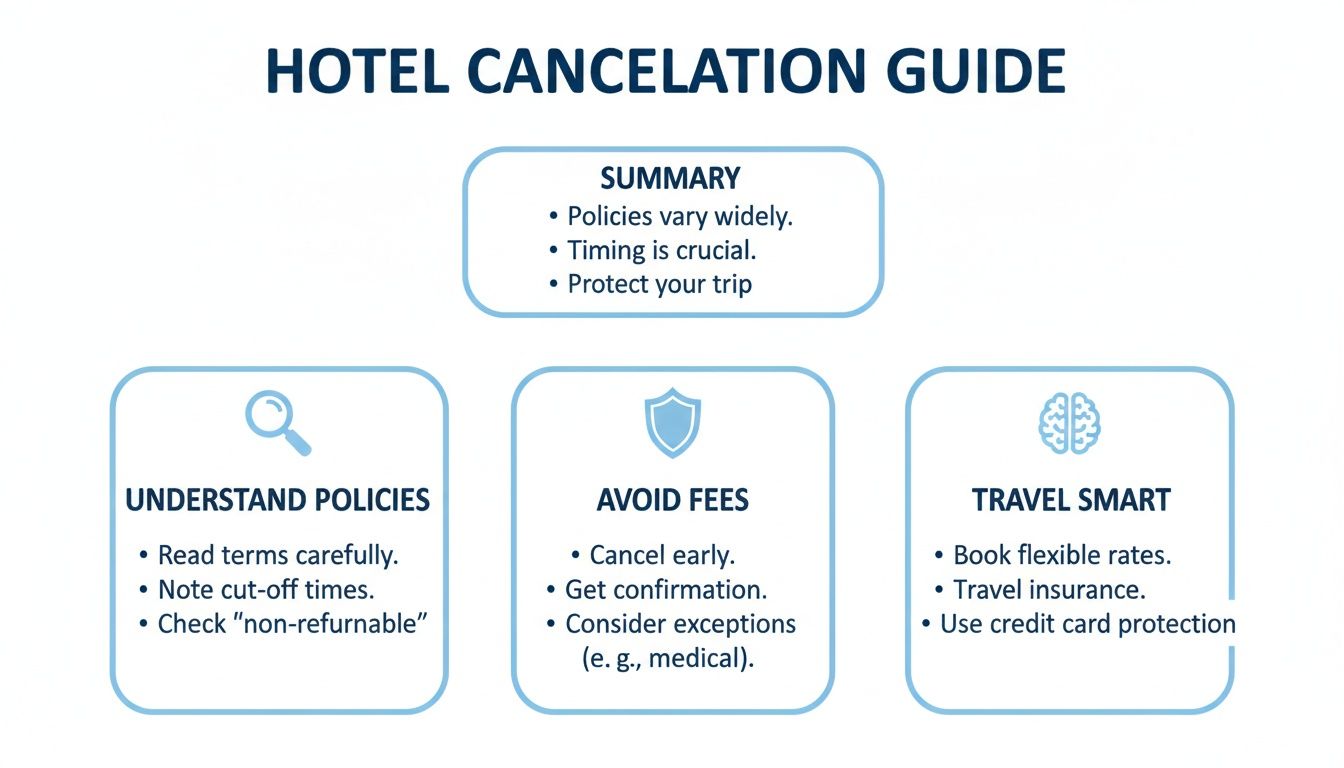
The big takeaway here is that knowing the rules of the game is just as crucial as finding a good rate in the first place.
At the other end of the spectrum, you have the non-refundable rate. It's exactly as harsh as it sounds: once you book, that money is gone for good, no matter what. Hotels love these rates because they guarantee them income, and in exchange, they give you a pretty steep discount.
Booking non-refundable is a real commitment. It's designed for travelers whose plans are set in stone—people who are 100% certain their trip is happening.
Actionable Insight: Only book a non-refundable rate if the savings are significant (think 15-20% or more) and you have travel insurance to cover unexpected emergencies. Otherwise, the risk often outweighs the reward.
If you go this route, be fully prepared to lose the entire cost of your stay if anything changes, whether it’s a family emergency or a flight cancellation.
Right in the middle of these all-or-nothing options are partial refund or tiered policies. They're a compromise, where the penalty for canceling gets steeper the closer you get to your check-in date. This lets hotels protect themselves from last-minute vacancies while still giving you some wiggle room.
A typical tiered policy might be structured like this:
Practical Example: You book a resort stay in Hawaii for a major holiday. The policy might allow a full refund up to 60 days out, but then require a 50% penalty up to 30 days out, and become fully non-refundable within a month of your stay. Actionable Insight: Read these policies twice. The dates matter immensely, especially for high-demand locations or peak travel seasons.
The moment you book for a group—a wedding block, a company retreat, a big family reunion—the rulebook changes entirely. A group booking cancellation policy is almost always way stricter than an individual one. After all, a hotel takes a much bigger financial hit when 15 rooms are canceled at once versus just one.
It’s a similar story for vacation packages that bundle your hotel with flights, tours, and car rentals. Unraveling one of those isn't as simple as calling the front desk, because multiple companies are involved. The cancellation terms will be dictated by the most restrictive part of the package—which, nine times out of ten, is the non-refundable flight. Always, always read the fine print on these. The penalties can be massive, and the deadlines are much, much sooner.
Ever wondered why cancelling a hotel room can feel so complicated? It’s not just hotels being difficult for the sake of it. Behind every cancellation policy is a straightforward business reality: hotels need to keep their rooms full.
<iframe width="100%" style="aspect-ratio: 16 / 9;" src="https://www.youtube.com/embed/9aOVQjNd8D0" frameborder="0" allow="autoplay; encrypted-media" allowfullscreen></iframe>Think of a hotel room like fresh produce at a grocery store. A grocer can't sell yesterday's milk, and a hotel can't sell last night's empty room. Once the clock ticks past midnight, the potential income from that room is gone forever. This simple fact makes last-minute cancellations a hotel's biggest financial headache.
When you cancel late, the hotel doesn't just lose your booking revenue; they lose the chance to sell that room to someone else. This is the real reason cancellation fees exist. They’re a form of insurance for the hotel against the very real cost of an unsold room.
This problem has gotten much worse in recent years with what the industry now calls "cancellation culture." The main culprits? Online Travel Agencies (OTAs) and booking sites. They've made it almost too easy for travelers to book multiple hotels for the same trip, sit back, see which price drops, and then cancel all the others just before the deadline.
While this feels like a win for travelers, it creates a massive wave of uncertainty for hotels. They find themselves scrambling to fill rooms they thought were guaranteed, often forced to slash prices at the last minute, which eats directly into their profits.
This is where those stricter cancellation policies come from. Hotels aren't trying to punish you; they're trying to protect their business from the chaos and financial drain of unpredictable cancellations. They need a way to encourage people who genuinely plan to stay and discourage those who are just holding a spot.
The financial toll of this trend is staggering. This widespread "cancellation culture" is forcing hotels to completely rethink how they manage their money. For instance, in the Asia-Pacific region, cancellations made through Booking.com wiped out 40% of revenue. In Europe, that number jumped to 42%.
Globally, these last-minute changes of heart add up to an estimated $2.1 billion in lost revenue for hotels every year. You can discover more insights about how cancellations impact hotel revenue on ehotelier.com.
A hotel's pricing strategy is a delicate balancing act. They have to forecast demand, schedule staff, and order supplies based on how many people they think will be checking in. A sudden flood of cancellations throws that entire operation into disarray.
To fight back, hotels have gotten smarter. They now use data to create different policies for different situations. This is why you'll often see a much stricter, less forgiving policy on a third-party booking site compared to the more flexible options you get when you book directly with the hotel.
Once you understand this financial pressure, it makes perfect sense why a flexible rate is almost always more expensive than a non-refundable one. When you book a flexible rate, you're not just buying a room; you're buying an option—the option to change your mind.
The hotel prices this flexibility directly into the rate to cover the higher risk they're taking. They know a certain percentage of these flexible bookings will inevitably be canceled. That slightly higher room rate helps them absorb the financial hit from the rooms they won't be able to re-sell.
So, when you choose that flexible option, you're essentially buying peace of mind. And from the hotel's perspective, they're selling you a small insurance policy against your own change of plans.
Getting hit with a cancellation fee is a traveler's nightmare, but it doesn't have to be a foregone conclusion. You often have more power than you realize. While hotel cancellation policies can look like they're set in stone, a few smart strategies can help you minimize or even completely sidestep those penalties when life throws you a curveball.
It all comes down to knowing the playbook and approaching the situation with a bit of finesse.
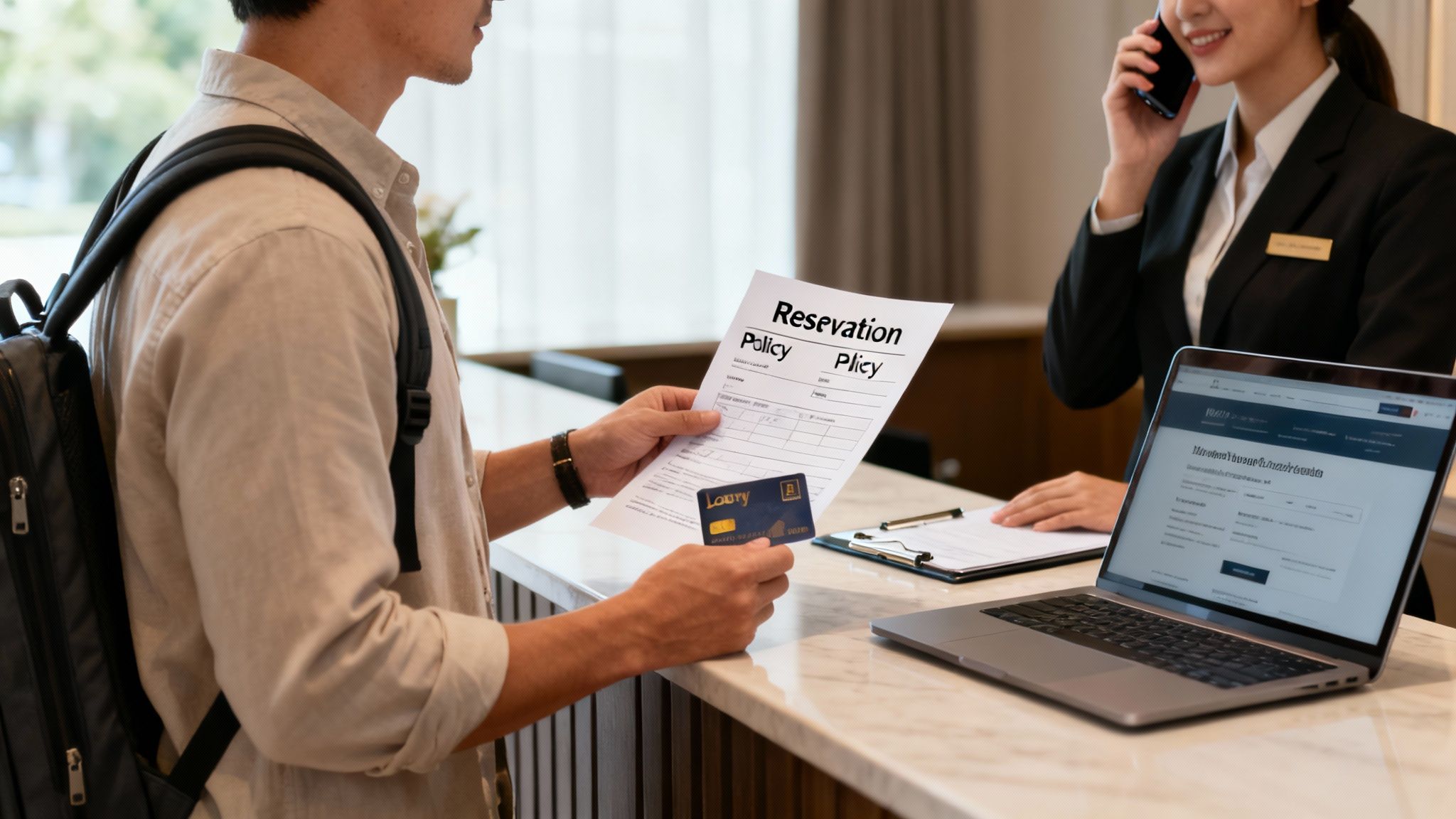
The trick is to be proactive. A simple, polite phone call or even just booking through the right channel in the first place can save you a serious headache. Let's walk through the steps for handling these situations like a pro.
This is one of the most powerful moves you can make, and it starts before you even click "confirm." Booking your room directly on the hotel's website or over the phone often puts you in a much better position than if you go through an Online Travel Agency (OTA).
Why? Because hotels hate paying commission to third-party sites, which can run as high as 15-30%. By booking direct, you're putting more money in their pocket, and that gives them a real incentive to keep you happy.
When you need a favor, like waiving a cancellation fee, a hotel manager has the freedom to help a direct customer. To them, you're their guest, not just a reservation number from Expedia or Booking.com.
Actionable Insight: Before booking on a third-party site, always check the price on the hotel's direct website. Even if it's the same price, book direct. The hidden value is in the customer service and flexibility you'll receive if a problem arises.
So many travelers sleep on this one. Many travel-focused credit cards come with built-in trip cancellation or interruption insurance as a standard perk. It's a hidden gem that can save you from a huge financial hit.
If you have to cancel for a covered reason—like a sudden illness, severe weather, or even jury duty—your credit card might just reimburse you for those non-refundable hotel charges.
Here’s how to make it work for you:
This built-in safety net can turn a major expense into a minor inconvenience. It’s always worth checking what protections are already sitting in your wallet.
Find yourself just outside the free cancellation window? Don't panic. Pick up the phone. Email is too easy for them to ignore, but a real conversation lets you connect with someone and plead your case.
Always call the hotel's local number, not the generic 1-800 corporate line. You want to talk to someone on-site—ideally a front desk manager or general manager who actually has the authority to bend the rules.
Here are a few phrases that work wonders:
The key here is your tone. Be polite, be honest, and be reasonable. A calm, respectful approach will get you so much further than an angry, demanding one.
From the moment you start this process, act like a detective. Keep a detailed log: the date and time of your call, the full name of the person you spoke with, and a summary of what you agreed on.
Actionable Insight: After the phone call, send a brief, polite follow-up email confirming your conversation. For example: "Hi [Employee Name], thank you so much for your help today. Just to confirm our conversation, you are waiving the cancellation fee for reservation #12345. I really appreciate your understanding." This creates a written record.
If they promise to waive the fee, ask for a confirmation email right then and there. This little piece of documentation is your proof if a charge mysteriously appears on your card later.
If the front desk staff can't help, politely ask to speak with the general manager. Still no luck? Your next move is to contact the corporate customer service office for the hotel chain. Someone at the corporate level can often override a decision made at a specific property, and your detailed records will make your case that much stronger.
Knowing the right moves to avoid a cancellation fee is half the battle. The other half? Saying the right thing. How you communicate can be the difference between getting hit with a penalty and walking away with a full refund. When plans go sideways, a clear, polite, and well-worded email is almost always your best first move.

To make it dead simple, I’ve put together a couple of ready-to-use templates. These aren't just fill-in-the-blank scripts; they're designed to help you state your case clearly and respectfully, giving you the best shot at a good outcome.
This one’s your go-to for a straightforward cancellation. Maybe you’re just a day or two past the deadline, or you’re a regular at that hotel chain. A little bit of polite persuasion can go a long way.
Subject: Cancellation Request for Reservation [#12345678] - [Your Full Name]
Dear [Hotel Manager Name or "Hotel Management Team"],
I'm writing to respectfully request the cancellation of my upcoming reservation, confirmation number [#12345678], for a stay from [Start Date] to [End Date].
Unfortunately, due to some unforeseen circumstances, my travel plans have changed, and I won't be able to make it. I realize this request is close to or just past the cancellation deadline outlined in your policy.
As a loyal guest of [Hotel Brand], I would be incredibly grateful if you would consider waiving the cancellation fee as a gesture of goodwill. I've always had wonderful stays with you and definitely plan to rebook in the near future.
Thank you for your understanding.
Sincerely,
[Your Full Name] [Your Phone Number]
Life happens. When a true, unavoidable emergency pops up, being direct and providing just enough context is the most effective approach. This template helps you convey the seriousness of the situation without getting into unnecessary detail.
Subject: Urgent Cancellation Due to Emergency - Reservation [#12345678] - [Your Full Name]
Dear [Hotel Manager Name or "Hotel Management Team"],
I am writing to inform you that I must urgently cancel my reservation, confirmation number [#12345678], which was scheduled for [Start Date] to [End Date].
This cancellation is due to a sudden family emergency that requires my immediate attention, making travel impossible at this time. I know the timing is very last-minute and likely falls outside the standard cancellation policy.
Given the serious and unavoidable nature of this situation, I kindly ask for your compassion in waiving any cancellation penalties. I am happy to provide documentation if needed. Your understanding during this difficult time would mean a great deal.
Thank you for your consideration.
Sincerely,
[Your Full Name] [Your Phone Number]
Sometimes, the policy itself is the biggest obstacle. Hotels use specific, often confusing, phrasing that can leave you scratching your head. Let's break down what these terms actually mean for your wallet.
Here are a few common lines you’ll see and the real-world cost behind them:
Let’s talk about one of the most powerful, and often forgotten, tools in your travel toolkit: your hotel loyalty status. When you need to cancel a reservation last-minute, the official policy might look like a brick wall. But for a frequent guest, that wall often has a hidden door.
Think about it from the hotel’s perspective. They spend a ton of money to keep their best customers coming back. They know how often you stay, how much you spend, and what loyalty tier you’ve earned. When a valued member calls with a genuine problem, they have a serious incentive to be flexible rather than risk losing all your future business over a single cancellation fee.
This is where being a top-tier member of a program like Marriott Bonvoy, Hilton Honors, or World of Hyatt really pays off. Hotel managers are given a surprising amount of discretion to bend the rules, and they're far more likely to do it for a Diamond or Titanium Elite member than for a first-timer who booked through a random third-party site.
This goodwill can save you real money in a few ways:
Your approach is everything. Don't call the corporate 1-800 number where you'll get a script-reader. The most effective move is a polite, direct phone call to the hotel's front desk. Getting a local manager on the line is the goal here.
When you speak to them, mention your loyalty status early, but do it naturally.
Practical Script: "Hi, my name is Jane Smith, and I'm a Platinum Elite member with you. I have a reservation for this Friday, but unfortunately, a family emergency just came up. I know I'm just past the cancellation deadline, but as a loyal guest, I was really hoping you might be able to help me out and avoid the fee."
See the difference? It’s not a demand. You're framing the request as one loyal customer asking for a favor. You're showing you understand the rules but are hoping for an exception based on your long-standing relationship with the brand.
By playing this card thoughtfully, you can often transform a rigid hotel cancellation policy from a financial trap into a flexible safety net. It’s the kind of peace of mind that proves your loyalty is worth more than just points and free breakfast.
Even when you think you have a handle on the rules, travel always finds a way to throw a curveball. Let’s clear up some of the most common gray areas and tricky situations that trip up even seasoned travelers.
Life happens. You miss a flight, plans change last minute, and you forget to cancel your room. In the hotel world, this is called a “no-show”—when you neither check in nor formally cancel.
From the hotel's point of view, it’s the worst possible outcome. They've held that room for you all night, completely losing the chance to sell it to someone else. Because of that, the penalty is almost always the harshest. You can expect to be charged for, at a minimum, the full cost of the first night, including all taxes and fees. If you booked a non-refundable rate, you'll unfortunately forfeit the entire amount you paid.
Yes, they can, and this catches a lot of people off guard. You might see a "pay at the hotel" option and assume your card won't be touched until you're standing at the front desk.
But in reality, most hotels will place a pre-authorization hold on your credit card shortly after you book. It’s not an actual charge, but a temporary freeze on funds, usually for the amount of the first night's stay. Think of it as the hotel "earmarking" the money to make sure your card is legitimate and has enough funds to cover a potential penalty if you break the rules. This hold usually vanishes from your statement within a few business days, but it does temporarily reduce your available credit.
Actionable Insight: If you're booking multiple hotels for a trip or traveling on a tight budget, be mindful of pre-authorization holds. Several holds at once can temporarily reduce your available credit, potentially causing issues with other purchases.
This is the million-dollar question. Travel insurance can be an absolute lifesaver, but its value really depends on how you book and your personal comfort level with risk. If you’re the type who only ever books fully flexible, cancellable rates, the extra cost might be overkill.
However, travel insurance quickly becomes a brilliant move in a few key scenarios:
A solid travel insurance policy essentially transforms a risky, non-refundable booking into a protected one. It gives you the peace of mind that a flexible hotel cancellation policy normally provides, letting you lock in great rates without sweating the "what-ifs."
Ready to book your next trip with the confidence that you're getting an incredible deal? Approved Experiences Traveler offers members-only wholesale pricing on over a million hotels worldwide, often with the flexible booking options you need. Unlock exclusive savings on hotels, cruises, car rentals, and more. Join today and start your journey.
From this collection
From this collection

best airlines in the us
Discover the best airlines in the US for reliability, comfort, and value. Our 2026 guide gives you actionable insights to book your next flight smarter.

best airport lounges
Discover the 7 best airport lounges for 2026. This guide details how to access them, standout amenities, and tips for elevating your travel experience.