

Resources
Articles
Notes, guides, and editorial standards from the Approved Experiences team. Written for members, in the same voice we use everywhere else.
Resources
Notes, guides, and editorial standards from the Approved Experiences team. Written for members, in the same voice we use everywhere else.
How to book international flights cheap with savvy timing, tools, and insider tactics that slash prices on your next global adventure.

Want to know the secret to booking cheap international flights? It's not about finding some magical glitch in the system. The real formula is surprisingly simple: be flexible, book at the right time, and know which tools to use. If you can master these three things, you'll consistently find incredible deals that leave everyone else wondering how you do it.
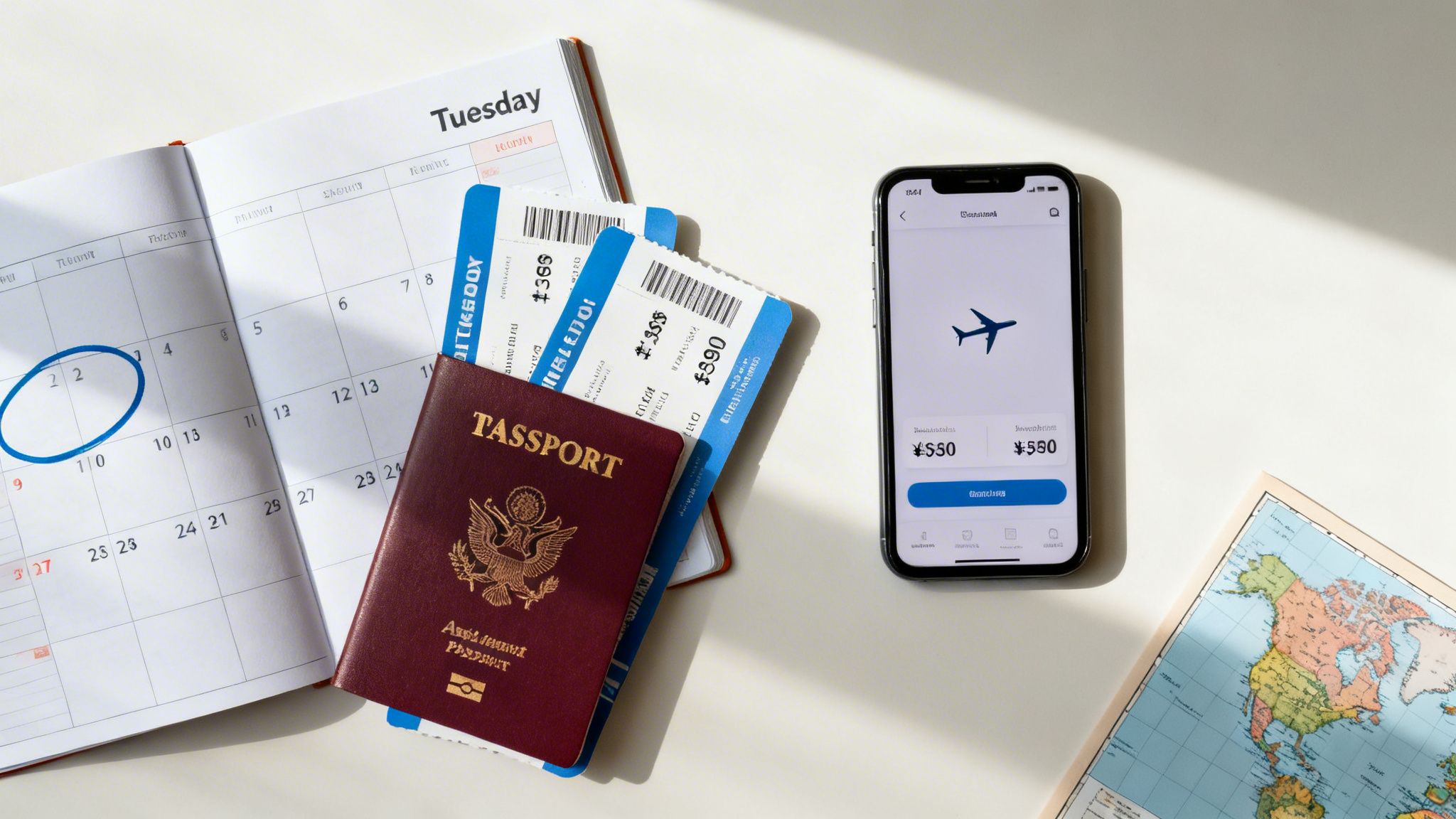
Finding a great deal isn't about luck; it's about having a solid strategy. This is where you shift from a passive searcher to a savvy traveler who understands how airlines price their tickets and how to turn that knowledge into real savings.
For instance, just moving your departure from a Friday to a Tuesday can slash the price. Actionable Insight: Before booking, use the "flexible dates" or "calendar view" on Google Flights. A quick look might show a Saturday flight to Paris for $950, while the same flight leaving on Wednesday is only $680. Similarly, being open to flying into a secondary airport—think London Gatwick (LGW) instead of Heathrow (LHR)—can often unlock a much lower fare. A little extra ground transport is a small price to pay for saving hundreds.
The entire foundation of finding cheap international airfare rests on a few core ideas. Instead of getting locked into a specific flight on a specific day, you need to broaden your horizons.
Even with costs rising in other areas, now is a surprisingly good time to be a bargain hunter. We're seeing some really competitive pricing on airfare, creating a perfect window of opportunity for anyone who knows where and how to look.
Believe it or not, the global air travel market is a great place for budget-conscious travelers right now. In 2024, average ticket prices were actually down over 5% compared to both 2023 and pre-pandemic 2019 levels. All that competition and added flight capacity are pushing prices down.
These concepts are the backbone of any successful flight-booking strategy. Master them, and you'll be well on your way to mastering the art of luxury travel on a budget.
To give you a quick overview, here are some of the most effective strategies we'll cover, broken down by how much you can save and how much effort they take.
| Tactic | Potential Savings | Difficulty Level | Best For |
|---|---|---|---|
| Date & Destination Flexibility | High | Low | Travelers without fixed plans who can let deals guide them. |
| Booking Window Strategy | Medium to High | Low | Anyone who can plan their trip at least 2-8 months in advance. |
| Alternative Airport Search | Medium | Medium | Those willing to travel a bit further from a secondary airport to save big. |
| Multi-City & Open-Jaw Flights | High | Medium | Travelers visiting multiple destinations on one trip. |
| Error Fare & Deal Alerts | Very High | Low | Spontaneous travelers who can book a surprise deal at a moment's notice. |
| Hidden-City Ticketing | High | High | Experienced, carry-on-only travelers who understand the risks. |
This table is just a starting point. As you dive deeper into each tactic, you’ll find the ones that best fit your travel style and unlock the biggest savings for your next adventure.
The big question isn't just where you're going, but when you should actually pull the trigger and buy your ticket. Honestly, nailing the timing is one of the easiest ways to score a cheap international flight, and it can save you hundreds of dollars without any crazy hacks.
Let’s cut through the noise. The most common—and most expensive—mistake I see people make is either waiting until the last minute or booking way too far in advance. Last-minute bookings are a surefire way to pay a premium. On the flip side, booking more than a year out often means you're looking at inflated placeholder fares before airlines even know what the real demand will be.
So, when is the magic moment to buy? From my experience, the sweet spot for most international trips is between three and six months before you plan to leave. This is the window where airlines have a solid read on demand but still need to fill seats, which creates the competitive pricing you want to see.
Once you get inside that two-month window, you'll often see prices start to climb. Airlines assume anyone booking that late is less flexible and more willing to pay up. Practical Example: Searching in January for a June flight to Lisbon, you might find fares around $700. If you wait until April to book that same flight, the price could easily jump to $1,100 as seats fill up.
For a more granular look at the ideal timing for different routes, this guide on the best time to book flights is a fantastic resource. Knowing the patterns for your specific destination gives you a serious leg up.
Beyond just when you book, when you travel makes a massive difference. Flying during peak season—like summer in Europe or Christmas in the Caribbean—is a guarantee you'll pay top dollar. The real pro move is to aim for the shoulder season.
These are those perfect little windows right before and after the peak tourist crush. You still get great weather, but you get to deal with fewer crowds and, most importantly, much lower prices on flights and hotels.
Here are a couple of real-world examples:
Targeting the shoulder season isn’t just about saving money; it’s about having a better trip. Imagine wandering the streets of Rome without being swallowed by a crowd or easily finding a perfect spot on a Thai beach. It’s a completely different experience.
A little bit of research is all it takes. A quick search for "best time to visit [your destination]" will almost always point you to these valuable shoulder season windows.
It seems the secret is getting out. More and more travelers are catching on to the benefits of booking early. In the first quarter of 2025, for instance, international travel searches shot up by 20% compared to the previous quarter.
What’s really telling is that people are planning further ahead. Searches in that prime 91-180 day window jumped by almost 70%. This is a huge shift, and you can see more on these Q2 2025 travel trends on Expedia Group's site.
As more people start booking in that 3-6 month window, the competition for the best-priced seats is only going to get tougher. If you understand what drives these fare changes, you can book with confidence, knowing you’ve locked in a great price for your next adventure.
Your most obvious flight path is rarely the cheapest. If you want to unlock serious savings on international travel, you have to start thinking like a seasoned flight hacker—looking beyond the simple A-to-B search and getting creative with your airports and routes.
Forget the default options. Instead of just accepting a high price from your local airport, you can often save hundreds of dollars by strategically building your own itinerary. This is where a little extra planning pays off, big time.
One of the most effective tricks in the book is using what’s known as a positioning flight. This just means booking a cheap, separate domestic ticket from your smaller home airport to a major international hub, then booking your long-haul flight from there.
For example, say you live in Cincinnati (CVG) and want to fly to Rome (FCO). A search from your home airport might show a round-trip fare of $1,200. But flights from a massive hub like New York (JFK) to Rome are far more competitive, sometimes dropping as low as $600. You could book a cheap flight from CVG to JFK for around $150, and just like that, you’ve cut your total cost by hundreds.
My Two Cents: When you do this, always leave yourself a generous layover—I’m talking at least three to four hours for a domestic-to-international connection. Because the tickets are booked separately, the airline has zero obligation to rebook you if your first flight is delayed and you miss the big one.
Big international airports almost always come with bigger price tags. Airlines know travelers gravitate toward the most well-known hubs, and they price those tickets accordingly. The easy way around this? Fly into a secondary airport instead.
You'd be surprised how many options there are:
Actionable Insight: When searching on Google Flights, enter your destination city ("London") instead of a specific airport code. Then, click on the map to see prices for all nearby airports at a glance. You might instantly see that a flight to Gatwick saves you $150 over Heathrow.
The infographic below shows a simple decision-making process for timing your booking, which is a crucial first step before you even start digging into routes.
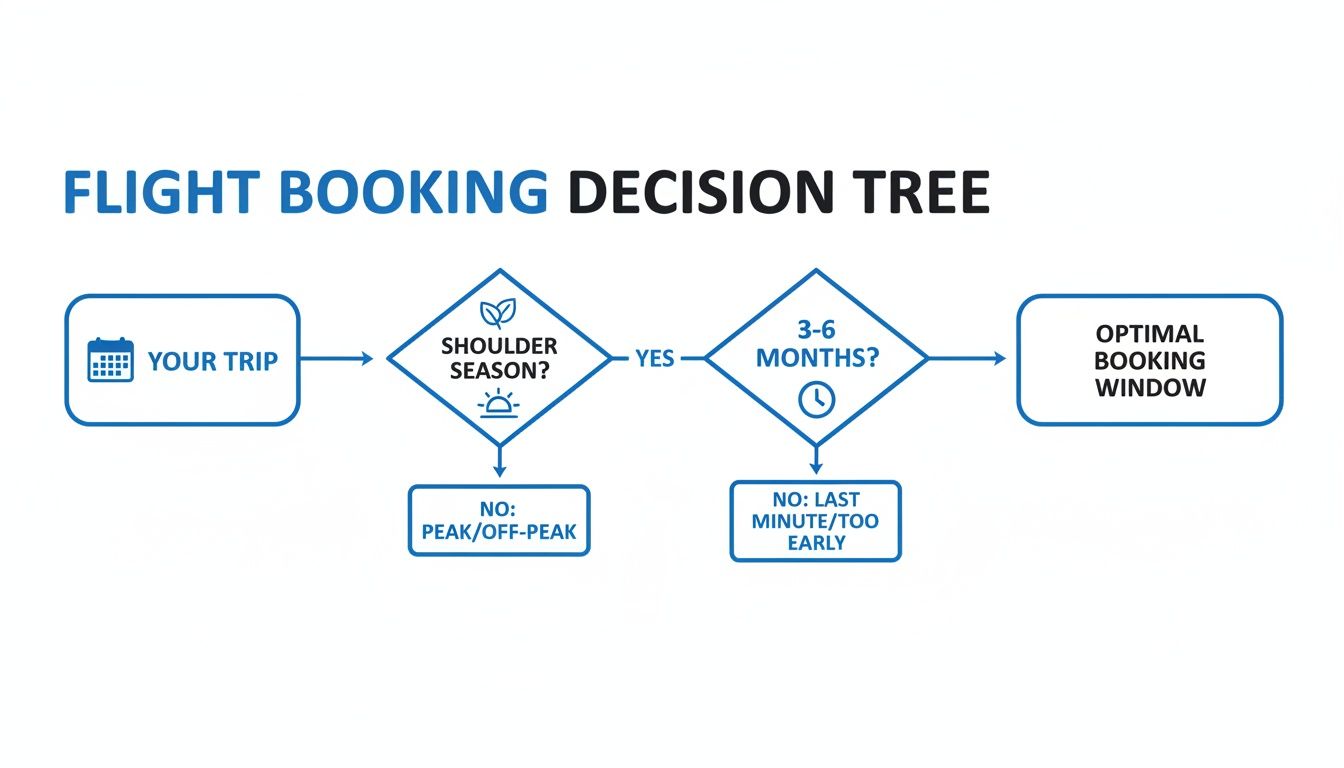
As you can see, the real magic happens when you plan your trip during the shoulder season and book a few months out.
Once you get comfortable looking at alternative airports, you can start exploring some next-level strategies. They take a bit more effort, but the deals can be incredible.
If you're visiting multiple destinations on one trip, never book a series of one-way flights. That's a rookie mistake. Instead, use the "multi-city" search function on Google Flights or Kayak. This lets you fly into one city and out of another, which is often dramatically cheaper and saves you the hassle of backtracking.
A real-world example? Say you're planning a trip to Southeast Asia. You could fly from Los Angeles (LAX) to Bangkok (BKK), travel overland through Cambodia to Vietnam, and then fly home from Ho Chi Minh City (SGN). This type of "open-jaw" ticket is frequently cheaper than a standard round-trip to a single city.
This is a powerful strategy, especially right now. U.S. international travel has come roaring back, with passenger volume hitting 105.7% of pre-pandemic levels by early 2025. This surge has increased competition on popular routes, creating more opportunities to find a deal if you know where to look. You can read more about the recovery of air passenger travel on the International Trade Administration's website.
Alright, this is an expert-level tactic that comes with some risks, but the savings can be massive. Hidden-city ticketing means booking a flight with a layover in your actual destination. You simply get off the plane there and ditch the final leg of the journey.
Let's say a flight from Chicago to Orlando is pricey. But you find a much cheaper flight from Chicago to Miami with a layover in Orlando. You’d book the Miami flight and just walk out of the airport in Orlando.
If you try this, you must follow these rules:
Tools like Skiplagged are designed specifically to find these kinds of fares. It’s not for every traveler or every trip, but knowing this option exists adds another powerful tool to your flight-hacking arsenal.
The usual flight search engines are a great starting point, but they won't show you everything. The truly incredible deals on international flights? Those are almost always hidden from the public eye. If you want to find the rock-bottom prices, you have to look past the big-name sites and explore the world of private, membership-based travel platforms.
<iframe width="100%" style="aspect-ratio: 16 / 9;" src="https://www.youtube.com/embed/I31tHUmeb1U" frameborder="0" allow="autoplay; encrypted-media" allowfullscreen></iframe>These platforms work on a completely different model. They don't make their money from airline commissions; instead, they charge members a yearly fee. That simple change in business model means they can give you access to wholesale prices that public websites simply can't offer.
Think of it like the difference between your local grocery store and a big warehouse club like Costco. By bringing together the buying power of thousands of members, these travel clubs can negotiate incredible bulk rates directly with airlines and other travel suppliers.
This is their secret sauce. You’re not just seeing the same fares as everyone else. You're getting a key to a private marketplace where the prices have been negotiated behind closed doors. The savings are often huge—I'm talking hundreds of dollars off a single international ticket.
Let's break it down with a quick example. Say you're looking for a round-trip flight from New York (JFK) to Paris (CDG) for a couple of weeks in September.
First, you hit up a popular search engine. It crunches the numbers and comes back with a best price of $850 on a major airline. Not bad, but that’s the standard retail price anyone can find.
Then, you log into a wholesale travel club, like Approved Experiences Traveler, and run the exact same search. Because the platform has access to private, unpublished fares, it finds the very same flight for just $675.
Just like that, you’ve saved $175 on a single trip. If you travel internationally even once or twice a year, a membership can easily pay for itself and then some.
By stepping outside the world of public search engines, you gain access to a pricing tier that is invisible to the average traveler. This is where the most consistent and significant savings are found.
It's a two-tiered system that most people don't even know exists. If you're curious about which platforms lead the pack, you can dig deeper into the best discount travel websites that use this insider model.
To really see the difference a membership can make, let’s look at a few popular international routes. This table shows what you might realistically expect to save.
| International Route | Average Retail Price | Membership Platform Price | Potential Savings |
|---|---|---|---|
| Los Angeles (LAX) to Tokyo (NRT) | $1,150 | $920 | $230 |
| Chicago (ORD) to London (LHR) | $900 | $710 | $190 |
| Miami (MIA) to Buenos Aires (EZE) | $1,050 | $855 | $195 |
The takeaway here is pretty clear. Public sites are fantastic for getting a baseline idea of what flights should cost. But when you’re ready to actually book and save serious money, the members-only platforms are where the real deals are hiding. For anyone who’s serious about traveling more for less, it’s a total game-changer.

Alright, let's move into the pro leagues of flight hacking. This is where truly legendary deals are found, the kind that make your friends think you're making it up. I'm talking about error fares—those rare but incredible glitches when an airline’s system accidentally posts a ridiculously low price.
These aren’t sales; they’re happy accidents. A simple human error, like a currency conversion mistake or a missing zero, can turn a $1,200 flight from New York to Tokyo into a $120 round-trip ticket. They're real, but you have to know where and how to look.
You’re not going to stumble upon an error fare on a standard travel search engine. By the time it would show up there, the airline's pricing team has already spotted and fixed the mistake. To catch one, you need to tap into the communities and services that specialize in finding them.
When an error fare appears, speed is everything. These deals can literally vanish in minutes as the airline scrambles to correct the price.
Here’s your game plan:
Snagging an error fare requires a mindset shift. You have to be ready to jump on a spontaneous opportunity the moment it appears.
Scoring one of these fares is an adrenaline rush, but you have to follow a few critical rules to avoid turning a dream deal into a major headache.
First and most importantly: DO NOT call the airline. This is the cardinal sin of error fare hunting. Calling to ask, "Did I really just get this incredible deal?" is the fastest way to alert them to the mistake, prompting them to cancel all the tickets booked at that price. Just book it and be quiet.
Second, wait for your e-ticket number. Don’t make any non-refundable plans—no hotels, no tours, no connecting flights—until you have that official confirmation. Sometimes airlines honor the mistake, but they can also cancel the bookings within a few days. The ticket number is the best sign that your fare is going to stick.
An error fare is a calculated risk. You book fast, stay quiet, and wait patiently. If the airline honors it, you've just won the travel lottery. If not, you get a refund and wait for the next one.
Beyond chasing glitches, there are far more reliable tactics you can use to protect your purchase and ensure you get the best price, even after you've clicked "buy."
The most powerful tool in your arsenal is the 24-hour cancellation rule. In the United States, the Department of Transportation requires airlines to let you cancel a flight within 24 hours of booking for a full refund, as long as you booked at least seven days before departure.
Actionable Insight: See a great fare to Madrid for $550 but aren't 100% sure? Book it now. You've locked in the price. Then, use the next 23 hours to check with your travel partner and confirm your hotel availability. If anything falls through, you can cancel for a full refund without any penalty.
For longer-term peace of mind, use a fare tracking tool that keeps an eye on your flight's price after you book. Some airlines and travel sites offer a price drop guarantee. If the price of your exact itinerary drops after you buy, they'll refund you the difference, usually as a travel credit. It’s a great way to make sure you don’t get buyer’s remorse if a big sale pops up later.
Even when you have a solid strategy, a few nagging questions always seem to pop up. Getting those answered is often the final step to booking with confidence, knowing you snagged the best deal possible.
Let's clear up some of the most common things travelers ask.
The idea of using a VPN to spoof your location and unlock lower prices is a popular travel hack. In theory, it makes sense—airlines might adjust fares based on the country you’re booking from. For instance, a ticket from New York to Bogotá could potentially show up as cheaper if your VPN makes it look like you're searching from Colombia.
But in practice, it’s a bit of a gamble. This trick doesn't work universally, and its success can depend on the airline, the specific route, and even the time of day you search. Actionable Insight: If you try this, always use your browser's "Incognito" or "Private" mode. This prevents the airline's website from using cookies to recognize you from a previous search and show you an inflated price.
A quick heads-up: If you book from a different "country," you'll likely have to pay in their local currency. Make sure you account for any foreign transaction fees your credit card might charge, as those can quickly erase whatever savings you found.
Without a doubt, the worst time to book is inside 30 days of your departure. In that final month, airlines hike up prices because they know their only remaining customers are either business travelers on an expense account or last-minute vacationers who have no other choice. You’ll see fares climb dramatically, especially in the last two weeks.
Booking way too far out—we're talking 10 or 11 months ahead—is another classic mistake. Airlines haven't usually finalized their schedules or pricing that far in advance, so you’re just seeing high, placeholder fares. For major holidays like Christmas or New Year's, the sweet spot is booking 6 to 9 months ahead.
The age-old advice that round-trips are always cheaper for international flights just isn't true anymore. With so many budget airlines in the mix and fierce competition on popular routes, you have to check both options every single time.
You can often cobble together a cheaper trip by "mixing and matching" airlines. For example, flying from Chicago to London on British Airways might be fine, but you could discover a return flight a week later on Norse Atlantic Airways that's $150 cheaper. Modern search engines like Google Flights make this comparison incredibly simple. Always price it both ways.
If I had to pick one golden rule for finding cheap international flights, it would be flexibility. Nothing gives you more power to save money than being flexible.
When you combine date flexibility with destination flexibility, you're almost guaranteed to find a flight deal that feels like a steal. And speaking of flexibility, packing light can save you a fortune in baggage fees. Our guide on mastering the airline personal item will show you how to pack more in less space and avoid those pesky extra charges.
Ready to stop searching and start saving? With Approved Experiences Traveler, you get exclusive access to wholesale flight prices you won't find on public search engines. Join today and see how much you can save on your next international adventure. Discover your next deal at https://www.approvedexperiences.com.
From this collection
From this collection

how do standby flights work
Want to learn how do standby flights work? This guide explains the process, airline policies, fees, and tips to help you catch that earlier flight.

vacation rental discounts
Learn how to find and secure amazing vacation rental discounts with expert strategies on timing, negotiation, and exclusive travel memberships.

best travel loyalty programs
Discover the 7 best travel loyalty programs for 2026. We break down airlines and hotels to help you maximize points, perks, and free travel.