

Resources
Articles
Notes, guides, and editorial standards from the Approved Experiences team. Written for members, in the same voice we use everywhere else.
Resources
Notes, guides, and editorial standards from the Approved Experiences team. Written for members, in the same voice we use everywhere else.
Want to know how to get hotel upgrades? This guide shares real-world strategies, pre-arrival tips, and what to say at check-in for a complimentary suite.

Getting a hotel upgrade isn't just about getting lucky. It’s a game, really—a strategic mix of timing, loyalty, and knowing how to ask. The secret is learning how the system works from the inside.
This isn't about demanding something for free. It’s about positioning yourself as the perfect candidate for a better room, turning a totally fine stay into a truly memorable one.
Ever wonder why a hotel would give you a suite when you only paid for a standard room? It's not just random generosity; it's smart business.
Think about it from the hotel's perspective. A premium room that sits empty for a night earns exactly zero dollars. It's a perishable good, like a ripe avocado. Tomorrow, its value is gone. So, giving that room to a guest already staying at the hotel is often a calculated move. For example, if a Junior Suite is unsold, upgrading a guest from a standard room into it costs the hotel virtually nothing but creates a priceless experience.
A complimentary upgrade does more than just fill an empty space. It creates a "wow" moment that pays the hotel back in spades.
At the end of the day, the hotel industry is built on creating great experiences. The small cost of upgrading someone into an unsold premium room is a tiny investment for a huge return. It generates goodwill and, just as importantly, shows you what you're missing. The hotel is banking on you loving that suite so much that you'll pay for it on your next trip. To get a better sense of how hotels set their prices, you can dig deeper into their pricing strategies and what influences room rates.
An unsold hotel room is the most perishable commodity in the world. Hotels would rather have a happy, loyal guest in a premium suite than let it sit empty, creating an unforgettable experience that pays dividends in future bookings and rave reviews.
Consider this your insider's playbook. We’re going to get past the wishful thinking and give you a repeatable strategy to help you land a better room on your next trip.
The real work of getting a great hotel upgrade happens long before you even think about packing. If you play your cards right during the booking process, you can dramatically increase your chances of turning a standard room into a memorable experience. It all boils down to where and how you book.
Booking your stay directly on the hotel's website or through one of their preferred travel agent partners is a game-changer. It immediately signals to the hotel that you're a valuable guest because they aren't forking over a hefty commission (often 15-25%) to a third-party site. Right from the get-go, you're on their good side.
I know it's tempting to book the absolute cheapest room available, but from my experience, this can be a real roadblock to an upgrade. Snagging that entry-level "standard" or "no view" room basically tells the hotel that price is your only concern, which often puts you at the very bottom of the upgrade list.
Here’s a better, more actionable approach: book one category up. Instead of the standard room, maybe go for the "deluxe" or "city view" option. This small step up, which might only be $20-$30 more per night, demonstrates that you're willing to pay for a better experience. This makes you a much more attractive candidate for a surprise-and-delight bump to a junior suite. The hotel sees you not just as a one-time guest, but as someone who might book that suite on a future trip.
It's a simple, profitable cycle for them.
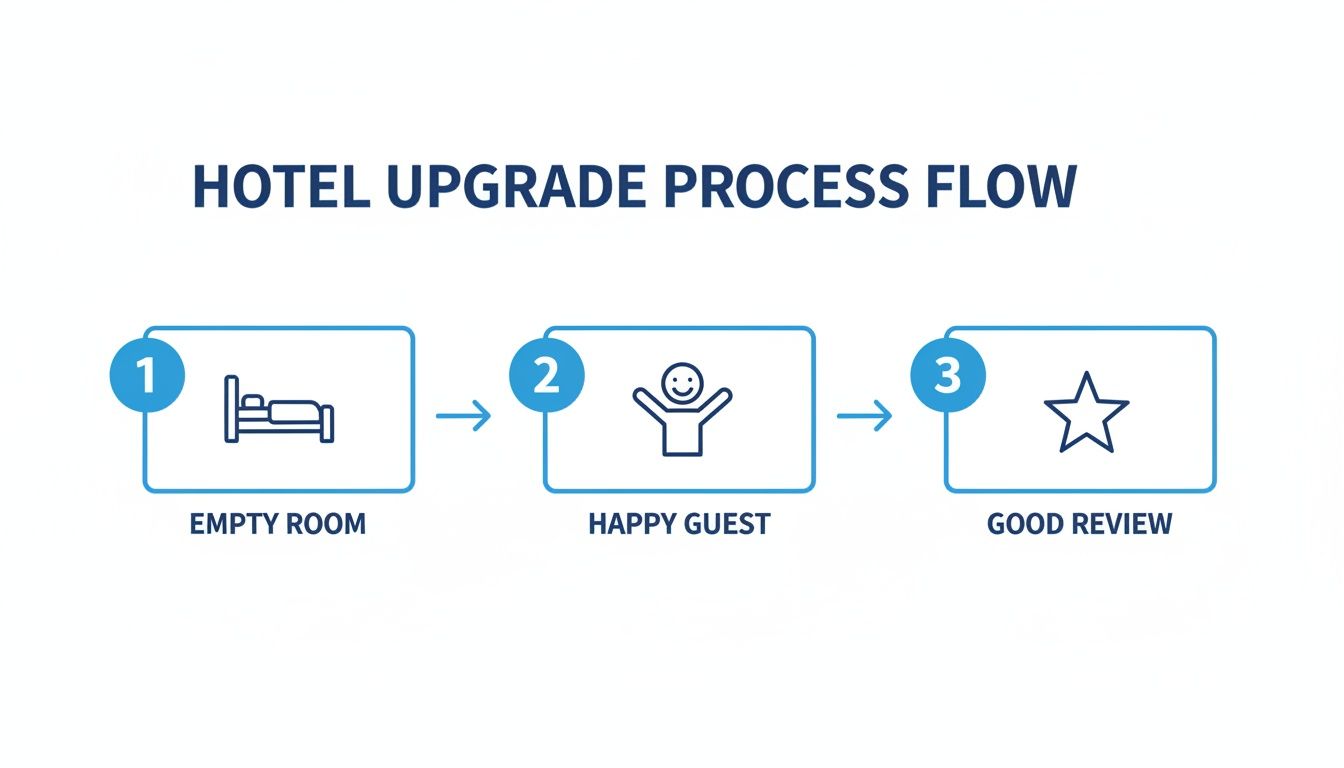
This really is a win-win. The hotel fills an otherwise empty premium room, you get a fantastic stay, and they get a glowing review. Everyone's happy.
Once your reservation is locked in, it’s time for your next move: a carefully worded pre-arrival email. I've found that sending a friendly note about a week before check-in is the sweet spot—it’s early enough to get on their radar but not so early that it gets lost in the shuffle.
The tone here is everything. You want to be gracious and personal, not demanding. Are you celebrating a birthday or an anniversary? Mention it! This gives the guest relations team a tangible reason to add a little something extra to your stay. They’re human, after all.
Here’s a practical example of what I always include in my emails:
Keep in mind, hotels aren't just giving rooms away. Smart standby upgrade programs can actually boost their profits by up to 35%. Research confirms that offering upgrades after the initial booking is a smart move for hotels with a good mix of premium rooms. This creates more opportunities for travelers like us. You can read more about the research behind hotel upgrade programs.
By taking these simple steps, you've already transformed yourself from just another reservation number into a real person—a valued guest celebrating something special. And that makes you exactly the kind of person they want to surprise with one of their best available rooms.
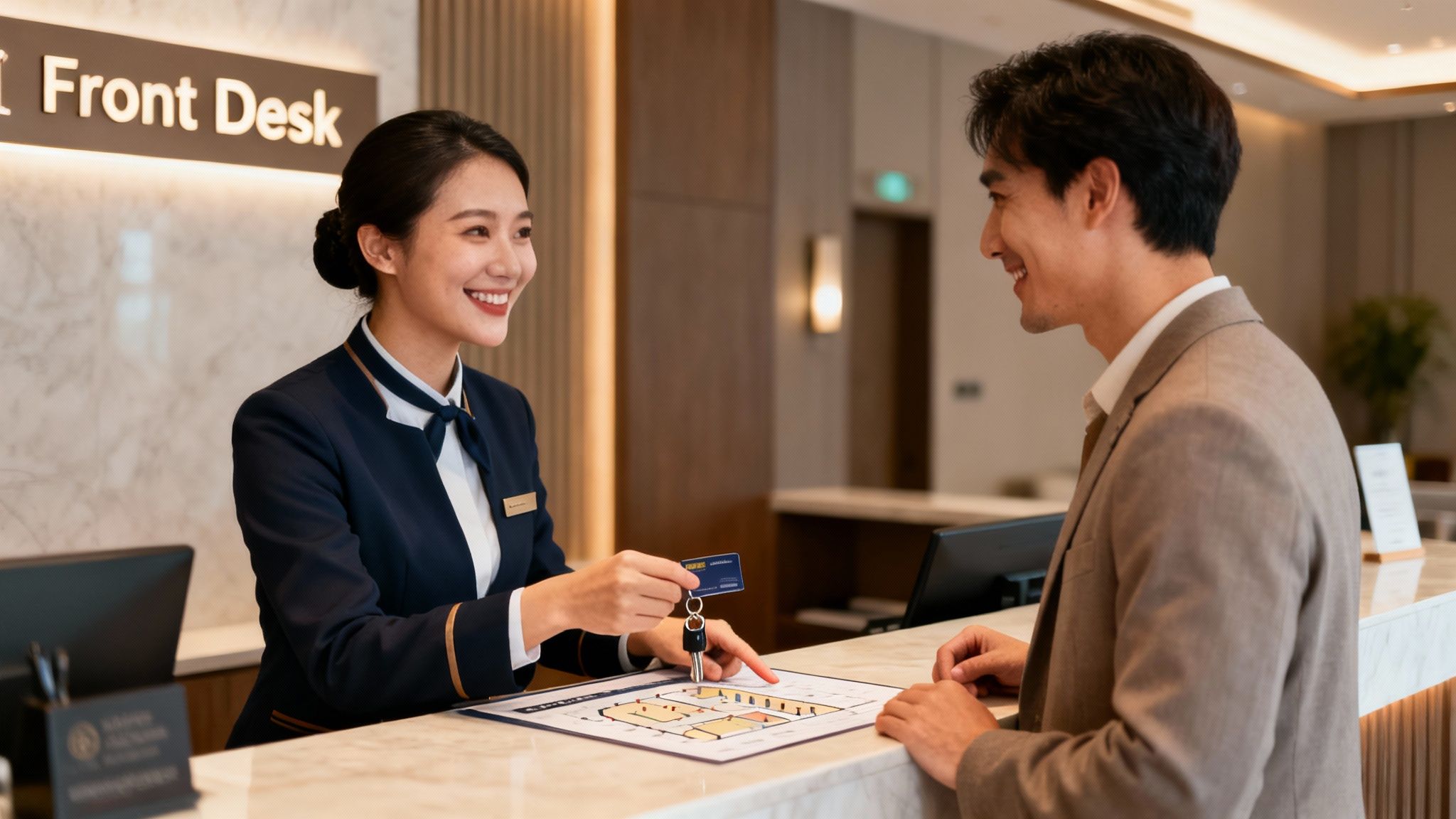
This is it—the moment of truth. All the prep work you've done comes down to this conversation at the front desk. Think of it less like a transaction and more like the start of a relationship. Your goal is simple: be the kind of guest they want to help.
A genuine smile and a relaxed, friendly attitude go an incredibly long way. Front desk staff deal with stressed-out, demanding travelers all day long. If you can be a bright spot in their shift—by making eye contact, smiling, and asking how their day is going—you've already set yourself apart and made them much more willing to see what they can do for you.
When it comes to asking for an upgrade, timing is almost everything. Try to avoid the check-in rush hours, like noon when everyone is checking out and 5 PM when the after-work crowd arrives. The lobby will be buzzing, and agents will be completely swamped.
Instead, aim for a lull. I've found the sweet spot is often mid-afternoon, somewhere between 2 PM and 4 PM. The front desk is typically quieter then, giving the agent more breathing room to actually look at the room inventory and see what's possible for your stay.
Key Takeaway: A polite, confident approach is your best tool. This isn't about being pushy. It's about making a graceful, reasonable request. Staff appreciate a guest who is pleasant and understands that an upgrade is a courtesy, not an entitlement.
Your opening line sets the tone. Before you even think about mentioning an upgrade, just be a normal, friendly human. A simple, "Hi, checking in under [Your Name]. Hope you're having a good day," builds immediate rapport.
Forget the old trick of sliding a $20 bill across the counter—it's outdated and can be awkward for everyone. A well-phrased question is infinitely more effective and professional. The secret is to be subtle, framing your ask as a hopeful inquiry rather than a firm demand.
Here are a few actionable lines I've seen work time and time again:
Notice how each of these phrases opens a conversation without cornering the agent. You're giving them the power to be the hero who grants your request, which is a much smarter approach.
To help you feel prepared for any situation, here are a few scripts you can adapt.
Knowing what to say can make all the difference. This table breaks down how to tailor your request based on your specific situation.
| Your Scenario | What to Say | Why It Works |
|---|---|---|
| You have elite status. | "Hi, I'm checking in. As a World of Hyatt Globalist, I was curious if any space-available suite upgrades are open for this stay." | This is direct yet polite. You're referencing a specific benefit of your loyalty status, which makes it a legitimate and expected inquiry, not a random ask. |
| You're celebrating a special event. | "We're so excited to be here for our honeymoon! If by any chance a romantic upgrade, perhaps to a room with a balcony, is available, it would be an amazing start to our celebration." | It creates an emotional connection and gives the agent a compelling reason to help make your stay memorable. It's a positive request tied to a happy occasion. |
| The hotel seems quiet. | "It looks like a quieter day here. I was wondering if that might mean a nicer room with a view has opened up for my stay?" | This shows you're observant and are making a logical request based on perceived availability. It comes across as more reasonable to the agent. |
| You booked through a premium program. | "I booked this through the Amex Fine Hotels + Resorts program and saw a room upgrade is a potential benefit. Could you check if one is available?" | Just like having elite status, you're tying your request to a specific program perk. This frames it as a standard, professional inquiry. |
No matter the scenario, remember to thank them for checking, whether an upgrade is available or not. A little gratitude ensures you're remembered positively for your next visit.
Having elite status with a big hotel chain can feel like a secret handshake, but it’s not always the golden ticket to a sprawling suite. Sure, loyalty is a huge piece of the puzzle, but the reality on the ground can be tricky, especially at franchise hotels where the bottom line often speaks louder than your status level.
Many of us have been there—arriving with high hopes from our hard-earned status, only to be met with a standard room. The problem is, you're often not the only elite member checking in that day. That's why you have to be smarter about how you use your loyalty.
Let's be honest: the advertised benefits of standard loyalty programs can be incredibly inconsistent. Take Marriott Bonvoy's Nightly Upgrade Awards (NUAs), for instance. They sound great in theory, but the reality is often disappointing.
Frequent travelers report a shockingly low 0-10% success rate with these awards. Some top-tier members have even said they've gone zero for dozens on their requests. You can read more about the widespread frustrations with Marriott's upgrade system to see just how common this is.
This points to a simple truth: if a hotel can sell a premium suite for full price, they usually will. Your loyalty perks can easily take a backseat to direct revenue. To get ahead, you need to make your reservation impossible to ignore.
The real secret is to "stack" your benefits. This means you don't just rely on one credential; you build a powerful guest profile by layering multiple high-value programs.
Think of it this way: when you book a stay using a card like The Platinum Card® from American Express through their Fine Hotels + Resorts program, you add a whole new dimension to your reservation. The hotel staff doesn't just see a loyalty number; they see a premium cardholder, which signals you're a high-value guest.
Here’s a practical, step-by-step example of how to stack:
When you combine your hotel status with a booking from a premium travel program, you're essentially putting yourself at the front of the upgrade queue. Your reservation sends a clear message that you value quality experiences, making you a much more attractive candidate for that corner suite.
While hotel loyalty programs have their place, premium travel memberships offer a completely different kind of leverage. Instead of just hoping the hotel will honor your status, these services become your personal advocate. If you want to see what's out there, our guide to the best hotel membership programs is a great place to start.
Services like Approved Experiences Traveler give you access to a dedicated concierge. These aren't just call center agents; they are travel pros with real relationships at top hotels. They can call the hotel's Director of Rooms on your behalf to negotiate an upgrade for you before you even pack your bags. This changes the entire conversation from a simple request to a professional inquiry from a trusted partner, dramatically increasing your odds of success.
Beyond what you say at the check-in desk, there are a few clever strategies that can seriously stack the odds in your favor. These are the subtle moves seasoned travelers rely on to consistently land better rooms. It all comes down to understanding the hotel’s rhythm and using it to your advantage.
One of the simplest and most effective tactics is all about timing. Traveling during a hotel’s shoulder season—that sweet spot just before or after peak tourist times—means lower occupancy. For example, visiting Miami in October instead of December, or Scottsdale in May instead of March. When the hotel isn't full, the front desk has way more flexibility to place you in a premium room that would otherwise sit empty.
The same logic applies to the day of the week. Hotels in business districts are often packed Monday-Thursday, while leisure hotels are full Friday-Sunday. If you can book against the grain (e.g., a Sunday night at a business hotel), you'll find a quieter hotel and a staff more able to offer an upgrade.
Here’s a powerful but often overlooked factor: the length of your stay. A hotel is far more likely to upgrade someone staying for just one or two nights compared to a guest booked for an entire week.
The reason is simple inventory management. Upgrading a guest for seven days takes a prime suite off the market, preventing the hotel from selling it last-minute to a full-price paying customer. A one-night upgrade, on the other hand, is a low-risk way to fill an empty room and create a happy guest with almost no financial downside for the hotel. This "short stay advantage" is a huge piece of the puzzle.
The numbers back this up. Luxury hotels have a 25% room upgrade rate, meaning about one in four guests gets a better room. For mid-scale properties, it’s around 15%, while budget hotels sit at just 5%. It shows how your choice of hotel and timing can make all the difference.
If your travel plans are flexible, think about breaking a longer trip into a few shorter stays at different hotels. You might just increase your chances of getting upgraded each time.
Sometimes, your best shot at an upgrade happens after you get your keys. If you walk into your room and find a legitimate issue—a rattling air conditioner, a view of the dumpsters, or a leaky faucet—you have the perfect reason to ask for a new room.
This isn't about making things up. It's about politely and calmly addressing a real problem.
Here’s a practical script for that conversation at the front desk: "Hi, I just got to room 415, and the noise from the ice machine next door is pretty loud. I was wondering if it might be possible to move to a quieter room, maybe on a higher floor if anything is available?"
This works because you’re not just complaining; you’re being reasonable and offering them an easy out. The simplest fix for the hotel is often to move you to a different—and hopefully better—room. This "problem-solution" approach frequently results in a nice complimentary upgrade as a gesture of goodwill.
Finally, for those looking to experience true opulence, checking out some top all-inclusive luxury resorts can give you a great benchmark for what to aim for. And if you do get great service, a subtle mention of your plan to share your experience online can go a long way. Something as simple as, "Thank you so much, this is fantastic! I can’t wait to post about this on Instagram," reinforces their decision to help you. In a world driven by reviews, hotels know the power of a happy guest.
For a deeper dive into saving money on your booking, be sure to check out our guide on https://www.approvedexperiences.com/blog/how-to-negotiate-hotel-rates.
Even the most seasoned travelers have questions when it comes to snagging a better room. Let's walk through a few common scenarios so you can fine-tune your approach and check in with total confidence.
In a word, yes. Booking the absolute rock-bottom, entry-level room basically tells the hotel that your only priority is price. Unsurprisingly, this often puts you at the very bottom of the list for potential upgrades.
Here's an actionable insight: Hotels are much more likely to reward a guest who booked a mid-tier room. It signals that you value the experience and are willing to pay a little more for it, making you a perfect candidate to be impressed with a suite. That small extra spend to go from a "standard" to a "deluxe" or "city view" room can dramatically increase your odds.
Why not both? The most successful strategy I've found is a simple two-step dance.
First, send a polite and friendly email to the hotel manager or front desk about a week before you arrive. Casually mention your loyalty status, the reason for your trip (especially if it's a special occasion), and ask about the possibility of an upgrade. This gets your name on their radar early. For example, find the "Contact Us" page on the hotel's website and email the General Manager or Front Office Manager directly.
Then, when you arrive, you can follow up with a warm, in-person request at the check-in desk. This is when the agent can see the real-time room inventory and has the power to make it happen. Combining that early, thoughtful outreach with a friendly face-to-face chat is the most consistently effective method.
A Quick Word on Wording: A true "complimentary" upgrade costs you absolutely nothing—it's 100% free. To avoid any awkward mix-ups, I always make a point to use the word "complimentary" in my request. An agent might offer you a "discounted paid upgrade," which can still be a fantastic deal, but you're never obligated to take it. For instance, they may offer a suite that's normally $200 extra for just $75 a night.
This is a delicate one, but it can work if you handle it with a bit of finesse. Obviously, your Hilton Diamond status doesn't mean anything official at a Hyatt property.
But you can still use it to your advantage. When you're checking in and making your request, you could try saying something like, "As a top-tier elite member with other hotel brands, I'm always on the lookout for a great new property to give my loyalty to."
This little phrase is brilliant because it's not demanding. It simply signals that you're a high-value, frequent traveler—exactly the kind of guest a hotel manager wants to win over for future stays. You're not asking for a handout; you're giving them a chance to earn your business.
Ready to unlock a world of travel perks and guaranteed savings? The Approved Experiences Traveler membership gives you direct access to wholesale pricing on over a million hotels, exclusive cruise deals, and concierge services that take the guesswork out of getting the best value. Start your journey toward smarter, more luxurious travel today. Learn more about Approved Experiences.
From this collection
From this collection

cheapest business class
Discover the cheapest business class options and tips to fly in style for less. Practical strategies, insider tricks, and real-world savings on premium fares.

december travel destinations
Explore the best December travel destinations, from warm escapes to winter wonderlands. Get expert tips on where to go in 2026 and how to save.

st lucia house rentals
Find your perfect St. Lucia house rentals. We review the 7 best sites for villas, from luxury estates to family-friendly homes. Book your 2026 trip.