All Articles
The Journal
How to Hire a Personal Assistant: how to hire personal assistant the right way
January 26, 202620 min readhiring a pavirtual assistant
Discover how to hire personal assistant efficiently: define needs, conduct interviews, and onboard for improved productivity.

That feeling of always being a step behind? It’s more than just being busy—it’s a flashing red light. Realizing you need help is the first, and most important, step in learning how to hire a personal assistant who can genuinely give you your time back.
Knowing When You Need a Personal Assistant
Most people don't just wake up one day and decide to hire an assistant. It's usually a slow burn. It's the creeping realization that you spend more time managing your life than actually living it. The tipping point often comes when your professional focus starts to fray because personal logistics are eating up all your mental bandwidth.
Think about your last weekend. Was it spent recharging with family and friends? Or was it a frantic game of catch-up—scheduling appointments, researching travel, coordinating home repairs? When that kind of life admin consistently bleeds into your downtime, it’s a clear sign you’ve hit your personal capacity. This isn’t a failure; it’s a resource problem.
Are You Drowning in Delegation Debt?
I like to call this "delegation debt"—it's all the time and energy you lose on tasks someone else could easily handle. It’s the invisible weight that slows you down and holds you back. A quick self-audit can show you just how much of this debt you're carrying.
Be honest with yourself. Do any of these sound familiar?
- Calendar Chaos: You're constantly shifting meetings around or, worse, double-booking yourself and missing personal commitments.
- Decision Fatigue: You feel mentally exhausted from making hundreds of tiny decisions every day, from what to order for lunch to which flight to book.
- Inbox Overload: Your personal email is a disaster zone of non-urgent but necessary tasks that all need a response.
- Project Procrastination: Important personal projects—like finally planning that family vacation or getting your finances organized—are always on the "someday" list.
The goal isn’t to add another person to your payroll. It’s to strategically buy back your most valuable, non-renewable asset: your time. When you start seeing this as an investment in your focus and freedom, not just another expense, the whole picture changes.
If you nodded along to more than one of those points, you're likely a perfect candidate for an assistant. The process of hiring one doesn't start with a job description. It starts with the honest admission that you can't—and shouldn't—do it all yourself. It’s a strategic move to offload the operational drag so you can get back to what truly matters.
2. Pinpoint Your Needs and Choose Your Hiring Model
Before you even think about writing a job description or posting an ad, we need to get brutally honest about what you actually need. This is where most people go wrong. They hire an assistant without a clear plan, and the relationship fizzles out within months because of a fundamental mismatch.
So, where do we start? With a simple, non-negotiable step: the Task Audit.
What Is a Task Audit?
For one full week, I want you to track every single thing you do that feels like a distraction, a drain on your energy, or is just plain outside your area of genius. This isn't about listing chores; it's about spotting the patterns that are holding you back.
Open a notebook or a spreadsheet and be meticulous. Your audit will likely reveal a clear profile of the kind of help you need.
For example, I've seen two common profiles emerge from this exercise:
-
The Founder's Profile: Their list is packed with things like, "Chasing down a signature for a Q3 legal doc," "Booking a last-minute flight to that investor meeting," or "Wasting an hour every morning filtering my personal inbox." This person needs a sharp, highly responsive operator who understands the pace of business.
-
The Busy Parent's Profile: Their list looks totally different: "Researching three different summer camps," "Calling to schedule dentist appointments for the kids," "Finding a plumber for that leaky faucet," and "Planning my son's 8th birthday party." This profile calls for a master of life logistics—someone who can manage a household with their eyes closed.
See the difference? One needs a business-savvy executive assistant, the other needs a personal life manager. Your task audit is the blueprint that tells you exactly who you’re looking for.
Don’t make the classic mistake of hiring a generalist for a specialist's job. If 80% of the tasks on your audit are complex business scheduling, don't hire someone whose main experience is running a household. Getting this right from the start will save you a world of time, money, and frustration.
Once your audit is done, you're ready to look at the different ways to hire an assistant. The right model for you will depend entirely on your needs, your budget, and frankly, how much you want to be involved in managing someone.
This flowchart can help you visualize that initial gut-check moment.
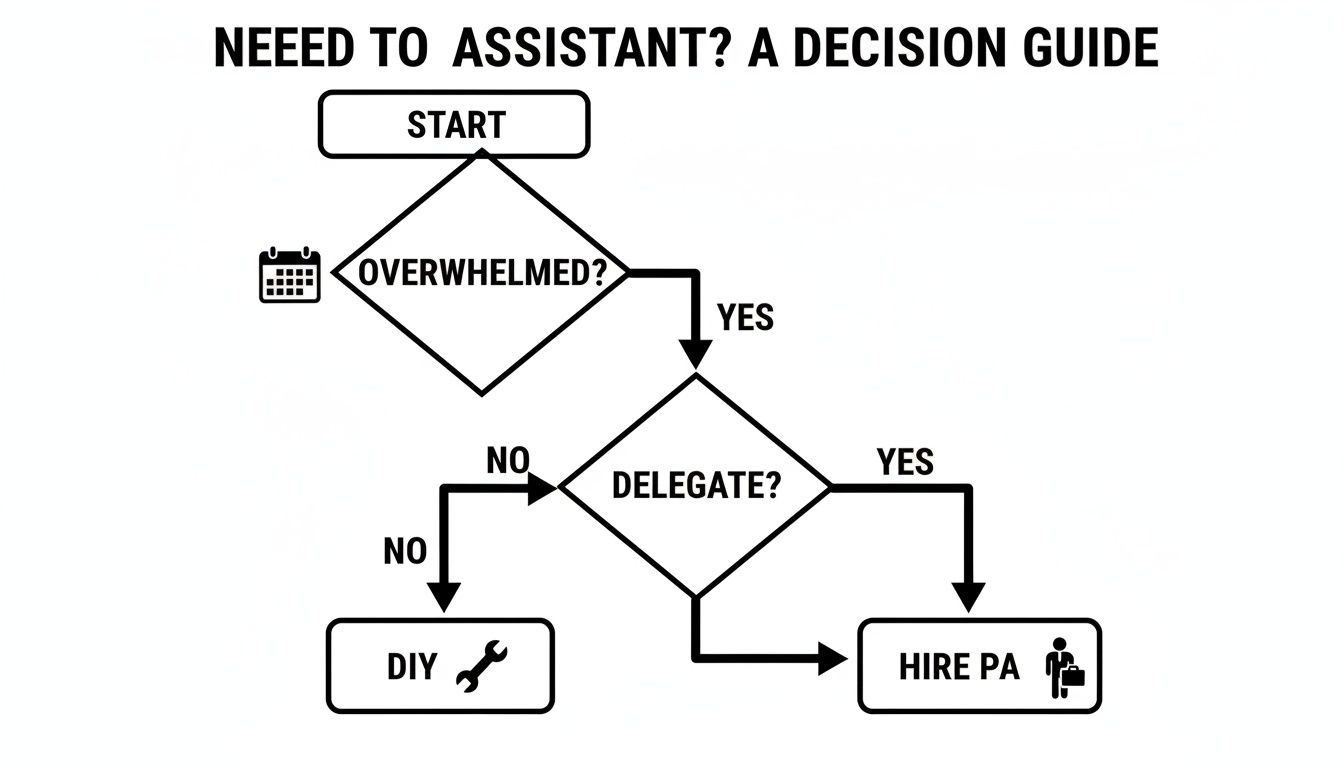
Feeling overwhelmed is the trigger, but being ready to truly delegate is the key. Once you've made that leap, it's time to pick your model.
Comparing Personal Assistant Models
The world of personal support has blown up far beyond just hiring a full-time employee. To help you navigate the options, I've put together a table comparing the most common models. This will help you decide which approach best fits your specific needs, budget, and lifestyle.
| Model | Best For | Typical Cost Structure | Pros | Cons |
|---|---|---|---|---|
| Full-Time Employee | Comprehensive, integrated support across personal and professional life. | Annual Salary + Benefits + Taxes | Deeply integrated into your life; exclusive focus; builds long-term trust. | High cost; you are an employer with all the HR and legal responsibilities. |
| Part-Time Employee | Consistent but not full-time needs (e.g., 15-20 hours/week). | Hourly Rate + Payroll Taxes | Dedicated support and consistency; lower cost than full-time. | Still requires you to be an employer; may have less availability. |
| Virtual Assistant (VA) | Remote, task-based work like scheduling, research, or email management. | Hourly Rate or Monthly Retainer | High flexibility; access to a global talent pool; cost-effective for specific tasks. | Can lack deep personal context; may juggle multiple clients; remote only. |
| Agency/Platform | Guaranteed execution without the management overhead; ideal for busy execs. | Monthly or Annual Subscription | No HR burden; team-based approach ensures reliability; pre-vetted talent. | Can be less personal than a direct hire; subscription model may be costly. |
Let's quickly touch on what each of these really means for you.
-
Full-Time or Part-Time Employee: This is the traditional route. You hire someone directly, and they work for you. It’s perfect if you crave a deep, long-term working relationship and need someone who truly understands the ins and outs of your life. The big catch? You become an employer, which means dealing with salary, benefits, taxes, and all the associated HR headaches.
-
Virtual Assistant (VA) Freelancer: This model has exploded in popularity, and for good reason. VAs are independent contractors who work remotely, often for several clients at once. This gives you incredible flexibility and access to specialized skills without the commitment of an employee. The market for remote PAs has seen a 20% increase in recent years, so the talent pool is massive. You can learn more about these trends from the latest personal assistant market statistics. The trade-off is that a VA’s availability might be limited, and they won't have the same deep, immersive context as a dedicated employee.
-
Agency or Platform-Based Assistants: Services like Approved Lux represent a totally different way of thinking. Instead of hiring one person, you subscribe to a service that gives you access to a team of highly-skilled operators. This model completely removes the HR burden from your plate. No payroll, no benefits, and no scrambling to find a replacement when your assistant gets sick. It’s built for people who demand guaranteed results and reliability without wanting to become a manager.
Ultimately, your task audit should be your guide. If your list is full of on-the-ground errands, a VA is out. If your needs are sporadic and digital, a full-time employee is overkill. Choosing the right model is the single most important decision you'll make in this entire process.
Writing a Job Description That Gets the Right Person to Apply

Think of your job description as your number one filter. It's not just a laundry list of tasks; it’s a sales pitch aimed directly at the exact person you want to hire. This is where you move past the generic templates and write something that speaks to a truly high-caliber candidate.
Let's get one thing straight: forget about vague requirements like "must be organized" or "good with people." Any top-tier assistant assumes those are table stakes. Your real goal is to paint a vivid picture of the role, the work environment, and the type of person who will absolutely thrive in it.
A great job description makes the wrong people click away and the right one feel like you wrote it just for them. And the raw material for this? It all comes from that detailed task audit you just finished.
From a To-Do List to Compelling Responsibilities
First things first, let's translate your task audit into a clear set of responsibilities. Group similar tasks together to give candidates a sense of the big picture. The key is to frame these duties as outcomes, not just actions.
Instead of: "Book flights and hotels." Try: "Manage complex domestic and international travel itineraries, ensuring seamless, door-to-door experiences from initial booking to ground transportation."
Instead of: "Schedule appointments." Try: "Proactively manage a dynamic personal and professional calendar, prioritizing commitments and resolving scheduling conflicts with diplomacy and foresight."
See the difference? This simple reframing elevates the work from a series of chores to a position of genuine ownership. It shows candidates the impact they'll have, which is exactly what a great assistant is searching for.
Defining Skills That Actually Matter
Now, let's talk about skills. It’s crucial to separate the teachable hard skills from the all-important soft skills.
- Hard Skills: These are the specific, technical abilities someone needs from day one. Be precise.
- Proficiency in Google Workspace (Docs, Sheets, Calendar) and Microsoft Office Suite.
- Experience with project management software like Asana or Trello.
- Familiarity with travel booking platforms and expense reporting tools.
- Soft Skills: These are the personality traits that will truly determine their success.
- Radical Resourcefulness: The knack for figuring things out and finding solutions without needing a step-by-step guide.
- Unwavering Discretion: A deep, intuitive understanding of confidentiality when handling sensitive personal and business information.
- An Anticipatory Mindset: The tendency to think two steps ahead, spotting potential roadblocks or needs before they become problems.
A smart candidate can learn your preferred calendar app in an afternoon. You can't teach someone good judgment, a proactive mindset, or a deep sense of loyalty. Hire for the traits you can't train.
Describing Your Personal or Household Culture
This is the secret sauce that most people leave out of their job descriptions. Your personal assistant is going to be operating in your inner circle, whether that’s your business or your private life. The cultural fit is everything.
Are you a formal, by-the-book person, or is your life a fast-paced, "figure it out as we go" environment? Be honest and explicit about your communication style and what you expect.
- For a Tech Founder: "You'll thrive here if you're comfortable with ambiguity, communicate concisely via Slack and email, and can pivot quickly when priorities change mid-day. We value speed and initiative over formal processes."
- For a Busy Family: "We are looking for a warm, steady presence who can bring calm to our chaotic schedules. The ideal candidate communicates with clarity and patience and enjoys being a central hub for family logistics."
Including these details is a powerful screening tool. It ensures you attract people who are not just capable, but genuinely compatible with your lifestyle and way of working. It will save you countless hours by helping the wrong candidates weed themselves out before you ever see their resume.
Conducting Interviews That Reveal True Potential
The resume might get them in the door, but the interview is where you find out if a candidate has the instinct and attitude to be a true partner. Forget asking stale questions like "What are your greatest weaknesses?" You’re not filling a standard corporate slot; you’re looking for someone you can trust implicitly, someone who has genuine foresight and a knack for getting things done.
Your real goal here is to push past the rehearsed, "right" answers and see how they actually think. This means tossing the script aside. Instead, focus on situational and behavioral questions that show you who they are, not just what they can do. Anyone can say they're proactive. You need to see it in action.
Going Beyond the Standard Questions
To really see how a candidate handles pressure, you have to throw realistic challenges their way. The best interview questions are basically mini-simulations of the work they’ll be doing for you every day. This is how you hire for instinct—a quality that’s infinitely more valuable than knowing a specific piece of software.
Here are a few powerful, scenario-based questions I’ve found incredibly revealing:
- The Travel Nightmare Scenario: "Walk me through the exact steps you’d take if my flight to an important international meeting was just cancelled. You have less than six hours before it was supposed to depart, and I’m already in the car, on my way to the airport and can't be reached."
- The Confidentiality Test: "You're in my office and overhear a sensitive piece of business information during a call I'm on. A colleague, who you like, asks you about it later. How do you handle that?"
- The Ambiguous Request: "I send you a quick message: 'Plan a nice anniversary dinner for my spouse and me next Friday.' What are the first five questions you ask me to turn that vague idea into a concrete, successful plan?"
These questions aren't about getting a single "right" answer. You're observing their thought process. Do they stay calm? Do they immediately start asking smart, clarifying questions? Do they think about multiple solutions and have a backup plan ready? Their response tells you everything about their problem-solving style, discretion, and ability to anticipate your needs.
Spotting the Subtle Red Flags
Asking the right questions is only half the battle; you also have to know what to watch out for. A truly great assistant is a master of detail and clear communication. The red flags you'll see in an interview are often subtle hints that these core traits might be missing.
Keep your eyes peeled for these warning signs:
- Vague Answers About Past Roles: If they use generic phrases like "I handled scheduling" or "I assisted with projects," press for details. A top-tier candidate can clearly explain what they accomplished and the impact they made. "I managed a calendar across three time zones for a C-level executive, which involved proactively rescheduling 10-15 conflicting meetings per week," is a much better answer.
- A Lack of Initiative in Their Questions: An interview is a two-way conversation. If a candidate doesn't ask you insightful questions about your communication style, your biggest pain points, or how you define success in the role, they probably lack the proactive mindset you need.
- Blaming Past Employers: Even if a previous job was a disaster, a professional knows how to frame the experience constructively. Complaining about old bosses or difficult colleagues is a huge red flag that suggests they don't take ownership.
- Reacting Poorly to Hypothetical Pressure: Watch their body language and tone when you pose a tricky scenario. Do they get flustered and defensive? Or do they lean into the challenge, treating it like a puzzle to be solved while remaining composed?
The single biggest red flag is a candidate who waits to be told what to do next. You are not hiring a task-taker; you are hiring a partner in efficiency. A great assistant is always thinking one step ahead, and that mindset should be evident even in the interview.
At the end of the day, you're hiring an assistant to reduce your mental load, not add to it. A candidate who seems like they'll need constant hand-holding or who can’t articulate their value clearly is not the right fit. Trust your gut here. If the conversation feels draining or difficult, that’s a preview of your working relationship. The right person will make you feel a sense of relief and confidence before they even have the job.
Onboarding Your Assistant for Long-Term Success

The contract is signed and the final interview is a distant memory. It's tempting to breathe a sigh of relief and think the hard part is over, but the next three weeks are arguably the most crucial phase of your entire working relationship. A thoughtful onboarding process is what turns a good assistant into an indispensable partner who can anticipate your needs before you even voice them.
Too many people make the mistake of just throwing their new assistant into the chaos, hoping they'll learn by osmosis. That's a surefire recipe for frustration on both sides. Instead, think of these first few weeks as a strategic investment—you're building the trust and rapport that will pay dividends for years.
This isn't just about handing over passwords and calendar access. It's a systematic transfer of knowledge, specifically the "you" knowledge. The goal is to get them up to speed quickly so they can start taking real, meaningful work off your plate.
The First Week Foundation
The first few days should be a blend of structured training and gradual, low-stakes task delegation. Your assistant can't read your mind, so it's your job to give them the manual. This doesn't have to be some formal, hundred-page document; it just needs to be a clear set of guidelines.
Kick things off with the absolute basics: access and communication. Get them into all the necessary digital tools right away—your calendar, email, project management software like Asana or Trello, and any travel booking accounts. There’s nothing more frustrating than wasting time on day three requesting access to something they needed on day one.
Next, you need to establish your communication rhythm.
- Preferred Channels: Are you a quick text person, a structured emailer, or someone who lives in Slack? Let them know where to reach you for different kinds of questions.
- Daily Check-ins: For the first two weeks, a quick 10-minute call each morning can work wonders. It helps align priorities and clears up small questions before they become major roadblocks.
- Response Times: Set clear, realistic expectations. For example, "For non-urgent emails, I'll expect a response within four hours. For urgent texts, aim for within 30 minutes."
This initial clarity prevents a world of misunderstanding down the road. It empowers your assistant to communicate effectively without feeling like they’re constantly bothering you.
Creating Your Personal User Manual
One of the single most effective things you can do is create a simple "user manual" about yourself. It’s a game-changer. This document demystifies your preferences and helps your assistant understand the unwritten rules of your life and work, acting as a shortcut to getting them to think like you do.
Don’t assume your preferences are obvious. Documenting how you like your coffee or that you never take meetings before 10 AM isn't micromanagement; it's providing the data your assistant needs to operate autonomously and effectively.
Your user manual is where you download all your unique quirks and priorities. Think about including details like:
- Key Contacts: A list of the most important people in your orbit (family, key clients, business partners) with a quick note on how you prefer them to be handled.
- Travel Preferences: Your go-to airline, hotel loyalty programs, and whether you’re a die-hard aisle or window seat person.
- Scheduling Quirks: Outline your personal rules, like "always block out 30 minutes of decompression time after a major presentation" or "never schedule personal appointments on a Monday."
- Feedback Style: Explain how you give and receive feedback. Do you prefer a formal weekly review or quick, in-the-moment notes?
Taking the time to document your preferences builds an incredible foundation from day one. It shows you’re invested in making the relationship work and gives your new hire the confidence to take initiative. By front-loading this information, you dramatically shorten their learning curve, allowing them to shift from just reacting to your requests to proactively managing your world.
A Modern Alternative to the Hiring Grind
Let's be honest, learning how to hire a personal assistant is a job in itself. You have to write job descriptions, vet a mountain of résumés, run background checks, and then untangle the complexities of employment contracts. Once you find that perfect person, you've officially become an employer—and that comes with payroll, taxes, benefits, and constant management.
But what if you could get all the support without shouldering any of that burden?
This is exactly where the old model of personal support is getting a much-needed update. Instead of locking yourself into hiring a single person, many entrepreneurs and executives are plugging into personal operations platforms. These services deliver the expert execution you need, but through a flexible, subscription-based model.
The Operations Platform Advantage
Think of it less like hiring a person and more like gaining an "always-on" operations department. Services like Approved Lux are built for one thing: getting your tasks done with military-grade reliability and efficiency. You’re not managing a person; you're submitting requests and getting results.
This approach flips the script and comes with some serious perks:
- No HR Nightmares: You completely sidestep the hiring, payroll, and benefits maze. There are no employment contracts to negotiate or sticky termination procedures to navigate.
- Unbreakable Reliability: When your assistant takes a well-deserved vacation or calls in sick, your entire support system usually grinds to a halt. With a platform, a team of specialists is always on deck, ensuring your requests are handled without a single hiccup.
- A Full Bench of Talent: Instead of depending on one person's skill set, you tap into a whole team with diverse expertise. You get a travel logistics pro, a savvy event planner, and a research whiz all in one.
This move toward tech-enabled services isn't just a niche trend. The global personal AI assistant market is expected to surge from $5.6 billion in 2024 to $13.2 billion by 2033. It's a clear signal that professionals crave efficient solutions without the traditional overhead of being an employer. You can dig deeper into this growing market on Go2MarketResearch.
An operations platform isn’t a person you manage; it's a system you activate. For leaders who value outcomes over personnel management, it offers a direct path to reclaiming time and reducing mental load.
Ultimately, this modern alternative redefines the goal. Instead of searching for the one perfect person to hire, you can access a reliable system built for pure execution. It's a strategic choice for anyone who wants the freedom of delegation without the heavy responsibilities of being the boss.
Common Questions About Hiring a Personal Assistant
Thinking about bringing on a personal assistant often sparks a few practical questions. Let's tackle the big ones I hear most often: cost, legal headaches, and the difference between a PA and an EA.
What's the Real Cost of a Personal Assistant?
This is the million-dollar question, and the answer truly depends on what you need. The price can vary dramatically based on where you live, the assistant’s experience, and how you hire them.
If you’re thinking about a full-time, in-house PA in a city like New York or San Francisco, you should budget for a salary in the range of $55,000 to $75,000 a year, and that's before adding benefits like health insurance.
For more flexibility, a freelance or virtual assistant is a great option. They typically charge by the hour, somewhere between $25 and $75. This is perfect if your needs change week to week, but just be aware your monthly bill will fluctuate with your workload.
A different model entirely is a platform-based service. You pay a predictable, flat subscription fee each month. This gets you access to a dedicated team of professionals without you ever having to think about salary, benefits, or payroll taxes.
What Legal Paperwork Do I Need to Hire Someone?
This is where things can get complicated, and it's a major reason people hesitate to hire directly.
When you bring on an employee, you're not just paying a salary—you're taking on a whole new set of responsibilities. You'll need to handle:
- An official employment agreement
- An I-9 form to verify their work eligibility
- A W-4 form for tax withholding
- Managing payroll taxes and securing workers' compensation insurance
If you hire them as an independent contractor, you'll still need a rock-solid contract that clearly defines the work, payment terms, and their independent status. Frankly, this administrative burden is why so many entrepreneurs and executives opt for an agency or a platform. They handle all the HR and legal complexities so you don't have to.
Is a PA the Same as an EA?
Not quite, though the lines can sometimes blur. The key difference really boils down to scope.
An Executive Assistant (EA) is almost always laser-focused on the business. They’re a strategic partner who manages a corporate calendar, preps you for board meetings, and handles professional communications within the company.
A Personal Assistant (PA), on the other hand, typically has a much broader, more blended role that often bridges your professional and personal life. They're the ones booking family vacations, coordinating household maintenance, managing personal appointments, and sometimes handling professional tasks, too.
Ultimately, the right choice comes down to a simple question: where is the biggest bottleneck in your day-to-day life?
Ready to reclaim your time without getting tangled up in the complexities of hiring? Approved Lux provides an always-on operations platform to manage your life's logistics with expert precision.
Learn more and get started with Approved Lux Personal Assistant
Want the wider view?
Ten categories. One report. Every quarter. The Approved List tracks what's rising and what's fading: data-backed signals, not opinions.
Free to join · Delivered by email