

Resources
Articles
Notes, guides, and editorial standards from the Approved Experiences team. Written for members, in the same voice we use everywhere else.
Resources
Notes, guides, and editorial standards from the Approved Experiences team. Written for members, in the same voice we use everywhere else.
Learn how to save on car rentals with expert tips on booking, avoiding hidden fees, and using memberships to cut costs.

Getting a great deal on a rental car isn't about luck; it's about having a solid strategy. The real key to saving serious money is a mix of smart timing, a little comparison shopping, and knowing where to find the value that other people miss. Think of this as your playbook for becoming a much savvier, more cost-conscious renter.
The best deals on rental cars are secured long before you ever step up to the pickup counter. I’ve seen it time and time again—savvy travelers consistently slash their costs by mastering just a few fundamental tactics. It’s all about planning and awareness, not hoping for a magical last-minute deal.
Once you understand how the pricing game works, you can start turning the system to your advantage. The core of this strategy is simple but incredibly powerful. It all comes down to knowing when to book, where to look, and how to use resources you probably already have. This is how you go from being a passive price-taker to an active, informed traveler who makes the smart call every time.
If there’s one thing that moves the needle on price more than anything else, it’s timing. Rental car prices are anything but static; they jump around based on demand, the season, and, most importantly, how far in advance you book. Waiting until the last minute is a gamble that almost never pays off, especially if you're traveling during a holiday or peak season when fleets are stretched thin.
Booking just a few weeks ahead can make a world of difference. Market analyses consistently show booking 14 to 30 days in advance almost always lands you a much lower rate. In sharp contrast, trying to book the same day or just a couple of days out can cost you 10–30% more as rental companies cash in on urgent demand.
With short-term leisure rentals making up a whopping 70-75% of the market, this price pressure really spikes during popular travel windows. You can dive deeper into these trends in this report on the car rental market. Simply shifting a last-minute summer booking to one made three weeks earlier can easily save you the cost of an entire rental day.
Actionable Example: A client booking a mid-size SUV for a July trip to Orlando in late June was quoted $85 per day. By checking again with an earlier booking date—simulating what it would have cost if they booked in April—the price dropped to just $65 per day. That’s a quick $140 saved on a one-week rental, just from planning ahead.
Sure, grabbing your car right at the airport is convenient, but you pay dearly for that convenience. Airport locations are notorious for passing on their high operating costs directly to you through a whole slew of extra taxes and fees.
You’ll see them listed on your bill, and they add up fast:
These sneaky charges can inflate your total bill in a big way. A quick search for off-airport locations—often just a short shuttle or rideshare away—can uncover dramatically lower base rates and far fewer of these surprise fees. A few minutes of extra travel time is a small price to pay for what can be substantial savings.
Getting the best deal on a rental car is about more than just booking early. It’s a game of timing, location, and strategy. While we all love the idea of a last-minute deal, that's a gamble that almost never pays off. More often than not, you're left with slim pickings and sky-high prices.
The real secret is hitting the booking "sweet spot." For most domestic trips, reserving your car two to four weeks in advance is the magic window. This gives you plenty of time to shop around but is close enough that you avoid the price gouging reserved for desperate, last-minute travelers.
This simple visual breaks down the core money-saving moves.
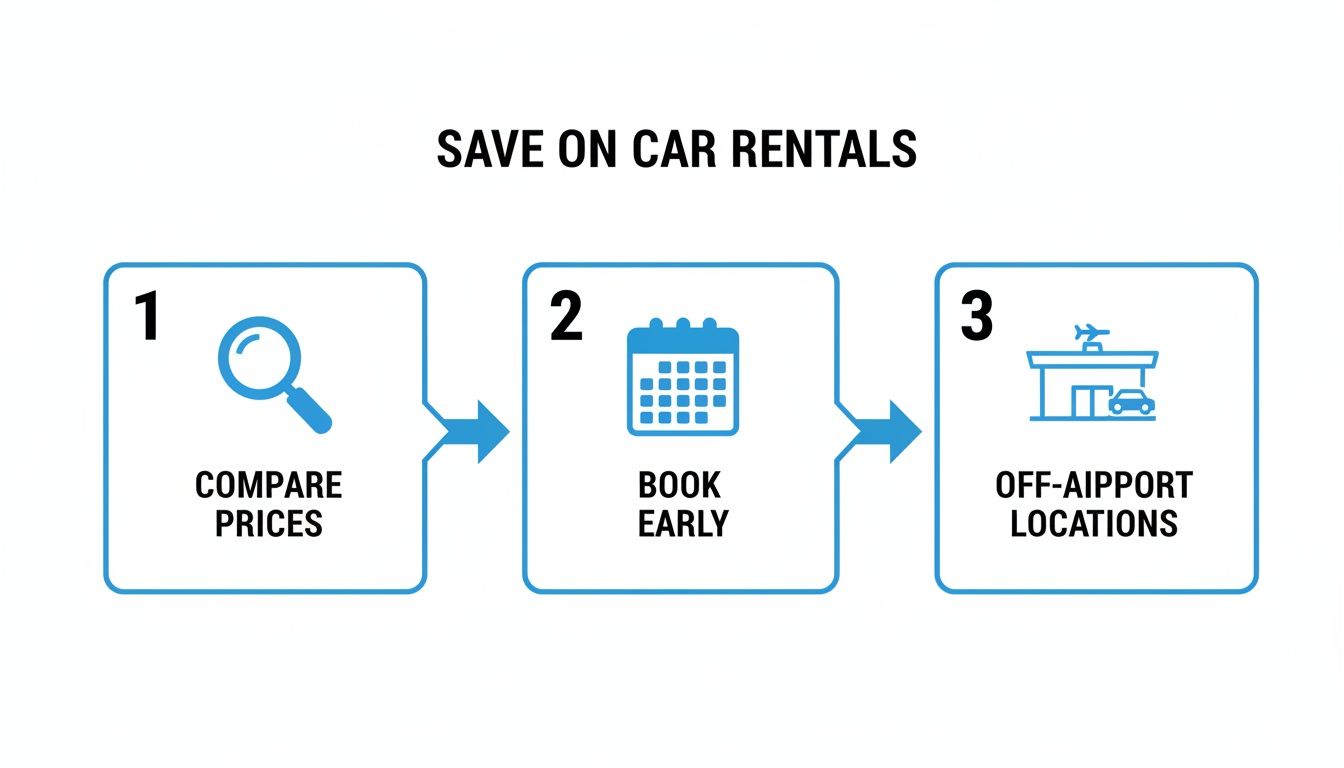
When you combine comparison shopping, early booking, and a smart pickup location, you’ll see your costs drop significantly.
Start your search with a rental car aggregator. Think of sites like Kayak or Rentalcars.com as your reconnaissance tool. They give you a quick, wide-angle view of the market, showing who has cars available and what the general price range looks like. It saves you the headache of hopping between a dozen different rental company websites.
But don't stop there. Once an aggregator helps you pinpoint the top two or three cheapest companies, head straight to their websites. Booking directly often unlocks perks you’ll never see on a third-party site.
Use the aggregator for research, then book direct to seal the deal. Those few extra minutes of cross-referencing almost always pay off with a better price and more benefits.
Where you pick up your car is one of the single biggest factors affecting your final price. Airport locations are incredibly convenient, but you pay a massive premium for it. Rental companies have to pay huge fees to operate at airports, and guess who they pass those costs on to? You.
These charges show up on your bill disguised as "concession recovery fees" or "customer facility charges." They can easily jack up your daily rate by 20% to 40% compared to a location just a few miles away in the city. Since most travel is centered around airports, this is a major budget-buster. A five-day rental from a major airport hub can easily cost 25-35% more than the exact same car from a neighborhood branch. You can dive deeper into how location impacts rental pricing to see the full scope of these trends.
Here’s a real-world example: For a week-long trip, I was quoted $480 for an SUV from Denver International Airport (DEN). The same company had an office downtown, a short rideshare away, offering the same SUV for just $350. Even after paying for a $40 Uber each way, I still saved $50 for the week. That's a practical, easy win.
It takes a little extra planning, but the savings are practically guaranteed.
Rental car prices aren't set in stone. They change constantly based on supply and demand, and you can use this to your advantage. This is hands-down one of my favorite tricks for making sure I never overpay.
Here’s the actionable plan: As soon as you find an acceptable rate, book it. But—and this is the important part—make sure it’s a cancellable reservation. Always choose the "Pay Later" option, as "Pay Now" deals are usually non-refundable.
With your initial booking locked in, you're not done. In the weeks leading up to your trip, spend five minutes every few days re-checking the prices for your dates. If you spot a lower rate, simply make a new reservation at the cheaper price, then go back and cancel your original one. It’s a simple but incredibly powerful way to capitalize on price drops and secure the absolute lowest rate.
The price you book online is just the starting point. The real test comes at the rental counter, where you're presented with a menu of insurance options and add-ons with a sense of urgency. This is precisely where a great deal can quickly become an expensive mistake.
Understanding what they're selling you—and whether you actually need it—is your single best defense against an inflated bill.
This part of the process is a massive profit center for the rental companies. But with a little prep work, you can confidently say "no, thank you" and keep that money right where it belongs: in your pocket.
The most confusing and expensive upsell is almost always the insurance. You'll hear them push a Collision Damage Waiver (CDW) or a Loss Damage Waiver (LDW), which can easily tack on an extra $15 to $30 per day.
Before you even think about accepting, you need to check the coverage you probably already have.
Many of us are already covered without realizing it:
Actionable Example: I once saved over $200 on a week-long rental in Arizona simply by knowing my credit card provided primary collision coverage. The agent was persistent, but I politely declined, showed proof of coverage on my phone when asked, and walked out paying exactly what I was quoted online.
Before you go, call the number on the back of your credit card. Ask them point-blank: "Does my card offer primary or secondary rental car insurance?" "Are any vehicles, like trucks or luxury cars, excluded?" Walking up to that counter armed with this knowledge is the difference between an informed decision and an expensive, impulsive one.
Insurance isn't the only trap. The rental counter is a buffet of other extras designed to pad your bill. They might seem convenient, but they're usually just overpriced versions of things you can get for much cheaper—or free.
These upsells are a core part of the business model in the $60.7 billion U.S. car rental market, often jacking up the final price by 20–50%. You can learn more about rental industry revenue streams from IBISWorld.
Let's look at the most common temptations and the smarter way to handle them.
To help you decide what's worth it and what's a waste of money, here’s a quick breakdown of common add-ons, their costs, and much cheaper alternatives.
| Add-On Item | Typical Daily Cost | Smarter Alternative | Estimated Savings (7-Day Rental) |
|---|---|---|---|
| Collision Damage Waiver (CDW) | $15–$30 | Use existing coverage from your credit card or personal auto policy. | $105–$210 |
| GPS Navigation Unit | $10–$15 | Use free apps on your smartphone (Google Maps, Waze). | $70–$105 |
| Prepaid Fuel | Premium per-gallon price | Fill the tank yourself before returning using an app like GasBuddy. | $20–$40 |
| Satellite Radio | $5–$8 | Stream music from your phone via Bluetooth or an aux cord. | $35–$56 |
| Electronic Toll Pass | $4–$6 + tolls | Pay tolls with cash or online after the fact. | $28–$42 |
As you can see, simply declining these common extras can easily save you hundreds of dollars on a single trip. A little planning goes a very long way.
This one sounds so convenient. "Just bring the car back empty, we'll handle the rest!" The catch? You're paying for a full tank of gas at their inflated rate, and there's zero refund for whatever you don't use.
Their per-gallon rate is almost always way higher than what you'll find at a local station. Instead, use an app like GasBuddy to find the cheapest gas near the airport before you drop the car off. This simple move ensures you only pay for the fuel you actually used and can easily save you $20 to $40.
In an era where everyone has a smartphone, paying $10 to $15 per day for a GPS unit is just throwing money away. For a week-long trip, that's over $100 for a clunky device that's probably less up-to-date than your phone.
Your phone already has superior, free options like Google Maps, Waze, or Apple Maps that give you real-time traffic updates. If you're traveling internationally, just download the maps for your destination ahead of time to use them offline and avoid any data charges.
Satellite radio is another small daily charge ($5-$8 per day) that adds up. Likewise, the electronic toll pass seems helpful, but it comes with a daily "service fee" of $4-$6—and they charge you that fee every single day of the rental, even on days you don't drive through a single toll.
The smarter play? For music, use your phone and a simple aux cord or Bluetooth. For tolls, do a bit of research on your route. Many toll roads let you pay online after you pass through, or you can just use the cash lane.
Some of the deepest discounts on rental cars are hiding in plain sight—right in your wallet. The memberships you already pay for are often packed with travel perks that most people completely forget about. We're not talking about chasing down obscure, one-off coupon codes. This is about making your existing connections work for you.
Let's break down how to turn those affiliations into real, tangible savings on your next rental car. This strategy goes way beyond the standard rental company programs and taps into a much bigger network of potential discounts.
Big organizations—think warehouse clubs and auto associations—negotiate bulk discounts with major rental car companies for their members. These aren't just a few dollars off; they can often beat the best publicly available rates and sometimes throw in valuable extras.
So, think about the groups you belong to. The most common (and powerful) sources for these discounts include:
Actionable Example: I once helped a family book a minivan for a week-long trip. The best public rate was hovering around $650. By simply logging into their Costco Travel account, we found the exact same vehicle class with the same company for $520... and it included a free second driver. That’s an instant $130 saved without any extra effort.
The real trick is to always check these membership portals before you look anywhere else. The savings are baked right into the rates you see, making it one of the easiest ways to cut your costs.
Your professional life can be another goldmine for discounts. Many companies, universities, and alumni associations negotiate special corporate rates for their people.
These are often called Corporate Discount Program (CDP) codes, and they can be incredibly valuable. If you work for a large company, poke around your employee benefits portal or ask HR if they have preferred rental car partners. You might be surprised.
In the same vein, your college or university alumni association likely offers travel discounts as a membership perk. A quick search on their website could uncover a discount code that unlocks a surprisingly low rate. It's one of the most underused methods for saving on car rentals, but it consistently delivers.
This is a no-brainer. Even if you only rent a car once or twice a year, signing up for the rental company's free loyalty program is one of the smartest moves you can make. The immediate benefits are worth the two minutes it takes to create an account.
For starters, members of programs like Hertz Gold Plus Rewards, National Emerald Club, or Avis Preferred can often skip the rental counter entirely. Your info is already on file, so you head straight to the garage, find your name on the board, and drive off. This can easily save you 30-60 minutes of waiting in a soul-crushing line after a long flight.
Beyond that massive convenience, you get other real perks:
Joining these programs costs you nothing. It immediately improves your rental experience and sets you up for future savings. It's a simple, actionable step that pays dividends from the very first time you rent.
Alright, let's put all this strategy into a simple, ready-to-use game plan. Think of this as your pre-flight check to make sure you’re not just getting a deal, but the best deal. I’ve broken it down chronologically to walk you through it from the moment you start planning.
Follow these steps, and you’ll sidestep those common, costly mistakes that catch so many travelers off guard.
This is where the real money is saved. Getting these first few steps right sets the foundation for a stress-free, budget-friendly rental.
Check Your Existing Coverage: Before you do anything else, make two quick calls: one to your personal auto insurance agent and another to your credit card company. Ask them point-blank if you have rental car coverage. You need to know if it's primary or secondary, and if there are any gotchas, like exclusions for certain car types or countries. This single step can save you a whopping $15-$30 per day.
Scan the Entire Market: Fire up an aggregator like Kayak to get a quick snapshot of the market rates. But don't stop there. Go directly to the rental company websites and check the rates you get through memberships like Costco, AAA, or AARP. It’s also worth comparing the airport locations to city branches just a short Uber ride away—the savings can be significant.
Lock in a Refundable Rate: Found a price you can live with? Great. Book it, but make sure you choose the "Pay Later" option. This gets your name on a car without forcing you into a non-refundable payment. It’s the key to staying flexible so you can pounce if a better deal pops up.
You’ve got a reservation, but the work isn't quite done. This is the time for final checks to make sure everything is buttoned up for a smooth pickup.
Confirm Everything: Log into the rental company's website and pull up your reservation. Double-check the pickup time, the location, and the vehicle class. No surprises.
Do One Last Price Check: This is your final chance to execute the "track and re-book" strategy. Run one last search for your dates. If you find a lower price—and you often will—you can snag the new, cheaper reservation and cancel your original one in a matter of minutes.
Get Your Paperwork in Order: Make sure your driver's license is current and not about to expire. Have your credit card and reservation number handy so you’re ready to roll at the counter.
Pro Tip: I always take a quick screenshot of my final booking confirmation, the one that shows the total estimated price with all the taxes. If the agent at the counter tries to tell you a different story, having that little piece of evidence on your phone can shut down any debate instantly.
This is the final boss battle. Stay sharp here to avoid last-minute upsells and protect yourself from any post-trip disputes.
Document the Car's Condition: Before you even put the key in the ignition, do a full walk-around. Use your phone to take a video or photos of every single scratch, ding, or stain you can find, inside and out. Point out anything significant to the agent and make sure they note it on your rental agreement.
Clarify the Fuel Policy: Most rentals are "full-to-full," meaning you need to bring it back with a full tank. Confirm this with the agent and glance at the fuel gauge to make sure you're actually starting with a full tank.
Just Say No to Extras: This is where your pre-trip research pays off. You’ll be offered the Collision Damage Waiver, prepaid fuel, a GPS unit, and satellite radio. If you've confirmed you have other coverage and don't need the add-ons, a confident and polite "no, thank you" is all you need. Stick to the plan.
By running through this checklist, you stop being a passive renter and become a savvy traveler who knows how to work the system. You’ll be armed and ready to lock in the best deal, every single time.
Even after years of booking rental cars, a few tricky questions always seem to surface. These are the little details and common sticking points that can hit your wallet with unexpected fees if you’re not ready for them. Let’s clear up the confusion with some practical, real-world advice.
It sounds crazy, but you’d be surprised how often the answer is a resounding yes. Rental car companies have pricing tiers, and their weekly rates are often dramatically cheaper on a per-day basis than their standard daily rates. A "week" usually means any rental from five to seven days.
Because of this little quirk in their pricing, you should always get a quote for a full seven-day rental if you need a car for five or six days. You might find the total cost for the week is actually less than your original quote. You’re not locked into keeping the car for all seven days, either. Just double-check the company's policy on early returns, though penalties are pretty rare on "Pay Later" reservations.
Here's a real-world example: I once needed a midsize car for a five-day trip. The quote came back at $60 per day, for a total of $300. Just for kicks, I ran the same search for a full week. The rate dropped to $350 for seven days, which is only $50 per day. Booking for the week was the obvious move, even though I returned the car two days early.
If you're under 25, you know the pain. That hefty daily surcharge can feel like a penalty for being young, sometimes even doubling the cost of the rental. It’s a huge budget-killer, but you don't always have to pay it.
Your best bet is to lean on memberships that have already negotiated these fees away.
If neither of those works for you, it's time to do some quick math. Compare the total rental cost (including the fee) against what you'd spend on ride-sharing or public transit for your trip. Sometimes, the car just isn't worth it.
Absolutely. One hundred percent yes. Most rental company loyalty programs are completely free to join and give you perks right out of the gate, even if you’re not a road warrior.
The single best reason is the ability to skip the counter at major airports. After a long flight, the last thing you want is to stand in a massive line. With a loyalty membership, you can often walk straight to the garage, find your name on the board, hop in your assigned car, and drive off. It’s a game-changer.
On top of that convenience, having an account saves all your preferences and driver info, making future bookings a breeze. And hey, even one or two rentals a year will slowly earn you points, which eventually turn into a free rental day or a nice upgrade. It costs you nothing and makes your travel life so much easier.
Technically, yes, many companies allow it. But I’ll be blunt: it’s a huge hassle, and I almost always advise against it. Using a debit card triggers a whole different set of rules that are far more restrictive than using a credit card.
If you go the debit card route, be prepared for:
To keep things simple and avoid any drama at the rental counter, a major credit card is always the way to go. It’s just the smoother, safer, and more predictable option.
Ready to put these strategies into practice and lock in deals the public never sees? With Approved Experiences Traveler, you get exclusive access to wholesale pricing that can save you up to 50% on car rentals from top companies worldwide. Stop overpaying and start traveling smarter.
Join Approved Experiences Traveler today and discover how affordable your next trip can be.
Article created using Outrank