

Resources
Articles
Notes, guides, and editorial standards from the Approved Experiences team. Written for members, in the same voice we use everywhere else.
Resources
Notes, guides, and editorial standards from the Approved Experiences team. Written for members, in the same voice we use everywhere else.
Discover how outsourcing to a virtual assistant can boost productivity. Learn task delegation, finding talent, and building an efficient workflow.

Bringing a virtual assistant on board is one of the smartest moves a busy professional can make. It’s all about strategically handing off the administrative, creative, or technical tasks that clog up your day to a remote expert. This frees you up to focus on the work that actually moves the needle, all without the costs and headaches of hiring a full-time employee.
Let's get real for a moment. The mental load that comes with a jam-packed schedule is completely draining. So many founders I talk to see delegation as some far-off luxury, but that’s the wrong way to look at it.
Outsourcing to a virtual assistant isn't an expense; it's a strategic investment in your own productivity and, frankly, your sanity.
It’s about getting rid of the decision fatigue that piles up from juggling a dozen small but necessary tasks. Think about it: every minute you spend on scheduling or inbox management is a minute you aren't spending on strategy, sales, or product development.
And you don't have to be a Fortune 500 CEO to make this work. If you’re buried under emails, constantly trying to coordinate schedules, or spending hours on research, you're the perfect candidate. The goal is simple: get your time back, starting with the very first task you delegate.
The thought of hiring someone can be daunting. You've got to find them, vet them, onboard them, and then manage them. It’s practically a second job.
This is exactly where a managed service like Approved Lux changes the game. Instead of sifting through countless profiles on freelance platforms, you get instant access to a reliable, pre-vetted team that's ready to go. You skip the entire hiring and management process and jump straight to getting things done. Check out how these virtual personal assistant services are built for seamless support right from the start.
This isn't some niche trend, either. The acceptance of remote professional support is exploding. The global virtual assistant market was valued at around $19.5 billion in 2025 and is expected to hit $55.4 billion by 2035. That’s a massive 184% jump.
This huge growth shows that businesses everywhere are waking up to the power of remote delegation. Understanding how outsourcing to a virtual receptionist for small business can manage critical functions is a key part of this shift toward more agile and efficient ways of working.
Deciding how to delegate is just as important as deciding what to delegate. Each option has its own set of trade-offs, from cost and commitment to management overhead. I've put together a quick comparison to help you see where each model shines.
| Factor | Full-Time Assistant | Freelance Virtual Assistant | Managed Service (e.g., Approved Lux) |
|---|---|---|---|
| Cost | Highest (salary, benefits, taxes) | Variable (hourly or project-based) | Moderate (subscription-based, no overhead) |
| Commitment | High (long-term contract, legal) | Low (flexible, short-term) | Flexible (monthly plans, easy to scale) |
| Management | High (direct supervision, training) | Medium (vetting, onboarding, QA) | None (managed for you, single point of contact) |
| Reliability | High (dedicated employee) | Varies (depends on individual) | High (built-in backup, pre-vetted team) |
| Skill Access | Limited to one person's skills | Wide (but requires hiring multiple VAs) | Wide (access to a diverse team of specialists) |
Ultimately, the right choice depends on your specific needs. A full-time hire offers deep integration, a freelancer provides flexibility for one-off projects, and a managed service like Approved Lux delivers reliability and scalability without the management burden. For most busy founders, the managed model hits the sweet spot.
Let's be honest. The biggest thing stopping most people from outsourcing isn't finding someone—it's figuring out what to let go of. You’re already swamped, and the idea of training someone else feels like just another thing on your to-do list.
This is the classic bottleneck, but breaking through it is easier than you think. It starts with a simple, brutally honest audit of your time.
For just one week, track everything. I mean everything—from that "quick" 5-minute email check that turns into 45 minutes, to the time you spend booking a dentist appointment. Don't judge it, just log it. At the end of the week, you'll have a real, unfiltered look at where your time is actually going.
With your time log in hand, it's time to get sorting. Look at every single task and ask yourself: "Does this truly require my specific expertise?" Most of us hang onto tasks out of habit, not necessity.
To make it easier, try bucketing your activities into these four categories:
This decision tree gives you a great visual for what to do when you feel the overwhelm creeping in. It’s a clear path from "drowning in work" to getting your time back.
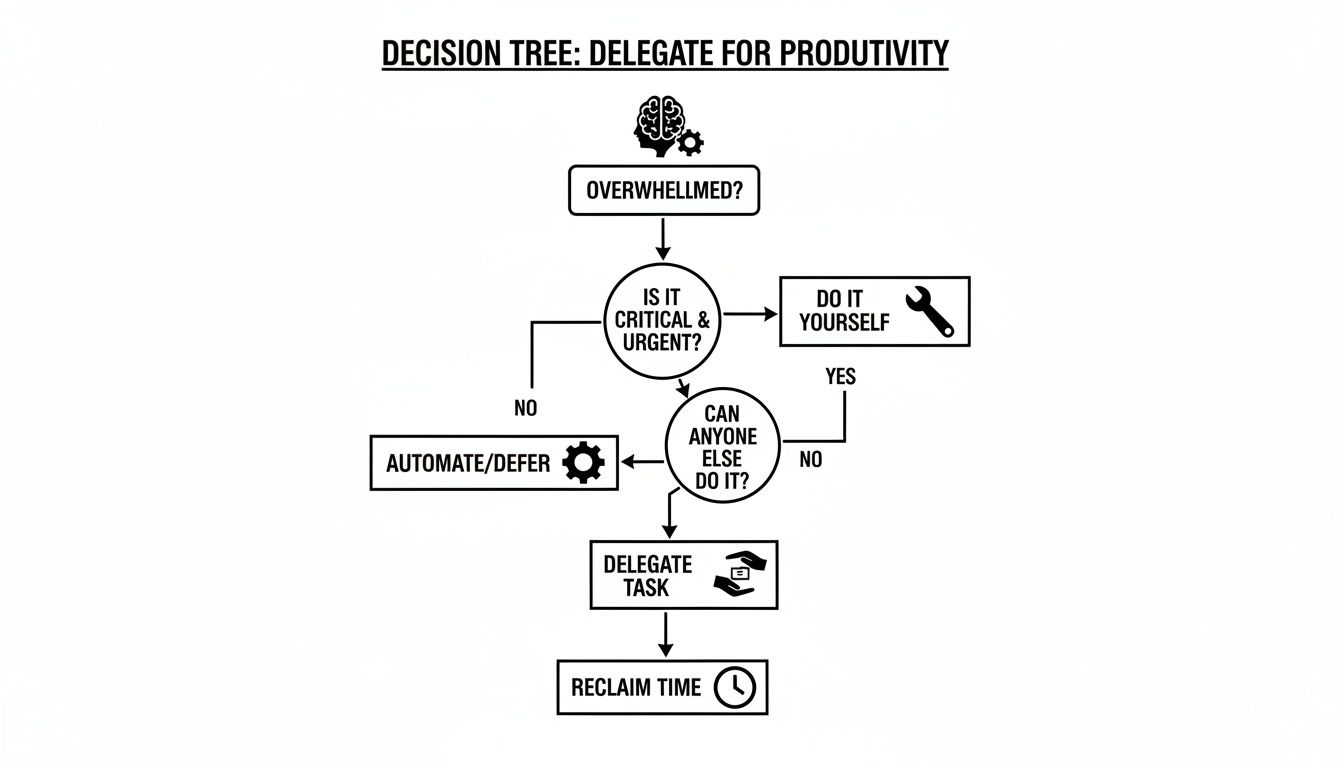
The takeaway here is simple: when your plate is too full, the answer is to take things off it. Delegating is the most direct way to buy back hours you can invest in what really moves the needle.
Once you know what you're delegating, you need to define how it gets done. This is where Standard Operating Procedures (SOPs) come in, but don't let the corporate jargon scare you. An SOP can be incredibly simple.
A good SOP is all about removing the guesswork. It’s not about control; it's about empowering your assistant to work confidently and independently. You’re looking for results, not a new person to micromanage.
Honestly, one of the best ways to create an SOP is to just hit record.
Fire up a tool like Loom and make a quick screencast of yourself doing the task. Talk through the process as you do it. This is usually way more effective than some dense, 10-page document nobody will read.
Let's say you're handing off your social media scheduling. Your SOP could be this simple:
That's it. This combo of a quick video and a few notes is all you need for a smooth handoff. Your new VA has everything they need to get started, which means fewer "quick questions" interrupting your day.
If you're still brainstorming what's possible, checking out the most in-demand virtual assistant skills can give you a ton of ideas for building out your first few SOPs.

Okay, so you’ve mapped out what to delegate. That’s a huge win. But now comes the part that can feel like searching for a needle in a haystack: finding the right person for the job.
The market for virtual assistants is absolutely booming. Job postings shot up by 35% in the last year alone, and with an estimated 40 million VAs working across the globe, you’ve got an incredible amount of talent to choose from. The challenge isn't a lack of options; it's cutting through the noise to find a perfect fit.
So, where do you even begin? Generally, you have a few different paths you can take.
For many, the first stop is a sprawling freelance marketplace like Upwork or Fiverr. They give you direct access to a massive pool of candidates at every conceivable price point. The downside? The sheer volume can be paralyzing, and you are 100% responsible for the entire process—vetting, interviewing, background checks, and onboarding. It can quickly feel like you’ve taken on a second full-time job.
Another option is to go through a specialized VA agency. These companies do some of the legwork for you by pre-screening candidates, which definitely saves time. But at the end of the day, you're still the one making the final hiring decision and handling the day-to-day management.
Then you have a completely different model: managed services like Approved Lux. Here, you’re not just hiring an individual; you’re subscribing to a service that provides a dedicated, pre-vetted, and professionally managed assistant. All the heavy lifting—recruitment, training, performance reviews, and even providing backup when your primary assistant is away—is handled for you. It's a direct route to reliable, high-quality support. For a closer look at the hiring process itself, our guide on how to hire a personal assistant is a great resource.
No matter which path you take, you have to talk to people. A resume can tell you what someone has done, but it can’t tell you how they think. You need to dig deeper with questions that reveal their real-world problem-solving skills, resourcefulness, and professional poise.
Ditch the generic "What are your greatest weaknesses?" and get practical. Throw them a few curveballs based on real situations you face.
Their answers here are pure gold. You’re not just testing for skills; you’re looking for a proactive partner who can think on their feet and take initiative.
Honestly, this is the single most effective tool in your vetting arsenal. A paid trial task is a small, self-contained project designed to see a candidate in action before you sign a contract. It's the ultimate "show, don't tell" interview.
A trial task is your crystal ball. It gives you a direct glimpse into their communication habits, attention to detail, and ability to follow directions when it actually counts.
Here’s how to set one up for success:
How a candidate handles this test—from the clarifying questions they ask upfront to the polish on the final deliverable—is the best indicator you’ll get of what it will be like to work with them. It’s a tiny investment that can save you a world of headaches later on.

The difference between a VA who just checks off tasks and one who becomes a true partner? It almost always comes down to how you bring them into your world. A messy, “figure it out as you go” start creates confusion and wastes time. But a thoughtful onboarding and communication plan sets the stage for success from day one.
This isn't just about handing over a list of to-dos. It's about integrating a strategic team member who can anticipate your needs and genuinely support your goals.
Think of that first week as laying the critical foundation for your entire working relationship. Your goal is to give your new VA the context, tools, and clarity they need to start winning for you immediately. I’ve seen it happen time and again: a rushed onboarding process guarantees you'll spend more time answering basic questions than you save by delegating.
A great onboarding process eliminates guesswork and builds your VA’s confidence. Instead of just sending a "welcome aboard" email and hoping for the best, structure the first few days with clear, manageable goals. This gradual ramp-up allows your VA to absorb information without feeling like they’re drinking from a firehose.
Here’s a practical, field-tested sequence for that crucial first week:
Day 1: Get The Keys to The Kingdom. Before you talk strategy, get the technical stuff out of the way. Set them up with secure access using a password manager like LastPass. Grant them access to your project management tool, communication app, and anything else they'll need. This is a purely logistical step that clears the path for the real work.
Day 2: The Kickoff Call. Now it’s time for a proper face-to-face (over video, of course). This call is your chance to establish rapport and share the "why" behind your business. Walk them through your communication style and key priorities. I always share my screen to give a quick tour of our digital workspace—it helps them visualize how we work.
Day 3: The First Easy Wins. Start them with simple, recurring tasks that have crystal-clear SOPs. Think inbox organization, scheduling a few social media posts, or a straightforward data entry job. These are low-risk assignments designed to help them get comfortable with your systems.
Day 4: Level Up the Complexity. Once they've got the basics down, introduce a task that requires a bit more brainpower. Maybe it’s researching and summarizing an industry article or finding contact details for a list of potential collaborators. This shows you trust their judgment.
Day 5: The Weekly Huddle. Wrap up the week with a quick review call. Talk about what went well, answer any lingering questions, and offer constructive feedback. This simple meeting establishes a regular feedback loop, which is absolutely essential for any successful long-term collaboration.
The right tools are what make remote work feel connected and organized. A chaotic mix of emails, texts, and random DMs is a recipe for missed deadlines and frustration. What you need is a central hub for all communication and task management. Your tech stack doesn't need to be fancy, but it does need to be consistent.
A well-defined tech stack acts as your virtual office. It provides a single source of truth for tasks, deadlines, and conversations, eliminating the "who said what where" confusion that kills productivity.
To make this simple, I’ve put together a table of the essential tools that form a powerful, no-nonsense setup for working effectively with a VA.
| Tool Category | Recommended Tool | Primary Use Case |
|---|---|---|
| Project Management | Asana or Trello | Assigning tasks, setting deadlines, and tracking progress on all projects. Creates a transparent view of the workload. |
| Instant Communication | Slack or Microsoft Teams | Quick questions, daily check-ins, and informal updates. Keeps your email inbox clean for external communication. |
| Secure Password Sharing | LastPass or 1Password | Granting secure access to accounts without ever sharing the actual password. A non-negotiable for security. |
| Document Collaboration | Google Workspace | Creating, sharing, and collaborating on documents, spreadsheets, and presentations in real-time. |
Using a combination like this ensures every part of your workflow has a designated home. For instance, a task request always goes into Asana with a clear deadline, while a quick "Hey, do you have a minute?" can happen in Slack. This discipline is what separates a good VA relationship from a great one.
One of the most common friction points I see is mismatched communication expectations. Do you need immediate replies, or is a response within a few hours okay? If you don't define this, you're setting yourself up for frustration.
Establish some clear rules of engagement from the very beginning:
By creating this simple structure, you empower your VA to work with confidence and autonomy. They'll know exactly how and when to get in touch, letting them focus on delivering great work instead of guessing what you want.
So, how do you know if bringing on a virtual assistant is actually working? It’s easy to fall into the trap of just counting the hours you’ve saved. But that’s only half the story. The real win isn’t just the time you get back; it's what you do with that time.
The objective isn’t simply to offload your to-do list. It's about building a partnership that directly fuels your professional growth and personal goals. This means shifting your focus from tracking inputs, like hours worked, to measuring the actual outcomes and value created.
This mindset is more crucial than ever. The virtual assistant market is exploding, with forecasts predicting it will grow by a staggering $92.29 billion by 2029, expanding at a compound annual growth rate of 52.3%. Administrative VAs still dominate the field, making up 38.4% of the market's revenue, which just goes to show how vital that foundational support is for any busy professional. You can dive deeper into the numbers in Technavio's latest industry analysis.
To get a true read on your success, you have to look beyond the timesheet. Instead of getting bogged down in administrative tracking, pick a few meaningful Key Performance Indicators (KPIs) that show the real-world impact on your business and your life.
Here are a few powerful KPIs I always recommend clients track:
The most powerful metric isn't how many tasks your VA checks off a list. It's how much mental space and strategic capacity you gain back. That's the real ROI.
Even with the best of intentions, the client-VA relationship can hit a few bumps. From my experience, the two biggest culprits are micromanagement and scope creep. Tackling these head-on is the key to building a partnership that lasts.
Micromanagement usually comes from a lack of trust or, more often, poorly defined SOPs. If you find yourself constantly double-checking their work or just re-doing it yourself, resist the urge to pull the task back. Instead, look at your instructions. Is the desired outcome crystal clear? Did you provide all the necessary context and tools?
Scope creep is that sneaky process where tasks slowly expand beyond what you originally agreed on. The best way to prevent this is with a quick weekly or bi-weekly check-in. It’s the perfect time to review the current task list, prioritize new requests, and make sure their workload is still manageable and aligned with your core objectives.
Ultimately, the goal is to evolve the relationship beyond a simple task-doer. You want a proactive partner who starts to anticipate your needs before you even have to ask. That transformation doesn't happen overnight; it’s built on a foundation of trust, empowerment, and a commitment to improvement.
Once your VA has a solid handle on their initial responsibilities, start giving them more ownership.
By actively fostering this kind of growth, you're not just delegating tasks. You're building a powerful operational engine that frees you up to achieve your most important goals.
Even after seeing all the benefits, it's smart to have a few questions before you jump in. Bringing someone new into your workflow, even remotely, is a big decision. Let’s tackle some of the most common things people wonder about.
Think of this as your final gut-check before you commit.
This is the big one, and the honest answer is: it really depends. The price tag is tied directly to the VA's location, their years of experience, and how complex your tasks are.
You might find a VA overseas for basic admin work at around $10 per hour, while a highly specialized, US-based assistant with executive-level skills could command upwards of $75 per hour. It's also common to see monthly retainer packages. For instance, a 20-hour block of time might cost anywhere from $500 to $1,500.
But here’s the real math you should be doing: what is your time worth? If you can offload an hour of work that lets you focus on something that actually grows your business, the investment pays for itself almost instantly.
Services like Approved Lux flip this model on its head. Instead of buying a block of hours, you get access to a team for a flat monthly fee. The entire focus shifts from tracking time to getting the results you need.
Security is non-negotiable. Please, never send a password through email or a chat message. The gold standard in this space is using a dedicated password manager.
Tools like LastPass or 1Password are absolutely essential. They let you share access to specific accounts without ever actually revealing your password. Your VA gets a login, but you keep control.
For documents, stick to secure cloud platforms with granular permission settings, like Google Drive or Dropbox. It's also a good idea to have a non-disclosure agreement (NDA) in place right from the start, especially if your VA is going to be handling sensitive company data or personal information.
The lines have definitely blurred over the years, but there's still a traditional distinction. An Executive Assistant (EA) is usually a full-time, in-house employee dedicated to one specific executive. They handle high-level strategic support and act as a gatekeeper.
A Virtual Assistant (VA), on the other hand, works remotely and often supports several clients at once across a huge range of tasks. If you're just getting started with this concept, it’s worth taking a moment to understand What Is a Virtual Assistant? and the sheer variety of what they can do.
That said, many top-tier VAs today are essentially virtual EAs, offering the same high-level support. The real difference is the employment model—an EA comes with salary, benefits, and overhead, while a VA is a contractor or part of a service, giving you way more flexibility and a much better handle on costs.
Before you make any big moves, take a look at your own instructions. More often than not, performance issues come down to a simple miscommunication or an unclear brief. Always start with direct, constructive feedback. Show specific examples of what went wrong and give them a chance to adjust.
If the issues persist even after you’ve tried to get back on track, then it might be time to part ways. This is honestly one of the biggest advantages of outsourcing—you can end a contract without the headache and legal tape of firing a traditional employee.
This gets even easier if you're working with a managed service. You don't have to have the awkward conversation yourself. You just let your account manager know what's happening, and they'll either coach the assistant or simply assign a new, better-fit professional to your account. No starting your search all over again from square one.
Ready to stop managing tasks and start focusing on what truly matters? With Approved Lux Personal Assistant, you get a dedicated, pre-vetted operations layer for your life without the burden of hiring or managing staff. Let our team handle the logistics while you reclaim your time and mental clarity.
From this collection
From this collection
executive assistant services
Discover how executive assistant services reclaim your time and reduce mental load. This guide covers use cases, ROI, and how to choose the right provider.

virtual assistant hiring philippines
Unlock success with virtual assistant hiring philippines. Our guide helps you find, vet, and manage top talent. Compare ROI vs. US-based services.

virtual assistant for small business owners
Find the perfect virtual assistant for small business owners. This guide covers choosing a VA, onboarding, pricing, tasks, and measuring success. Start here.