

Resources
Articles
Notes, guides, and editorial standards from the Approved Experiences team. Written for members, in the same voice we use everywhere else.
Resources
Notes, guides, and editorial standards from the Approved Experiences team. Written for members, in the same voice we use everywhere else.
Our detailed private jet membership comparison breaks down jet cards, fractional ownership, and charter models to help you find the most cost-effective option.

Deciding on the right private aviation solution really comes down to three paths: jet cards, memberships, and on-demand charters. Think of it like this: a jet card is a debit card for flight hours, a membership is a subscription for access and perks, and a charter is simply pay-as-you-go. The best choice for you hinges entirely on how often you fly, your budget, and whether you need guaranteed access at a moment's notice.
This comparison will break down exactly which model is built for your lifestyle, providing actionable insights to help you choose wisely.
The world of private jets isn't just a simple choice between owning a plane or flying commercial. There's a whole spectrum of options designed for different travelers—from the executive who’s in the air every week to the family planning a once-in-a-lifetime trip. Getting a handle on how jet cards, memberships, and on-demand charters work is the first step toward making a smart decision. These aren’t just different ways to pay; they're fundamentally different philosophies for accessing the sky.
Each one fills a specific need. A jet card, for instance, is ideal for someone flying between 25-50 hours a year who wants to lock in their costs and avoid the rollercoaster of market pricing. For example, a consultant flying from LA to San Francisco twice a month finds this predictability invaluable for budgeting. On the flip side, an on-demand charter gives total freedom to the person who just needs a jet for a single trip, with no strings attached.
To really compare these private jet options fairly, we need to define the main categories you’ll run into. Each one is designed for a different level of use and financial commitment, and each comes with its own set of trade-offs.
Here’s a quick snapshot of how they stack up:
| Feature | Jet Cards | Membership Programs | On-Demand Charter |
|---|---|---|---|
| Commitment | Upfront purchase of hours | Annual/monthly fee | Per-flight basis |
| Pricing | Fixed, predictable hourly rate | Tiered benefits & preferred rates | Dynamic, market-based pricing |
| Best For | Flying 25-50 hours/year | Frequent, varied travel | Infrequent, occasional trips |
| Availability | Highly guaranteed access | Guaranteed, often tiered | Subject to aircraft availability |
A membership program acts as the bridge between the other two. You typically pay an annual fee for access to a fleet at special rates—whether capped, dynamic, or a hybrid—along with other lifestyle benefits. It’s like joining an exclusive club where flying is the main event, but far from the only perk.
Actionable Insight: The real difference isn't just about the money—it's about predictability versus flexibility. A jet card holder pays a premium to know their price is fixed and a plane is always waiting. A charter client accepts market risk for total, uncommitted freedom.
Ultimately, the right path is the one that mirrors your travel habits. If your schedule is all over the place and you need a plane on 24-hour notice, a jet card or a top-tier membership is a powerful tool. But if you're planning a special getaway months in advance, the cost savings from a simple on-demand charter might be too good to pass up.
Choosing how to fly private isn’t just about the price tag—it’s about finding the model that fits your life. Getting this wrong can be a costly mistake. The debate between jet cards, memberships, and on-demand charters really comes down to how you value predictability, flexibility, and cost.
Each option is built for a different kind of traveler. A jet card gives you certainty. A membership offers tiered access and perks. A charter delivers pure, pay-as-you-go freedom. Let's dig into what that actually means for your wallet and your schedule.
The biggest divide comes down to how you pay.
Jet cards are the gold standard for predictable costs. You buy a block of 25 hours on a specific jet class, and you get a fixed, all-inclusive hourly rate. If you buy a card from a provider like NetJets for a light jet at $7,000/hour, you know a 3-hour flight will cost exactly $21,000, regardless of market demand. This is your shield against the wild price swings that happen during peak season.
On-demand charters, on the other hand, live in the world of dynamic, market-based pricing. The cost for the same trip can change by the hour based on aircraft location, demand, and routing. For example, a one-way trip from New York to Miami might cost $15,000 in a quiet May week but soar to $30,000 during the holiday rush. You can score deals, but you can also get burned.
Membership programs, like the one from Wheels Up, often split the difference. Members might get capped hourly rates—not quite as rigid as a jet card, but they protect you from the worst market volatility. For instance, your rate might be capped at $8,500/hour, so even if the market rate is $10,000, you pay the lower price.
Actionable Insight: With a jet card, you pay a premium for budget certainty. With a charter, you're rolling the dice on market prices to get ultimate flexibility and potentially lower costs. To decide, ask yourself: "Can my budget absorb a 50% price spike for a last-minute trip?" If the answer is no, a fixed-rate option is safer.
"Can I get a jet when I need one?" This is the other million-dollar question.
Jet card holders and those in top-tier memberships almost always get guaranteed access to an aircraft, often with as little as 24-48 hours' notice. For executives whose schedules can change in a heartbeat, this is a non-negotiable benefit. Practically speaking, this means if a crucial meeting moves from London to Geneva, you can book the flight that afternoon without worrying if a plane is free.
Chartering is a different story. It’s always subject to aircraft availability. During slammed periods—think major holidays or big sporting events—finding the right jet at a decent price can be a real headache. You’re essentially competing against everyone else for a finite number of planes.
This decision tree helps visualize which route makes the most sense based on how often you fly.
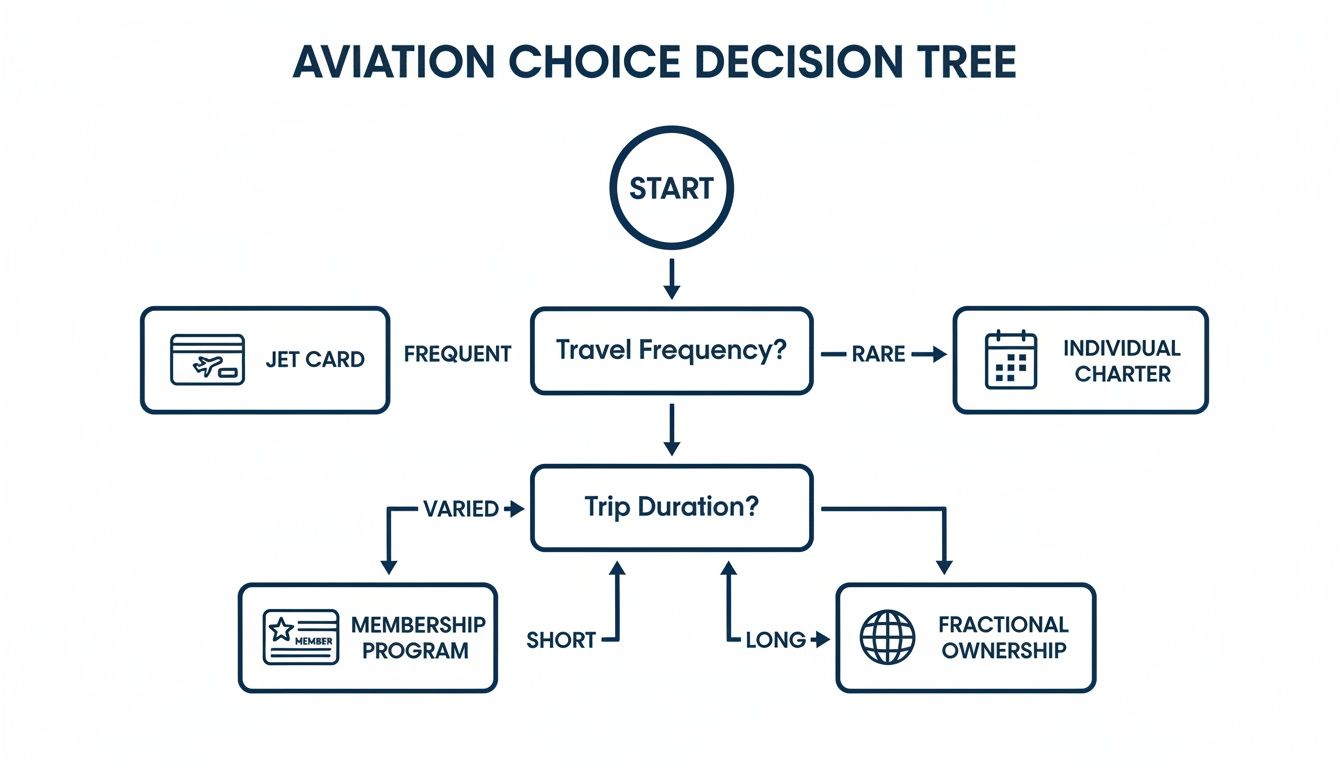
As you can see, if your travel is frequent and predictable, a guaranteed model is your best bet. If you only fly once or twice a year, the ad-hoc nature of chartering is probably a better fit.
Let's break down how these models stack up feature by feature.
This table gives a quick side-by-side look at the core differences you'll encounter when choosing between the main private aviation models.
| Feature | Jet Cards | Membership Programs | On-Demand Charter |
|---|---|---|---|
| Pricing Model | Fixed hourly rates; prepaid block of hours. | Annual fee + capped or discounted hourly rates. | Dynamic, market-based pricing per trip. |
| Upfront Cost | High (e.g., $150,000+ for 25 hours). | Moderate (annual fee, plus flight costs). | None. Pay as you fly. |
| Guaranteed Access | Yes, typically with 24-48 hours' notice. | Often, especially for higher tiers. | No, subject to market availability. |
| Ferry Fees | Usually waived within a primary service area. | Often waived or reduced. | Almost always included in the price. |
| Peak-Day Surcharges | Yes, rates can increase significantly. | Common, but may be capped for members. | No specific surcharge, but base rates are much higher. |
| Best For | Frequent flyers (25-50 hours/year) needing consistency. | Regular flyers (15-40 hours/year) seeking perks/access. | Occasional flyers (<15 hours/year) prioritizing cost. |
Each model serves a purpose, but understanding these distinctions is key to avoiding a mismatch between your travel needs and your financial commitment.
The hourly rate you see advertised is almost never what you actually pay. A smart comparison has to look at all the extra fees, which can differ wildly between these models.
The market is clearly shifting. The charter services space alone hit $16.38 billion in 2025 and is on track to hit $24.02 billion by 2030. This boom is being driven by travelers who are tired of market volatility and want the guarantees that cards and memberships provide, even though prices for these programs have jumped 28% since 2020. Big players are all in; Flexjet just pulled in $800 million in financing to grow its fleet, specifically going after people who fly 25-100 hours a year. You can learn more about the private jet travel growth in 2025 and what’s driving the industry forward.
Knowing the difference between a jet card and a membership program is one thing, but seeing how they play out in the real world is where you find true clarity. The "best" option in any private jet membership comparison comes down to a simple, personal question: how do you actually travel?
Let's move past the theory and walk through three common traveler profiles. By breaking down their specific needs, we'll see which model makes the most sense and, more importantly, why. Think of it as a blueprint for your own decision.

First up, meet Alex. Alex is a CEO who lives on a plane between New York, Chicago, and Miami. We're talking 40-50 hours per year, with meetings popping up on the calendar less than 48 hours out. Time is the most valuable currency here.
For someone like Alex, commercial aviation is out of the question—the delays and rigid schedules just don't work. On-demand chartering seems flexible, but the price swings and the risk of no aircraft available during peak demand are deal-breakers. The last thing a CEO has time for is vetting operators and haggling over prices for every single flight.
Recommendation: A Jet Card A 25-hour or 50-hour jet card is practically built for Alex. It delivers the two things that matter most: guaranteed access with minimal notice and a fixed hourly rate. This completely removes budget surprises and the logistical nightmare of starting from scratch for every trip. Plus, for all those one-way flights, waived ferry fees are a huge financial win.
Now, let's look at the Chen family. They plan three or four incredible international vacations each year. Think the Caribbean for the holidays or a summer tour of Europe. They travel with a group of 6-8 people, so they need a comfortable super-midsize or heavy jet for those long-haul flights.
A jet card would be a poor fit here. It's too rigid and would tie up a massive amount of capital for just a handful of trips. While they could charter each flight, they want a more elevated, consistent experience with benefits that extend beyond the runway.
Recommendation: A Membership Program A mid-tier membership program is the perfect match. The Chens can pay an annual fee to unlock access to a diverse fleet, often with capped or discounted hourly rates. This gives them the freedom to pick the perfect jet for each trip—a super-mid for the short hop to St. Barts and a heavy jet for the flight to Paris. Many of these programs also bundle in lifestyle perks like partnerships with luxury resorts, which is right in line with how they travel.
Finally, there's Sarah and Tom. They're planning a once-in-a-lifetime trip for their 10th anniversary to Napa Valley. They fly private maybe once a year, if that, and have a very specific date in mind. Their goal is simple: experience the magic of private aviation for one special event without any strings attached.
For this scenario, both jet cards and membership programs are complete non-starters. The high upfront costs and annual commitments are designed for frequent flyers. Sarah and Tom would be paying a premium for guarantees and year-round access they simply don't need.
Recommendation: On-Demand Charter On-demand charter is the only choice that makes sense. It’s a straightforward, pay-as-you-go model that allows them to book the exact jet they want, for the exact dates they need, with zero long-term commitment. Because they're planning ahead, a good broker can find them a fantastic aircraft at a competitive market rate. It delivers the full private jet experience they're dreaming of, without the long-term price tag.
To make a smart comparison between private jet models, you have to look past the flashy advertised hourly rates. The real cost of flying private is a much more complex equation, full of upfront payments, sneaky recurring fees, and variable charges that can completely change your total investment.
Getting a handle on this financial landscape is the only way to figure out which model actually delivers value for how you travel.
That advertised price is just the starting line. A jet card's attractive hourly rate can quickly get inflated by fuel surcharges and peak-day premiums. An on-demand charter quote might be hiding hefty positioning fees. Without a transparent cost analysis, you’re just setting yourself up for expensive surprises later on.
To get the full picture, we need to break down the costs into three buckets. Each private aviation model handles these expenses differently, which directly impacts how predictable—or unpredictable—your budget will be.
Upfront Costs: This is the cash you need just to get in the door. For a jet card, it’s the full purchase price—think $150,000 for 25 hours on a light jet. For a membership, it's the initiation fee and first year’s dues, which can run anywhere from $10,000 to $50,000 before you even take your first flight. On-demand charter is the outlier here with $0 in upfront costs.
Recurring Expenses: These are the ongoing fees just to keep your access active. This is primarily the territory of memberships, which charge annual dues whether you fly a lot or a little. Jet cards and charters don't have these, since your commitment is tied to the hours you buy or the individual trips you book.
Variable Charges: This is where the numbers can really start to climb. We're talking about fuel surcharges, international fees, de-icing in the winter, premium catering, and Wi-Fi. Peak-day surcharges alone can tack on an extra 25-40% to your flight cost during the holidays.
Actionable Insight: The core financial trade-off is this: Are you willing to pay a premium for cost predictability (jet cards and some memberships), or would you rather accept market volatility for a lower commitment (on-demand charter)? Your tolerance for financial uncertainty is a huge deciding factor.
This explosive growth is all over the market data. The global private jet market is sitting between $35-38 billion in 2025, which is a 5% jump from last year. With over 22,000 business jets in the air logging 5.2 million flights annually, the demand for this kind of travel is undeniable. The U.S. is the epicenter, accounting for a massive 60% of all flights. Discover more insights about 2025 private jet market statistics to see how this trend is reshaping the industry.
Let's put this into practice with a concrete example. Imagine you fly 25 hours a year, mostly on domestic routes in a light jet. Here’s how the costs could stack up.
| Cost Component | 25-Hour Jet Card | Mid-Tier Membership | On-Demand Charter |
|---|---|---|---|
| Upfront Cost | $175,000 (at $7k/hr) | $15,000 (Annual Dues) | $0 |
| Hourly Flight Cost | Included in Upfront | $150,000 (at $6k/hr) | $187,500 (at $7.5k/hr) |
| Ancillary Fees | $10,000 (Taxes, Surcharges) | $12,500 (Taxes, Catering) | Included in Hourly |
| Total Annual Cost | $185,000 | $177,500 | $187,500 |
As you can see, the membership model comes out slightly cheaper in this specific scenario, but it locks you into an annual commitment. The jet card offers fantastic cost predictability, while the on-demand charter is the most expensive of the three but gives you total freedom with zero commitment. This practical example shows that the "cheapest" option really depends on your flight volume and how much flexibility you need.
Any serious private jet membership comparison has to look past the aircraft. Sure, hourly rates and guaranteed access are the flashy numbers everyone focuses on, but they're just one piece of a much larger puzzle. The most experienced travelers know the real value comes from a program that ties the entire luxury travel experience together, creating savings and convenience that start long before you board and end long after you land.
This is where a totally different model of membership is starting to make waves. Instead of seeing private aviation as a standalone line item on your travel budget, it treats it as the crowning piece of a fully integrated travel ecosystem. It's not just about booking a jet; it's about making every single part of your trip—from the flight to the hotel suite to the car waiting for you—work smarter.

Imagine a membership where the benefits don't disappear the moment your jet touches down. That's the core idea behind a platform like Approved Experiences Traveler. They've shifted the focus from just aviation to a tiered membership that offers a much wider value proposition—one that old-school jet programs just can't compete with.
Take their Diamond tier, for instance. It gives you access to empty-leg private jet charters at an incredible value. But the real genius is how that perk is seamlessly bundled with wholesale pricing on a massive global inventory of hotels, cruises, and car rentals.
Suddenly, the entire value calculation changes. The savings you get from just one or two hotel bookings can often cover a huge chunk of the membership fee, making the private aviation perks that much sweeter. For the savvy traveler who demands both exclusivity and efficiency, it's a no-brainer.
Let’s map this out with a practical, real-world scenario. Picture a family planning a luxury ski trip from Miami to Aspen.
Traditional Approach: They might book an on-demand charter for $35,000. Then, they'd book a five-star hotel and an SUV rental separately at retail rates, adding another $15,000. Their all-in trip cost is a straightforward $50,000.
Integrated Membership Approach: With a platform like Approved Experiences Traveler, that same family could snag an empty-leg charter to a nearby airport for as low as $18,000. They then use their membership to book the exact same hotel and SUV at wholesale prices, saving 30% or more. That brings the lodging and transport cost down to $10,500. Their new total? $28,500, a savings of over 40%.
Actionable Insight: This isn't just about cutting costs; it's about making your travel budget pull double duty. By integrating every part of the trip, the membership unlocks value at every stage. You can either pocket the difference or reinvest it into an even more incredible experience.
The numbers speak for themselves. Integrated platforms that combine private aviation perks with 24/7 concierge services are generating staggering value—one has reported over $146 million in member savings. While the U.S. is the current leader, this model is gaining serious traction globally, with huge interest in Europe and the Middle East. It proves there's a universal hunger for smarter luxury travel. For those who fly often, these memberships don't just cut costs compared to retail; they guarantee access to a fleet of over 22,000 jets. You can discover more about private jet charter market trends and see how this integrated model is shaking things up.
Beyond the immediate bottom-line savings, a truly top-tier membership adds layers of value that elevate the entire travel experience. This is where features like a robust rewards program and a dedicated concierge service become game-changers in any private jet membership comparison.
A key differentiator is the ability to earn and redeem credits on all your bookings. Every hotel stay, car rental, or cruise you book through the platform generates Reward Credits. These credits then become a currency you can apply to future trips, creating a self-sustaining cycle of value. As a practical example, the credits you earned from your business hotel stays this month could pay for your next empty-leg charter.
On top of that, having a 24/7 concierge is like having a personal travel chief of staff on speed dial. This isn't just about booking flights. They handle the complex itineraries, score reservations at impossible-to-get-into restaurants, or arrange unique local tours. For busy travelers, that convenience is priceless—it buys back time and eliminates the friction of travel planning. This holistic approach is what separates a simple flight program from a complete travel solution.
Stepping into the world of private aviation can feel complex. I get it. You've got questions, and getting clear, straightforward answers is the only way to make a decision you feel good about. Let's break down the most common things travelers ask when they're trying to choose the right way to fly.
The biggest difference boils down to how you pay and what that payment gets you.
Think of a jet card like a high-end debit card for flying. You buy a block of hours—usually 25—at a locked-in hourly rate. The main draw here is predictability; you know exactly what you're spending per hour.
A membership is more like joining an exclusive club. You pay an annual fee, which unlocks access to an entire fleet at special members-only rates. Those rates could be capped, dynamic, or simply discounted from the charter market. Plus, memberships almost always bundle in other perks that have nothing to do with the plane itself.
Actionable Insight: If you know you'll fly a specific number of hours each year, say 30, and want a fixed budget, a jet card is a solid bet. But if you fly a bit less, maybe 15-20 hours a year, and you’d get real value from a 24/7 concierge or access to luxury travel partners, a membership program is probably the smarter play.
Not at all—and knowing the difference is your ticket to finding incredible value.
A standard on-demand charter is a flight you build from the ground up. You pick the plane, the route, and the schedule. It’s entirely yours. But remember, you're paying for the aircraft's entire journey, which includes the cost for it to fly back to its home base, even if you're only on it for one way.
An empty-leg flight is totally different. It’s a one-way trip the jet is already scheduled to make without any passengers. This happens when a plane drops a client off and has to fly back home or reposition for its next charter. Since the operator has to make that flight anyway, they'll sell the empty seats at a massive discount—often up to 75% off the normal price.
The catch? Flexibility. The destination and departure time are already set. But if you're spontaneous or your plans align, the savings are simply unbeatable.
The hourly rate you see advertised is almost never what you'll actually pay. A smart private jet membership comparison always looks deeper at the extra costs that can pile up fast.
Here’s a practical checklist for any quote:
Actionable Insight: Always demand an all-inclusive quote that breaks down every single potential charge. If a provider is hesitant to do this, consider it a red flag. Transparency is key.
The financial tipping point where a membership makes more sense than just chartering on-demand usually hits when you fly between 15 to 25 hours a year. Fly less than that, and the pay-as-you-go model of chartering is probably a better fit.
But it’s not just about the hours you fly. A membership can be worth it much sooner if you put a high price on things like:
If you fly consistently and want a higher, more predictable level of service, a membership is a very smart investment.
Ready to move beyond just booking flights and start traveling smarter? Approved Experiences Traveler combines private aviation access with wholesale savings on your entire trip. Discover how our tiered memberships can elevate your journeys and deliver exceptional value today.
From this collection
From this collection

how to charter a private jet
Learn how to charter a private jet with our complete 2026 guide. Get insider tips on pricing, booking, and choosing the right aircraft for your flight.

best private jet charter companies
Discover the 7 best private jet charter companies for reliability, luxury, and value. Our expert roundup offers actionable insights for your next flight.

charter jet cost per hour
Discover charter jet cost per hour basics, what drives pricing, and smart tips to compare options and save on luxury travel.