

Resources
Articles
Notes, guides, and editorial standards from the Approved Experiences team. Written for members, in the same voice we use everywhere else.
Resources
Notes, guides, and editorial standards from the Approved Experiences team. Written for members, in the same voice we use everywhere else.
Understand the true private jet membership cost with our complete guide. We break down fees, compare models, and reveal what to ask before you join.

When people ask about the true private jet membership cost, they're often looking for a single, straightforward number. But it's not quite that simple. Think of it less as a fixed price and more as a dynamic blend of fees, with most entry-level memberships kicking off somewhere between $100,000 and $250,000 for the year.
This initial investment is your key to a fleet of aircraft, unlocking the private jet lifestyle without the staggering financial weight of full ownership.

Let's get straight to it: trying to pin down the exact cost of a private jet membership can feel like trying to nail Jell-O to a wall. You see flashy ads for hourly rates, hear talk of annual fees, and are left wondering what the actual, all-in number looks like when the bill arrives. The reality is, your total cost is a mix of several key components, not just one flat fee.
It helps to think of it more like joining an exclusive club than buying a car. You're not just paying for the physical jet; you're investing in unparalleled flexibility, guaranteed access, and, most importantly, predictable costs. This is the smart alternative to owning an aircraft outright, which comes with millions in upfront costs plus a never-ending stream of unpredictable expenses for maintenance, crew salaries, and hangar fees that can easily top $1 million a year.
A private jet membership completely flips the financial script. Instead of carrying the entire burden of keeping a multi-million dollar asset airworthy, you get on-demand access to a professionally managed fleet. It’s a structure built for discerning travelers who value their time and their money.
The benefits are clear and translate directly into a better experience, both in the air and on your balance sheet:
A common myth is that memberships only make sense for people flying hundreds of hours a year. The truth is, for anyone flying between 25 and 100 hours annually, a membership often proves to be a far more financially prudent choice than relying on on-demand charters or even fractional ownership.

To get a real handle on your budget for private travel, you have to look beyond a single sticker price. The total private jet membership cost is made up of several distinct pieces that work together. Think of it like building a house—you have the foundation, the framing, and the finishing touches. Each part has its own cost, and you need to understand them all to see the full picture.
Most membership programs are built this way on purpose. They’re designed for clarity, giving you a predictable way to forecast your annual spending based on how much you plan to fly. This approach has opened the door to private aviation for a much wider audience. Gone are the days when the only option was full aircraft ownership and its massive capital outlay.
Today, for members flying a typical 25 to 50 hours annually, the all-in costs generally land somewhere between $150,000 and $400,000. It's a fundamental shift from tying up capital in an asset to paying for flexible, on-demand access.
The first cost you'll see is the membership fee itself, which is usually paid once a year or sometimes broken down into monthly payments. This is essentially your "key" to the entire operation. It grants you access to the provider’s fleet, their expert service team, and, most importantly, guaranteed availability when you need it.
These fees can range from a few thousand dollars to over $100,000 a year. The price tag really depends on the exclusivity of the club and the level of white-glove service you're signing up for. This recurring fee covers all the background logistics—aircraft management, pilot readiness, and the administrative backbone that makes seamless travel possible. A higher fee often buys you better access on peak holidays, a broader choice of aircraft, and more personalized concierge support.
Once you're a member, the cost you'll interact with most is the occupied hourly rate. This is what you pay for every hour the plane is in the air with you on board. These rates are the biggest driver of your total spend and vary quite a bit depending on the size of the jet you choose.
For example, a flight on a light jet might run between $5,500 and $7,000 per hour. If you need a larger, long-range aircraft for an international trip, you could be looking at $15,000 per hour or even more.
But what’s great about this model is that the hourly rate is typically all-inclusive. It bundles everything into one clean number:
This transparency is a major advantage over on-demand chartering, where you often get an itemized bill that can feel like a game of whack-a-mole with surprise fees.
Practical Example: Let's say your membership offers a mid-size jet at $9,000/hour. For a 3-hour flight from New York to Miami, your base flight cost is a straightforward $27,000. Add 12 minutes of taxi time (0.2 hours = $1,800) and the 7.5% Federal Excise Tax, and your predictable, all-in cost for that trip is approximately $30,960.
To give you a clearer view, here’s a breakdown of the typical costs you’ll encounter in a private jet membership. Understanding these components helps demystify the pricing and allows for more accurate budgeting.
| Fee Component | Typical Cost Range | What It Covers |
|---|---|---|
| Membership Fee | $5,000 - $100,000+ annually | Access to the fleet, guaranteed availability, concierge services, and provider overhead. This is your "key" to the program. |
| Occupied Hourly Rate | $5,500 - $15,000+ per hour | The all-inclusive rate for flight time, covering pilots, fuel, maintenance, insurance, and standard in-flight amenities. |
| Federal Excise Tax (FET) | 7.5% of the flight cost | A mandatory U.S. government tax applied to all domestic flight segments and associated fees. |
| Fuel Surcharge | Varies (often 0% - 15% of hourly rate) | A variable charge to cover unexpected spikes in fuel prices. Many premium memberships absorb this cost into their fixed hourly rates. |
| Taxi Time | 0.2 hours (12 minutes) per leg | A standard, fixed charge added to each flight to cover aircraft movement on the ground before takeoff and after landing. |
| Peak-Day Premium | 5% - 25% surcharge | An additional fee for travel on high-demand days (e.g., major holidays) to ensure aircraft availability. |
This table simplifies the financial moving parts, showing how the total cost is a combination of fixed access fees and variable usage costs.
While memberships are designed for simplicity, there are a few other variable costs, or ancillary fees, that can pop up. Knowing about them ahead of time means no surprises on your statement.
Here are the most common ones:
Getting familiar with these core components gives you a solid framework for understanding your investment. For an even deeper dive into aircraft-specific costs, our guide on how much private jets cost is a great next step.
While the membership fee and hourly rate are the headline numbers, the final price you pay can swing quite a bit depending on a few key variables. Getting a handle on these is the secret to flying smart and managing your budget. It’s a bit like investing—knowing the market forces helps you make better decisions about when and how you fly.
The biggest factor, hands down, is the jet you choose. This is what sets your occupied hourly rate. A nimble light jet perfect for a quick hop from Los Angeles to Vegas is going to be worlds apart in cost from an ultra-long-range jet built to fly nonstop from New York to Dubai.
Picking the right aircraft always comes down to a balance: what you need for the trip (how many people, how much luggage, how far you're going) versus what you want to spend. Providers usually group their fleets into a few simple categories.
Light Jets (e.g., Phenom 300, Citation CJ3): These are your workhorses for short, regional trips of 2-3 hours with up to six people. You're typically looking at hourly rates in the $5,500 to $7,000 range. They’re the go-to for quick business meetings or weekend getaways.
Midsize & Super-Midsize Jets (e.g., Citation Latitude, Challenger 350): A solid step up in cabin space, range, and comfort. These can comfortably seat 8-9 passengers for a cross-country flight. Here, hourly rates generally fall between $8,000 and $13,000.
Heavy & Ultra-Long-Range Jets (e.g., Gulfstream G650, Global 7500): Built for flying across oceans, these jets can carry 12 or more passengers in absolute luxury. That size and capability come with a price tag, with hourly rates starting at $15,000 and climbing past $20,000.
Practical Example: A three-hour flight from Chicago to Aspen for a ski trip with 8 passengers is a perfect mission for a midsize jet, costing around $30,000 ($10,000/hour x 3 hours). Trying to squeeze into a light jet wouldn't work with the luggage, while a heavy jet would be overkill, potentially doubling the cost. Matching the jet to the mission is the #1 way to control your spending.
Beyond the jet itself, the realities of logistics and market demand have a huge say in your final bill. One of the most common—and often misunderstood—charges is the positioning fee, sometimes called a "ferry flight."
If the jet you need isn't already at your departure airport, the operator has to fly it there empty, and that cost gets passed on to you. A good membership program will have a large, well-positioned fleet to keep these fees to a minimum.
On the flip side, you can make these logistics work for you with empty leg flights. When a jet drops off its passengers and has to fly empty to its next pickup point, operators will sell that "empty leg" at a steep discount—often 50-75% off the standard charter price. They require flexibility, but the savings can be incredible.
When you’re looking at a membership, it's so important to get into the weeds on all potential charges, much like understanding hourly rates and hidden fees for high-end car services. A transparent provider will be upfront about these costs from the very beginning.
Finally, the simple economics of supply and demand play a massive role. Flying when everyone else wants to fly will always come at a premium.
On top of that, the regulatory landscape is starting to add new costs. For instance, new sustainability mandates and aviation taxes in Europe are becoming a factor. We're seeing new passenger taxes pop up in countries like France and the UK, plus a push for more expensive Sustainable Aviation Fuel (SAF). Operators usually pass these costs on through surcharges, which makes the cost predictability of a fixed-rate membership program even more appealing. You can read the full research about these emerging charter trends for a deeper dive.
Stepping into the world of private aviation feels a bit like choosing a new car. You could rent one for a weekend trip, lease one for a few years, or buy one outright. Each option serves a totally different need, and the same is true for flying private. To really grasp the value of a membership, you have to see how it stacks up against the other ways to get in the air.
It's not a one-size-fits-all world. The right choice hinges entirely on how you travel, your budget, and how much you value sheer convenience. We'll break down the main options—on-demand charter, jet cards, and fractional ownership—to show you exactly where a membership fits in.
The infographic below shows how the big three factors—aircraft size, flight path, and demand—come together to determine the final price of any private flight, no matter which model you choose.
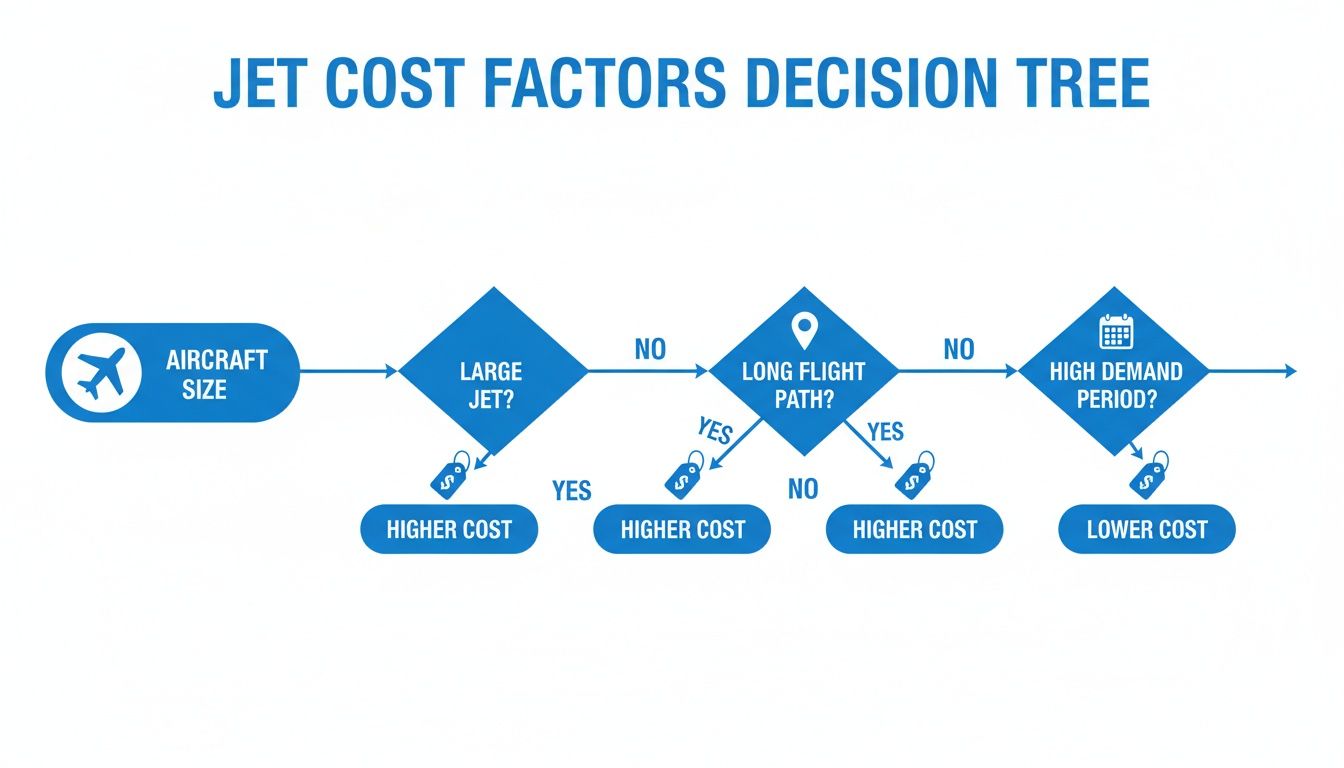
As you can see, the journey to a final price always starts with the right aircraft, but logistics and timing play a huge role. This is where the different models really start to show their true colors.
Think of on-demand charter as the Uber of private jets. You book a specific aircraft for a specific trip with zero upfront commitment. It’s the simplest and most flexible way to fly private.
A charter from New York to Palm Beach might cost $20,000 one week, but that same flight could jump to $35,000 the next if demand spikes. That kind of volatility makes budgeting a real headache.
A jet card is a step up in commitment, designed for more predictability. You’re essentially buying flight time in bulk, prepaying for a set number of hours—usually 25, 50, or 100—on a specific class of aircraft at a fixed hourly rate.
Fractional ownership is a serious investment. You’re literally buying a share (say, a 1/16th or 1/8th slice) of a specific aircraft, which entitles you to a proportional number of flight hours—a 1/16th share typically gets you 50 hours a year.
The Membership Advantage: A private jet membership hits the sweet spot. It delivers the predictable costs and guaranteed access of a jet card but with far more flexibility and often a much lower barrier to entry than fractional ownership.
Feeling a little overwhelmed? Don't worry. This side-by-side comparison table is designed to cut through the noise and help you see which model truly aligns with your travel needs.
| Model | Best For | Pricing Structure | Pros | Cons |
|---|---|---|---|---|
| On-Demand Charter | Infrequent fliers (1-15 hours/year) | Per-trip dynamic pricing | No upfront cost, ultimate flexibility | Unpredictable costs, inconsistent service |
| Jet Card | Regular fliers (15-50 hours/year) | Prepaid block of hours | Fixed rates, guaranteed availability | Large upfront payment, less flexibility |
| Membership | Frequent fliers (25-100 hours/year) | Annual fee + fixed hourly rates | Predictable costs, fleet access, high service | Annual commitment required |
| Fractional Ownership | Very frequent fliers (50+ hours/year) | Acquisition cost + monthly + hourly | Owner-like experience, tax benefits | High capital outlay, depreciation risk |
Ultimately, a membership is crafted for the savvy traveler. It’s for someone who flies often enough to demand consistency, value, and top-tier service but wants to steer clear of the heavy financial burdens of owning an asset.
To see how different programs compare, check out our deep dive into the best private jet membership programs on the market today.

Most private jet memberships are pretty straightforward: they sell you access to flights. That’s where the service begins and ends. At Approved Experiences Traveler, we see things differently. We believe private aviation shouldn't be an isolated luxury but the capstone of a completely integrated, high-value travel ecosystem.
Our whole approach is built to shift your focus from the private jet membership cost to the total return on your entire travel lifestyle. We don’t just book planes; we offer a smarter way to see the world by bundling private air with wholesale pricing on everything else you do. This strategy turns what is normally a major expense into a key part of a much bigger savings plan.
We know that one size never fits all, especially when it comes to travel. That's why we’ve created three distinct membership tiers that scale with your specific needs. Each level builds on the one before it, offering more value and more exclusive benefits as you go.
Gold Membership: This is your gateway into the world of wholesale travel. Gold members get immediate access to incredible savings on over a million hotels, all the major cruise lines, and thousands of car rental agencies across the globe. It's the perfect fit for the frequent traveler who wants to dramatically cut costs without ever compromising on quality.
Platinum Membership: Taking everything from the Gold tier and adding another layer of benefits, Platinum is for those who travel extensively for both business and pleasure. It’s designed for members who need more robust support and even deeper discounts across a wider array of luxury experiences.
Diamond Membership: Our premier tier is for the most discerning travelers. Diamond members get all the perks of Gold and Platinum, plus our highest level of white-glove service, including a 24/7 concierge. Most importantly, it unlocks exclusive access to empty-leg private jet charters.
This tiered system ensures you're only paying for the access and benefits you'll actually use, making it an incredibly efficient way to manage your travel budget. You can see a full breakdown of what each tier offers by exploring our complete traveler pricing plans.
The Diamond membership completely changes the math on private flying. Instead of being locked into retail charter rates or steep hourly fees, Diamond members get privileged access to empty-leg flights at a massive discount. These are the repositioning flights that jets have to make between chartered trips—and they would otherwise fly empty.
Practical Example: A private charter from Miami to the Bahamas could easily cost $15,000. As a Diamond member, you might find an empty leg for that exact route for as little as $4,000, simply because the jet needed to be there for its next booked client anyway. This benefit alone can transform private jet travel from a recurring splurge into an accessible and affordable part of your membership.
Think about it: you could fly from Miami to the Bahamas for a tiny fraction of the standard price, simply because the jet needed to be there for its next booked client anyway. That's the power of our connected ecosystem—we find opportunities that traditional aviation providers just can't offer.
The real magic of the Approved Experiences Traveler model is how it creates a self-reinforcing savings loop. The money you save booking a five-star hotel in Paris or a luxury cruise through the Mediterranean directly offsets the cost of your membership and any private flights you decide to take.
Here's a practical, real-world example of how the savings multiply:
When you start adding up those savings over a full year of travel, the value is impossible to ignore. Private aviation is no longer a standalone expense; it becomes the pinnacle of a smart, cost-effective travel strategy where every piece works together to elevate your experience while saving you money.
Before you sign on the dotted line with any provider, it’s time to look past the slick marketing and ask some hard-hitting questions. Think of it like a pre-flight check for your investment. Getting the right answers ensures a smooth ride, while vague responses can signal future turbulence.
A truly transparent provider will be happy to answer everything. Use this checklist to dig deep and make sure you know exactly what you’re getting into.
<iframe width="100%" style="aspect-ratio: 16 / 9;" src="https://www.youtube.com/embed/mWS9vCAMHD4" frameborder="0" allow="autoplay; encrypted-media" allowfullscreen></iframe>Getting a handle on the operational details is your first step. The answers you get here will tell you a lot about the quality of the service and help you get a real handle on your total private jet membership cost.
How a company manages its aircraft has a huge impact on your experience—from whether a jet is available when you need it to the specific plane you end up flying on. Don’t make assumptions; get the details.
Guaranteed Aircraft Access: "When I book a mid-size jet, am I guaranteed that specific class of aircraft? Or could I be swapped to a different type?" This is a crucial question that reveals if you're paying for a consistent, predictable standard or just access to a fluctuating charter market.
Safety and Pilot Standards: "What are your minimum requirements for pilot experience? And what about the aircraft and operators—do they hold third-party safety ratings like ARGUS Gold/Platinum or Wyvern Wingman?" Safety should be the top priority, and the best providers are proud to show off their credentials. Actionable Insight: Don't accept a simple "yes." Ask to see the safety audit documents (the ARGUS TripCHEQ or Wyvern PASS report) for a recent flight.
The fine print is where the budget-busting surprises are usually hiding. Asking pointed questions about fees and operational rules can literally save you tens of thousands of dollars over the course of your membership. If you get a fuzzy answer, that's a major red flag.
A provider’s willingness to clearly explain their fee structure is a direct reflection of their commitment to transparency. If they can't give you a straight answer on daily minimums or peak-day fees, it's a sign that surprise charges may be part of their business model.
Here are the money questions you absolutely have to ask:
When you're exploring private jet travel, the numbers really matter. Let's break down some of the most common questions people ask to help clarify the true cost and value of a membership.
For the vast majority of flyers, the answer is a resounding yes. If you fly less than 150 hours a year, a membership almost always makes more financial sense.
Think about it this way: owning a new mid-size jet means a $15 million upfront cost, plus a constant stream of expenses. You've got maintenance, crew salaries, hangar fees, and insurance, all of which can easily top $1 million a year before you even take off. A membership completely sidesteps that financial burden, trading unpredictable ownership costs for a clear annual fee and fixed hourly rates.
The final hourly cost depends on the jet, but it's a simple calculation. Let's say you book a mid-size jet with an occupied hourly rate of $9,000. You’ll need to add the 7.5% Federal Excise Tax (FET), which brings your real hourly cost to $9,675.
It's always smart to ask if fuel surcharges or other fees are included. The best programs are transparent, bundling everything into one number so there are no surprises on your invoice.
The gold standard for any membership is transparency. Your hourly rate should be as close to an all-inclusive number as possible, protecting you from hidden fees and unexpected charges.
Absolutely. This is one of the biggest advantages of a membership over fractional ownership. You aren't locked into a single type of aircraft.
This means you can choose the right tool for the job every time. Need to make a quick 1-hour hop from Los Angeles to Las Vegas with one colleague? A light jet is perfect and cost-effective. Taking the extended family across the Atlantic for a holiday? Book a heavy jet with all the space and amenities you need. It’s a far more efficient way to fly, ensuring you only pay for the aircraft you actually need on any given trip.
Ready to see how the right membership can deliver value far beyond the runway? The Approved Experiences Traveler program combines exclusive access to private aviation with incredible wholesale pricing on luxury hotels, cruises, and unique adventures. It's a complete ecosystem designed to elevate your entire travel life.
From this collection
From this collection

how to charter a private jet
Learn how to charter a private jet with our complete 2026 guide. Get insider tips on pricing, booking, and choosing the right aircraft for your flight.

charter jet cost per hour
Discover charter jet cost per hour basics, what drives pricing, and smart tips to compare options and save on luxury travel.

private jet membership comparison
Our detailed private jet membership comparison breaks down jet cards, fractional ownership, and charter models to help you find the most cost-effective option.