←All Articles
The Journal
A Founder's Guide to Time Management for Entrepreneurs
February 14, 202621 min readfounder productivitydelegation strategies
Discover actionable time management for entrepreneurs. Learn goal alignment, delegation, and automation to stop feeling busy and start scaling your business.

As an entrepreneur, your most valuable asset isn't your product, your funding, or even your team. It's your time. And yet, most of us are burning through it at an alarming rate.
Effective time management for entrepreneurs isn't about finding a new productivity app or waking up at 4 AM. It’s about a fundamental shift in how you think—moving from being busy to being productive. It's about building a framework where every action you take is deliberately aligned with your biggest goals, ensuring every hour pushes the business forward instead of just keeping the lights on.
This means you have to get ruthless about eliminating, automating, and delegating the tasks that eat up your day but deliver almost no real value.
Why You Feel Busy But Not Productive
Does this sound familiar? Your day is a chaotic whirlwind of an overflowing inbox, chasing down late payments, and hopping between back-to-back meetings that should have been emails. You're constantly moving, constantly working.
At the end of a 12-hour day, you collapse, exhausted. But when you look back at the week, you realize the needle hasn't really moved on the things that matter. That's the classic founder's trap: mistaking motion for progress. We get caught distinguishing high-impact work from high-effort distractions.
Think about the founder of a fast-growing e-commerce brand. She might spend her morning putting out customer service fires, her afternoon on the phone with a difficult supplier, and her evening tweaking product descriptions. She’s been "working" all day, but she hasn't spent a single minute on marketing strategy, vetting new product lines, or nurturing key partnerships—the very things that will actually scale her business.
The True Cost of Administrative Drag
This isn't just a feeling; it's a quantifiable drain on your company's potential. Research consistently shows that business owners spend a shocking 36% of their workweek on routine administrative tasks. That's just the official stuff. When you add in all the other low-value activities, it's easy to see how founders can lose over 21 hours every single week to work that doesn't drive growth.
Let's break down where that time really goes.
The Entrepreneur's Weekly Time Drain
This table illustrates the common time-sinks that pull founders away from strategic, high-growth activities.
| Low-Value Activity | Average Hours Lost Per Week | Potential Impact on Business |
|---|---|---|
| Email & Inbox Management | 5-7 Hours | Delayed responses to key partners; missed opportunities. |
| Scheduling & Calendar Coordination | 3-4 Hours | Inefficient use of peak energy hours; meeting fatigue. |
| Invoicing & Financial Admin | 2-3 Hours | Cash flow problems; wasted time chasing payments. |
| Social Media & Content Updates | 3-5 Hours | Inconsistent branding; low ROI on time spent. |
| Customer Support & Troubleshooting | 4-6 Hours | Founder becomes a bottleneck; poor customer experience. |
| Total Weekly Drain | 17-25+ Hours | Stagnant growth; founder burnout; strategic neglect. |
This lost time is precisely why so many entrepreneurs feel stuck in a hamster wheel, unable to escape the daily grind to do the visionary work only they can do.
The great paradox for many entrepreneurs is that the very skills that got them started—the hustle, the grit, the willingness to do everything themselves—are the same ones now holding the business back.
Breaking this cycle demands a radical mindset shift. You have to evolve from being the primary doer of every task to being the strategic architect of your business. To get a better sense of how you can offload both personal and professional tasks, our guide on the benefits of lifestyle management services is a great place to start.
Building a Smarter Operational Framework
The only way out is to build systems that absorb the operational drag for you. It all starts with honestly identifying which activities truly require your unique expertise versus those that can be systemized, delegated, or automated away completely.
A smart operational framework is designed to solve three core problems:
- Decision Fatigue: It dramatically cuts down the number of small, daily decisions you have to make, saving your brainpower for the choices that actually matter.
- Context Switching: It protects your focus by minimizing the constant jumping between different types of tasks, which is a known productivity killer.
- Reactive Workflows: It shifts you from a state of constantly putting out fires to proactively executing a plan that is 100% aligned with your goals.
Tackling these issues head-on is the first real step toward reclaiming your most precious resource: your focused attention. This is how you finally start achieving genuine productivity and steer your business toward the growth you know it's capable of.
Build a Framework Aligned with Your Goals
Trying to run a business without a system is like trying to sail a ship in a storm with a spinning compass. You feel busy, you're definitely moving, but you're just reacting to the waves instead of steering toward your destination. Real time management for entrepreneurs isn't about finding the perfect app; it's about building a simple, personal structure that connects every single thing you do back to your biggest goals.
It's a surprisingly uncommon practice. In fact, a recent study found that 82% of people—and that includes plenty of founders—don't have any kind of dedicated time management system at all. A third just wing it with scattered to-do lists, and nearly a quarter let their inbox dictate their day. It turns out even ten minutes of intentional planning can save you hours down the line.
Define Your North Star with Simplified OKRs
Before you can manage your time, you have to know what you're managing it for. This is where a simplified version of Objectives and Key Results (OKRs) comes in handy. Forget the complex corporate software; all you need is a whiteboard or a notebook.
First, set one to three high-level Objectives for the quarter. These aren't small tasks; they're the big, ambitious goals that get you fired up. They answer the question, "What does winning look like in 90 days?"
Next, break each Objective down into two or three measurable Key Results. These are the hard numbers that tell you if you've actually succeeded. They take a lofty goal and make it a concrete target.
For the founder of a new SaaS startup, it might look like this:
- Objective: Nail our beta launch and get real market traction.
- Key Results:
- Get 500 active users on the platform by the end of Q2.
- Hit a user satisfaction score of 8/10 or higher in feedback surveys.
- Convert 10% of those beta users into our first paying customers.
Suddenly, you have a filter for every distraction. Every new email, meeting request, or "quick task" can be measured against one simple question: "Does this get me closer to my Key Results?"
This is the exact trap so many of us fall into—the cycle of low-impact "busy work" that creates a false sense of progress while pulling us away from what actually moves the needle.
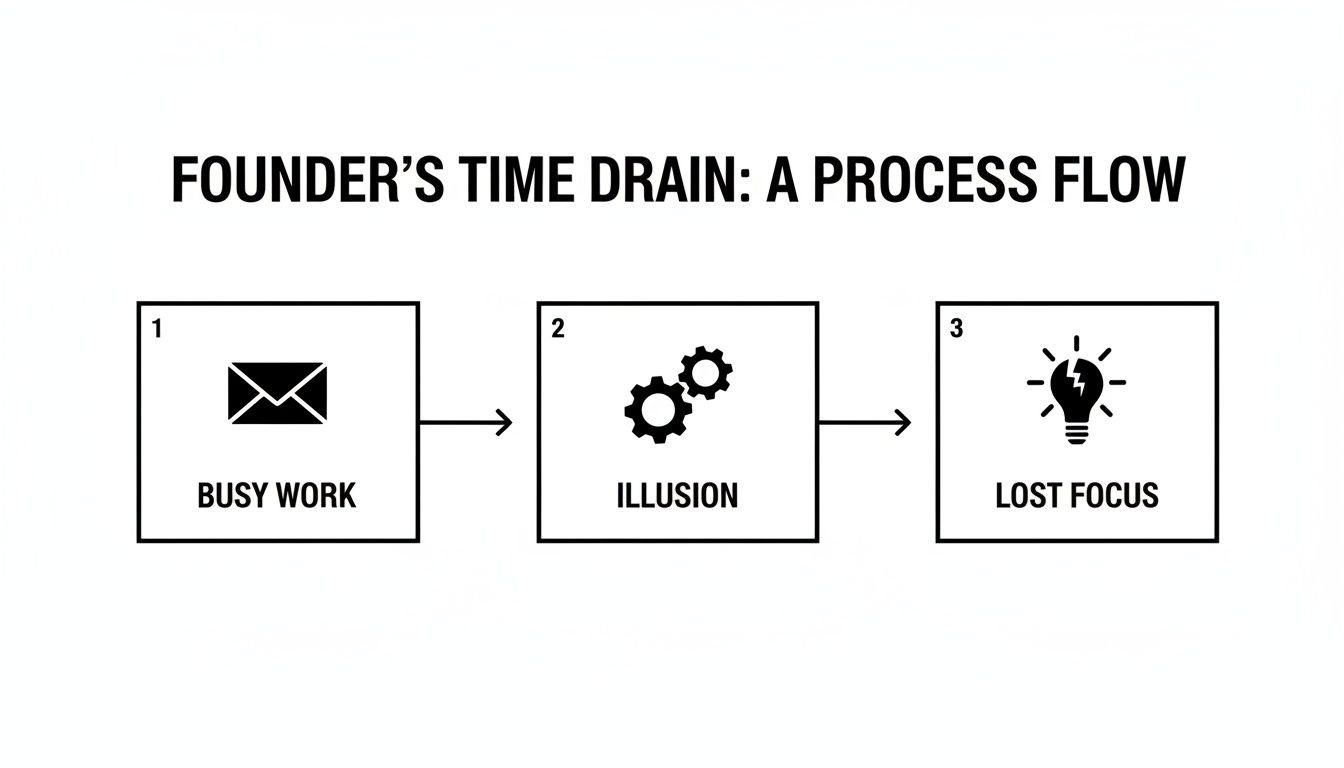
As the diagram shows, it’s a slippery slope from being busy to losing sight of the goals that truly matter.
Prioritize Ruthlessly with the Eisenhower Matrix
Once your big goals are clear, you need a way to sort through the daily flood of tasks. The Eisenhower Matrix is a classic for a reason—it’s a brutally effective tool for separating the genuinely important from the merely urgent.
A core part of this framework is learning how to prioritize tasks effectively so you're not just spinning your wheels. The matrix forces you to categorize everything on your plate into four quadrants.
- Quadrant 1: Urgent & Important (Do Now): Fires that need putting out. A server crash, a major client complaint, a looming deadline. Handle these immediately.
- Quadrant 2: Not Urgent & Important (Schedule): This is your money zone. It’s strategic planning, building key relationships, and improving your systems—the stuff that creates long-term growth.
- Quadrant 3: Urgent & Not Important (Delegate): Most interruptions live here. A non-critical email, a colleague's "quick question," or a meeting you were cc'd on. They scream for your attention but don't serve your goals. Hand them off.
- Quadrant 4: Not Urgent & Not Important (Eliminate): The time sinks. Mindless social media scrolling, unnecessary reports, and any "busy work" that produces no real value. Cut these out without mercy.
The real secret is to shrink Quadrant 1 by living in Quadrant 2. The more time you spend on proactive, strategic work, the fewer emergencies will pop up to derail your day.
As a founder, this means making a conscious trade-off. Replying to a routine vendor email (a Q3 task) can wait. Blocking off two hours for deep, Q2 work—like mapping out your entire Q3 marketing strategy—cannot. This framework gives you the clarity and the permission you need to protect your most valuable time for your most valuable work.
Structure Your Week for Deep Work and Efficiency
Having a solid strategy is great, but executing it day-to-day is where the magic really happens. This is where you turn your big goals into actual progress. The secret? You have to build a system that fiercely protects your most valuable—and limited—resource: your focused attention.
Let's dive into two of the most powerful techniques I've seen work for founders who need to get things done: time blocking and task batching.
The Fortress of Focus: Time Blocking in Action
Think of time blocking as treating your focus like a C-level meeting you simply can't miss. Instead of living by a reactive to-do list, you proactively carve out specific "blocks" of time on your calendar for your most important work. This creates dedicated, uninterrupted windows for what author Cal Newport famously calls “Deep Work.”
This is the kind of distraction-free concentration that lets you push your cognitive limits and produce your best stuff.
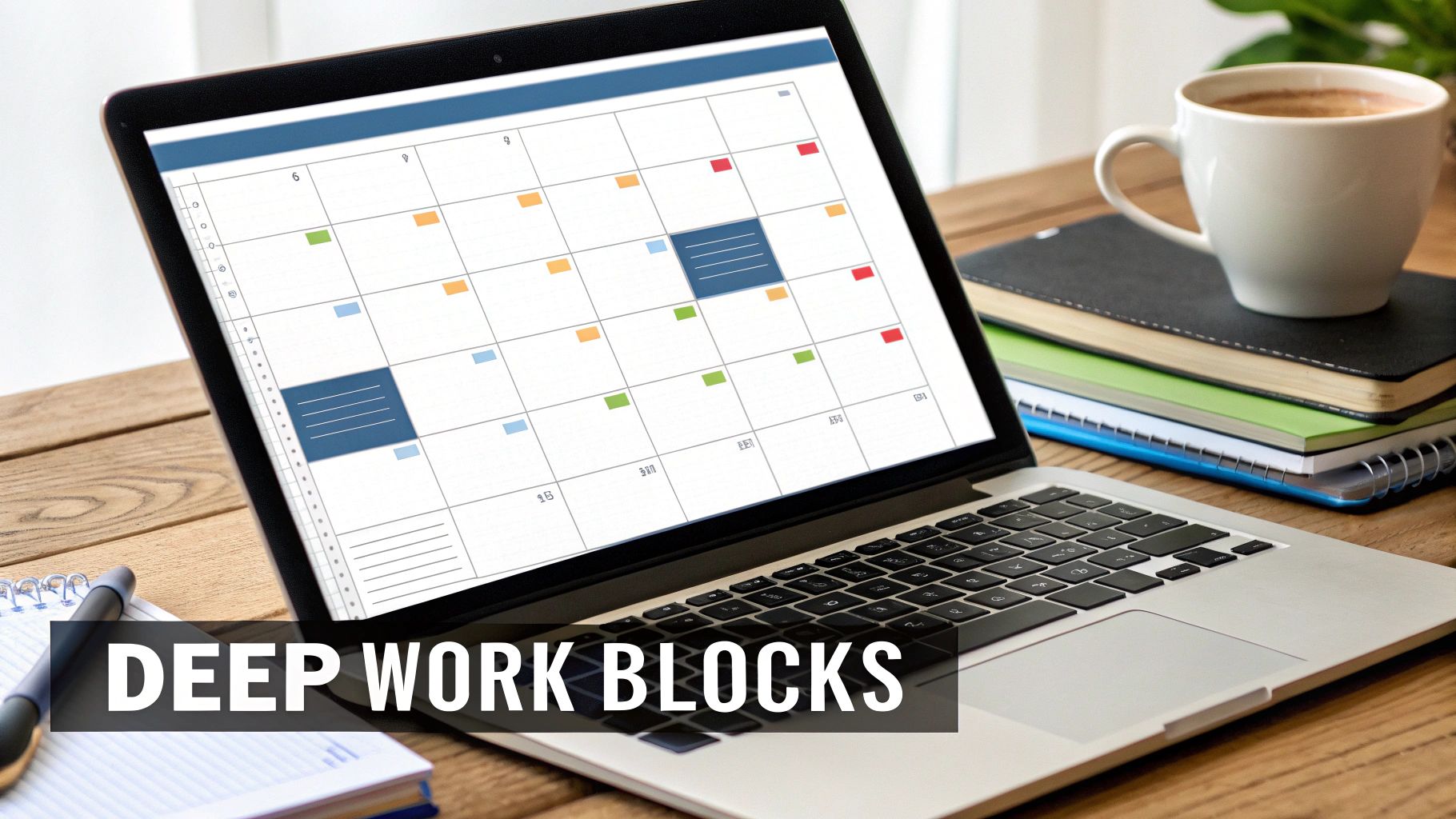
Without this structure, your day gets hijacked by everyone else's priorities. Time blocking ensures the "important, but not urgent" work—the stuff that actually grows the business—gets the attention it deserves.
For example, I once worked with an e-commerce founder whose calendar was a total mess. It was all supplier calls, random ad tweaks, and constant email pings. We restructured her week to look more intentional:
- Monday (9 AM - 11 AM): Marketing Strategy. Two solid hours to analyze last week’s campaign data and map out this week's promotions. No emails. No Slack. Just focus.
- Wednesday (1 PM - 4 PM): Supplier Relations. A three-hour block dedicated entirely to negotiating with key suppliers and exploring new partnerships.
- Friday (9 AM - 12 PM): Growth & Optimization. This window was her sacred time for deep work on improving conversion rates or testing new site features.
This isn't about creating a rigid, suffocating schedule. It’s about building a fortress around your most valuable work so you're always moving the needle on your biggest goals.
The Efficiency Hack: Get More Done with Task Batching
Task batching is a simple but brilliant idea: group similar tasks together to avoid the mental whiplash of context switching. Every time you jump from writing a proposal to checking analytics to taking a client call, your brain burns precious energy just trying to reorient itself.
Batching is the antidote.
By grouping similar activities, you stay in a single cognitive mode for longer. The result is higher-quality work completed in less time. It’s about working smarter by respecting how your brain actually functions.
A consultant’s week is a perfect example. Instead of scattering everything around, they can create themed days or blocks.
Here's how that might look:
- Tuesdays are for clients. All client calls are scheduled back-to-back. This keeps them in "client-facing mode," making them sharper and more present in every single conversation.
- Wednesdays are for strategy. The entire day is blocked for writing proposals and deep strategic planning. No calls, no interruptions—just the focused thought required for high-impact work.
- Fridays (9:00 AM - 10:30 AM): The Admin Blitz. A tight 90-minute block is set aside for all the little things: processing invoices, clearing non-urgent emails, and handling internal paperwork.
This isn't just about organizing a calendar; it’s about designing your week around your own energy. Schedule your deep, creative work for when you're at your peak (usually the morning) and batch the low-energy admin tasks for that afternoon slump.
When you combine time blocking for your big priorities with task batching for raw efficiency, you create a powerful weekly rhythm that drives your goals forward and protects your focus. You'll stop feeling just "busy" and start being truly productive.
Master Strategic Delegation to Reclaim Your Time
For most founders I know, the biggest thing holding back their growth isn't a lack of ideas or a shortage of opportunities. It's the founder themselves.
We’ve all been there, trapped by the “I can do it faster myself” mindset. It’s what got us off the ground, but eventually, it becomes the anchor dragging the whole business down. True time management for entrepreneurs isn't about micromanaging every minute; it's about creating leverage.
And your single greatest point of leverage? Strategic delegation. This isn't just about handing off tasks you don't like. It's about consciously building an "operations layer" that works for you, handling the essential but low-value work so you can focus on the visionary stuff that only you can do.
Think beyond basic admin. I'm talking about coordinating complex business trips across multiple cities, handling all your vendor communications, or even taking care of the personal logistics—like scheduling home repairs—that chew up your mental bandwidth. Every single decision you can take off your plate is a huge win.
Getting Over the Delegation Hump
Let’s be honest. The main reason most of us resist delegating is trust. You worry it won’t be done right. You think it'll take longer to explain the task than to just do it. You're afraid the quality will suffer. These fears are real, but they usually come from a lack of process, not a lack of good people.
The fix is surprisingly simple: create a delegation playbook. This isn't some hundred-page corporate manual. It’s a lean, living document that makes your preferences and expectations totally clear, ensuring things get done your way from the very beginning.
Delegation is an investment, not an expense. You are literally buying back your most precious, non-renewable asset—your time—so you can pour it into things that actually grow the business, like strategy, sales, and innovation.
When you systemize how you hand things off, the process becomes repeatable and scalable. You're not just getting one task done; you're building a machine that can handle that task forever without you.
How to Build Your Delegation Playbook
A clear process is everything. Vague instructions get you vague results. What you need is a simple, step-by-step guide that anyone can pick up and run with. This playbook is your insurance policy for getting consistent, high-quality work.
Here’s what goes into it:
- Spot the Right Tasks: Start by listing out all the recurring tasks you do that don't really need your specific genius. A good question to ask is, "What am I doing every single week that someone else could handle with the right instructions?"
- Document the Process (Once): For each task, record a quick screencast using a tool like Loom. Just talk through the steps as you do the task one last time. A video is so much more effective than a long-winded document. You can also use a simple numbered list with screenshots.
- Define "Done": Be ridiculously clear about what a finished task looks like. Don't say "book my travel." Instead, say "book a direct flight arriving before 2 PM, an aisle seat in economy plus, and a hotel within a 10-minute walk of the conference center." Specificity is key.
- Set the Rules of Engagement: How and when should they update you? Make it clear. For example, "Email me a summary of the top three options by end-of-day Tuesday. Please don’t text me for non-urgent questions."
This initial effort is where the magic happens. A 20-minute investment in creating a solid process can easily save you hundreds of hours over the next year. You have to start thinking like a systems builder, not just a doer. For a much deeper dive on this, check out our guide to outsourcing to a virtual assistant, which covers how to find and train the right person.
Where to Start? Go for Quick Wins
The best way to build your delegation muscle is to start small. Focus on low-risk tasks that have a high impact on your time and mental energy. Getting these off your plate will give you an immediate boost and build the confidence you need to hand off bigger responsibilities down the road.
Here’s a simple way to find your first few tasks:
- The Repetitive: What are you doing over and over again?
- Example: Managing your calendar and scheduling all your meetings.
- Example: Pulling numbers and sending out a weekly performance report.
- The Time-Sinks: What tasks eat up hours but don't require your strategic brain?
- Example: Researching new software tools or potential vendors.
- Example: Transcribing your meeting notes and pulling out the action items.
- The Skill Gaps: What are you just not that good at?
- Example: Designing simple graphics for social media posts.
- Example: Basic bookkeeping and categorizing expenses.
Whatever you do, don't start by delegating a mission-critical client project. Start with something simple, like scheduling your next dentist appointment or booking that upcoming business trip. Once you see a well-defined process work flawlessly, you'll naturally start looking for more things to hand off. This is how delegation goes from a source of anxiety to your most powerful tool for getting your life back.
Let Automation Handle the Busywork
Delegation is powerful, but technology is where you find true leverage. Think of automation as a tireless digital assistant who executes all the repetitive, mind-numbing tasks with perfect precision, 24/7. It's one of the most effective ways for entrepreneurs to manage their time, freeing up mental space and putting huge parts of your business on autopilot.
The best part? You don't need to be a programmer to get started. Today's tools are built for founders, not developers, and they let you connect the apps you already use to create powerful, time-saving workflows.
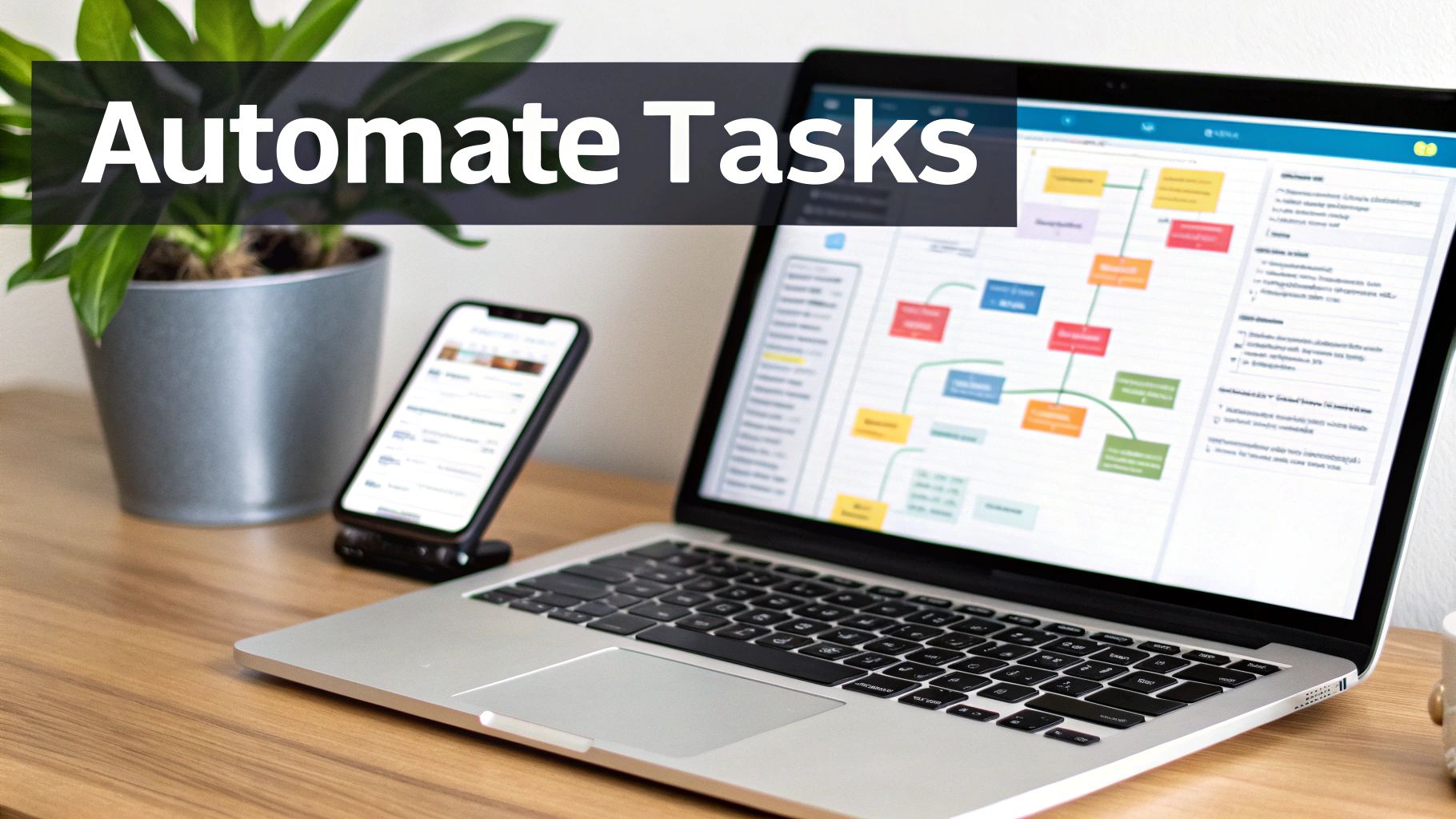
This isn’t about saving a minute here or there. This is about building systems that claw back huge chunks of your week so you can finally focus on the strategic work that actually grows your business.
Where to Start With Automation
The secret is to begin with the simple stuff that causes the most friction. What are the tedious, multi-step processes you find yourself doing over and over again? Those are your first targets.
Here are a few high-impact ideas I’ve seen work wonders for founders:
Marketing & Sales
- Automate Lead Follow-Up: Use a tool like Zapier to connect your website’s contact form directly to your CRM (like HubSpot or Pipedrive). The moment a new lead comes in, it can trigger a personalized welcome email sequence. No more leads slipping through the cracks because you got busy.
- Schedule Social Media in Batches: Instead of logging in every single day to post, use a platform like Buffer or Later to schedule an entire week or month of content in one sitting.
Operations & Finance
- Chase Invoices Automatically: Set up your accounting software (QuickBooks or FreshBooks) to automatically send polite reminders for overdue invoices. This one simple move can massively improve your cash flow and saves you from having to make awkward "where's my money?" calls.
- End the Scheduling Nightmare: Stop the back-and-forth emails trying to find a meeting time. A tool like Calendly lets you send a link to your calendar, and people can book a time that works for them. The event is then dropped into both of your calendars automatically.
Automation isn't about removing the human touch from your business. It's about letting the robots handle the robotic tasks so you can be more human where it counts—with your clients, your team, and your partners.
AI is pushing this even further. A recent analysis found an AI platform cutting entrepreneurs' work hours by 50%, showing just how accessible these powerful tools have become. They're no longer just for big corporations.
High-Impact Automation Tools For Entrepreneurs
Choosing the right tool can feel overwhelming, but most founders can get incredible results by starting with just a few key platforms. Here’s a quick breakdown of where you can get the biggest bang for your buck.
| Tool Category | Example Tool | Primary Use Case | Time-Saving Benefit |
|---|---|---|---|
| Workflow Automation | Zapier | Connecting different web apps to trigger actions | Eliminates manual data entry and task handoffs between tools |
| Meeting Scheduling | Calendly | Allowing others to book time on your calendar | Kills the back-and-forth emails to find a meeting time |
| Social Media Management | Buffer | Scheduling posts across multiple platforms | Lets you batch content creation into a single session |
| Email Marketing | Mailchimp | Sending automated email sequences to subscribers | Nurtures leads and customers on autopilot |
| Project Management | Asana | Automating task creation and project handoffs | Keeps projects moving without constant manual check-ins |
The key is to pick one or two tools that solve your biggest headaches and master them first. Once you see the time you get back, you'll be hooked.
A Quick Look: Automation in Action
I once worked with a digital agency owner who was completely swamped. She was so buried in administrative work that she had no time left for strategy or sales—the very things that would grow her business.
Here's how she used a few simple automations to completely change her workweek:
- Client Onboarding on Rails: When a new client signed their contract (via DocuSign), a Zapier workflow kicked in. It automatically created a shared Google Drive folder, added them to a "New Client" onboarding sequence in Mailchimp, and set up their project in Asana with all the standard first-month tasks.
- Content Curation Made Easy: She connected her social media scheduler to an RSS feed of top industry blogs. Every time a new article was published, it was automatically added to a queue for her to review and approve. This saved her hours of scouring the internet for content.
- Bookkeeping Simplified: She set up rules in her accounting software to automatically categorize recurring expenses like software subscriptions. What used to be a multi-hour monthly chore became a quick 15-minute review.
The result was staggering. She reclaimed over 10 hours per week. That was time she immediately poured back into client strategy and landing new deals.
Her story is a perfect example of how a few well-placed automations can act like a digital concierge service, handling all the logistics in the background so you can stay focused on what matters. Start small, find your biggest time-sinks, and let technology take care of the rest.
Sticking With It: Common Time Management Questions Answered
Look, even the most perfectly crafted system for goal setting, time blocking, and delegation will run head-on into the chaos of the real world. That’s just business. Implementing a new way of managing your time is a process, and you're bound to hit a few snags along the way. Think of this as your troubleshooting guide for when that beautifully planned week gets sideswiped by reality.
Let’s dig into some of the most common hurdles I see entrepreneurs run into when they're trying to get their time back. The goal here isn't perfection—it's about making small, consistent improvements that actually stick.
How Can I Possibly Time Block When My Schedule Is So Unpredictable?
This is, without a doubt, the number one question I get from founders. When your days are a blur of putting out fires, a rigid, color-coded calendar can feel like a joke.
The trick is to start small and build in flexibility. Don't try to map out every single minute of your week right out of the gate. Instead, just block out one or two absolutely non-negotiable "deep work" sessions for your most critical tasks. This is your most valuable time—protect it like a fortress.
For everything else, you can lean on a more fluid approach, like "themed days." It might look something like this:
- Mondays: All things marketing and sales.
- Tuesdays: Product development and team sync-ups.
- Wednesdays: All client-facing meetings and calls.
This gives your week a rhythm and structure without suffocating you. You start by ring-fencing the time for your most important work and then let the urgent, reactive stuff fill in the gaps. Once you feel more in control, you can gradually add more detail to your calendar.
The best time management for an entrepreneur isn’t about a rigid schedule; it’s about a resilient framework. It’s built to bend with the daily chaos of being a founder, not break.
What’s the Very First Thing I Should Delegate?
Picking that first task to hand off is a huge step. Get it right, and you build momentum and prove to yourself that this whole delegation thing actually works.
My advice? Pick a recurring, low-stakes task that you genuinely dislike doing and that follows a clear, repeatable process. You're looking for something that drains your mental energy but doesn't require your unique strategic mind.
Here are a few great quick wins to consider:
- Scheduling all your appointments (both work and personal).
- Booking your travel, for business and for pleasure.
- Managing your personal calendar to make sure nothing clashes.
- Transcribing meeting notes and pulling out the key action items.
Getting these administrative headaches off your plate delivers an immediate win. It frees up precious mental space, builds your confidence in the delegation process, and creates a small but powerful positive feedback loop that makes you want to delegate more.
Why Haven’t Other Time Management Systems Worked for Me?
So many traditional time management systems just don't click for entrepreneurs because they're way too rigid. More importantly, they’re often completely disconnected from actual business outcomes. They get you focused on checking off tasks, not hitting your goals.
The framework we've been talking about is different because it always starts with your high-level strategic objectives. It forces you to define what "winning" actually looks like first, and then gives you flexible tools to help you get there.
The key is not to try and change everything at once. Just pick one thing from this guide—maybe it's task batching, maybe it's the delegation playbook—and really commit to it for a few weeks. Consistency is so much more important than perfection here. It's those small, sustainable changes that lead to massive shifts in your productivity over the long haul.
At Approved Lux Personal Assistant, we specialize in creating that operational layer for busy founders and executives. We step in to handle the logistics, coordination, and planning so you can get back to the visionary work that only you can do. See how you can reclaim your time by learning about our personal assistant services.
Want the wider view?
Ten categories. One report. Every quarter. The Approved List tracks what's rising and what's fading: data-backed signals, not opinions.
Free to join · Delivered by email