

Resources
Articles
Notes, guides, and editorial standards from the Approved Experiences team. Written for members, in the same voice we use everywhere else.
Resources
Notes, guides, and editorial standards from the Approved Experiences team. Written for members, in the same voice we use everywhere else.
Discover what is lifestyle management and how it helps busy professionals reclaim their time, reduce mental load, and build a more efficient life.

Think of lifestyle management as a personal COO for your life. It's a high-level service designed to handle all the non-work logistics that drain your time and mental energy, so you can pour your focus into what truly matters.
Let's use an analogy. An elite Formula 1 driver has one job: perform at their peak on the track. Behind the scenes, a huge operations crew handles everything else—engineering, pit stops, travel, data analysis. The driver isn't worrying about whether the tires are ready or the jet is fueled. They just drive.
That's the essence of modern lifestyle management. It’s far more than just hiring someone to tick off a to-do list. It’s about having a strategic partner who builds and maintains a seamless operational system for your personal life.
This is a huge departure from traditional assistants or concierge services, which are almost always reactive. You have to tell them exactly what to do. A lifestyle management service, on the other hand, gets to know you, starts anticipating your needs, and manages complex, multi-step projects from beginning to end.
For example, an assistant might book a flight you ask for. A lifestyle manager handles the entire door-to-door journey: ground transport, dinner reservations that match your dietary needs, and even a backup plan in case of delays. The best services blend human expertise with powerful technology to make it all happen, a model we dive into in our guide on digital concierge services.
To really understand what is lifestyle management, it helps to compare it to roles we’re more familiar with. A traditional assistant is tactical; they execute specific tasks you give them. A lifestyle management platform is strategic; it oversees entire areas of your life and requires very little of your direct input.
Here’s a simple way to think about the difference:
This proactive, big-picture approach is what sets the service apart. It's about building systems that run your life smoothly in the background. The real win isn't just getting your time back—it's about freeing up your cognitive bandwidth. When you offload the mental load of constant planning and decision-making, you can redirect that precious energy toward your career, family, or personal well-being.
To make it even clearer, here's a quick breakdown of how these services stack up. This table highlights the fundamental differences in their approach, scope, and ultimate goal.
| Aspect | Lifestyle Management | Traditional Assistant/Concierge |
|---|---|---|
| Approach | Proactive & Strategic | Reactive & Task-Based |
| Scope | Manages entire life domains | Executes specific, assigned tasks |
| Goal | Reduce mental load and optimize life | Complete a checklist of duties |
| Relationship | Strategic partner | Service provider |
As you can see, the shift is from a simple service provider relationship to a genuine strategic partnership. One is about getting things done; the other is about designing a better life.
To really get what lifestyle management is all about, it helps to think of it as a system built on four distinct pillars. These aren't just separate services; they work together to create a support structure that goes way beyond just checking off a to-do list. It’s a framework for proactively managing the logistics of your entire life.
Each pillar tackles a critical area where complexity and constant demands eat up your time and cause stress. Once you see how they fit together, it becomes clear how this approach methodically brings order to the chaos, freeing you up to focus on what truly matters.
This is the bedrock of any good lifestyle management service. It's not just about booking appointments. It’s about strategically building a schedule that actually reflects your priorities. Think of a lifestyle manager as the architect and gatekeeper of your calendar, making sure it serves your goals, not just a random list of obligations.
For example, instead of you getting stuck in an endless email chain trying to schedule a board meeting, your lifestyle manager handles all the coordination. They find a time that works for everyone, book a venue, sort out the catering, and send out the agenda. This proactive management turns your calendar from a reactive mess into a powerful tool for getting things done.
This map really drives the point home: lifestyle management acts as a bridge, taking on all the logistical tasks so you can redirect your energy where it has the most impact.
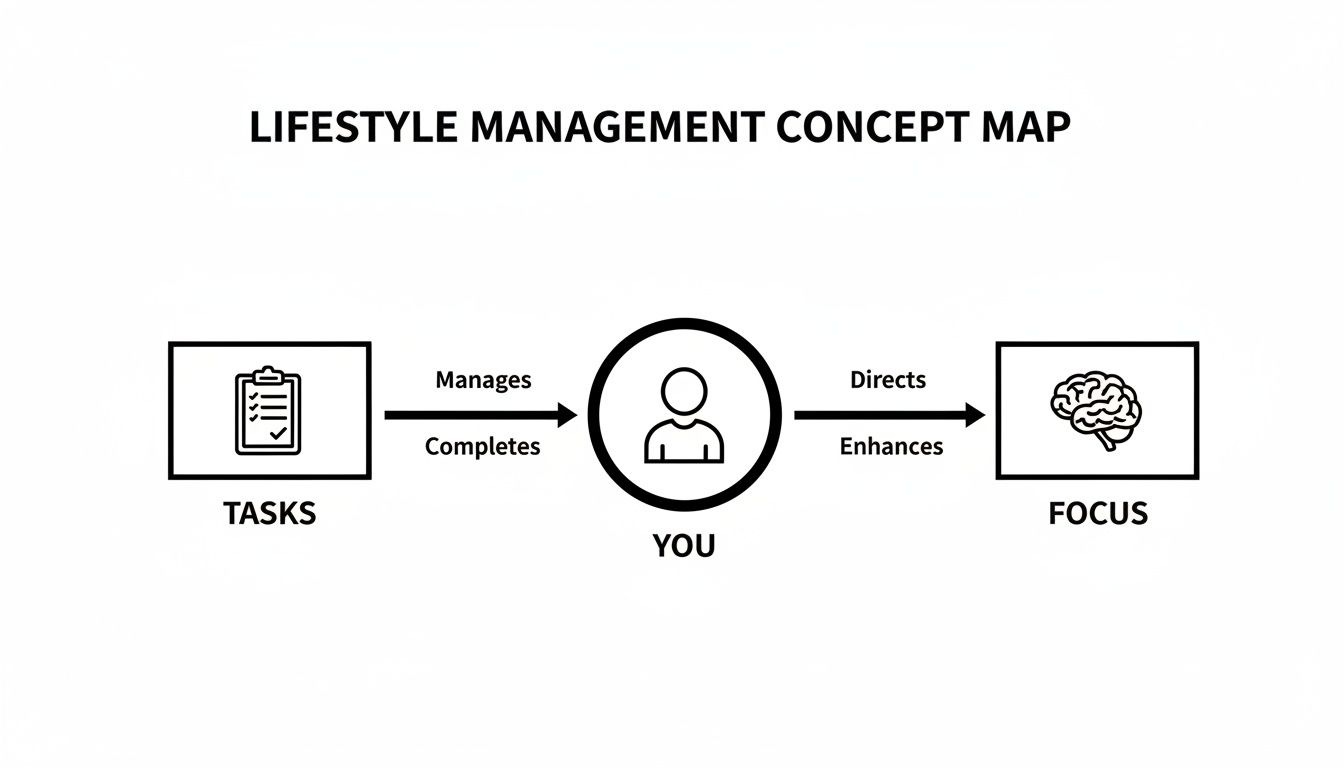
The idea is simple but powerful: by delegating the "how" (the tasks), you get back the mental space to excel at the "what" (your focus).
For anyone who travels frequently, managing complex trips is a huge headache. This component is all about seamless, door-to-door itinerary planning that thinks of every little detail, taking the stress out of being on the move. It’s the difference between just booking a flight and having an entire travel experience orchestrated for you.
Imagine a multi-city business trip. A lifestyle manager doesn’t just book flights and hotels. They also:
This level of foresight ensures your travel is smooth and predictable, so you can stay focused on the reason for your trip in the first place.
"True efficiency isn't about doing more. It's about creating systems that let you do fewer things with greater impact. Lifestyle management is that system for your personal life."
Life doesn't pause just because you're busy with work. This pillar tackles the operational side of running a household and managing family life—which is basically a full-time job on its own. The goal is to get your home running like a well-oiled machine, cutting down on daily friction and last-minute emergencies. A big piece of this is streamlining your home environment, and a good household management software can be a game-changer here.
This can mean anything from coordinating with vetted plumbers and electricians for home maintenance to managing the kids' school and sports schedules, planning family parties, or even handling grocery shopping and bill payments. It's all about making sure your home life runs as smoothly as a well-managed company.
At the end of the day, lifestyle management recognizes that your own well-being is the engine for everything else. This final pillar is dedicated to managing the tasks that support your health and personal goals—the very things that are often the first to get pushed aside when you're swamped.
This support can look like a lot of different things:
By offloading these essential but time-sucking tasks, you're making sure your own health stays on the front burner without adding another thing to your mental plate. Together, these four components create a powerful operational engine that simplifies your life and gives you back your two most valuable resources: time and focus.
Thinking about lifestyle management as just "buying back a few hours" misses the point entirely. It's a strategic move, an investment in your most finite resources: your time, your focus, and your energy. The return shows up in a calmer mind, sharper productivity, and the mental freedom to excel at what you do best.
Let's unpack the real value you get when you hand over the complex logistics of your life. It’s not just about ticking off a to-do list. When you have the confidence that every little detail is being handled reliably behind the scenes, you unlock a new gear for performance and well-being. This changes the game, turning a "nice-to-have" service into a powerful engine for growth.
The most obvious win is getting time back, but the real magic isn’t in the number of hours saved. It’s about the quality of the time you regain. You aren't just offloading ten hours of errands and admin work; you're gaining ten hours to pour into high-impact activities that only you can do.
That could be an extra hour of uninterrupted deep work on a critical business proposal, genuinely present time with your family, or just the quiet space to think strategically without the constant ping of logistical distractions. The productivity gains from this shift aren't just linear—they're exponential.
Think of your brain like a computer with a set amount of processing power. Every task, no matter how small—from scheduling a dentist appointment to researching summer camps—is like an open tab eating up your mental RAM. A lifestyle management service acts as your external hard drive, closing dozens of those tabs for you.
This reduction in mental load is one of the most powerful, if less visible, benefits. Decision fatigue is a real thing; the quality of your choices plummets after you've made too many in a day. By outsourcing hundreds of small decisions, you save your best cognitive energy for the big ones that truly shape your career and life.
By delegating the relentless stream of logistical choices, you create the mental quiet needed for clarity and focus. It’s not just about doing less; it’s about creating the conditions to do your most important work better.
This newfound mental clarity is the bedrock of peak performance. It’s what allows you to be fully present in a board meeting, creative when solving a tough problem, and truly engaged with the people you love. If you're curious about how this compares to other forms of support, our guide on outsourcing to a virtual assistant breaks down the differences.
Finally, a top-tier lifestyle management service delivers something you can't put a price on: peace of mind. It’s the deep-seated confidence that comes from knowing things will be done right, on time, and to a high standard—without you having to micromanage the process.
This isn’t just about getting things done; it’s about flawless execution. A seasoned lifestyle manager brings a curated network of trusted vendors and the experience to see around corners, anticipating problems before they even happen.
This layer of expert reliability completely removes the stress and guesswork of managing it all yourself. You get to delegate outcomes, not just tasks, freeing you from the mental and emotional weight of oversight. Your life goes from a series of chaotic fires to put out to a smoothly running system.

To really get what what is lifestyle management is all about, we need to move past the definitions and see it in action. This isn’t some abstract concept for the ultra-wealthy; it’s a hands-on, operational tool that high-achievers and busy families use to solve very real, everyday problems.
And it's a field that's growing—fast. The global Lifestyle Management Service market, valued at $5.5 billion in 2025, is on track to hit nearly $10 billion by 2033. This isn't just a blip; it's a clear signal that people are actively outsourcing their daily grind to buy back their most precious resource: time.
So, let's dive into four different scenarios where a dedicated lifestyle manager turns daily chaos into a well-oiled machine.
Imagine Alex, a founder just three months out from a massive product launch. The pressure is on. Days are a blur of investor meetings, frantic product development, and putting out team fires. Every single distraction, no matter how small, is a direct threat to hitting the deadline.
The Problem: Alex’s calendar was a disaster, a jumbled mix of professional deadlines and personal to-dos. Time was constantly bleeding out—booking last-minute flights for investor pitches, scrambling to find a reliable dog walker, trying to remember to make a dentist appointment. Each tiny task shattered the deep focus needed to guide the company through its most critical phase.
The Solution: Alex brought in a lifestyle manager to run the entire "back end" of their life. This dedicated pro took over all travel arrangements, finding smart, cost-effective flights and hotels that made work on the road easier. They also managed all personal appointments, found and vetted a trustworthy dog walker, and even set up meal deliveries for those long nights at the office. The result? Alex reclaimed 15-20 hours a week, but the real win was eliminating the constant mental context-switching that was killing productivity.
Next up is Sarah, a senior executive who spends nearly half her year traveling between international offices. Her work life is a whirlwind of different countries and time zones, but life at home keeps rolling along without her.
The Problem: Sarah was in a perpetual state of catch-up. She'd be in a board meeting in London while trying to coordinate a plumber for a leak back in her New York apartment. She’d be on a flight to Tokyo, using spotty airplane Wi-Fi to plan her son’s birthday party. It was a recipe for stress, missed details, and the constant, nagging feeling of never being fully present.
The Solution: Sarah now has a single point of contact who manages both sides of her life. Her lifestyle manager handles:
This integrated system lets her operate at peak performance globally without her family life paying the price.
The goal of lifestyle management is to create a seamless operational layer for your life. It ensures the background logistics are handled flawlessly, so you can stay focused on the foreground.
Now think about Mark, a consultant whose job puts him in a different city every week. His life is a relentless cycle of packing, unpacking, and navigating new places. The logistical friction is exhausting.
The Problem: Mark spent his Sundays—his one day off—just prepping for the week ahead. This meant booking hotels, arranging rental cars, and researching decent restaurants near client sites. He was constantly running on fumes, worn down by the sheer administrative weight of his own schedule.
The Solution: Now, Mark just forwards his weekly client schedule to his lifestyle manager, who handles the rest. They know his preferences down to the letter—aisle seats on planes, hotels with a good gym, a quiet corner table for dinner—and build itineraries that feel completely effortless. This proactive support transformed his Sundays from a chore into a day of actual rest and recovery.
Finally, let's meet the Miller family. Two working parents, two kids in different schools with their own packed schedules of extracurriculars. Their life is a masterclass in organized chaos, and the mental load of keeping it all straight is immense.
The Problem: Their shared digital calendar was a war zone of conflicting appointments. Every day was a scramble to arrange school pickups, find time for home repairs, or plan a simple family get-together. The parents felt less like partners and more like co-project managers of a very complicated, understaffed operation.
The Solution: Their lifestyle management service acts as a central command center for the family. A dedicated manager coordinates the family calendar, schedules babysitters, books home maintenance, plans family vacations, and even handles all the holiday gift shopping. This support has dramatically lowered the temperature in the household, freeing them up to actually enjoy their time together instead of just managing it.

Picking a lifestyle management service isn't like hiring a handyman. You're bringing on a partner to operate the most critical, behind-the-scenes parts of your life. It’s a decision that requires some real thought, because not all services are created equal—not by a long shot.
The real difference-maker isn't a flashy website or a laundry list of services. It's the philosophy behind their operation. You have to dig a little deeper. The best services act as a proactive, operational layer for your life, anticipating what you need before you even realize it yourself.
To cut through the marketing fluff, you need a clear way to evaluate your options. By focusing on a few key areas, you can find a partner that genuinely delivers on the promise of more time, less mental clutter, and flawless execution.
First things first: Is their approach proactive or reactive? This is the single most important question you can ask, and it separates the true lifestyle management partners from glorified task-runners. A reactive service is just an order-taker, waiting for you to tell them exactly what to do.
A proactive service, on the other hand, is a game-changer. They learn your rhythms, understand your long-term goals, and start anticipating your needs. They don't just book the flight you requested. They notice you fly to New York every quarter and start mapping out logistics for your next trip before it's even on your radar.
If you want to truly free up your mental bandwidth, you need a service that’s always thinking one step ahead.
Next, you need to get a crystal-clear picture of what they actually do—and what they don't. Vague promises of "handling everything" can often hide some serious limitations down the road.
A top-tier service should offer a truly comprehensive scope that covers all four pillars we've discussed: time and scheduling, travel, home and family, and personal support. Watch out for providers that are overly specialized or have hidden restrictions. Some might be amazing at complex travel itineraries but completely drop the ball on coordinating home maintenance.
"A truly great lifestyle management service offers a single point of contact for a complex life. The value isn't just in the tasks they do, but in the simplicity and reliability they bring to your world."
The whole point is to find a single, integrated platform that acts as the command center for your life. Juggling multiple providers for different needs completely defeats the purpose.
In this day and age, the tech a service uses is just as crucial as the people behind it. A clunky, outdated platform just adds another layer of friction to your life—the exact opposite of what you want.
Look for a seamless blend of expert human support and an intuitive, easy-to-use tech interface. Communication should be simple and centralized, whether it's through a dedicated app, a clean dashboard, or a streamlined messaging system. You need to be able to submit requests, see what's happening, and chat with your team without any hassle.
The market for these services is absolutely booming. Lifestyle concierge services, a huge piece of this puzzle, are expected to jump from $16.4 billion in 2025 to $36.4 billion by 2035. A massive driver of this growth, particularly in the U.S., is the demand for this kind of seamless coordination powered by smart tech. You can dig into more data on these market trends to see where the industry is headed.
Finally, any reputable service will be completely upfront about its pricing. If you encounter hidden fees, confusing membership tiers, or unexpected upcharges, run the other way.
Whether they use a flat monthly subscription, a retainer, or a pay-per-request model, you should know exactly what you're paying for and precisely what's included. Ask for a clear breakdown of costs and make sure you understand any potential add-on charges for specialized tasks or third-party vendors. A trustworthy partner values clarity, ensuring there are no financial surprises. It's a hallmark of a truly professional operation.
It's completely normal to have a few questions swirling around, even after getting the gist of it. After all, bringing someone in to manage the moving parts of your life is a big step, and it's smart to look at it from every angle.
Let's clear up some of the most common things people ask. We'll get into the nitty-gritty of how this differs from other types of support, tackle the myth about who it's for, and give you a real sense of what you can finally hand over. Think of this as the final piece of the puzzle, showing you exactly how a service like this can fit into your world.
This is the big one, and probably the most important distinction to understand. While a virtual assistant (VA) and a lifestyle manager both give you back time, they play on completely different fields. The real difference comes down to their approach: one is reactive, and the other is proactive.
A VA is fantastic for executing specific tasks you've already defined and planned. You are the project manager, and they are the doer. You might ask a VA to:
A lifestyle manager, on the other hand, is a strategic partner. They don't just wait for a to-do list; they take ownership of entire domains of your life, often with very little direction. They anticipate needs and manage complex, multi-stage projects from start to finish. In this model, they are the project manager, freeing you from the mental heavy lifting.
A virtual assistant takes individual tasks off your plate. A lifestyle manager takes entire operational functions out of your brain. One is about delegating; the other is about true cognitive offloading.
This idea of strategic oversight is the heart of what lifestyle management is. It’s not about finding someone to handle your admin overflow; it's about building a system that runs the "business of your life" in the background.
This is a really common assumption, and it makes sense. But the answer is a hard no. While high-net-worth individuals certainly use these services, the core value isn't about luxury—it's about the strategic value of your time.
The better question is, "Is my time worth more than what this service costs?" For busy founders, executives, and other professionals, the answer is almost always a resounding yes. Every hour you spend trying to find a reliable plumber or planning the family vacation is an hour you aren't spending on your business, on big-picture thinking, or just being present with the people you care about.
See it as an investment in your own peak performance and well-being. There's a growing trend of professionals investing in systems to improve their lives. The U.S. life coaching industry, which is a close cousin to personal optimization, has been growing at a 9.5% rate for the past five years. You can find more details about this growing wellness industry on ibisworld.com.
The real beauty of lifestyle management is its scope. It's designed to be intentionally broad, covering just about every logistical corner of your life outside of your primary job. The aim is to give you a single point of contact for a very complex world, so you can stop juggling dozens of different vendors and service providers.
Here’s a quick look at the kinds of tasks—from the mundane to the massively complex—that can be taken off your hands:
Everyday Logistics and Errands
Complex Project Coordination
The rule of thumb is simple: if it's part of the "business of life" and doesn't require your unique personal touch or professional expertise, it can be offloaded. This is the system that lets you reclaim not just your time, but your focus, too.
Ready to stop managing the chaos and start living a more focused, efficient life? Approved Lux provides the operational layer you need to offload logistics, reduce mental clutter, and reclaim your most valuable asset—time. Discover how our personal operations platform can work for you.
From this collection
From this collection
availability management
Stop calendar chaos with availability management. Learn practical strategies for professionals to set boundaries and operate more efficiently in 2026.
hand off approach
Master the hand off approach: Delegate tasks, reduce mental load, and boost efficiency with expert frameworks.

simplify my life
Overwhelmed? Discover practical steps to simplify my life, reduce stress, reclaim your time, and enjoy more joy.