

Resources
Articles
Notes, guides, and editorial standards from the Approved Experiences team. Written for members, in the same voice we use everywhere else.
Resources
Notes, guides, and editorial standards from the Approved Experiences team. Written for members, in the same voice we use everywhere else.
Explore why are hotels so expensive and uncover the real cost drivers behind your stay plus expert tips to save on your next trip.

Ever found yourself staring at a hotel bill, wondering how the price got so high? The simple truth is you're not just paying for a bed for the night. You're buying a small slice of a miniature, 24/7 city, and your room rate covers everything from the multi-million dollar mortgage to the sophisticated software that changes room prices by the minute.
That surprisingly high number on your bill is anything but random. It’s the result of a complex financial engine humming away behind the front desk. Think of it less as paying for a room and more as buying a temporary share in an intricate, service-driven business. Every dollar is carefully allocated to cover a mountain of expenses that most guests never see.
From the mortgage on a prime piece of real estate to the salaries of dozens of staff members—front desk, housekeeping, maintenance, management—the overhead is immense. For example, a single commercial HVAC unit for a large hotel can cost over $100,000 to replace. That's a practical cost your room rate has to help cover. Throw in the daily operational costs like utilities, mountains of laundry, and marketing, and the picture starts to become a lot clearer. Hotels have to cover all these massive fixed and variable costs before they see a single dollar of profit.
This diagram shows a simplified breakdown of where your money goes, illustrating how the final price is a blend of operational necessities, staffing, and dynamic market pricing.
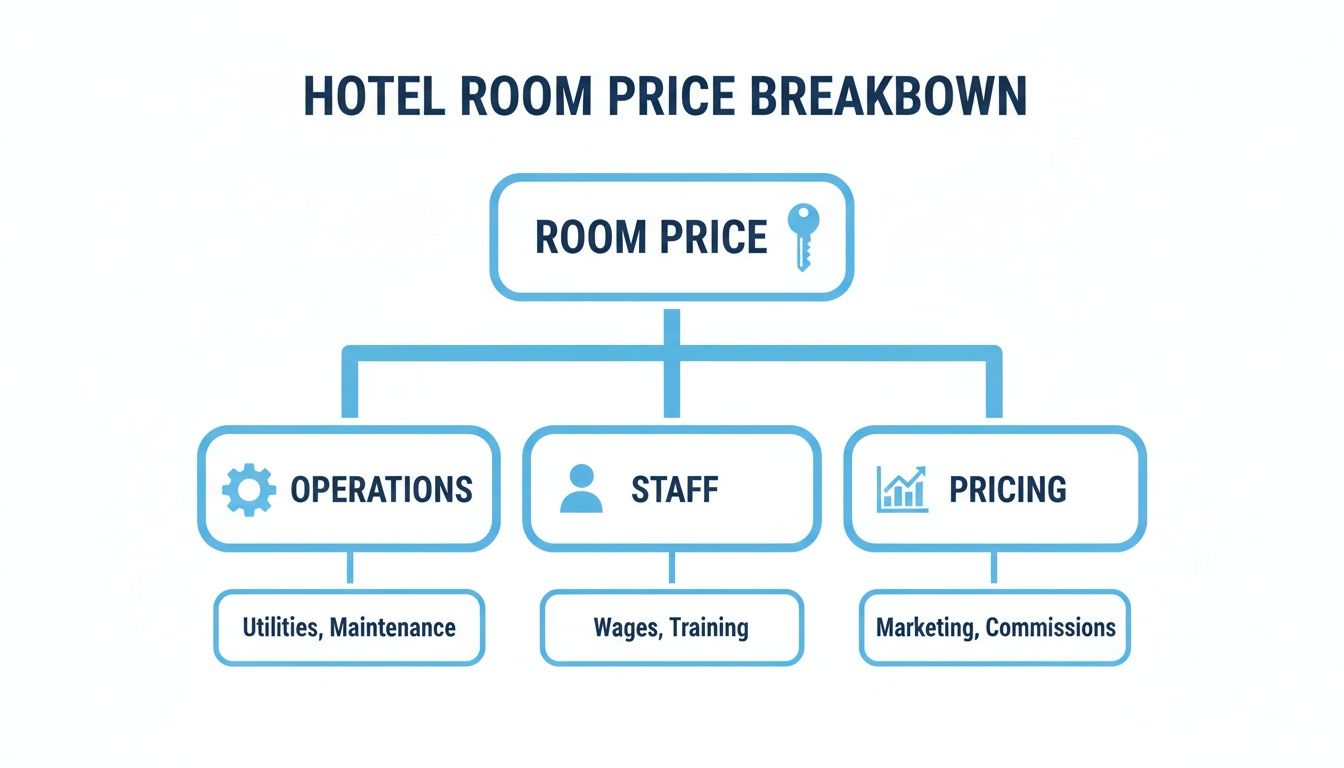
As you can see, your room rate is built on these three core pillars. Each one adds a significant chunk to the final cost you pay at checkout.
To really get a feel for what’s driving that price, it helps to look at the main culprits one by one. The table below gives you a quick snapshot, but let's break down the major players that inflate your bill.
| Cost Driver | How It Affects Your Price |
|---|---|
| Operational Overhead | These are the non-negotiable costs—property taxes, utilities, insurance, maintenance—that the hotel pays whether it’s full or empty. |
| Labor & Service | A hotel's reputation lives and dies by its staff. Wages and benefits for a large 24/7 team are one of the biggest line items on the budget. |
| Dynamic Pricing | Algorithms adjust rates constantly based on demand, local events, and even the day of the week, all to maximize revenue for the hotel. |
| Distribution Fees | When you book on sites like Expedia, the hotel pays a commission of 15-30%. That cost gets baked right back into your room rate. |
| Branding & Marketing | Franchise fees for big names like Marriott or Hilton, plus all the advertising needed to get you in the door, add up and are passed on to you. |
Each of these factors plays a crucial role in the final number you see. Let's dig a little deeper into the five big ones:
Ever wonder why that hotel room costs so much, even on a quiet Tuesday night? It’s because a hotel is a machine that never, ever stops running. Think of it less like a building and more like a self-contained city that’s awake 24/7, 365 days a year.
That nonstop operation comes with an absolutely staggering bill. A huge chunk of what you pay for a room isn't for the fluffy pillows or the fancy lobby; it's to feed the beast—the immense, invisible machine humming along behind the scenes. This is where fixed costs come in. These are the expenses the hotel has to pay whether it’s completely sold out or has just one person checked in. They're the relentless, predictable costs that form the very foundation of the business.
The single biggest fixed cost? The building itself. It’s no secret that hotels occupy some of the most desirable real estate on the planet—prime downtown corners, stunning beachfronts, or right next door to major attractions. That premium placement comes with an astronomical price tag.
But it's not just the mortgage or the initial purchase price. It’s the crushing weight of ongoing property taxes, which can be mind-boggling in desirable cities.
Let's put that in perspective with a practical example. A large hotel in the heart of Manhattan could easily be on the hook for several million dollars in property taxes every single year. A similarly sized hotel just an hour away in a quiet suburb might pay a fraction of that, maybe $200,000 to $500,000. That massive difference has to get baked into the room rates of the city hotel.
A hotel's location dictates more than just a great view; it sets a baseline cost of operation that directly inflates the price of every single room, every single night.
And the bleeding doesn't stop with real estate. There's a constant river of other fixed expenses just to keep the "city" functioning. These are the non-negotiables that add up fast:
While fixed costs set the financial floor, variable costs add the next layer to the price you pay. These are the expenses that ramp up with every single guest who walks through the door. They're directly tied to how full the hotel is.
Think about your room before you arrived. Housekeeping armed with cleaning supplies, fresh linens, and towels had to get it ready. Every stay chips away at the inventory of tiny shampoo bottles, soaps, and coffee pods. As a practical example, a mid-range hotel might budget between $20 and $40 per occupied room just for housekeeping labor and supplies. The laundry operation alone is a beast, requiring industrial-scale machines, gallons of detergent, and the staff to run it all.
For a mid-sized hotel, these daily consumables can easily add up to tens of thousands of dollars per month. Each time you use a fresh towel or grab a complimentary bottle of water, it creates a small but very real cost for the hotel. Multiply that by hundreds of rooms and thousands of guests, and you start to see how these tiny expenses become a major financial driver behind that final price on your bill.
That warm, welcoming smile at the front desk, the flawlessly crisp sheets on a freshly made bed, and the convenience of late-night room service don't just happen by magic. Delivering that seamless hotel experience comes at a steep price, driven by what is often a hotel's single largest expense: its people.
Think about it. From the general manager overseeing the entire operation to the concierge scoring you last-minute dinner reservations, every single role is critical. You've got housekeepers, maintenance staff, bellhops, restaurant servers, and security personnel, all working in shifts to keep the property running smoothly 24/7. This massive, coordinated workforce is the real engine behind hospitality, and their wages, benefits, and training take up a huge slice of the operating budget.
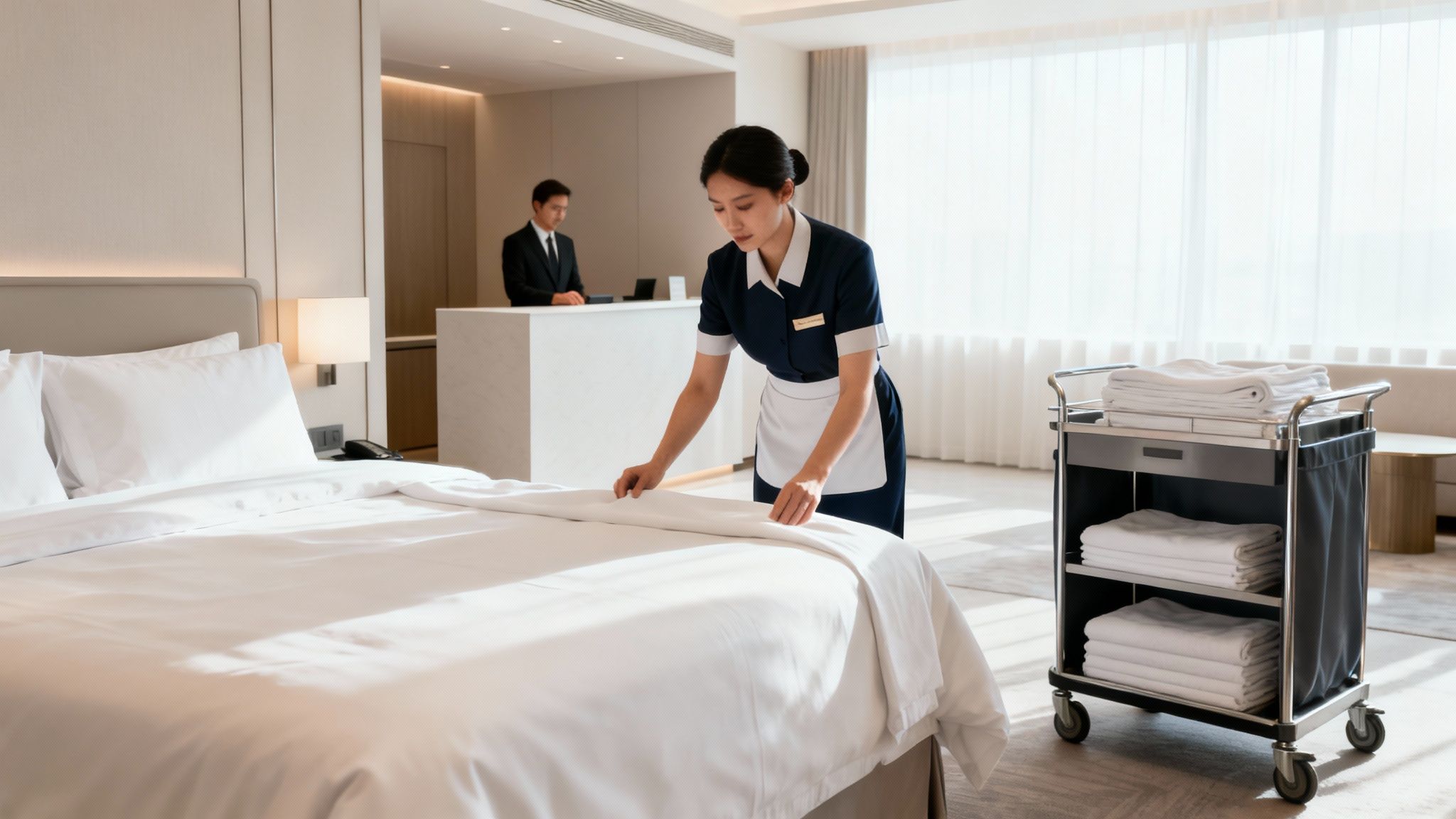
The level of service you expect is directly tied to the number of people a hotel has on its payroll. It's really the difference between a budget roadside motel and a five-star luxury resort. The motel might get by with a single person at the front desk and a small housekeeping team, keeping labor costs as low as possible.
A luxury hotel, on the other hand, is selling you a premium experience, which demands a much higher staff-to-guest ratio. That means more employees are on hand to cater to your needs, giving you that personalized attention you're paying for. Of course, that also means much, much higher payroll expenses, which are baked right into your room rate.
A practical example: a luxury hotel might have one staff member for every two or three guests. A mid-range hotel? That ratio is probably closer to one for every ten guests. This gap in manpower is a primary reason why premium hotels cost what they do.
Here’s a not-so-secret industry secret: hospitality has a massive employee turnover problem. This constant churn creates a costly cycle of recruiting, hiring, and training new staff, which drains both time and money. When an experienced employee walks out the door, the hotel doesn't just lose their skills; it has to invest heavily to get a new hire up to speed.
This is all made worse by persistent labor shortages. In the U.S. alone, the hotel industry employed over 2.17 million people in 2025, paying out more than $128.47 billion in compensation. Even after adding thousands of new jobs, staffing still hasn't bounced back to pre-pandemic levels. This forces hotels into a bidding war, offering higher wages and better benefits just to attract and keep talent. You can dig deeper into the industry's labor pains in this detailed report on hospitality sector employment trends.
At the end of the day, the human element is what turns a simple room into a memorable experience. The cost of keeping a skilled, motivated, and large-enough team is one of the biggest reasons hotels are so expensive.
Here’s how that labor cost shows up during your stay:
So, the next time you're enjoying the comfort of a well-run hotel, remember the complex and expensive human network working behind the scenes. That impeccable service is a direct result of a serious investment in people—an expense that makes up a huge part of the price you pay.
Have you ever looked up a hotel room, seen it for $150, and then checked back a day later only to find the exact same room is now listed for $500? It feels random, almost personal. But it’s not.
Welcome to the world of dynamic pricing. This is the sophisticated, high-stakes game hotels play, constantly tweaking their rates based on what's happening in the market, right down to the minute.
Think of it less like a price tag in a store and more like the stock market. A room's value isn't fixed; it ebbs and flows with supply and demand. Hotels use powerful software that crunches dozens of data points—from flight bookings to local weather forecasts—to predict how many people will want a room and set the highest price they think someone will pay. This is precisely why that amazing hotel costs a fortune during peak season; the system is built to squeeze every last dollar out of a high-demand situation.
Once you understand how this game is played, you can start to play it to your advantage. Knowing what makes prices jump is the first step to avoiding those frustrating surges.
So, what flips the switch on a hotel’s pricing algorithm, telling it to jack up the rates? It comes down to a few key triggers that signal a flood of potential guests is on the way.
The most obvious one is seasonality. A resort in Miami is always going to be more expensive in March when the sun is shining than in the middle of a humid, stormy August. A ski lodge in Aspen? Prices shoot through the roof the moment the first snowflake hits the ground.
But it goes deeper than just the time of year. Specific events create these intense, short-term demand bubbles that can send prices into orbit. These include:
Let’s put this into perspective. Picture a decent, mid-range hotel just a few blocks from a major football stadium.
On a random Tuesday night in the offseason, you could probably snag a standard room for $180. There are plenty of empty rooms (high supply) and not a lot of people looking (low demand). Easy.
Now, let's jump forward a few months. The home team has defied all odds and made it to the championship game, hosted right there at that stadium. Suddenly, 50,000 fans are swarming in from out of town, all of them scrambling for a place to stay.
The hotel’s pricing software sees this tidal wave of search traffic and bookings. With a fixed number of rooms and an absolutely massive spike in demand, the system goes into overdrive, automatically and aggressively cranking up the price. That same $180 room is now going for $650 a night—and it will sell out, guaranteed. This isn't just about covering the bills; it's about capitalizing on a golden opportunity.
At its core, this is a simple, powerful principle: limited supply meets overwhelming demand. The hotel isn't just selling a bed for the night; it's selling a scarce resource at its absolute peak value.
And this isn't just a local phenomenon. Even with a massive building boom—over 268,000 new hotel rooms are in the final planning stages for 2025—demand is roaring back so fiercely that it can’t keep up. U.S. hotel occupancy is projected to hit 63.38%, nearly matching pre-pandemic levels. This gives hotels in hotspots like New York City the confidence to see just how high they can push their prices.
This scarcity is why some 3-star hotel rates for late 2025 are already pacing a jaw-dropping 35.4% higher than the previous year. If you want to see the numbers for yourself, you can dive into these U.S. hotel industry trends and get the full picture.
So, we've covered the basics—the mortgage, the staff, the light bill. But the price you see online has another, less obvious layer of costs baked right in, all tied to how you book your room and the brand name on the sign out front.
Think of it this way: a hotel is like a product manufacturer. They create the room. But to get that room in front of millions of potential buyers, they have to put it on the shelves of a massive online department store, like an Expedia or a Booking.com. And just like in retail, shelf space in those prime locations isn't free. Not by a long shot.
Every time you book a room through an Online Travel Agency (OTA), the hotel has to kick back a serious commission for the referral. This isn’t some small finder's fee; it's one of their single biggest expenses.
How much are we talking about? Those commissions typically run from 15% to a staggering 30% of whatever you paid. That means for every booking that comes through a third-party site, a huge slice of your payment vanishes before it even hits the hotel's books.
Let's break it down with a practical, real-world example:
This puts hotels in a real bind. They desperately need the eyeballs and bookings the OTAs deliver, but they bleed revenue with every click. To make the math work, they have no choice but to inflate their rates to cover that guaranteed loss. You, the guest, end up footing the bill for the OTA's commission.
The convenience of booking on a major travel site comes with a hidden tax. A huge chunk of what you pay is really just a marketing fee passed from the hotel to the booking platform. It’s a massive driver of high hotel prices.
Beyond the booking fees, there's another major cost hidden in plain sight: the brand itself. When you stay at a Marriott, Hilton, or Hyatt, you’re almost always staying at a property owned by an independent operator who is just licensing the name.
This franchisee has to pay the giant parent corporation a constant stream of fees for the privilege of using the brand, plugging into its massive marketing and reservation systems, and putting that trusted logo on their towels. These franchise fees are another hefty operating cost that gets baked directly into your nightly rate.
These fees usually break down into a few key parts:
For the person who actually owns the hotel, these fees can easily eat up more than 10% of their total revenue. So, let's connect the dots. If a hotel loses 20% to an OTA and another 10% to franchise fees, they might only be keeping $0.70 of every dollar you spend. And that’s before they pay a single employee or turn on a light.
That powerful, trusted brand name gives you consistency and a certain standard of quality, but that peace of mind comes with a price tag built right into your bill.
So, you’ve seen behind the curtain. You know why that hotel room costs so much—the messy web of operating costs, the algorithms jacking up prices, and all the hidden fees. Understanding the game is the first step to winning it. Now, it’s time to move past the generic travel hacks and into real strategies that put money back in your pocket.
<iframe width="100%" style="aspect-ratio: 16 / 9;" src="https://www.youtube.com/embed/pRiN8Xz6LSI" frameborder="0" allow="autoplay; encrypted-media" allowfullscreen></iframe>The secret isn’t about finding a slightly better deal; it’s about sidestepping the retail pricing game entirely. Every price you see on the big booking sites is inflated. It’s padded to cover their hefty commissions and massive ad spends. But what if you could tap into the price the hotel actually wants to sell the room for, before all that gets tacked on? That’s where smart travel begins.
The single biggest lever you can pull is timing. Dynamic pricing is a machine that feeds on demand, so your goal is to travel when demand is low. The easiest way to do this is by booking during the shoulder season—that perfect window just before or after peak season.
Actionable Insight: Instead of booking a Tuscan villa in July, look at the first two weeks of June or the last two weeks of September. You'll likely find rates are 20-30% lower, the weather is still beautiful, and the crowds are thinner.
Sometimes, the best way to get a great deal is to look beyond traditional hotels. The world of alternative accommodations has exploded, offering more space, flexibility, and often far better value—especially if you're traveling with a group or planning a longer stay.
This is the most powerful strategy of all, because it lets you bypass the entire retail travel ecosystem. Imagine a private, members-only marketplace where hotels list their unsold rooms at rock-bottom rates, completely free of the 15-30% commissions they’re forced to pay the big online travel agencies.
This is the world of wholesale travel.
These platforms work on a completely different business model. Instead of taking a cut from every booking, they charge a flat membership fee. This simple shift allows them to pass the wholesale rates—the prices usually reserved for travel agents and big corporate accounts—directly to you.
This model cuts out the expensive middlemen (the OTAs) and the massive marketing costs discussed earlier. The result is access to the same hotel rooms you see on popular sites, but at prices the general public never gets to see.
Let’s make this real. Say you’re booking a weekend at a nice luxury hotel in a major city. The price difference between a public booking site and a private wholesale platform isn't just a few dollars—it's often dramatic.
| Booking Method | 3-Night Stay at a Luxury Hotel | Why the Price is Different |
|---|---|---|
| Public Retail Site | $1,500 | This price is inflated with OTA commissions, marketing costs, and dynamic pricing surges. |
| Wholesale Platform | $950 | This is the hotel's net rate, offered without the layers of fees. The savings go directly to you. |
In this practical, real-world scenario, you save $550 on the exact same room, at the exact same hotel, for the exact same dates. This isn’t a fluke; it's how the wholesale market works every day. Platforms like Approved Experiences Traveler were built on this exact principle: giving members a smarter, more affordable way to book premium travel. Once you understand how the system is rigged, you can finally stop overpaying and start traveling better.
If you've ever felt like hotel pricing is a bit of a black box, you're not alone. Let's pull back the curtain on a few of the most common questions travelers have, so you can book your next trip with a lot more confidence.
Yes, they exist, but banking on them is a high-stakes gamble that rarely pays off like it does in the movies. The idea is that hotels will slash prices on unsold rooms to avoid a total loss for the night. While that can happen, it's becoming less and less common, especially in popular spots or during busy travel seasons where high demand is practically guaranteed.
Actionable Insight: Instead of waiting until the last minute, book a refundable rate 2-3 months in advance. Then, set a price alert. If the price drops, you can cancel and rebook at the lower rate, giving you security without the risk.
This is all about the complicated and often messy agreements between hotels and the websites that sell their rooms. A hotel might dangle a slightly lower rate on its own website to entice you to book direct, saving them the hefty 15-30% commission they'd otherwise pay to an online travel agency (OTA).
On the flip side, a big booking site might launch its own promotion, temporarily undercutting the hotel’s direct price to win your business. But the real price differences—the ones that truly matter—come from accessing private, wholesale rates. These prices aren't available on any public retail site because they cut out all the middlemen and their markups entirely.
The secret to deep savings isn't about pitting one public booking site against another. It’s about stepping outside that retail system entirely. Wholesale travel platforms tap into net rates that public-facing sites simply can't compete with.
They can, but the road to meaningful savings is usually a long, expensive, and restrictive one. Racking up enough points for truly valuable rewards, like free nights at a great property, often requires a ton of spending and unwavering loyalty to a single hotel brand. That severely limits your choices, sometimes forcing you to pay more for a room just to stay "in the system."
For example, you might need to spend $10,000 with one brand to earn a single free night that's only valued at $300. This is a practical reason why the math often doesn't work out for casual travelers. The immediate, upfront discounts you get from a travel membership that offers wholesale pricing across thousands of different brands will almost always deliver more value, right away, without tying you down.
Ready to stop overpaying and start traveling smarter? Join Approved Experiences Traveler and unlock exclusive access to wholesale hotel rates the public never sees. Find your next amazing stay at an unbeatable price.
From this collection
From this collection

how to save money on hotels
Discover how to save money on hotels with expert tips on booking, timing, loyalty programs, and negotiation. Start slashing your travel costs today.

best family vacations
Discover the best family vacations for 2026. Our guide covers trips for all ages & budgets, with tips on how to save big on hotels, cruises, and more.
vacation rental discounts
Learn how to find and secure amazing vacation rental discounts with expert strategies on timing, negotiation, and exclusive travel memberships.