All Articles
The Journal
Cruise Itinerary Planning That Actually Works
September 27, 202615 min readcruise planning guideport planning
A practical cruise itinerary planning guide with steps for ships, ports, timing, and budgeting so every sailing fits your schedule and goals.

You're trying to plan one cruise for people who don't travel the same way. The children want beaches and activities, a parent needs low-impact walking, someone has dietary restrictions, and a grandparent wants a quiet place to sit after lunch. Meanwhile, flights, cabins, transfers, dining reservations, shore excursions, and school or work calendars all have to line up.
That's why cruise itinerary planning is an infrastructure decision, not a destination poll. The right sailing connects the group's goals, physical needs, booking horizon, port capacity, travel documents, and household schedule. A beautiful route can still fail if the embarkation airport is inconvenient, the port days are too intense, or the cabin inventory disappears before everyone agrees.
Why Cruise Itinerary Planning Starts With Goals Not Ports
A famous port can still produce a poor family holiday. The route may look perfect until the ship lacks adjoining cabins, the dining schedule conflicts with children's routines, or the shore days demand more walking than an older traveler can manage. Cruise itinerary planning works better when the household's requirements determine the sailing, not the other way around.
Write a one-page goal sheet before comparing itineraries. It turns a group conversation into a decision record and gives you a consistent test for every ship, cabin, and route.
Define the outcomes
Separate must-haves from nice-to-haves. Limited walking stamina, supervised children's activities, and serious dietary restrictions belong in the first category. A particular beach, balcony view, or specialty restaurant usually belongs in the second.
Translate each outcome into a planning constraint:
- Mobility: Check accessible cabins, manageable distances to elevators, and excursions with minimal walking or dependable transport.
- Family rhythm: Review kids' clubs, varied dining venues, quiet common areas, and late meal options.
- Embarkation: Set a realistic departure-airport radius. Identify embarkation ports the household can reach without exhausting connections.
- Pacing: Choose between a classic 7-night sailing, a shorter getaway, or a longer voyage with more sea days.
- Cabin logistics: Confirm the number of rooms, whether adjoining cabins are required, and who needs proximity to elevators or accessible facilities.
This sequence matters because the ship is the operating system for the trip. The cabin layout, onboard services, port schedule, and travel connections must work together before a destination earns a place on the shortlist.
A port-first choice creates predictable compromises. You may secure a celebrated destination, then find that the ship cannot support the cabin arrangement, dining flexibility, or excursion style the group needs. Let goals narrow the ship list first. Evaluate ports after the household can function comfortably onboard.
Rank the trade-offs
Conflicts will appear. An attractive route may require a distant airport. A smaller ship may offer a stronger cultural itinerary but fewer children's facilities. A port-heavy schedule may suit energetic adults while exhausting a family traveling with older relatives.
Use this ranking:
- Safety and access
- Embarkation and travel feasibility
- Cabin and household layout
- Onboard services
- Port sequence and destination appeal
- Optional upgrades
Practical rule: Any requirement that determines whether someone can travel comfortably outranks a scenic preference.
Keep the goal sheet active throughout the booking process. Test each ship against it, then test the cabin, dining setup, and excursions. Remove options that create repeated strain instead of asking travelers to tolerate the mismatch.
The result is a workable infrastructure plan, not a wish list. It prevents a persuasive family member, scarce cabin inventory, or an appealing port from pulling the trip away from what the household actually needs.
Timing Your Booking Window and Choosing the Right Channel
Booking timing should reflect the sailing, the cabin, and the people traveling. In the 2026 CruiseLine.com and Shipmate member survey, 44.4% of respondents booked 7 to 12 months before sailing, 25.7% booked 13 to 18 months ahead, and 11.9% booked 18 or more months ahead (survey results). That means the majority planned at least seven months in advance, which is especially relevant when several rooms, accessible cabins, or a particular sailing date matter.
The same survey found that 45.9% ranked a 7-night cruise as their top choice, while 59% were considering 8 to 13-night cruises and 34.5% were considering 14-night or longer cruises (CruiseBound planning guidance). Longer sailings require more coordination, so don't treat them like extended versions of a weekend booking.
Match the window to the sailing
| Sailing Type | Ideal Lead Time | Channel Note |
|---|---|---|
| Popular summer or holiday sailing, suites, adjoining cabins | 12 to 18 months | Use a channel that can monitor inventory and coordinate multiple rooms |
| Shoulder-season route | 9 to 12 months | Compare direct booking with an advisor or consolidated platform |
| Repositioning or last-minute repositioning inventory | 6 to 9 months | Confirm flights, cabin availability, and port logistics before committing |
These are operating rules, not promises about fare movement. Early access matters when you need a specific cabin, preferred dining arrangement, accessible features, or a coordinated group booking. It also gives you more time to align airfare, pre-cruise lodging, and school or work calendars.
Choose the channel for the workload
In the same survey, 50.7% booked directly with the cruise line, 32.2% used a local travel agent, and 12.5% used a travel agent website (booking-channel data). Direct booking works well when one traveler controls a simple reservation and wants to manage every detail. An advisor becomes more valuable when the booking includes multiple households, cabin types, transfers, flights, or special requests.
A consolidated platform can also reduce fragmentation. Approved Traveler, for example, provides access to 44+ cruise lines and 30,000+ itineraries, allowing a family to compare inventory in one request rather than repeating the same research across separate line websites.
Before placing a deposit, compare the channel's handling of fare changes, cabin moves, dining requests, transfers, and pre-cruise stays. Review this guide to the best time to book cruises as a planning reference, then write down the payment deadlines and cancellation rules for your actual sailing.
Matching Ship, Cabin, and Route to Your Travel Style
A ship isn't “good” in isolation. It's suitable or unsuitable for a particular household. Match three elements: how travelers spend time onboard, how much movement the route requires, and what kind of cabin reduces friction.
Use the traveler profile as the filter
| Traveler profile | Ship fit | Cabin and route fit |
|---|---|---|
| Multi-generational family | Mid-sized or large contemporary ship | Family-friendly cabin layout, varied dining, kids' clubs, manageable port rhythm |
| Long-stay retirees | Smaller or mid-sized ship with quiet common areas | Balcony or accessible cabin, enrichment programming, mixed sea and port days |
| Timeshare owners | Ship with predictable dining and practical scheduling | Route that fits existing travel weeks and a cabin plan that protects flexibility |
| Digital nomads | Ship with dependable connectivity and usable work areas | Cabin with a comfortable workspace, longer sailing, or meaningful sea days |
| Frequent cruisers | Ship selected for loyalty value and itinerary density | Shorter port-heavy route when the ship is secondary to destinations |
| Adults seeking cultural depth | Small-ship luxury or destination-focused sailing | Wine-region, Northern Europe, or other routes where port access matters more than onboard scale |
Families often overbuy ship size. A large resort ship makes sense when children need constant entertainment and adults want extensive dining and activity choices. It's less suitable when the group includes travelers who struggle with long walks between venues or who prefer a calm onboard atmosphere.
Retirees often overbuy port density. A route with consecutive early departures can turn every morning into a logistics exercise. Mixed sea days create time for enrichment, rest, laundry, and enjoying the vessel.
Digital nomads should test connectivity expectations before choosing a long sailing. Reliable Wi-Fi can matter more than a larger cabin or a famous port. Frequent cruisers, by contrast, may accept a compact cabin if the route delivers new ports and strengthens useful loyalty benefits.
Select the cabin for movement and recovery
A cabin is the household's recovery base. Put mobility needs, sleep patterns, seasickness concerns, and proximity to traveling companions ahead of a view.
A family might choose adjoining cabins near elevators, while a couple on a longer cultural route might value a quiet balcony away from major entertainment venues. A solo traveler who spends little time in the room may rationally choose an interior cabin and allocate the difference to excursions or pre-cruise lodging.
Route density should follow the same logic. High port density suits energetic travelers who want each day to deliver a new experience. Mixed sea days suit pacing-conscious retirees and multi-generational groups. Longer crossings work best for travelers who view the ship as the destination, not merely transportation between ports.
For a broader comparison of line styles and onboard positioning, use this overview of different cruise lines. Don't rank brands first. Build a shortlist around the traveler profile, then compare the actual sailing, cabin inventory, and port schedule.
Mapping Ports, Sea Days, and Shore Time
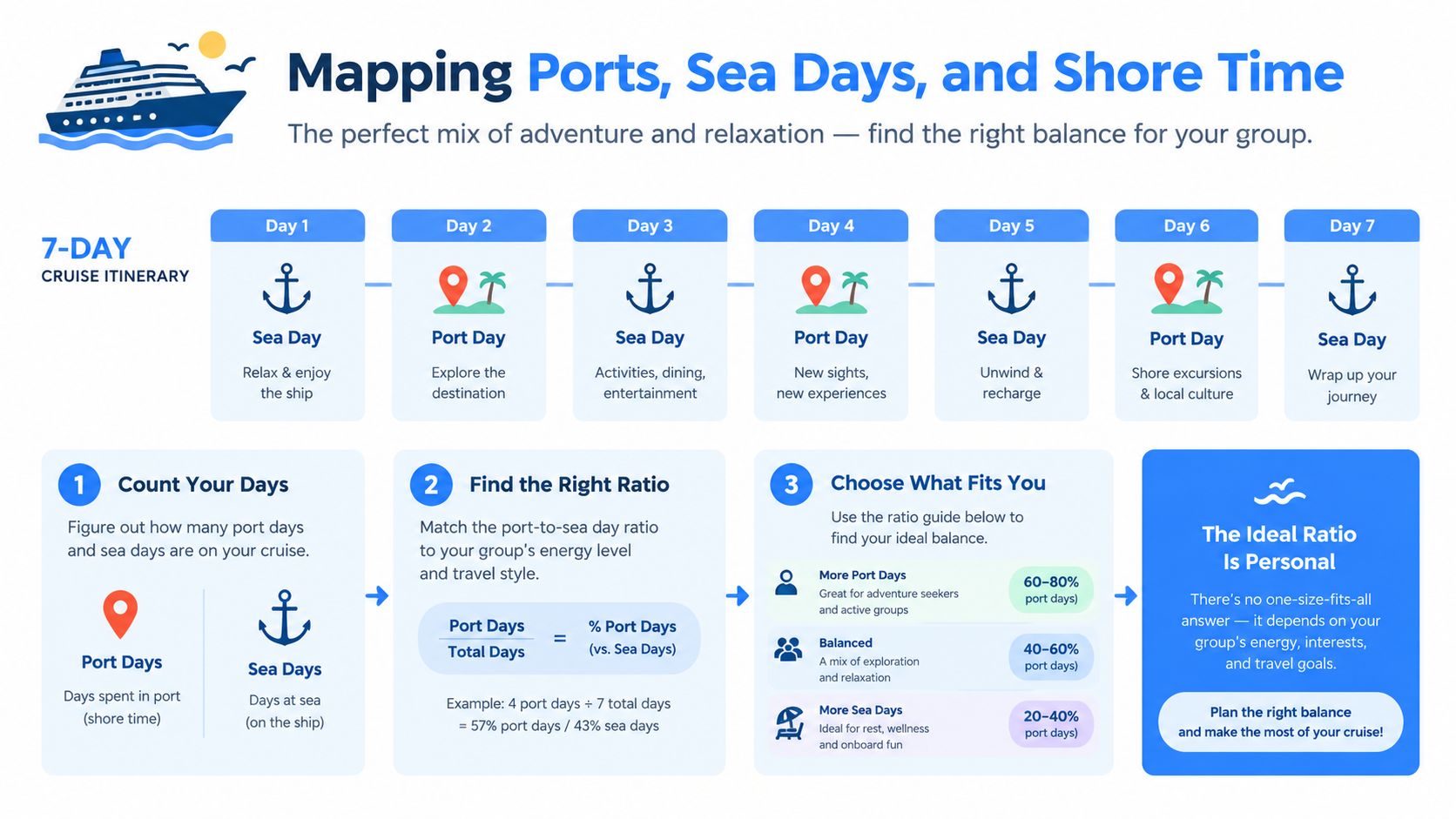
The itinerary grid is where the plan becomes real. Mark every port day, sea day, tender call, arrival time, departure time, and excursion window before you judge whether the route is attractive.
A traditional cruise itinerary commonly operates as a loop that starts and ends at a hub port, often lasting seven days with three to five ports of call depending on port proximity (CLIA industry report). Longer sailings need a different rhythm. One planning source recommends at least one sea day for every two port days on cruises longer than seven nights and advises against stacking three high-intensity port days in succession (sea-day planning guidance).
Build the port grid
Start with geography. Sequence nearby ports together when possible, avoid unnecessary backtracking, and identify whether the route favors long sightseeing days or relaxed waterfront stops. Then examine the usable time, not just the arrival date.
Many ports provide a narrow 8:00 AM to 5:00 PM-style window, and tendered calls can add 30 to 60 minutes of transit time before you reach shore (port timing guidance). A tender port should never receive the same excursion assumptions as a docked port.
Use these checks for every stop:
- Arrival: Record the scheduled arrival and the realistic time to leave the ship.
- Access: Mark docked or tendered status, mobility demands, and local transport.
- Activity: Note opening hours, lunch closures, reservation requirements, and walking distance.
- Return: Leave a substantial buffer before all-aboard time, especially for independent plans.
- Weather: Designate one stop as a flex day where the group can shorten or change activities.
Ports also have infrastructure limits. Cruise planners evaluate fuel consumption, port costs, safety, onboard revenue, shore-excursion capacity, and port ratings. Two average-sized cruise vessels can bring more than 6,000 passengers ashore at once, which makes berth timing and local capacity central to the itinerary rather than minor operational details (port deployment analysis).
For readers managing maritime paperwork or local approval questions alongside travel logistics, the Maritime Approval page offers a useful reference point.
Duplicate this port card for each stop:
- Port and date:
- Docked or tendered:
- Ship arrival and departure:
- Realistic shore time:
- Primary activity:
- Walking and mobility demands:
- Independent or ship-organized excursion:
- Return-to-ship buffer:
- Weather backup:
- Emergency contact and transport plan:
Use the video below as a visual companion while you build the grid.
Coordinating Flights, Transfers, and Pre-Cruise Stays
Build air travel around the ship's departure, never around the flight that happens to look convenient. Arriving at the embarkation city at least one day early reduces the risk that a delay, missed connection, or baggage problem becomes a missed sailing (cruise preparation guidance).
This matters most for fly-cruise itineraries through Caribbean, Mediterranean, Baltic, and other distant gateways. A pre-cruise hotel is not wasted time. It's a buffer, a recovery night after long-haul travel, and a simpler starting point for a household carrying multiple bags.
Put every segment on one timeline
Choose a refundable hotel near the terminal when the rate and cancellation terms make sense. Confirm luggage storage, breakfast timing, accessibility, and the transfer route. If a private transfer is appropriate, schedule it with a 30-minute arrival buffer before the time you intend to reach the ship.
| Day | Segment | Action | Buffer / Risk Note |
|---|---|---|---|
| Day before sailing | Inbound flight | Arrive in the embarkation city | Protect against connection and baggage delays |
| Day before sailing | Hotel transfer | Travel to a refundable terminal-area hotel | Confirm accessibility and luggage storage |
| Embarkation day | Hotel to terminal | Use a pre-arranged transfer | Leave a 30-minute arrival buffer |
| Sailing day | Embarkation | Complete terminal and ship procedures | Keep documents and medication in carry-on bags |
| Port days | Shore logistics | Follow the port-card plan | Recheck local transport and return timing |
| Disembarkation day | Ship to airport or hotel | Use a transfer suited to the release schedule | Don't schedule a tight return flight |
| After sailing | Return journey | Fly home or continue to a post-cruise stay | Allow recovery time after a demanding itinerary |
Post-cruise lodging can be valuable when the group has a long flight home, different return dates, or a desire to explore the final city without rushing. Keep the same timeline discipline. Record the inbound flight, hotel, transfer, embarkation, every port, disembarkation, return flight, and provider contact number in one place.
When one segment changes, you should know immediately which downstream segments need adjustment. A single reroute plan is safer than ten separate conversations among family members.
Budgeting the Cruise and Stacking Reward Credits
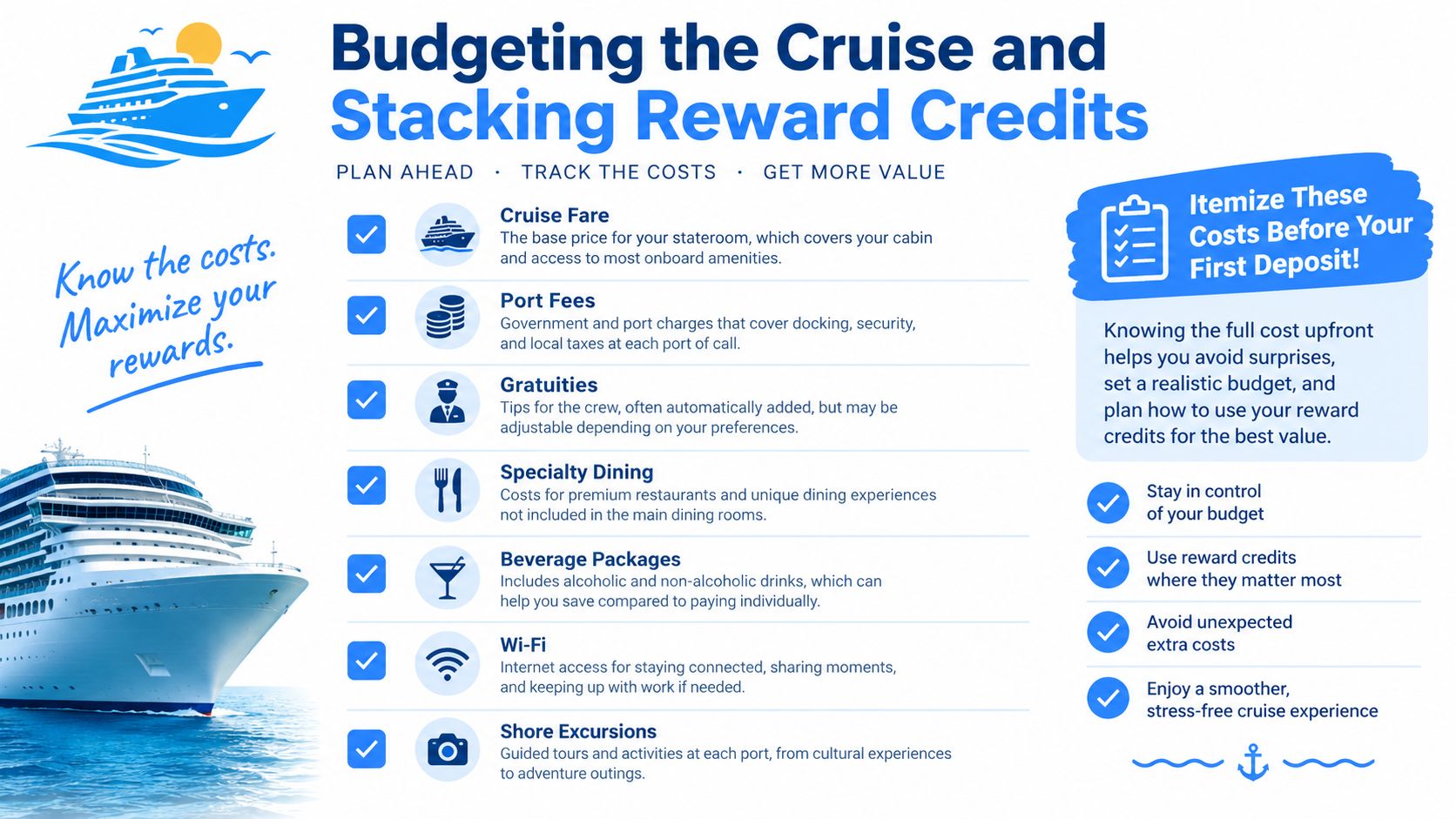
The deposit is not the budget. Build the full spending model before committing, then test it again when the trip is close enough for add-ons and fare changes to matter.
Include these line items:
- Cruise fare: Record every traveler and cabin separately.
- Port fees and gratuities: Include the charges shown in the reservation terms.
- Specialty dining and beverage packages: Compare actual usage with package conditions.
- Wi-Fi: Price the people or devices who need access.
- Shore excursions: Separate ship-organized tours from independent plans.
- Flights and transfers: Include baggage, ground transport, and airport parking where relevant.
- Pre- and post-cruise lodging: Use the room count and number of nights the household needs.
- Travel insurance: Match coverage to medical, cancellation, and interruption risks.
- Onboard spending: Allow for shopping, treatments, activities, and incidental charges.
- Contingency: Reserve 8% to 12% for surprise costs such as visa fees, taxi strikes, or weather-driven itinerary changes.
Treat Reward Credits as a planning layer
Reward Credits should be tracked against the booking components that generate them. Calculate the credit-to-cash relationship for each reservation, then consider the cabin, air, hotel, and activities as separate decisions rather than one opaque package.
Confirm that the 110% Best Value Guarantee applies before placing any component outside the platform. The guarantee means that if a member finds a lower publicly available price, the refund equals 110% of the difference. Don't assume every fare, supplier, or changeable reservation qualifies. Verify the terms for the exact component.
At 90 days before sailing, run a second comparison. Check whether a fare adjustment, cabin change, replacement hotel, or additional Reward Credits would improve the total structure. If you booked through the same channel, ask whether it can rework the reservation without compromising cabin location, dining, or cancellation protection.
Budget checkpoint: The cheapest individual component can still create the highest total cost if it forces a separate transfer, nonrefundable hotel, or inconvenient flight.
Use this worksheet for the second pass:
| Decision point | Question to answer | Action |
|---|---|---|
| Cabin category | Does the room support sleep, mobility, and household proximity? | Compare the total cost of moving categories |
| Drink package | Will the planned usage justify the package conditions? | Price individual consumption against the package |
| Excursion bundle | Does the bundle fit the port schedule and group ability? | Remove activities that create fatigue or timing risk |
| Air and hotel | Are the arrival buffers and cancellation terms adequate? | Protect the day-before arrival plan |
| Reward Credits | Which booking component creates the most useful future value? | Record credits by component and redemption purpose |
For practical ways to reduce unnecessary spend without weakening the itinerary, review this cruise savings planning guide. The objective isn't to strip the trip down. It's to direct spending toward the cabin, pacing, and experiences that improve the household's voyage.
Documentation, Packing, and Contingency Planning
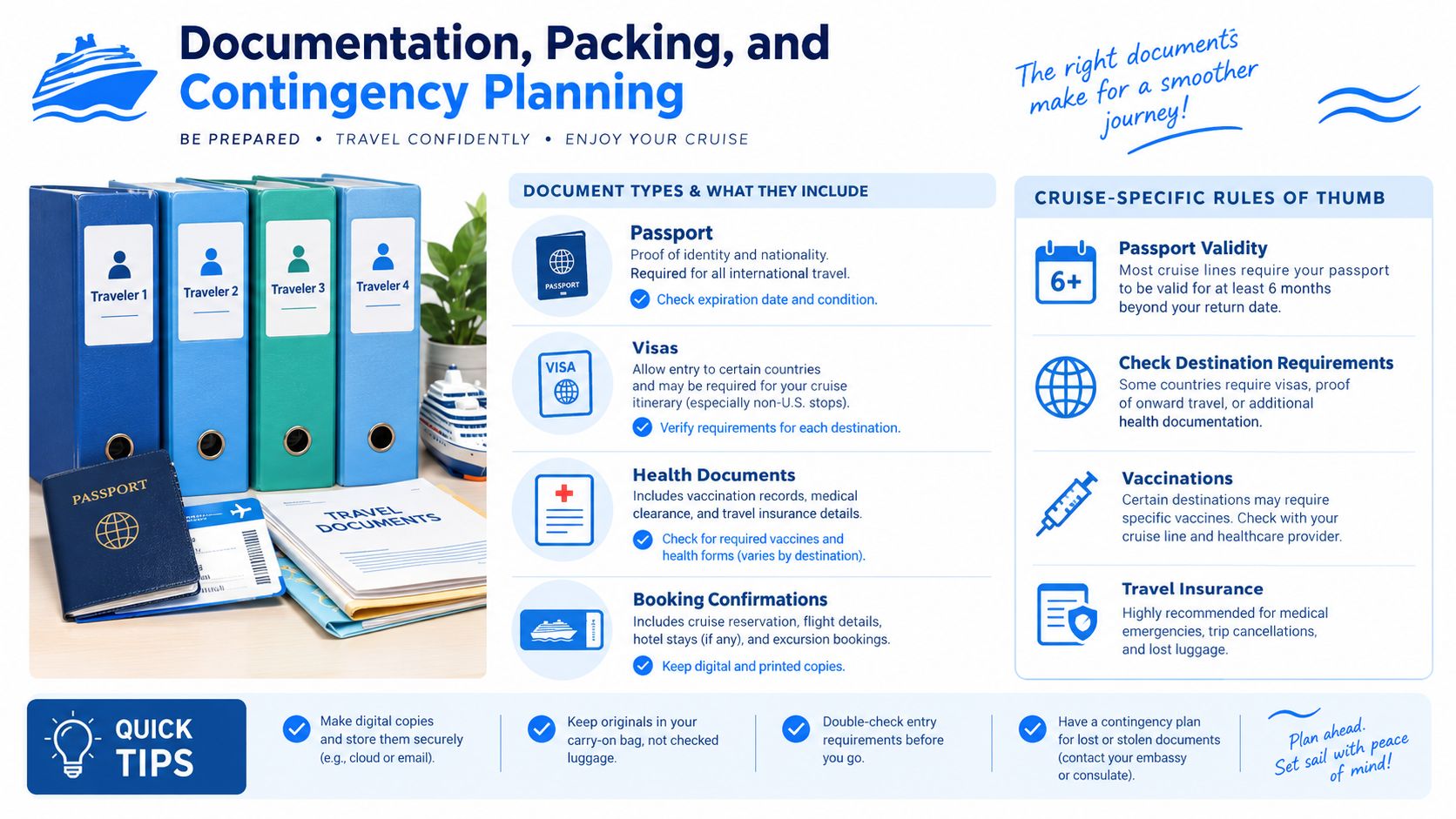
A strong itinerary can fail at the terminal if one traveler's documents are missing or a mobility device doesn't meet the ship's requirements. Create a pre-departure ledger organized by traveler, with a separate folder for each household member.
Keep passports, visas, health records, insurance details, booking confirmations, medication information, and emergency contacts together. Carry originals in hand luggage, store offline digital copies, and verify passport validity beyond six months from the sailing date. Complete the visa check 90 days before departure, then revisit it if the itinerary or traveler nationality changes.
Pack by day type and traveler
Generic packing lists miss the operational details. Build a matrix that separates embarkation day, port days, sea days, formal evenings, and regional flights.
- Embarkation: Keep medication, documents, swimwear, essential toiletries, and a change of clothes accessible.
- Port days: Match footwear and clothing to walking, weather, religious-site requirements, and transport.
- Sea days: Pack comfortable layers, reading material, activity clothing, and anything needed for medical routines.
- Formal evenings: Confirm the dress expectations and keep suitable clothing protected from checked-bag delays.
- Mobility equipment: Check storage, doorway, power, and boarding rules before departure. A detailed cruise ship scooter policy guide can help you identify questions to ask the cruise line.
For regional flights, check baggage and weight rules separately from the cruise line's allowance. A bag that works for the ship may not work for a connecting airline. Label mobility devices, medication bags, and essential documents clearly, and keep them with the traveler whenever possible.
Set contingency triggers
Write the response beside the risk, not in a separate folder.
- Missed flight: Contact the airline, cruise line, hotel, and transfer provider in that order, then use the next viable route to the embarkation port.
- Weather delay: Activate the preselected hotel or alternate transport plan and notify every affected traveler.
- Medical event: Keep insurance, medical contacts, prescriptions, and accessibility requests available offline.
- Tender disruption: Replace the excursion with a shipboard or dockside option and preserve the day's energy for later ports.
- Lost document: Use the offline copy, contact the issuing authority, and notify the cruise line immediately.
Escalate beyond self-serve planning when the household includes many travelers, multiple ships, several cabin types, complex accessibility needs, or tightly connected flights and stays. In those cases, the Approved Lux 24/7 Personal Assistant included with Lux Traveler can coordinate travel logistics and household scheduling for up to 10 household members. That changes the work from one person maintaining a fragile spreadsheet into a coordinated operating plan.
Approved Experiences Traveler consolidates access to 44+ cruise lines and 30,000+ itineraries, along with flights, hotels, transfers, and activities, so you can compare the complete voyage rather than isolated components. Visit Approved Experiences Traveler to build your itinerary around the household's timing, cabin needs, port sequence, and contingency plan.
Want the wider view?
Ten categories. One report. Every quarter. The Approved List tracks what's rising and what's fading: data-backed signals, not opinions.
Free to join · Delivered by email