
All Articles
The Journal
Cruise Line Itineraries: A Reference Guide for Smart Booking
October 18, 202614 min readcruise bookingcruise planning
Explore cruise line itineraries across 44+ lines and 30,000+ sailings. Compare route lengths, ports, seasons, and booking logistics in one reference guide.
In 2024, cruise ships carried 34.6 million ocean-going passengers, while the Caribbean, Bahamas, and Bermuda accounted for 43% of passenger itineraries, according to CLIA's 2025 State of the Cruise Industry report. That volume makes itinerary comparison a routing problem, not a destination-list exercise. Check port rotations, sea days, schedule resilience, and how you will get home.
A destination list can conceal awkward transfers, a one-way endpoint, tight connections, or a port call exposed to disruption. Compare equivalent schedule fields across lines, then weigh the trade-offs against your group's needs, calendar, and tolerance for change. Consolidated wholesale access can make those comparisons easier by bringing multiple lines' itineraries into one place.
What Cruise Line Itineraries Actually Represent
An itinerary is a complete voyage plan, not a sequence of postcards. It combines the ship, sailing dates, departure and arrival ports, port order, time at sea, arrival and departure times, and the logistics of getting everyone on and off the vessel. A familiar destination can look very different depending on where the ship starts, how long it stays, and what comes before and after it.
Start by checking the embarkation and final disembarkation ports. Then inspect each port call and sea day, and confirm whether the sailing returns to its starting port or ends somewhere else. Finally, consider the ship and the schedule around the trip. That sequence helps catch practical problems before you fall in love with the destination names.
For example, a port-heavy rotation may suit travelers who want frequent excursions, while a sailing with more time at sea may work better for a group that values quiet onboard days. Neither is automatically superior. The right choice depends on the travelers and the route's logistics.
Approved Traveler's available cruise inventory is described as covering 44+ cruise lines and 30,000+ itineraries. Those figures are publisher-provided product details, not an independent measure of global cruise supply. The operational fields below are a useful baseline for comparing options across brands.
| Field | What It Tells You | Why It Matters |
|---|---|---|
| Embarkation and disembarkation ports | Where the sailing begins and ends | Determines flights, transfers, and whether you need separate transport at each end |
| Port-call times and berth duration | When the ship is scheduled to arrive and leave | Helps assess excursion time and the margin for returning to the ship |
| Sea-day count and port sequence | How the voyage divides time between sailing and stops | Sets the trip's pace and the amount of time spent ashore |
| Ship and passenger capacity | Which vessel operates the route and its scale | Provides context for onboard experience and ship-level comparisons |
| Voyage type | Whether it is a round trip, open jaw, repositioning sailing, or cruise segment | Clarifies endpoint logistics and how the sailing fits into a larger trip |
Where Cruise Line Itineraries Operate Globally
In 2024, the Caribbean, Bahamas, and Bermuda accounted for 43% of ocean-going passenger itineraries, or approximately 14.9 million travelers. The Mediterranean ranked next, representing about 16.7% of global volume, roughly one in every six passengers. These figures show where sailings concentrate, but route planning still comes down to port rotations, seasonal deployment, and the dates you can travel.
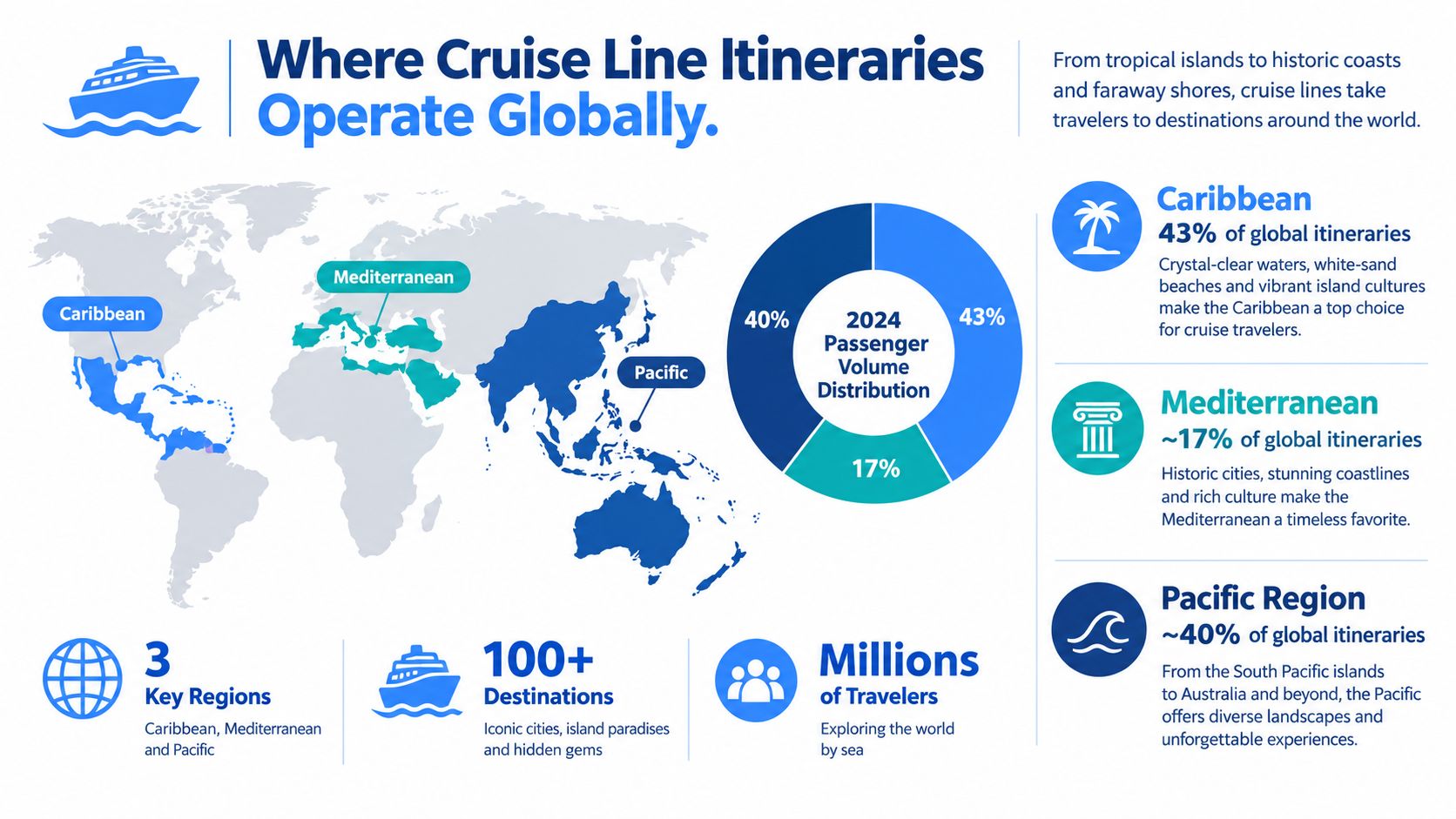
Caribbean loops make up a large share of sailings. Mediterranean and wider European routes offer different port sequences, while Alaska, the Pacific Northwest, Northern Europe, Asia, and expedition regions add other routing choices. Compare the itinerary itself, not just the destination names: the order of ports and the sailing days between them shape how the trip works.
Season determines which ships and routes are available. Alaska sailings are seasonal, and Mediterranean schedules also change across the year. A route that suits your household may not run on your preferred dates, so check actual departure dates before planning flights or time off. Ship deployment affects both the ports you can embark from and the sequence of stops.
A single-brand search limits your comparison to that company's sailings. Compare departure ports and route rotations across brands before choosing; for Florida options, consult this guide to cruises from Florida ports. Consolidated access to multiple lines makes it easier to compare schedules on consistent terms, rather than treating each brand's destination list as the whole market.
How Ports Function Inside a Voyage Rotation
Cruise ports have distinct operational roles. Homeports are where voyages begin and end. Ports of call are intermediate stops. Hybrid ports do both, handling embarkation and disembarkation on some sailings and day visits on others. A peer-reviewed geographic study identified these roles in its analysis of Caribbean and Mediterranean port networks. (Geographic study of cruise-industry growth and port roles)

Plan around each port's role. At a homeport, allow time for embarkation and build flexibility into your flight or hotel arrangements. At a port of call, check how much time the ship allows ashore and how you'll return before departure. Hybrid ports require you to confirm which role applies to your sailing.
Cruise and Ferry's industry analysis says itineraries are commonly developed two to three years ahead, drawing on booking data, regional demand, traveler surveys, and travel-advisor input. That lead time reflects coordination between ship deployment and port operations. Published schedules can still change, so compare the port rotation, sea days, and disruption risk rather than choosing from destination names alone.
Practical rule: Choose your embarkation and disembarkation ports first. Then assess how the intermediate stops and sea days work as a rotation, and compare schedules across lines using consistent details. A consolidated view of multiple lines makes that comparison easier than checking each brand's listings separately.
The Standard Schema Behind Every Cruise Line Itinerary
A planner should be able to read an itinerary as a structured record. The port names matter, but so do their timestamps, the ship operating the route, and the details that reveal how the sailing fits together.
Use this checklist when comparing listings:
- Endpoints: Record the embarkation port and final disembarkation port. Different endpoints mean you'll need to plan transport for both.
- Port calls: Capture each port's scheduled arrival and departure times, plus its berth duration. These show how much time ashore the schedule allows.
- Sailing pattern: Note the number of sea days, distance between calls, and whether the voyage is a round trip, open jaw, repositioning sailing, or consecutive cruise segment.
- Vessel: Record the ship identifier, gross tonnage, and passenger capacity. These details help distinguish ship-level characteristics from route features.
The environmental profile also deserves careful treatment. For ships of 5,000 gross tonnage or more, the International Maritime Organization (IMO) requires annual operational Carbon Intensity Indicator (CII) calculation and reporting. The indicator links CO₂ emissions to transport work, measured against capacity and distance; its rating runs from A to E, with A representing the strongest performance. A ship rated D for three consecutive years, or rated E, must develop a corrective-action plan. (IMO guidance on short-term greenhouse-gas reduction measures)
Don't confuse a ship's annual CII rating with a voyage-level estimate. Two routes with similar destination lists may have different distances, port approaches, or sea-day patterns. Compare the itinerary's route data separately from the vessel's reported annual performance.
Voyage Types Across the 44+ Cruise Lines
Voyage type tells you what kind of trip you're buying. A closed-loop Caribbean itinerary starts and ends at the same port, which can simplify transport planning. Mediterranean and European rotations tend to be organized around successive port calls, so check the order and time available at each stop rather than counting destinations alone.
Other patterns suit different travel styles. World and grand voyage segments typically cover a broader route and may involve extended time at sea. Expedition sailings prioritize access to remote regions, where the experience depends on the route and conditions as well as the destinations. River sailings follow a different operating model from ocean voyages, so compare them on their own terms.
There's no universal ideal length or port density. A first-time cruiser may prefer a straightforward loop with manageable transfers, while repeat cruisers may welcome a less familiar rotation or a longer stretch at sea. Families should be especially honest about pacing: a busy port sequence can be exciting, but it also means repeated mornings with plans to manage.
| Voyage Type | Typical Length | Sea-Day Profile | Best Fit |
|---|---|---|---|
| Closed-loop Caribbean | Varies by sailing | Mix of port days and sea days | First-time cruisers and families seeking a straightforward round trip |
| Mediterranean or European rotation | Varies by route | Often organized around successive port calls | Travelers prioritizing cultural stops and varied ports |
| World or grand-voyage segment | Varies by segment | Can include extended sea-day stretches | Repeat cruisers looking for a longer, broader journey |
| Expedition or remote-region cruise | Varies by destination | Set by remote routing and operating conditions | Destination-focused travelers comfortable with less conventional routes |
| River sailing | Varies by route | Different pace and port access from ocean voyages | Travelers who want a river-based itinerary rather than an ocean rotation |
Treat this table as a way to classify what you're seeing, not a substitute for checking the actual sailing dates, vessel, and port schedule. The ship's advertised route is the starting point for comparison.
Repositioning Cruises as a Distinct Routing Pattern
A repositioning cruise moves a ship between seasonal markets. It isn't a conventional itinerary with fewer stops. The route is designed around the vessel's transfer, so travelers often trade frequent port calls for long stretches at sea and a one-way journey.
Typical Atlantic repositioning sailings run about 10–14 nights. They commonly depart in spring, around April–May, or fall, around October–November. A representative route might leave Fort Lauderdale or New York, call at Bermuda, the Azores, or the Canary Islands, and finish in Barcelona or Southampton roughly two weeks later. Transpacific repositioning routes commonly last 20–25 days. (Repositioning-cruise route overview)
The first planning task is transport at both ends. If you book an Atlantic sailing that finishes in Europe, don't assume a return flight from the departure city will work; arrange the outbound and return journeys around the two different endpoints. Then check how many sea days the voyage includes and decide whether that's a benefit or a drawback.
A repositioning sailing suits travelers who want sustained onboard time. It's a poor fit for anyone who needs a port visit to anchor each day.
Remote workers and repeat cruisers may appreciate the unhurried pace. Families who expect frequent shore activities should look closely at the sea-day pattern before committing. Packing and pacing matter too: a long crossing calls for more thought about what you'll want onboard than a short loop built around regular port stops.
Disruption Risk Inside Any Published Itinerary
A published itinerary describes the planned route, not a guarantee that every port call will go ahead. Supplier terms allow changes, delays, port substitutions, and cancellations, including adjustments to arrival and departure times, services, and shore excursions. MSC's terms also permit the carrier or vessel master to omit or change scheduled ports for safety or operational reasons. (Published cruise supplier terms and conditions)
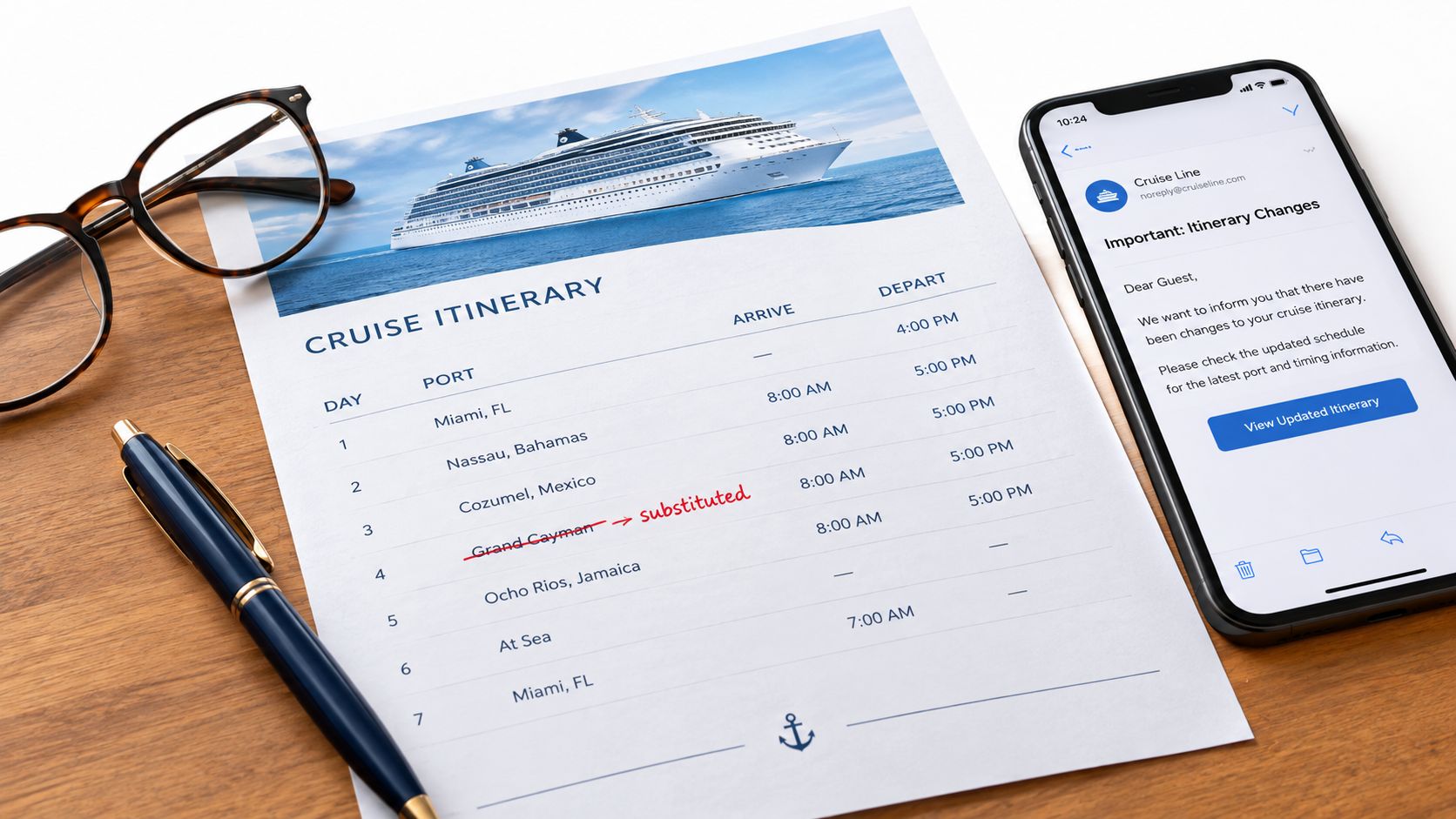
Assess the route as an operating schedule, not just a list of destinations. Before booking, ask what the voyage offers if a port drops off the rotation. Would the added sea day still suit your plans? Could a missed call disrupt independent transport, a hotel stay, or a prepaid excursion? Read the booking terms, and avoid building your trip around a port visit that the supplier does not guarantee.
Under the supplier terms cited above, a scheduled 8:00 a.m. arrival and 5:00 p.m. departure still shouldn't be treated as a guarantee. If the ship changes its schedule, confirm the revised times and tender arrangements onboard before heading ashore. For an independently booked excursion, leave a generous return buffer. A late return can mean missing the ship.
Use this checklist to manage the risk:
- Check the update: Confirm the current schedule and whether tender arrangements have changed.
- Protect the return: Choose a ship-arranged excursion, or leave ample time to get back from an independent booking.
- Limit financial exposure: Avoid nonrefundable plans that depend on one port call unless you are comfortable with the risk.
- Review your cover: Check how your travel arrangements handle cancellations or interruptions. This guide to travel cancellation insurance can help you assess that part of the plan.
A port-day decision should account for both the published schedule and the possibility of a change.
Here's a short video to help you think through itinerary planning and port-day decisions.
Final Payment and Cancellation Mechanics Across Lines
A cruise itinerary's financial terms matter as much as its port rotation and dates. Holland America lists final payment 120 days before departure for most cruises. Its cancellation schedule provides a 75% refund at 119–91 days, 50% at 90–61 days, and no refund at 60 days or less. (Holland America's cancellation policy)
For families booking several cabins, record the payment deadline before committing to flights, hotels, or excursions. Under the Holland America schedule above, canceling 80 days before departure falls in the 50%-refund band; canceling 45 days out falls in the no-refund band. Treat each cabin's booking terms separately when coordinating household decisions.
Carnival handles cancellations before final payment differently. Its policy provides a nonrefundable, nontransferable future cruise credit equal to the deposit, minus a $50-per-person service fee. The credit must go toward a new reservation made within 12 months, applies to eligible Carnival sailings priced in U.S. dollars, and can be used only toward the future cruise price. (Carnival's deposit and final-payment cancellation policy)
For a two-person booking, the fee deducts $100 from the deposit before the balance becomes credit. That credit is not cash, and its restrictions affect whether it will be useful to your household. Compare each line's payment deadline and cancellation terms as operational constraints when weighing itineraries. Policies vary by cruise length, fare, itinerary, and sailing date, so use the terms in your booking confirmation rather than assuming one calendar applies across lines.
Coordinating Transfers and Shore Activities Around Itineraries
Group logistics work best when one person owns each moving part. For a multi-generational group of eight to ten travelers across two to four cabins, assign one person to track each cabin's payment deadline and another to coordinate shared ground transfers. That prevents one household's booking from being mistaken for the status of the whole group.
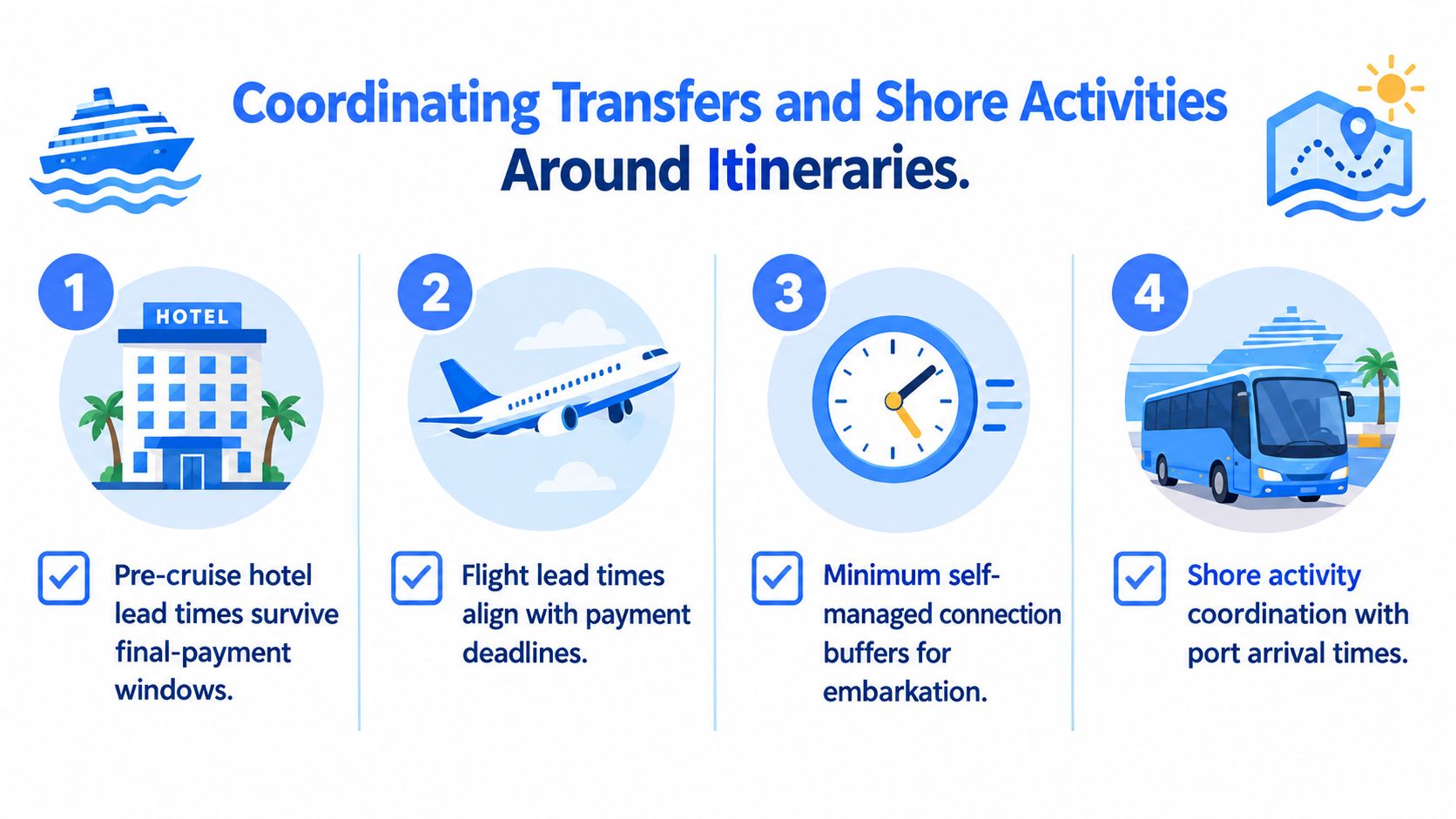
Before choosing flights, work backward from embarkation and disembarkation. Build in a self-managed connection buffer that gives your party room to handle delays, luggage, and transfers. Avoid a plan that depends on every traveler arriving at the last possible moment, particularly when several households are joining from different places.
For shore activities, compare the excursion timing with the ship's arrival and departure times. Account for local time-zone changes, and confirm whether the port is a tender port, where passengers transfer between ship and shore by smaller boats. Those details affect how much usable time your group has and how tightly you can schedule an independent activity.
When a trip includes a separate land excursion, use a planning resource that lays out transport and timing clearly. This trip advice from Irie Tulum Boutique Hotel can help you think through the practicalities of coordinating a destination day beyond the cruise schedule.
Accessing Cruise Inventory Through One Consolidated Platform
When you compare cruise lines through separate search systems, differences in terminology and display can make routes harder to evaluate side by side. A consolidated platform changes the comparison by bringing the sailing choices and their planning context into one workflow. The value is operational: you can compare departure ports, dates, cabin categories, amenities, and per-person pricing, then coordinate flights, transfers, and pre- or post-cruise hotels around the sailing.
Approved Traveler provides wholesale-rate access to 44+ cruise lines and more than 30,000 itineraries, including ocean and river cruises, alongside a broader travel marketplace. That marketplace lists 1,000,000+ hotels, 700+ airlines, 30,000+ car rental locations, 500,000+ vacation homes, 5,500+ tour packages, and 150,000+ activities. These are publisher-provided inventory figures. (Cruise booking comparison guidance)
The practical difference is that a household can compare a Caribbean loop, a Mediterranean rotation, and an expedition option against the same basic questions: where the ship starts and ends, how port calls are spaced, how much time is spent at sea, and what extra transport the route requires. You aren't limited to the language or loyalty structure of one cruise line.
Approved Traveler members earn Reward Credits on bookings. Those credits never expire and can be applied to future bookings, maintenance fees, resort usage fees, annual renewal, and eGift cards usable in the U.S., Mexico, Canada, Costa Rica, Australia, and the U.K. For repeat cruisers, the relevant question is whether one consolidated access model suits how often and how broadly the household travels, not whether a single cruise search looks convenient.
Quick-Reference Checklist for Booking Cruise Line Itineraries
Before you book, compare the trip as a route and as a household commitment. Keep this working checklist with the sailing options you're considering:
- Verify the route record: Check the embarkation and disembarkation ports, port-call times, berth durations, sea days, ship, capacity, distances, and voyage type.
- Match the sailing to your pace: Decide whether the port rotation, sea-day balance, and total trip length fit your travelers.
- Plan for changes: Treat ports as planned calls, review the supplier terms, and avoid fragile plans that depend on a single stop.
- Calendar the money decisions: Record each cabin's final-payment and cancellation dates before you commit to flights, hotels, or excursions.
- Coordinate the ground plan: Arrange endpoint transport, allow safe connection buffers, and check tender status and local time changes for shore activities.
- Compare through one access framework: Use consistent route fields across lines, then assess how Reward Credits fit the household's broader travel plans.
For family travel, Boomerang Member Share lets the primary member earn Reward Credits on hotel and car bookings made by shared family and friends. The 110% Best Value Guarantee provides a refund of 110% of the difference if a member finds a lower publicly available price. Keep those benefits in context: they complement careful itinerary, payment, and transport planning, but they don't replace it.
Approved Experiences Traveler consolidates access to cruise itineraries and the surrounding travel inventory in one membership platform. Compare routes across cruise lines, coordinate the related travel, and visit Approved Experiences Traveler to see whether that infrastructure fits your next sailing.
Want the wider view?
Ten categories. One report. Every quarter. The Approved List tracks what's rising and what's fading: data-backed signals, not opinions.
Free to join · Delivered by email