
All Articles
The Journal
Comparing Wholesale and Retail Booking for Mandarin DC Hotel
October 10, 202616 min readhotel bookingwholesale inventory
Explore wholesale vs retail booking for the Mandarin DC Hotel with Approved Traveler membership, Reward Credits benefits, and the 110% Best Value Guarantee.
In 2019, the former Mandarin Oriental Washington, D.C. operated 373 rooms, including 51 suites, at 68.7% occupancy, with a $332 average daily rate and $228 RevPAR (Mandarin Oriental operating summary). Those figures reveal something many booking comparisons miss: the question isn't just whether the mandarin dc hotel has a room. It's whether your booking channel can surface the right room, preserve the right service expectations, and create value across a multi-room or extended-stay itinerary.
The property also carries a naming problem. It opened as Mandarin Oriental, Washington, D.C. in March 2004, later relaunched as Salamander Washington DC in 2022, and has since been described in coverage as The Potomac Hotel (Mandarin Oriental history, property relaunch coverage). Older reviews and room descriptions therefore need to be separated from current booking information before you compare rates.
For luxury travelers, the booking channel is part of the product. Wholesale membership can consolidate access, credits, and support, while retail channels may work perfectly well for a short single-room visit. The right decision depends on inventory, guarantees, room configuration, total friction, and how much value your trip creates beyond one reservation.
Understanding Booking Options for Mandarin DC Hotel
Start by identifying who controls the booking interface and inventory you can see. A hotel website presents the property's direct retail offer. An online travel agency, or OTA, presents public rates and whatever allocation it receives or can retrieve. A membership platform may present negotiated wholesale inventory behind a login, with benefits that extend beyond the room itself.
That distinction matters most when the itinerary includes suites, several rooms, or dates that require coordination. A public search can show an available standard room while hiding whether the property has a suitable suite combination, whether adjacent rooms can be requested, or whether the rate includes a useful protection policy. You should compare more than the headline price.
Use this sequence before booking:
- Confirm the operating identity. Match the property's current name and address against the older Mandarin Oriental records.
- Compare like with like. Check cancellation terms, taxes, room size, breakfast treatment, parking, and included connectivity.
- Test the room plan. Search the exact number of rooms and guests together, then verify whether suites or adjacent rooms are available.
- Assign value to channel benefits. Review Reward Credits, the 110% Best Value Guarantee, support access, and household eligibility.
- Document the booking. Save the room category, dimensions, rate conditions, and property name shown at purchase.
A useful overview of the differences between direct, retail, and membership booking paths is available in this travel booking platform comparison. Treat it as a framework, not a substitute for checking the property's current terms.
The central question is operational: does the channel reduce the work required to secure and manage the stay? For one uncomplicated night, that may not matter much. For a family gathering, a suite-heavy reservation, or a long visit, it can determine whether the trip feels organized or improvised.
Overview of Retail and Wholesale Channels
A visible hotel rate is only the public face of distribution. For a luxury property with a meaningful suite mix, the more important question is which channel can surface the room type you want, under terms you would still accept after comparing taxes, cancellation rules, and support options.
Retail booking starts in places most travelers already know. The hotel site presents direct offers. Online travel agencies aggregate listings across many properties and may show inventory received through contracts, connectivity feeds, or merchant arrangements. That makes retail search convenient, but it does not guarantee a complete view of what can be booked at that property on that date.
Wholesale access follows a different operating model. A membership platform places negotiated travel supply inside one account so the traveler is not stitching together separate searches, policies, and service contacts across multiple sites. The point is operational efficiency. Price matters, but so do inventory breadth, post-booking support, and whether the same account can carry benefits across repeated bookings.
As noted earlier in the property's historical operating figures, the former Mandarin Oriental had a limited suite count within its total room inventory, which is why suite availability deserves separate attention rather than being treated like a standard-room search. A traveler seeking one king room is solving a simpler distribution problem than a family organizer trying to secure multiple suites, adjacent rooms, or a longer stay with specific protections attached.
Practical rule: “Available at the hotel” and “available through this booking channel” are separate questions.
That distinction becomes more important because luxury inventory is often filtered before the traveler ever sees it. One channel may display a standard category while another has access to a more useful configuration, or the same room may appear with different support conditions once booked. Consolidated wholesale infrastructure can improve the odds of finding participating inventory in one place, but it does not remove the need to confirm the exact room category, occupancy rules, and rate terms before payment.
The difference is easier to see if you compare stay types. Travelers who need more than a conventional room often evaluate layout, kitchen access, and length-of-stay practicality alongside price. If you want a quick reference point on that style of lodging, this guide can help you understand the aparthotel definition. The relevance here is structural. Booking decisions change once room function matters as much as nightly rate.
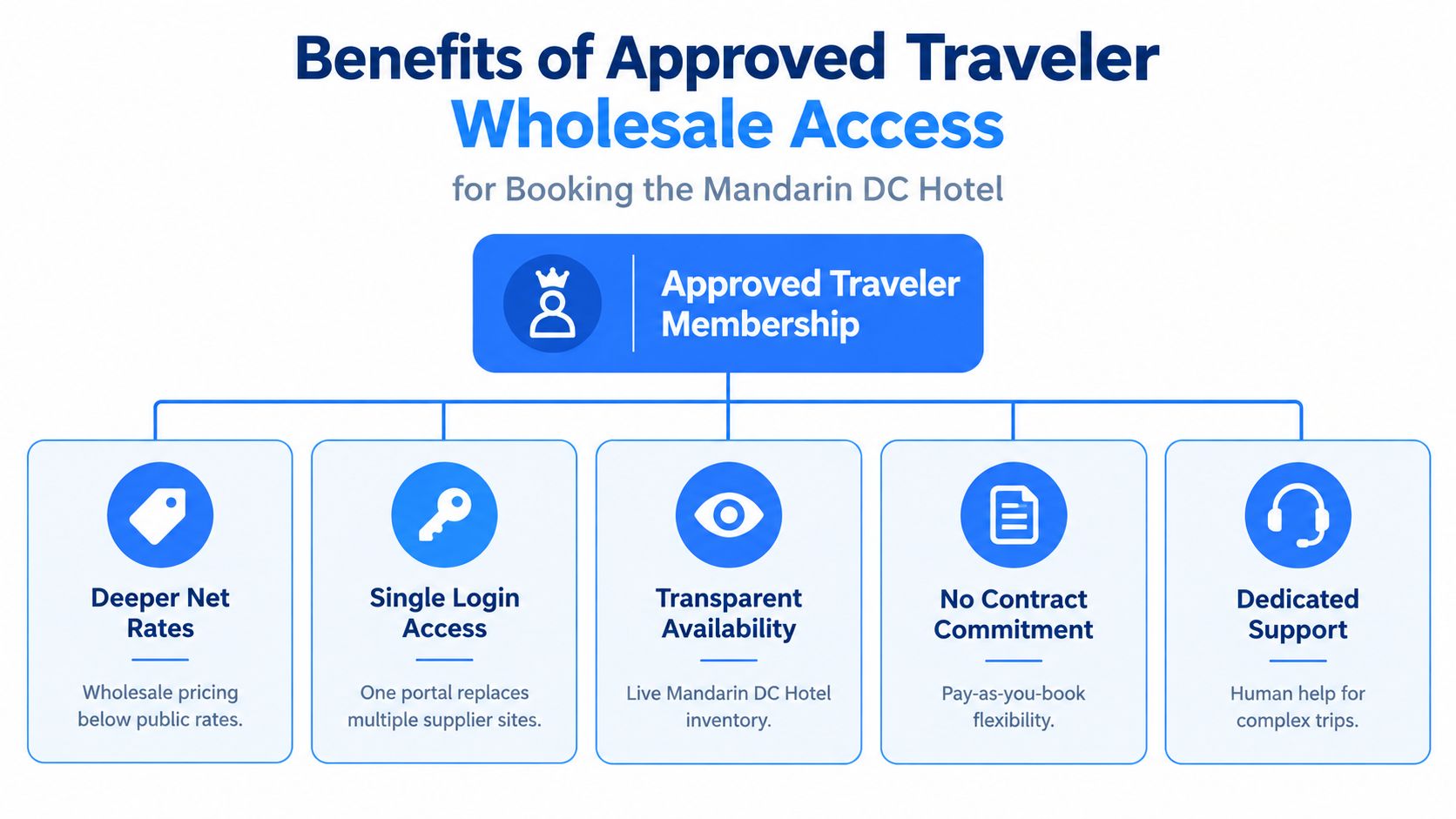
For a short, simple stay, a retail rate may be perfectly adequate. The hidden value gap appears when booking friction increases. A wholesale membership can matter more if Reward Credits accumulate across bookings, if a 110% Best Value Guarantee changes the downside of finding a better comparable rate later, or if one support structure helps correct a reservation involving several travelers. For a broader framework, review hotel booking sites and their operating differences.
Benefits of Approved Traveler Wholesale Access
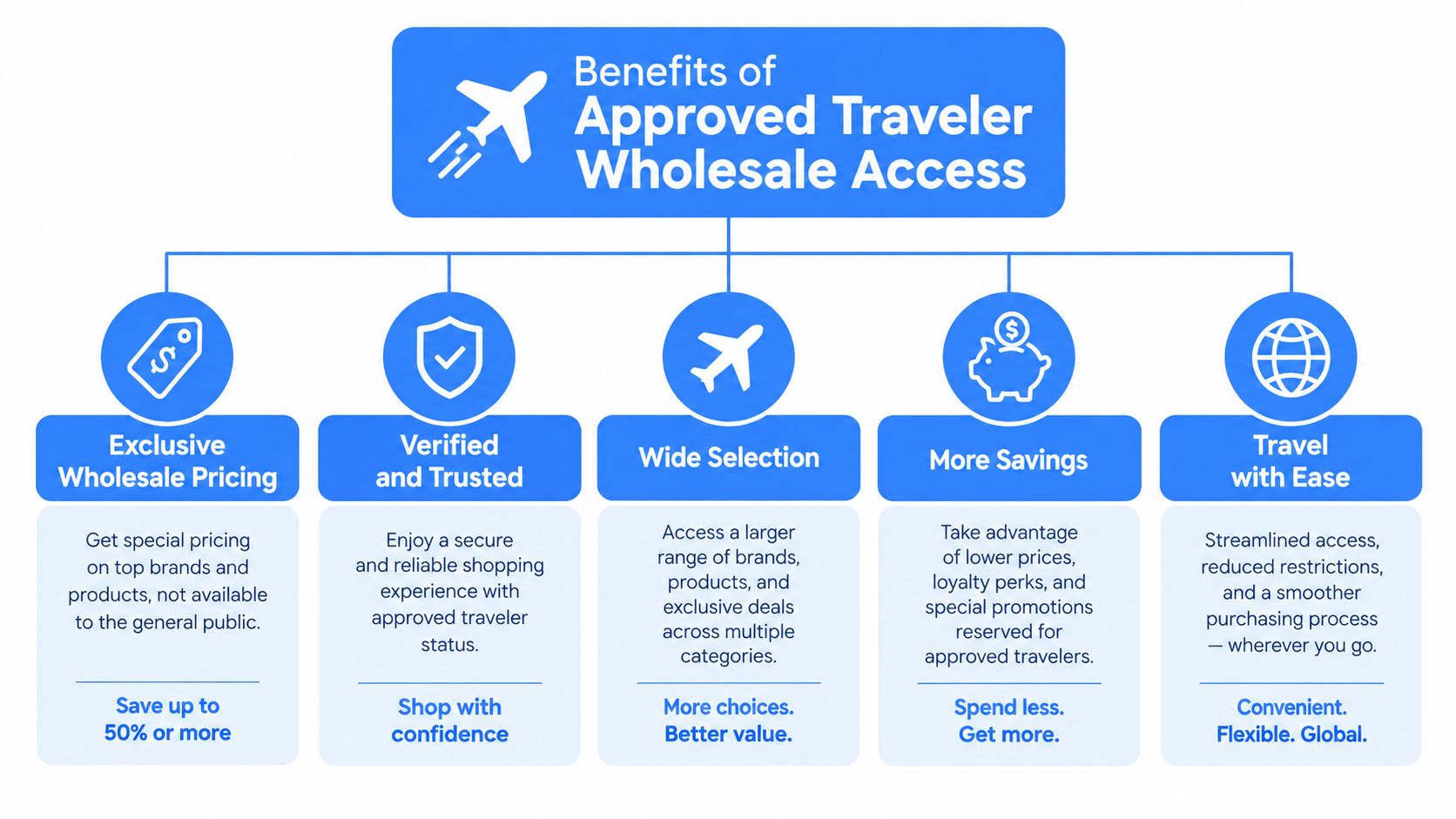
Approved Traveler's value rests on infrastructure that retail booking usually keeps separate. The five relevant pillars are consolidated inventory, Reward Credits, household scale, the 110% Best Value Guarantee, and support. Their importance changes with the booking pattern.
Consolidated inventory
One membership replaces the need to maintain multiple fragmented travel access points. That doesn't guarantee a particular Mandarin DC hotel suite will be available, but it gives the traveler one search and booking environment for comparing participating inventory. This is most useful when a trip includes hotels, vacation homes, flights, activities, or car rentals rather than a single room.
The practical gain is less tab switching and fewer disconnected terms to reconcile. A family organizer can research the hotel stay within the same infrastructure used for other travel components, then keep booking records and benefits associated with one account.
Reward Credits
Members earn Reward Credits on every booking. Credits don't expire and can be redeemed toward future bookings, maintenance fees, resort usage fees, annual renewal, and selected eGift cards. Their value depends on redemption, so a responsible comparison shouldn't assign them an invented dollar amount.
Consider a family organizer booking several rooms for one Washington stay. The useful calculation isn't “how much cash back will this room produce?” It's whether the booking generates credits that can later support another eligible travel or membership expense. That creates a form of continuity retail OTA bookings often lack, especially when the traveler isn't loyal to one hotel brand.
Household scale and Boomerang Member Share
Approved Traveler supports up to 10 household members, with benefit parity and no per-person fees. The Boomerang Member Share program extends the structure by allowing the primary member to earn Reward Credits on eligible hotel and car bookings made by shared family and friends.
That changes the economics of delegation. A parent organizing rooms for adult children, or a household coordinating travel across generations, can centralize the booking relationship without requiring every traveler to operate a separate membership.
The 110% Best Value Guarantee
The 110% Best Value Guarantee addresses a weakness in ordinary public-rate comparison. If a member finds a lower publicly available price under the guarantee's terms, the refund equals 110% of the difference. It isn't the same as claiming that every search produces the lowest rate, and the eligibility conditions still need to be checked.
The protection matters because rates can change after research. A member who documents the competing public offer and follows the claim process has a defined remedy rather than relying on a vague promise of price parity.
V.O.I.C.E. and travel infrastructure
Timeshare owners can also use V.O.I.C.E. to deposit up to 5 weeks per year for credits, exchange weeks without a fee, or list weeks through a peer-to-peer rental marketplace without a listing fee. That feature isn't necessary for a Mandarin DC hotel reservation, but it illustrates the broader difference between a standalone hotel search and consolidated travel infrastructure.
For frequent travelers, the strongest benefit isn't one isolated rate. It's the ability to connect hotel bookings, family participation, future redemption, and support inside one system. Members comparing the wider membership structure can review the Gold Card benefits, but the decision should remain tied to actual booking frequency and complexity.
Pitfalls of Retail Booking Channels
A room rate can look competitive and still produce the weaker booking outcome. That gap usually appears when travelers treat public visibility as if it were complete inventory, or assume that a room displayed on one retail channel reflects the same allocation, servicing path, and support quality available elsewhere.
The risk grows with party complexity. A hotel site may show several standard rooms but say little about adjacency, connecting options, or whether the inventory shown is the inventory still practical for one household. An OTA may list a suite category, yet that allocation can move separately from direct channels or consolidated wholesale access. For a family or multi-room group, each reservation can confirm successfully while the full room plan fails.
The suite allocation problem
As noted earlier, suites represent only a limited share of the former property's keys. That matters because suite availability is not interchangeable with general room availability. If one booking needs a suite for grandparents, another room for parents, and another for children, searching each room one by one often creates a fragmented result instead of a usable one.
Retail shopping can hide a real value difference. Public channels are good at showing visible rates. They are less reliable at showing whether the remaining inventory still supports the trip as a whole, especially when travelers care about room mix, proximity, or coordinated servicing. A consolidated wholesale environment can be stronger here because the booking decision is evaluated at the itinerary level, not just by the first available public room.
Retail comparison also tends to flatten unlike offers into a single price table. Two rates may look close, yet carry different cancellation terms, payment timing, breakfast treatment, or support responsibilities. Once a stay changes, those differences stop being minor.
The total-cost blind spot
Guest feedback on the property points to no in-room coffee facilities, expensive parking, limited casual dining, breakfast waits exceeding 30 minutes, windows that couldn't be opened, and renovation-related access limitations (guest review evidence). Those points matter because they affect the daily operating cost of the stay, not just comfort.
A one-night visitor may accept those trade-offs. A family organizer, remote worker, or guest managing older relatives may value fast breakfast, easier morning routines, and fewer on-property workarounds far more than a small difference in headline rate.
A public rate shows the room price. It does not show the coordination cost.
Why rate parity isn't enough
Rate parity can make retail offers appear equivalent across channels, but similar pricing does not mean similar value. A public booking may omit Reward Credits, may not give the traveler the protection of a defined 110% Best Value Guarantee, and may split service across the hotel, an OTA, and the payment channel if something is unclear.
A better booking process is more disciplined. Search for the whole party at once, compare the exact room category and cancellation terms, confirm current facility access, and judge the channel by inventory quality and post-booking support, not only the first number on the screen.
Detailed Comparison of Booking Channels
The room spread matters more than it first appears. At the former property, guest rooms ran from approximately 400 to 700 square feet and included high-speed wireless internet, video-on-demand, Apple TV, Samsung 55-inch 4K televisions, smart-device connectivity, bedside USB ports, and international adapters (former room specifications). That range is wide enough to change how well a booking works for a couple, a family member sharing space, or a traveler carrying work equipment.
| Criteria | Approved Traveler | Retail Channels |
|---|---|---|
| Inventory access | Consolidated wholesale access through one membership environment | Public hotel or OTA inventory, often separated by channel |
| Reward Credits | Earned on every eligible booking and redeemable for stated future uses | Usually tied to the individual hotel, OTA, or program terms |
| Guarantee policy | 110% Best Value Guarantee, subject to its conditions | Policies vary by hotel website or OTA |
| Service-level benefits | Membership support and centralized booking infrastructure | Direct hotel or OTA support, often separated |
| Total cost evaluation | Room rate plus the potential value of Reward Credits and guarantee protection | Room rate plus applicable property, channel, parking, dining, and stay-related costs |
| Booking flexibility | One account can support household and broader travel planning | Often requires separate accounts and booking flows |
Inventory access
Inventory is where the hidden differences start. A wholesale membership model can consolidate room supply that would otherwise be split across a hotel site, one or more OTAs, and separate service desks. That matters most for suites, multi-room stays, and bookings where one traveler is coordinating for other people, because fragmentation can reduce visible availability even when the property still has saleable inventory in another channel.
Consolidation also affects service quality, not just search convenience. If booking, payment, and support sit in one environment, the traveler has a clearer path when a room type changes or a special request needs follow-up. Retail channels still make sense for a simple one-room stay, especially for guests who want a direct relationship with the hotel, but they do not automatically offer the best view of higher-category inventory.
Credits and guarantee protection
Wholesale value is often understated because it does not always appear in the first nightly rate. Reward Credits create post-booking value, and the 110% Best Value Guarantee adds a defined protection mechanism if a qualifying lower public price appears later. Those two features change the economics of the reservation, even when the initial public rate looks competitive.
The right comparison is disciplined. Match the exact dates, room category, occupancy, cancellation policy, and included terms. Then compare the approved channel's full payable amount against a qualifying public offer. If the guarantee applies, the refund is 110% of the difference. Reward Credits should be tracked separately, because they have value without needing to be forced into an assumed cash-equivalent discount.
Service and room fit
Room fit is an operational issue. A room near 400 square feet and one near 700 square feet can perform very differently once luggage, extra seating, or a work setup enters the picture, so category names alone are weak decision tools. Ask for the exact layout, bathroom setup, and bed configuration before booking, especially if more than one person will use the room heavily during the day.
Channel structure also shapes what happens after purchase. Travelers who want a clearer view of supplier relationships can review how Samba connects direct bookings. The practical conclusion is simple. Inventory consolidation can improve access to suites and reduce service handoffs, while wholesale membership benefits can create value that a public rate comparison misses.
Use Cases for Different Traveler Profiles
A good booking choice depends on what the traveler is trying to control. For the same mandarin dc hotel stay, the visible room rate can matter less than suite access, service continuity, and whether the booking channel keeps one coordinator from chasing scattered confirmations.

Multi-generational family organizers
Family groups usually face a coordination problem before they face a pricing problem. The property historically offered roughly 38,000 square feet of function and pre-function space, including an 8,300-square-foot Grand Ballroom for up to 800 guests at a seated dinner and a 5,350-square-foot Oriental Ballroom for up to 450 banquet-style guests (meeting facilities overview).
Those figures matter less for a small reunion than the operational signal behind them. A hotel set up for events can handle group movement, but the booking channel still determines whether room blocks, nearby categories, or suite inventory are visible early enough to be useful. Inventory consolidation can make a real difference here, especially if one organizer is booking for several relatives and wants fewer service handoffs.
Approved Traveler is the stronger fit when multiple household members may book under one structure, Reward Credits have future value, or the lead planner wants one record across related reservations. Public channels can still work for a simple two-room stay, but they are weaker when success depends on adjacency, upgrades, or matching several arrivals to one family plan. Current room names and facilities should always be reconfirmed, because older Mandarin Oriental descriptions may not map cleanly to the present operation.
Snowbirds and extended-stay guests
Longer stays expose small frictions. The review-based issues noted earlier, including coffee setup, parking cost, and casual dining limitations, matter more over five nights than over one.
That changes the channel decision. A retail booking can be reasonable if the guest has already confirmed how those daily routines will be handled and values dealing directly with the hotel. Wholesale access becomes more attractive when the stay sits inside a broader travel pattern, because Reward Credits, centralized records, and the 110% Best Value Guarantee can create value that does not show up in a headline nightly rate.
Some snowbirds should also compare the hotel against temporary housing rather than against other hotels. For travelers who need nearby non-hotel options, a separate tool can help locate DC units by SMS. That comparison is useful when the hotel suits meetings or short city access, but not the economics or routines of a longer household stay.
Remote workers
Remote workers need the room to perform as both lodging and workspace. Prior property materials referenced wireless internet, Apple TV, device connectivity, and bedside charging support. The more important question is whether the current setup supports sustained work hours without interruptions, not whether the amenity list looks polished.
Ask for current connectivity terms, desk or table dimensions, wellness access, and any renovation or maintenance notices before booking. Channel choice matters here because service continuity affects problem resolution. Frequent bookers may get more value from Approved Traveler if they want one account across hotel and vacation bookings, while a short solo work trip may still favor a direct retail reservation with current room confirmation.
High-net-worth executives
Executives usually buy reliability. A small public rate gap matters less than fast response, stable handling, and access to the right room type when plans change.
A Lux Traveler account adds the Approved Lux 24/7 Personal Assistant and supports up to 10 household members, which is useful when business travel overlaps with family scheduling or assistant-led booking. For a single straightforward stay, direct booking can still be the cleanest option. For recurring travel with multiple participants, consolidated wholesale access is often the better value because it improves control over suites, reduces booking fragmentation, and adds benefits beyond the initial displayed rate.
Recommendations for Booking the Mandarin DC Hotel
A small rate gap can hide a much larger value gap once you factor in suite access, service recovery, and future-use credits.
Start with the booking risk, not the headline price. Ask four questions: How many rooms are required? How important are suites or adjacency? Will the household make additional bookings? How costly would a booking problem be? Those answers usually separate a simple retail purchase from a stay that benefits from wholesale membership infrastructure.
Approved Traveler is the stronger choice when the trip involves multiple rooms, a suite-dependent itinerary, recurring travel, or several people booking under one umbrella. The main advantage is not only the initial rate comparison. It is the combination of consolidated inventory access, Reward Credits, and the 110% Best Value Guarantee, which can create better total value over time if the traveler uses those features. Track credits carefully and confirm the exact room category in writing before relying on any guarantee claim.
Retail channels still make sense for a short, single-room stay with limited coordination risk. In that case, speed and direct property confirmation may matter more than downstream membership value. For longer visits, confirm the exact square footage of your assigned category in writing, since category names alone may not distinguish the compact and premium ends of the property's range.
Before payment, save the confirmation and ask the property to confirm adjoining-room, accessibility, pool, fitness, parking, dining, and audiovisual requirements. Travelers comparing complex booking options can review Approved Experiences Traveler if they want one membership structure for wholesale inventory, credits, and household use.
Want the wider view?
Ten categories. One report. Every quarter. The Approved List tracks what's rising and what's fading: data-backed signals, not opinions.
Free to join · Delivered by email