All Articles
The Journal
Personal Assistant Description That Reclaims Your Time
September 20, 202616 min readpersonal assistant dutiesassistant responsibilities
Learn what a personal assistant description really covers, from duties and KPIs to ROI. See tailored examples and how Approved Lux delivers.
A useful way to think about a personal assistant description isn't “What errands can this person run?” It's “What part of my week keeps getting eaten by coordination?” That reframing matters because one independent survey found the average adult spends 21 hours and 36 minutes per week on work admin plus 8 hours and 48 minutes on personal admin, or more than 30 hours weekly in total, according to Brightpearl's admin-time survey. If you're searching for a personal assistant description, you're usually not looking for a nicer task list. You're trying to stop admin from taking over your work and home life.
Introduction to What a Personal Assistant Description Really Means
Brightpearl's admin-time survey found that adults can lose more than 30 hours a week to work and personal admin, as noted earlier. That number explains why a search for a personal assistant description usually starts after a breaking point, not out of curiosity.
At first glance, the role can look like a list of small tasks. Book the appointment. Change the flight. Follow up with the contractor. Confirm camp forms. Yet small tasks rarely stay small. Each one pulls attention, requires a decision, and leaves an open loop to remember later.
That is the part many job descriptions miss.
A good personal assistant description is really an operating document. It defines which kinds of coordination leave your head and enter someone else's system. The difference matters because the cost is not only time. It is context switching during the day, cleanup work at night, and the mental load of tracking what is still unresolved.
For a founder, that admin tax often shows up as lost strategic hours. For a parent, it shows up as household friction and last-minute scrambling. For a frequent traveler or caregiver, it shows up when one schedule change triggers five more messages, two new bookings, and another round of follow-up.
The practical question is simple. What function is this role taking over?
A weak description stays at the surface. It says the assistant handles scheduling, errands, and reminders. A useful description goes one layer deeper and names the outcome. It assigns ownership of recurring coordination, vendor follow-up, appointment management, travel adjustments, and routine research so the client spends fewer prime hours on logistics and carries fewer open loops.
That shift changes the hiring decision. You are not just filling a support role. You are deciding which parts of life and work need a standing operator, someone who catches loose ends before they turn into interruptions.
The role is also more established than many people assume. One labor snapshot cited by Zippia's occupation demographics reports about 33,641 personal assistants employed in the United States, with women representing 80.7% of the occupation and the average age at 48, alongside a broader personal assistant and office assistant grouping of 133,655 workers. The point is practical. Administrative support remains a durable way people protect time, reduce coordination drag, and keep daily operations from spilling into every spare hour.
Understanding the Core Concept Behind Modern Personal Assistance
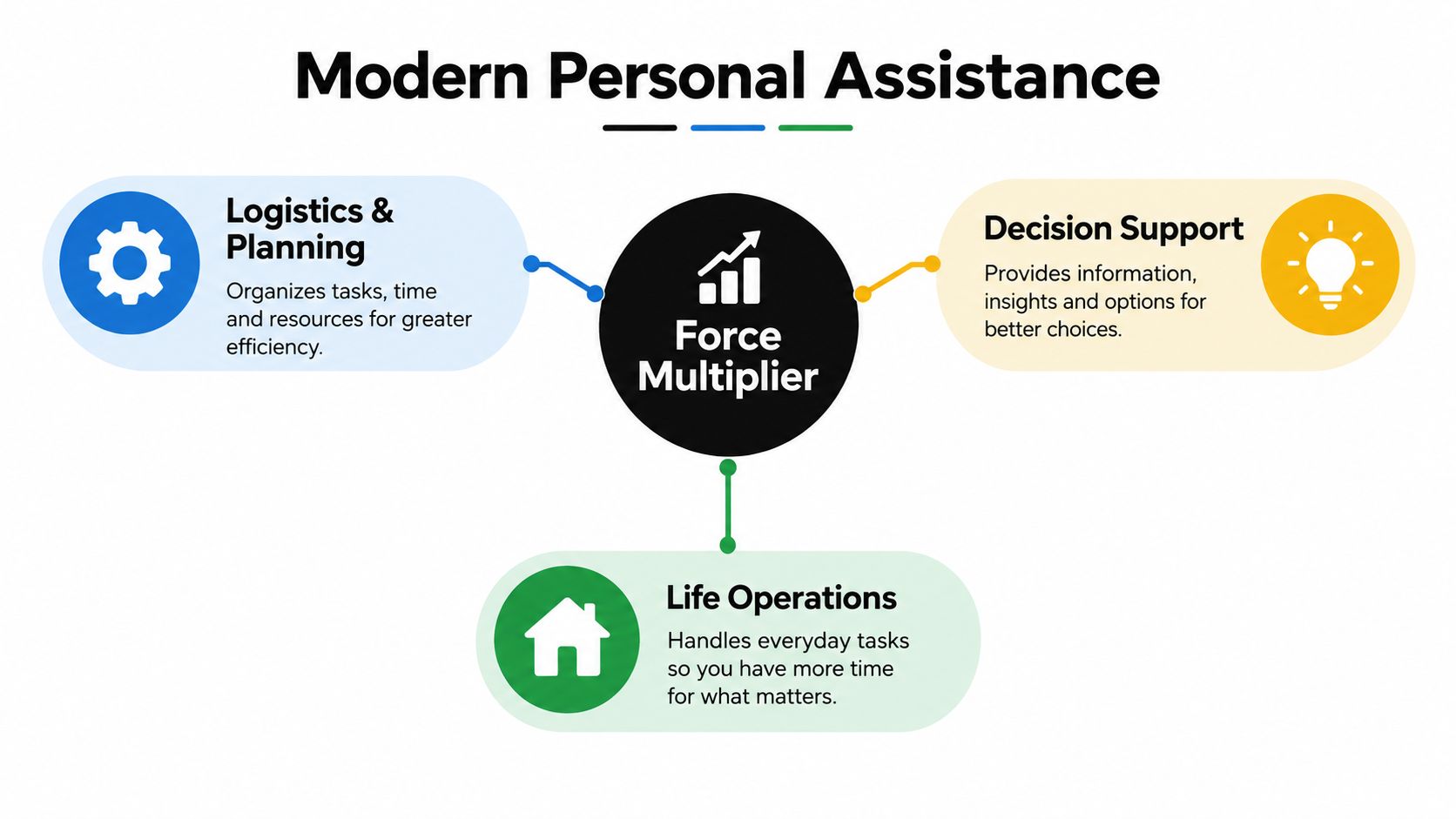
A modern personal assistant is an operating system for recurring life logistics. The role matters because time loss rarely comes from one large task. It comes from constant switching, follow-up, and remembering what still needs attention after your workday should have started.
Personal chief of staff is the better model
The most useful comparison is a chief of staff for personal operations. The assistant may handle errands, bookings, and reminders, but the higher-value function is ownership of coordination. That means fewer loose ends sitting in your head and fewer moments where a simple task turns into three follow-ups, two decisions, and a calendar change.
In practical terms, strong support does three things at once:
- Holds context: preferences, routines, deadlines, and repeat friction points stay documented instead of living in your memory
- Owns the process: tasks move from request to completion without constant checking from you
- Protects attention: small logistics stop interrupting work blocks, family time, or recovery time
This is the difference between assigning work and offloading operational drag.
If you delegate dinner reservations but still need to remember dietary notes, confirm the booking, and adjust timing after a meeting runs late, the task moved but the mental load stayed with you.
Task list versus operational impact
A weak personal assistant description reads like a shopping list of chores. Schedule appointments. Book travel. Run errands. Send reminders.
A stronger description explains what those activities change. Calendar conflicts get resolved before they become text chains. Travel changes get handled without turning you into the backup coordinator. Household or family logistics stay on track even when your attention is somewhere else.
That distinction matters because different clients are buying different forms of relief.
A founder may need protection from calendar sprawl and inbox-driven interruptions. A parent may need someone to manage recurring family coordination. A frequent traveler may need active itinerary monitoring and rebooking support. A caregiver may need appointment tracking, paperwork follow-up, and vendor communication handled with consistency.
Same job title. Different operating goal.
The question behind the search
People often search for a personal assistant when they feel busy. Busy is not the best hiring signal. The better signal is repeat coordination cost.
Ask a narrower question: what keeps bouncing back to me after I thought I had already handled it?
That usually reveals the true problem:
- tasks that require follow-through across several steps
- decisions that depend on stored preferences
- scheduling changes that create a chain reaction
- routine responsibilities that still consume prime attention
Once you can name that pattern, the role becomes easier to define and easier to measure.
Why modern support improves with repetition
Good assistance gets stronger over time because context compounds. After enough repetition, the assistant knows which flights are acceptable, how much buffer to leave between commitments, which vendors respond quickly, and what deserves escalation.
That accumulated knowledge reduces both admin time and cognitive residue. Research on mental load points to the strain of organizing, anticipating, and coordinating tasks across a household, which is often the part people cannot easily hand off through one-off help alone, as explained in an IZA discussion paper on mental load.
A useful personal assistant description should account for that layer. It should describe not only what gets done, but what stops living in your head.
Core Responsibilities and KPIs That Define Great Support
A practical personal assistant description needs two parts. First, it should specify the work. Second, it should define what “good” looks like. Otherwise, you end up with vague promises and no way to judge whether support is helping.
To ground the role, start with the main work clusters.
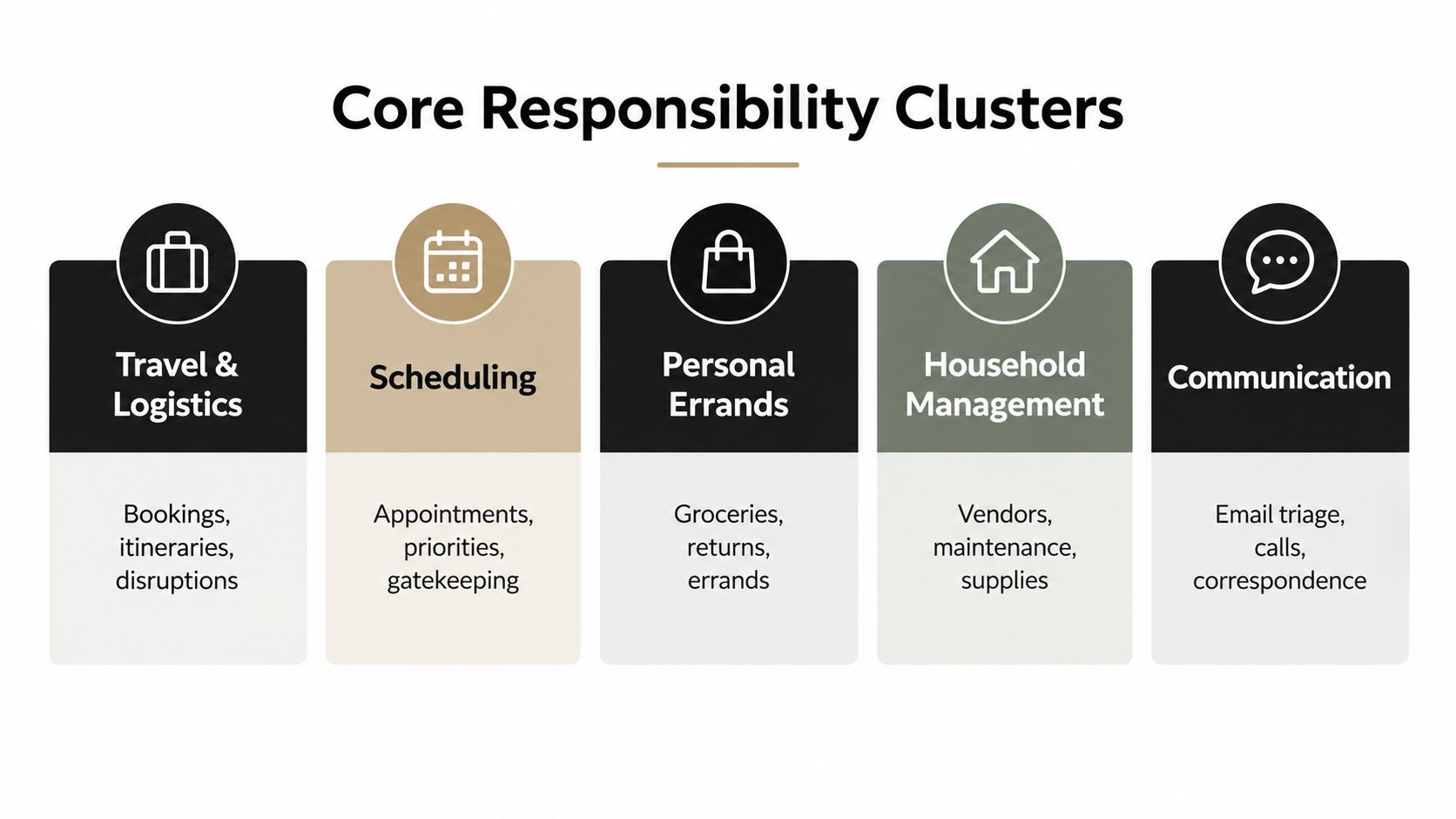
Five responsibility clusters that matter
Travel and logistics
This includes booking flights, hotels, and ground transport, building itineraries, tracking changes, and handling disruptions. Example: a consultant's return flight is canceled. The assistant finds the best rebooking option, adjusts the hotel, updates the calendar, and sends the revised itinerary.
Scheduling and calendar control
This covers appointments, meeting coordination, conflict resolution, reminders, and protecting focus blocks. For many professionals, this is the first place delegation pays off because meetings spread unless someone actively gates them.
Personal errands and household coordination
Think gift sourcing, returns, dry cleaning, home services, maintenance appointments, and event details. These tasks aren't hard. They're expensive in fragments.
Research and recommendations
This means vetting options, comparing vendors, summarizing reviews, checking availability, and presenting choices in a usable format. A busy person doesn't need more tabs. They need a short list and a recommendation.
Professional support
Inbox triage, email drafting, light document formatting, expense tracking, and meeting prep all fit here. For a deeper breakdown of the operating scope, this overview of what assistants do in practice is useful.
A quick walkthrough helps show how these categories show up day to day:
KPIs that make the role measurable
A description becomes useful when it includes outcomes. Good KPIs don't need to be fancy. They need to reflect whether operational noise is dropping.
| KPI | What it measures | Practical example |
|---|---|---|
| Hours reclaimed | Time no longer spent on admin | The client stops spending evenings on appointment follow-up |
| Turnaround time | How quickly routine requests move | A travel change is addressed before it creates a missed connection |
| Conflicts resolved | How often scheduling friction gets handled | Double-bookings disappear instead of becoming weekly fire drills |
| Follow-through rate | Whether tasks get fully closed | The vendor is booked, confirmed, and added to the calendar |
| Decision reduction | How many micro-choices are removed | The client reviews two vetted options instead of starting from scratch |
A compact audit checklist
Use this when reviewing any personal assistant description:
- Does it define ownership? “Assist with scheduling” is weaker than “own appointment coordination and conflict resolution.”
- Does it include follow-up? Booking without confirmation is incomplete support.
- Does it mention communication norms? Response channels and escalation rules prevent confusion.
- Does it identify success metrics? If not, performance becomes subjective.
- Does it fit your actual life? Family logistics, travel, or founder support each require a different spec.
A clear description protects both sides. You know what you're delegating, and the assistant knows what they're accountable for.
How Hiring Models Compare on Cost and Overhead
A hiring model changes the price of support more than the job title does. The role may be called personal assistant, executive assistant, or concierge support. Your actual decision is simpler: are you buying time back, or are you adding another person to manage?
That distinction matters because admin work carries two costs. One is visible, the invoice or salary. The other is the mental load of remembering, clarifying, following up, and checking whether anything got done.
Why salary alone misses the real cost
A full-time hire can make sense if your workload is steady and heavy enough to keep one person busy. But salary is only one line item.
A Stealth Agents cost analysis estimates payroll taxes and benefits add about 29% to 40% above compensation, putting a national-median executive assistant at roughly $91,000 to $130,000 annually before equipment and management overhead. Separately, the C-Suite Assistants salary report places the national median base salary for an Executive Assistant at $110,000. Base pay is the starting number. Operating cost is the number you live with.
That gap is where many hiring decisions go sideways. A lower base figure can still produce a high-overhead setup if you also need to recruit, train, supervise, and build backup coverage.
True Cost Comparison for Personal Assistance Options
| Model | Annual Cost Range | Overhead and Management | Availability |
|---|---|---|---|
| In-house Executive Assistant | National median base salary $110,000 per C-Suite Assistants salary report; fully loaded national-median cost roughly $91,000 to $130,000 before equipment and management overhead, as noted earlier from Stealth Agents | Hiring, onboarding, payroll, benefits, equipment, direct supervision | Usually business-hour dependent |
| Offshore support model | Often lower hourly spend, but quality control and context management vary | Lower cash cost can come with more follow-up, re-explaining, and process checking | Varies by provider and time zone |
| Subscription assistant service | Usually structured as recurring service rather than employee compensation | Less employer overhead. Fit depends on scope, responsiveness, and who owns follow-through | Often designed for flexible access |
The overhead test that matters
A practical rule helps here. If the support model still requires you to act as project manager, editor, and reminder system, you have reduced labor cost more than you have reduced admin burden.
That is the hidden tax.
For a founder, that tax shows up as inbox triage and calendar repair bleeding into strategy time. For a parent, it shows up at 9:30 p.m. while confirming camp forms and rescheduling appointments. For a frequent traveler or caregiver, it shows up in context switching. Every handoff that needs extra explanation erodes the return.
Use these questions to compare models before you choose one:
- How much training does the model require up front?
- Who owns follow-up without being chased?
- How often will you need to restate preferences or context?
- What happens when priorities change midweek?
- Does the model reduce mental load, or only reduce hourly cost?
A personal assistant description should match the kind of overhead you can tolerate. If you need a partner who can hold context across family logistics, business scheduling, travel changes, or care coordination, the cheaper option can become the expensive one once your time is factored in.
For a more specific breakdown of full-time support versus flexible alternatives, see this guide on when hiring an EA makes financial and operational sense.
Tailored Personal Assistant Description Examples for Real Life
A generic personal assistant description usually fails because real life isn't generic. A founder, a traveling sales executive, and a parent managing school logistics all need different forms of support. The title may stay the same. The operating spec should not.

Working parents and dual-career households
This version of the role is less about errands and more about removing the second shift.
A useful description might read like this: the assistant coordinates school paperwork, pediatric appointments, camp registration, household vendors, birthday logistics, and recurring family calendar updates. Communication should favor text for quick approvals and email for weekly summaries. Success looks like fewer evening coordination sessions and fewer missed family details.
One reason this matters is that the burden is often invisible. Pew Research's working-parent report says parents, especially moms, still carry the mental load of balancing family needs and work demands. The same source also cites another 2026 report finding 81% of working moms handle parenting tasks while at work, while a Care.com sandwich-generation report referenced in the verified data found 80% feel mentally overloaded from making care decisions. That's not a minor inconvenience. It's an operating burden.
Founders and solo practitioners
This description should be blunt about protecting high-value hours.
Use language like: the assistant manages calendar intake, travel coordination, inbox triage, client scheduling, document formatting, and routine vendor research. Requests should be routed through a small number of channels, and the assistant should escalate only true exceptions. Success metrics include fewer scheduling interruptions, cleaner handoffs, and more uninterrupted work blocks.
If your revenue depends on judgment, every hour spent rearranging logistics is a poor trade.
Frequent business travelers
Travel-heavy professionals need a description built around volatility, not just booking.
A stronger version says the assistant handles itineraries, airport transfers, hotel changes, restaurant reservations, schedule adjustments across time zones, and disruption response when plans break. The communication standard matters here because delays often happen outside office hours.
The role works best when it reduces decision fatigue during movement. The traveler shouldn't be comparing three hotel options in a rideshare after a delayed flight. They should be approving one smart fallback.
Sandwich-generation caregivers
This is one of the clearest use cases for a personal assistant description because the workload is orchestration.
A practical description includes elder-care appointments, family calendar coordination, home-service scheduling, medication pickup reminders, sibling communication, and school or teen logistics running in parallel. The assistant doesn't replace family judgment. They reduce the coordination burden around it.
A PLOS ONE study on women, mothers, and mental load defines mental load as the non-visible cognitive process of thinking about, planning, organizing, and managing unpaid housework and caregiving. That wording is useful because it explains why simple task completion isn't enough. The hard part is often holding the whole system together.
A copy-ready structure you can adapt
If you're writing your own description, include these elements:
- Primary operating area: Work admin, family logistics, travel, or care coordination
- Typical weekly tasks: Name recurring tasks, not just categories
- Communication rules: Text for urgent, email for summaries, call for live changes
- Decision boundaries: What can be handled independently, what needs approval
- Success standard: Time reclaimed, conflicts prevented, and follow-through quality
Quantifying Time Reclaimed and ROI From Delegation
A personal assistant description earns its place when you price the admin tax against the work and attention it pulls you away from.
As noted earlier, outside research puts routine administrative work at a meaningful share of the day, and meeting coordination alone can consume hours each week for managers. That matters because delegation is not just about clearing tasks. It is about reducing context switching, follow-up debt, and the mental overhead of keeping dozens of small commitments active at once.
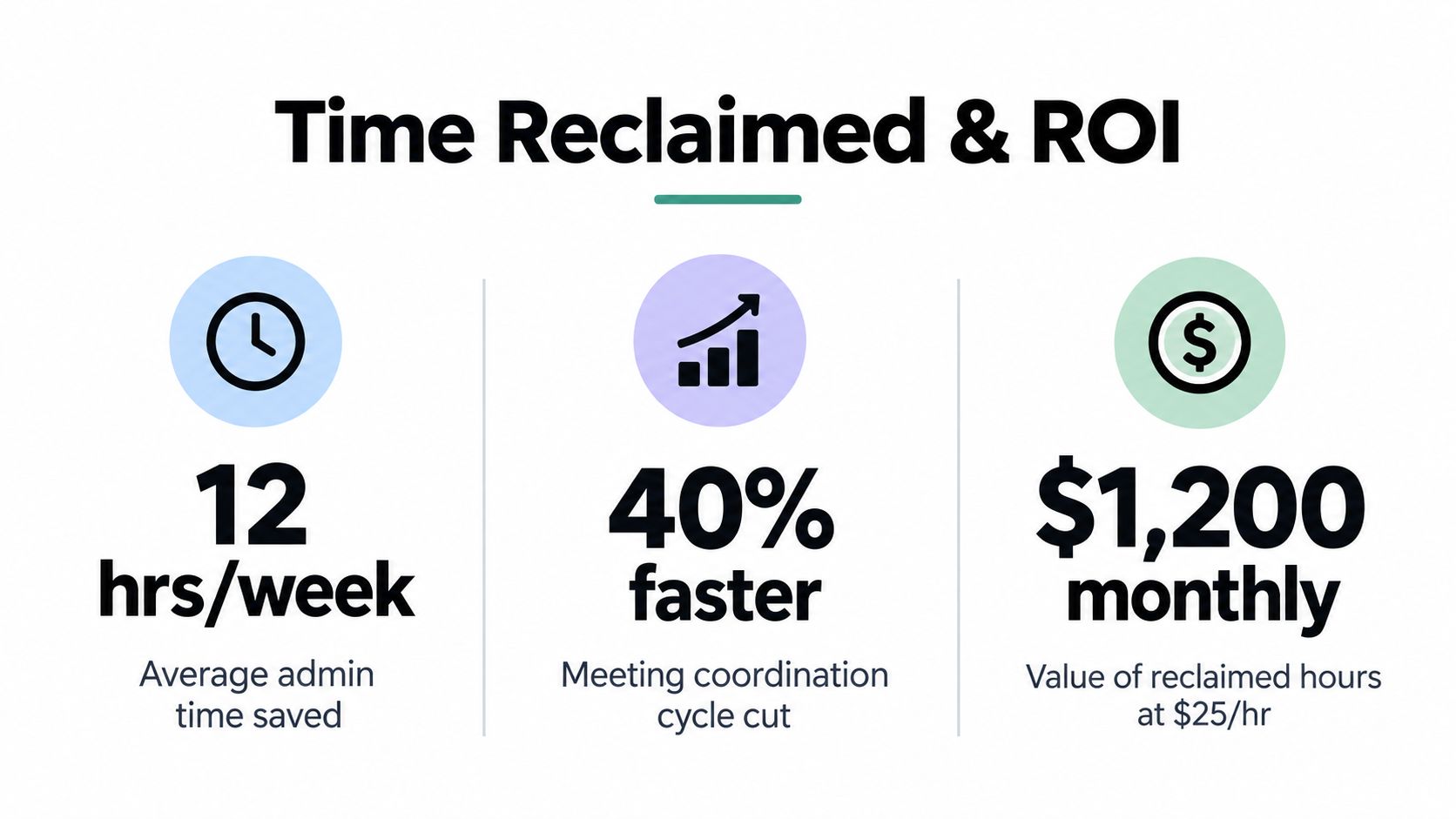
A simple ROI formula
Use this:
Hours reclaimed per week × your effective hourly value = weekly time savings created
The key is choosing the right hourly value. Salary is often the wrong number.
For a founder, that value may be sales conversations, proposal review, hiring decisions, or product work. For a consultant, it may be billable time. For a parent or caregiver, the return often shows up differently: fewer interruptions during the workday, fewer night-time planning sessions, and less stress from being the only person tracking what happens next.
A good description works like an operating manual. It transfers repeatable decisions out of your head and into a system someone else can run.
Two practical ways to calculate value
For revenue-linked professionals
List the tasks that directly create income or protect growth. Then list the tasks that support those activities but do not require your judgment every time. Inbox triage, scheduling, routine research, reservation changes, document follow-up, and status checks usually sit in that second group. If support gives you even a few more hours each week for client work, selling, or team leadership, the return is usually easy to see.
For families and caregivers
Use a household operations lens. Count the evening interruptions that disappear, the appointments arranged without workday disruption, the school or care details handled without repeated reminders, and the planning burden no longer carried by one person. The gain is time, but it is also steadier attention and less decision fatigue.
Delegation pays twice when it removes both the task and the need to keep remembering the task.
A better before-and-after test
Before support, your day can feel like running a computer with too many tabs open. Each small obligation may take only a few minutes, but together they slow everything down. Work gets interrupted. Personal logistics spill into business time. One exception, like a delayed flight or a changed appointment, pulls you into recovery mode.
After support, requests move into a managed queue with ownership, follow-up, and clear decision rules. You approve the parts that need your judgment. Someone else handles the motion around them. That is the return from a strong personal assistant description. It buys back time, yes, but it also returns focus to the highest-value parts of your role.
How Approved Lux Delivers on the Ideal Description
A useful solution in this category needs to match the standards above. It should reduce operational noise, lower management burden, and work across both personal and professional life without requiring a full-time hire.
One option is Approved Lux. It's a monthly subscription that provides 24/7/365 access to a US-based human Assistant team through Triple-channel access by phone call, SMS text, or email, with all three monitored at equal priority. The service covers travel and logistics, scheduling, personal errands, research and recommendations, and professional support. Onboarding captures preferences and access standards, and Proactive Preference Learning means the Assistant team adapts over time rather than treating each request as a fresh start.
Where the fit is strongest
The model is easiest to understand when you map it to actual use cases:
- Founders and solo practitioners: It works as a first layer of support before an in-house hire makes sense.
- Working parents: The Lux Circle plan supports up to 4 people on one account, which fits shared household coordination.
- Frequent travelers: The always-on structure matters when disruptions happen outside office hours.
- Caregivers: Team-based support helps with repeated scheduling, follow-up, and family logistics.
What the pricing structure signals
The pricing is straightforward. Lux Solo is $99.99 per month for individual access. Lux Circle is $299.00 per month for up to 4 people on one account.
For people who also need travel benefits, there's a practical bundling angle. Lux Traveler costs $1,799 per year and includes access to Approved Lux. If someone would otherwise buy Lux Circle and Approved Traveler separately, the combined annual total would be $4,487 according to the publisher information, so the bundled route is the cleaner fit for that use case.
The key point isn't the label. It's the operating model. If your personal assistant description is really a search for dependable help without W-2 overhead, this kind of structure lines up with the need.
If your week keeps disappearing into scheduling, travel changes, follow-up, and family logistics, Approved Lux Personal Assistant is built to remove that admin layer with a US-based human Assistant team available by call, text, or email. It turns a vague personal assistant description into something operational you can use, whether you need individual support or coordination for a household. See how it works at Approved Lux Personal Assistant.
Want the wider view?
Ten categories. One report. Every quarter. The Approved List tracks what's rising and what's fading: data-backed signals, not opinions.
Free to join · Delivered by email