All Articles
The Journal
Process Improvement Implementation: A Playbook That Ships
October 1, 202614 min readimplementation playbookoperations efficiency
A practical process improvement implementation playbook for busy teams. Define goals, map workflows, pilot changes, and lock in ROI without burning out.
Your pilot worked. The new intake form reduced rework, the team followed the revised approval path, and the dashboard finally showed movement. Then the normal week returned. A customer escalation landed, two people took leave, the inbox filled up, and nobody checked whether the new process was still being used.
That is the true test of process improvement implementation. Designing a better workflow is usually easier than protecting it from operational noise. The rollout survives only when someone owns the follow-through, reviews the evidence, handles exceptions, and keeps the change visible after the launch meeting ends.
Why Most Process Improvement Initiatives Stall After the Pilot
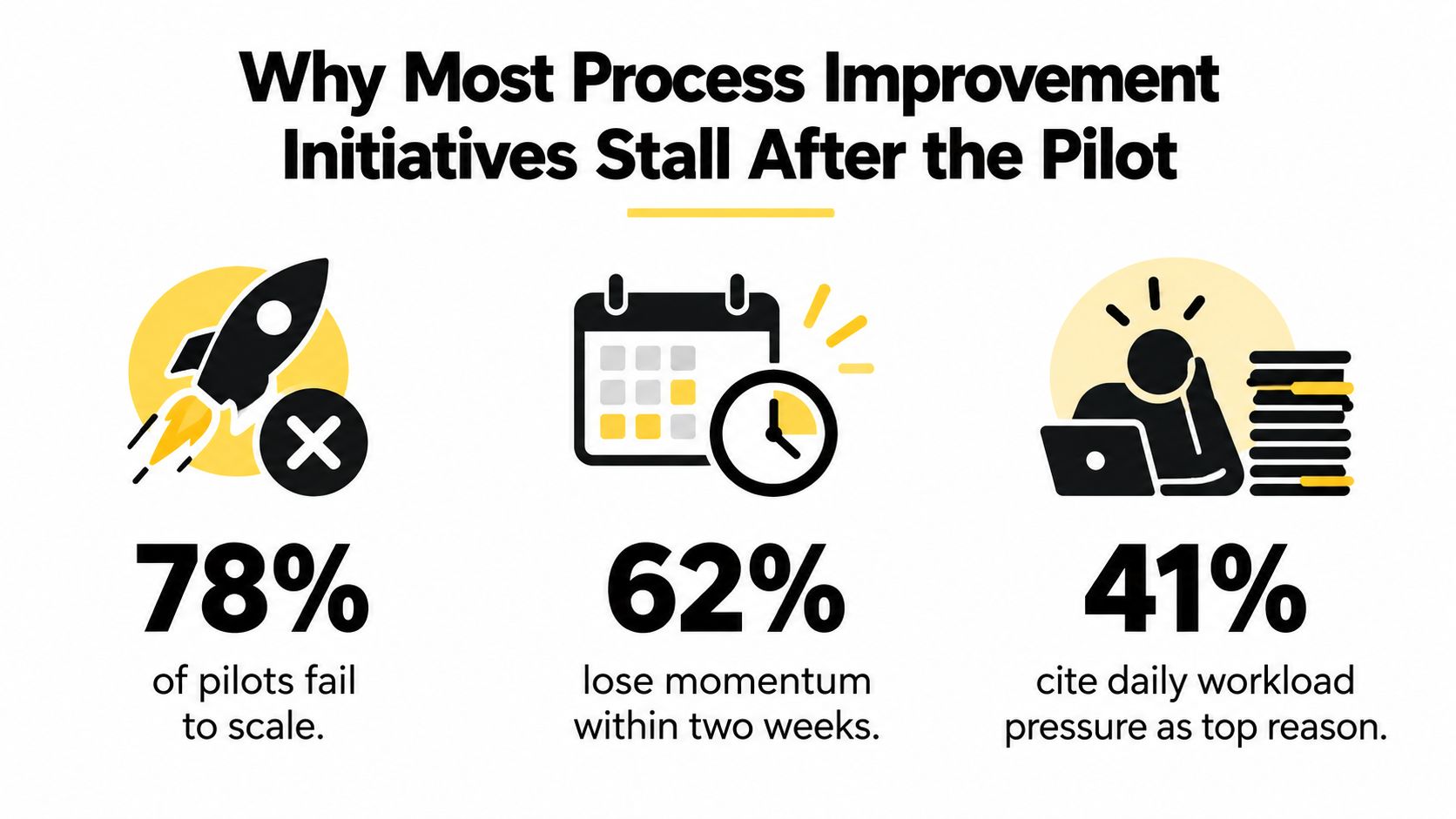
The familiar pattern is simple. A leader sponsors a pilot, the team proves a gain, and everyone agrees to “roll it out.” The owner returns to delivery work, the manager moves to the next priority, and the new process becomes optional in practice. Within days, people revert to the shortcut that feels fastest under pressure.
The failure point isn't usually the idea. It's the gap between pilot sign-off and steady-state behavior. A successful test answers, “Can this work?” It doesn't answer, “Who will check compliance on a busy Thursday, update the SOP after an exception, or escalate a blocked handoff?”
Evidence on transformation execution points to the same problem. GBTEC's 2025 process excellence and AI readiness report states that 88% of business and operations leaders say their organization is struggling with transformation, while only 43% say processes are managed as a strategic asset. The report also identifies a frontline disconnect: 73% of frontline supervisors and 82% of leaders believe improvement should be embedded in daily work, but only 39% of frontline supervisors say that is happening in practice.
Practical rule: A pilot is evidence. Implementation is a management system.
The fix starts by treating the second shift as real work. Status chasing, data capture, exception handling, documentation, and follow-up reminders don't disappear because the redesigned workflow is better. If nobody is assigned to perform them, they compete with revenue work and lose.
Teams also need to account for overcoming organizational change exhaustion. Repeated initiatives create resistance when employees experience each rollout as another demand without capacity, ownership, or visible support. Make the change smaller, give it a named operator, and keep the review rhythm short.
Document backup ownership as well. A no-single-point-of-failure approach helps prevent the process from depending on the one person who remembers every exception.
Defining Goals, Baselines, and KPIs You Can Actually Measure
Start with one workflow, not an enterprise ambition. “Improve operations” is a slogan. “Reduce the time from qualified request to approved proposal while maintaining review quality” gives a team something it can observe and change.
Write the outcome in operational terms:
- Cycle time: Reduce the elapsed time between two named events.
- Error rate: Reduce returned, incomplete, or corrected items.
- Capacity: Reclaim recurring hours from administrative handling.
- Customer experience: Improve a defined satisfaction or response measure.
A defensible baseline doesn't require a formal research project. Pull timestamps from tickets, use existing approval logs, review completed work, or keep a short time diary. The important requirement is consistency. A baseline recorded casually and a result measured rigorously will create a misleading victory, a problem highlighted in this review of process improvement pitfalls.
Use the five-minute test
Choose metrics that another person can retrieve without asking you to reconstruct the process. If a KPI requires a custom spreadsheet, manual interpretation, and a meeting to explain the meaning, it won't survive a packed week.
Use this test for every candidate metric:
- Who owns the number?
- Where does the source data live?
- What event starts and ends the measurement?
- How often will someone review it?
- What decision follows a change in the result?
| Filter Test | Pass Example | Fail Example |
|---|---|---|
| Clear owner | Operations coordinator reviews approval cycle time | “The leadership team monitors efficiency” |
| Existing source | Ticket timestamps from the service desk | A new manual survey with no assigned collector |
| Defined boundary | Request received to decision recorded | “Time spent on the process” |
| Simple cadence | Reviewed every Friday | Checked when someone remembers |
| Action attached | Escalate when delays recur | Report the number without a response |
Keep one primary KPI and a small number of guardrails. For an intake workflow, cycle time might be primary, while incomplete submissions and customer complaints protect against making the process faster by lowering quality.
The implementation standard is straightforward: establish the baseline before changing the workflow, record the source, name the reviewer, and state what action the metric will trigger. Without those four decisions, the dashboard is decoration.
Mapping the Current-State Workflow Without a Six-Month Discovery
Mapping fails when teams document the ideal process instead of the work people perform. The current-state map must include queues, rework, informal approvals, missing information, and the exceptions that operators handle without announcing them.
Start with a one-page flow note. Write the process as a timeline from trigger to completed outcome, using plain verbs such as “receive,” “check,” “request,” “approve,” and “record.” Add the person or role responsible for each action. Keep commentary beside the step rather than burying it in a separate document.
Then create lightweight swimlanes. Put customer, operations, finance, manager, and system activities in separate lanes. This exposes a common source of delay, work passing between roles without a clear acceptance rule.
Capture the waiting layer
Teams often record active work and ignore waiting. That omission hides the actual constraint. A request may take only a few minutes to review but remain in an inbox until someone notices it. A manager may approve quickly after opening the item, while the request sits unassigned beforehand.
Mark each handoff with four fields:
- Sender: Who releases the work?
- Receiver: Who accepts responsibility?
- Required input: What must be present?
- Exception path: What happens when the input is missing?
Don't merge decision lanes with execution lanes. “Manager approves” and “Coordinator updates the record” are different actions with different owners. Combining them makes accountability disappear.
Use a compressed mapping sprint rather than a prolonged discovery exercise. Three to five focused sessions are enough for many contained workflows when the right operators attend and the team works from actual examples. Session one captures the normal path. The next sessions test exceptions, queues, and handoffs.
The map earns its place when a new operator can use it to explain where work is, who has it, and what blocks the next step.
Build a small artifact stack:
- Narrative timeline: The sequence, including waits and rework.
- Swimlane view: The role-based movement of work.
- Handoff matrix: Sender, receiver, required input, and escalation trigger.
- Exception register: Recurring deviations and their current treatment.
This method aligns with practical process planning guidance that recommends mapping the existing process, analyzing the trouble points, redesigning with the people who perform the work, and monitoring the result. The value isn't visual polish. It's converting hidden operational knowledge into decisions the team can test.
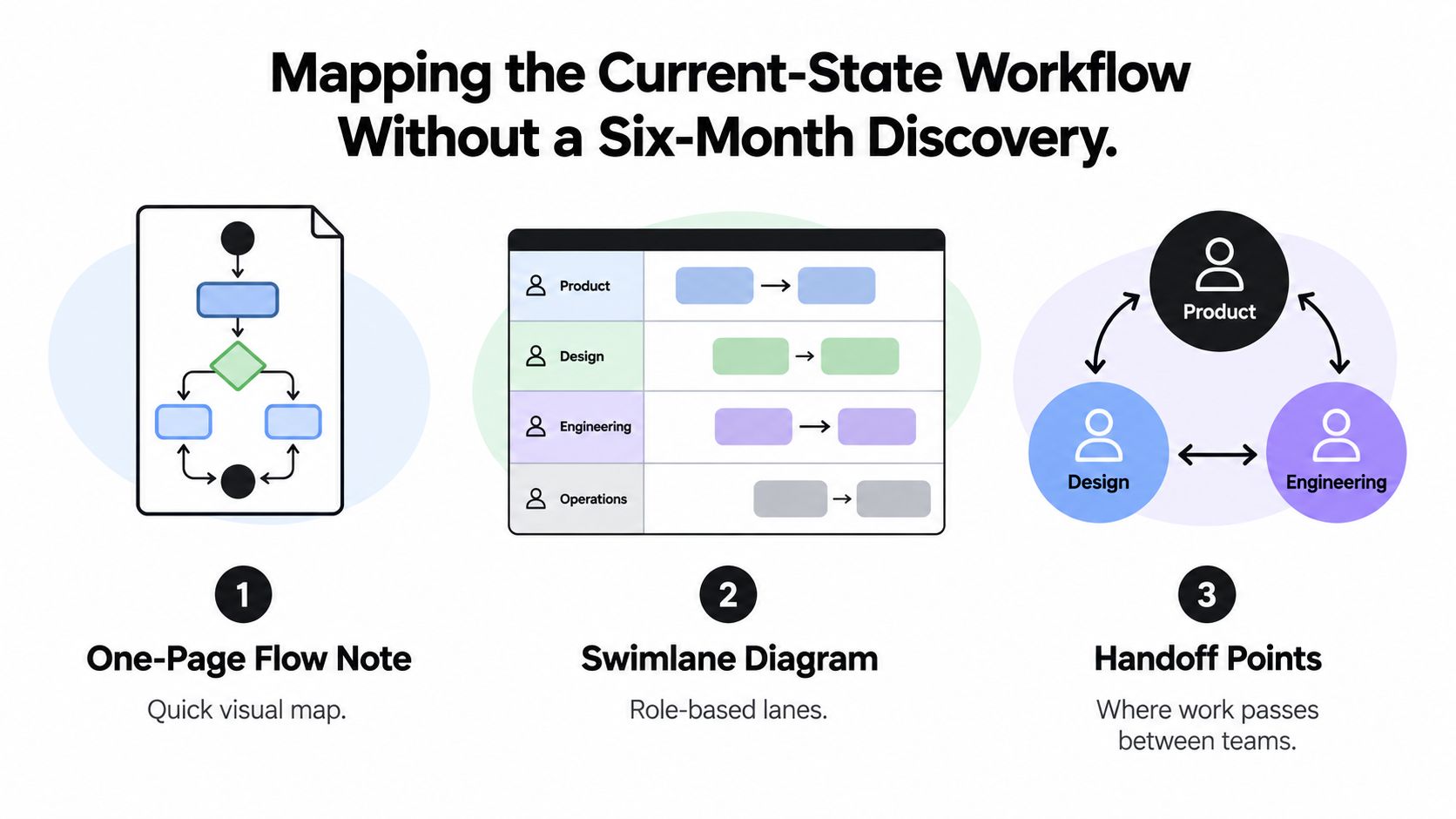
A short visual explanation can help teams distinguish flow, roles, and handoffs:
Picking a Bottleneck and Running a Tight Pilot
Don't improve everything at once. Pick the constraint that consumes the most recurring capacity and has a fix the team can test without rebuilding the organization.
Score candidate bottlenecks against three criteria:
- Frequency: How often does the problem occur?
- Cost: How much time or effort does each occurrence consume?
- Fixability: Can the team change the condition without waiting for a major system project?
A recurring approval chase may outrank a rare but dramatic system failure. The best target is often boring: missing information, unclear ownership, duplicate entry, or a queue nobody monitors.
| Candidate Process | Frequency (1-5) | Cost per Occurrence (1-5) | Fixability (1-5) | Total |
|---|---|---|---|---|
| Approval follow-up | 4 | 3 | 5 | 12 |
| Duplicate data entry | 3 | 4 | 3 | 10 |
| Rare system outage | 1 | 5 | 1 | 7 |
Use PDCA, Plan, Do, Check, Act, to keep the pilot bounded. Appian's explanation of continuous improvement describes the practical pattern: define the target and baseline, test a small change, compare results, and standardize only after the gain is proven.
Your pilot brief should fit on one page:
- Hypothesis: If we change this condition, this KPI will move.
- Baseline: Current result and measurement source.
- Intervention: The single change being tested.
- Owner: One person responsible for execution.
- Window: A fixed two-week test.
- Success metric: The result that supports rollout.
- Stop condition: The result or risk that ends the test.
Track data daily, with formal reviews on day five and day ten. A ten-day checklist can be as simple as:
- Confirm the owner and baseline.
- Brief the people performing the workflow.
- Start the intervention.
- Record exceptions rather than correcting them without noting it.
- Review early movement on day five.
- Remove scope that wasn't in the brief.
- Compare the result with the baseline on day ten.
- Standardize, revise, or stop.
If bottleneck theory is new to your team, this SaaS bottleneck analysis guide offers useful framing for separating constraints from symptoms. You can also use a practical workflow streamlining method to keep the pilot focused on movement through the process.
A restaurant example makes the sequence tangible. The team set a 20-minute service target, tested a kitchen layout, measured actual service times, and changed the layout across shifts after service time fell from 30 minutes to 18 minutes, as documented by 6Sigma.us's process improvement tools guide. The lesson is not the restaurant format. It's the discipline of testing one intervention against a defined baseline.
Locking In Gains With Ownership, Cadence, and Escalation
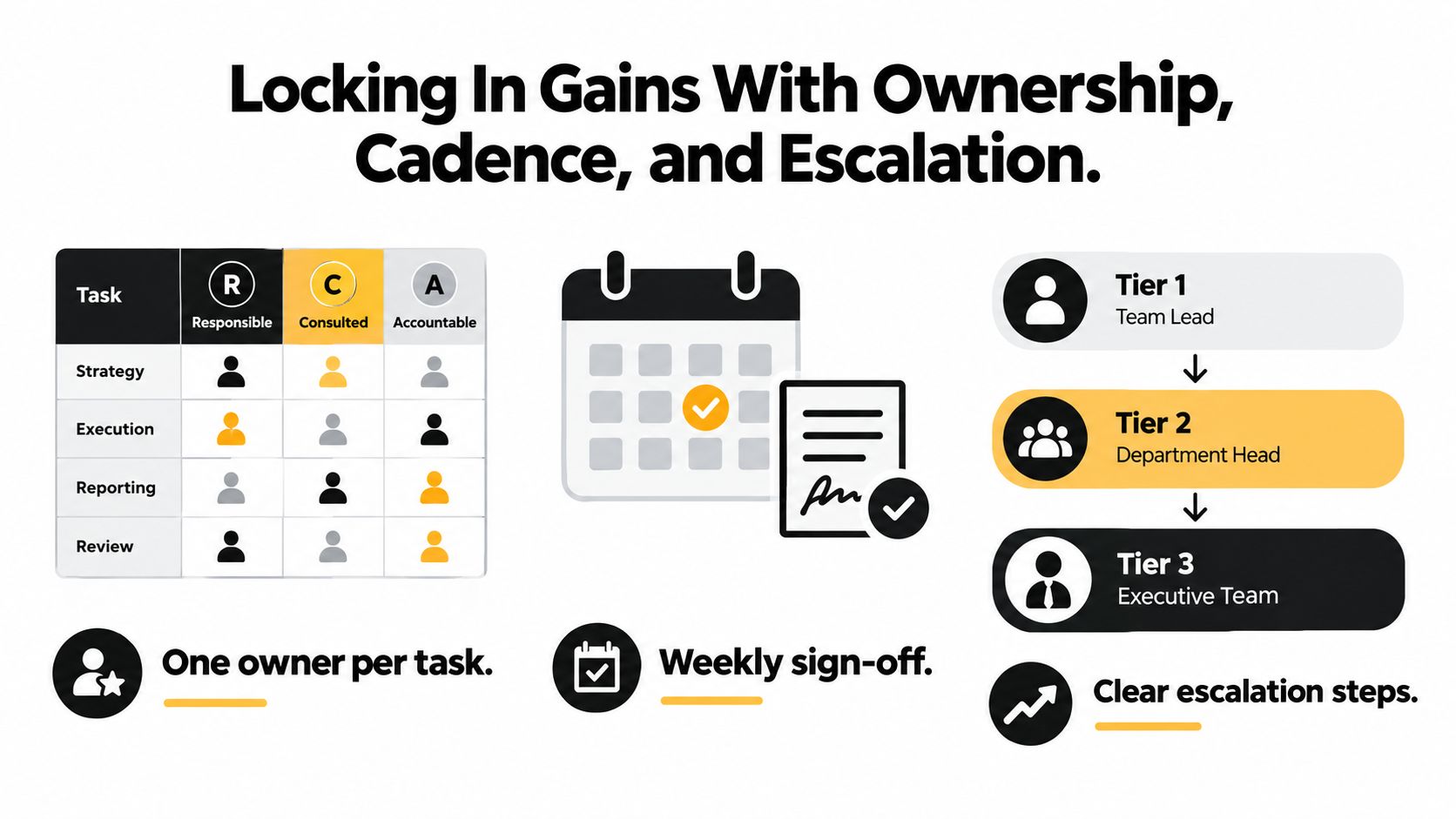
A process survives when the recurring work has an owner, a review rhythm, and a consequence for missed conditions. A RACI matrix is useful only when it names people or specific roles, not entire departments.
Assign one Responsible operator for each recurring task. Add one Consulted subject-matter partner for decisions that need expertise, and one Accountable leader who reviews the result and signs off. Keep the structure narrow. Five people copied on an update aren't five owners.
Turn responsibility into operating behavior
Pair the RACI with an escalation path. Define the trigger, the first responder, the backup, and the expected response time. For example, an incomplete request might return to the sender, while a blocked approval might move to the accountable manager after the agreed threshold.
A usable matrix looks like this:
| Trigger | First Response | Escalation | Backup |
|---|---|---|---|
| Required input missing | Responsible operator requests correction | Accountable lead if unresolved | Named deputy |
| Approval waiting beyond target | Responsible operator sends one follow-up | Manager reviews the queue | Operations backup |
| Repeated exception | Owner logs the pattern | Process lead decides whether to redesign | Deputy process owner |
Store the SOP where the team works. That may be the service desk, project workspace, or team channel. A polished document in a shared drive nobody opens isn't a control.
Use a cadence that fits a full calendar:
- Monday, 15 minutes: Review the KPI, open exceptions, and decisions needed.
- Friday, 5 minutes: Confirm completion, unresolved blockers, and owner changes.
- Monthly, 30 minutes: Review recurring defects, update the SOP, and select one improvement.
Run the first two cycles personally if you're the sponsor. Demonstrate how to record an exception, escalate a blocked item, and update the process note. Then hand over the work using explicit criteria: the owner knows the trigger, can access the source data, understands the escalation route, and has completed a review without supervision.
A cadence is real only when the meeting still happens after the process stops being interesting.
Use this team accountability framework to reinforce the ownership model, but don't confuse visibility with control. A status column can show that work is late. Only a named person with authority can resolve why it is late.
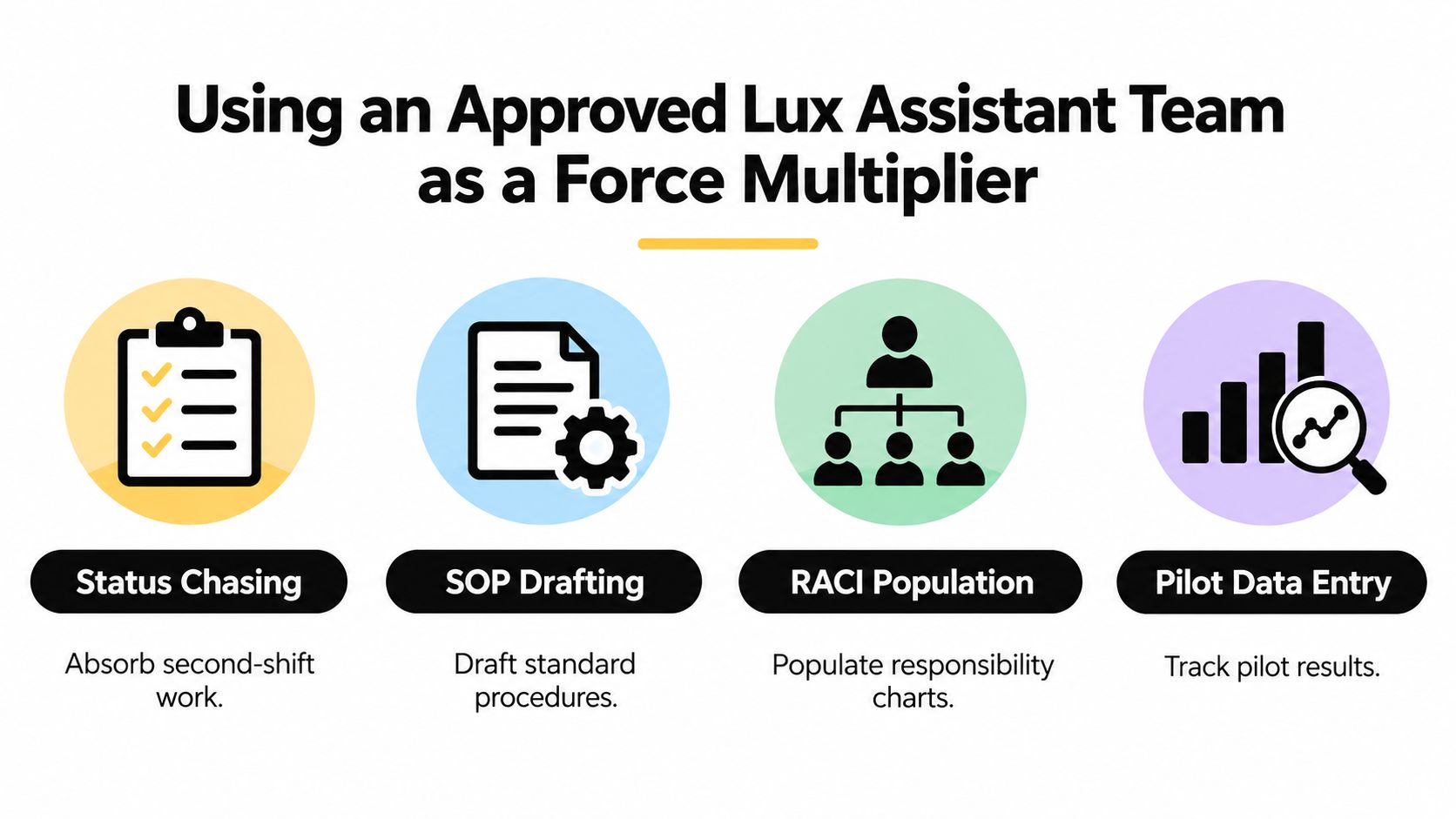
Using an Approved Lux Assistant Team as a Force Multiplier
Implementation creates a second-shift workload that many teams underestimate. Someone must chase status, draft the SOP, populate the RACI, collect pilot data, prepare the weekly summary, and remind owners about follow-ups. Those tasks are essential, but they don't require the process sponsor to personally perform every administrative action.
An Approved Lux Assistant team can function as a delegated execution layer for that work. The Assistant team can handle scheduling, inbox triage, document formatting, research, follow-ups, and expense tracking, which makes it suitable for the coordination around a rollout while the accountable operator retains approval authority. The point isn't to outsource process judgment. It's to remove operational noise that keeps the judgment owner from reviewing evidence and making decisions.
Use a delegation brief with five fields:
- Task: “Collect daily approval timestamps from the service desk.”
- Owner: The Assistant team prepares the report; the process owner validates it.
- Deadline: State the delivery time and review cadence.
- Definition of done: Include the source, missing entries, exceptions, and comparison with baseline.
- Receipt confirmation: Ask the Assistant team to confirm the brief and flag missing access.
Route work through the right channel
Approved Lux provides Triple-channel access, so the Assistant team can be reached by phone call, SMS text, or email, with each channel monitored at equal priority. Use the channel based on the work rather than forcing every task into a meeting:
| Work Type | Best Channel |
|---|---|
| Rapid status request | SMS text |
| Documents, tables, and source files | |
| Live walkthrough or exception review | Phone call |
This removes calendar tax from small coordination tasks. A process owner can send a short message asking for a status chase, email the latest SOP for formatting, or use a call to walk through an exception.
Capture preferences once, improve the handoffs
Proactive Preference Learning lets the Assistant team capture how the organization works, which formats people prefer, and which signals they trust. Create a preference checklist covering report layout, escalation wording, preferred review day, source systems, naming conventions, and approval boundaries.
The Assistant team can then own recurring review preparation, weekly summaries, KPI tracking, and follow-up reminders. The process owner still decides whether to change the workflow, expand the pilot, or accept a risk. This division matters because implementation fails when the decision-maker is buried in low-value coordination, not because every task requires senior judgment.
Approved Lux is a monthly subscription with US-based human Assistants, available 24/7 through its three communication channels. Lux Solo provides individual access at $99.99 per month, while Lux Circle covers up to 4 people at $299.00 per month, according to the publisher's product information. Treat the service as flexible execution capacity, not as a replacement for the accountable process owner.
Scaling, Measuring ROI, and Knowing What to Fix Next
Scaling should be a controlled repetition of what already worked. Take the proven pilot, preserve its trigger, steps, RACI, escalation path, and KPI definition, then apply that template to the next high-cost workflow. Run the next rollout as a contained wave rather than opening every process at once.
Tie the result to the baseline. Your dashboard should show the cycle-time change, error movement, hours reclaimed per person, and attributable financial impact where the data supports it. The administrative opportunity can be substantial: one published estimate calculates that a 30% administrative load equals about 600 hours per knowledge worker annually across 250 working days (PomodorOnline's administrative workload estimate). Use that figure as an ROI framing reference, not as a promise about your team's recoverable capacity.
Report weekly while the change is being scaled. Move to monthly review after the workflow stabilizes. One view is enough if it answers three questions: Is the process being followed? Is the result holding? What decision is required?
Several quiet failure modes deserve an explicit check:
- Missing baseline: You can't prove the gain or detect regression.
- Pilot celebration: One successful workflow becomes an isolated improvement.
- Diffuse ownership: Everyone supports the change, but nobody maintains it.
- Overloaded operator: The team assigns more recurring work to the person already carrying the queue.
- Unmanaged exceptions: The normal path looks healthy while edge cases create rework.
Choose the next repair by evidence
Triage the next workflow when cycle-time variance exceeds 25%, handoff defects repeat weekly, or one person becomes the de facto owner. The first condition indicates instability, the second shows a recurring transfer failure, and the third exposes a continuity risk. These thresholds are operating rules for prioritization, not universal benchmarks.
The broader case for disciplined implementation is strong. A 2025 study of 268 projects found that 198 projects, or 73.9%, implemented recommended changes, and every implemented project improved its process. Among those implementations, 55.6% delivered a financial benefit, while 49% reduced lead time, as reported in the study published by SAGE Journals. The result supports a practical conclusion: improvement creates value when teams finish the implementation work, not when they merely design a better future state.
Use the same loop every time: baseline, map, choose one bottleneck, run PDCA, assign ownership, review the evidence, and standardize the gain. Then give the recurring coordination to a capable execution layer so the next improvement doesn't depend on the sponsor finding spare time.
Approved Lux Personal Assistant gives you a US-based Assistant team for scheduling, research, follow-ups, document support, and recurring coordination through Triple-channel access. Use it to absorb the second-shift work around process improvement while your team keeps decision authority, then visit Approved Lux Personal Assistant to choose the plan that fits your operating load.
Want the wider view?
Ten categories. One report. Every quarter. The Approved List tracks what's rising and what's fading: data-backed signals, not opinions.
Free to join · Delivered by email