
All Articles
The Journal
Scheduling Service Options Compared: Which Fits You
October 26, 202613 min readscheduling assistantexecutive scheduling
Compare self-managed calendars, apps, in-house EAs, offshore VAs and subscription scheduling service options on cost, coverage and judgment.

Mobile workers spent 18% of their working hours on inefficient, unproductive, or low-value tasks, equivalent to about seven hours per week, according to Salesforce's 2025 survey of 350 mobile workers. That reframes the scheduling service decision: you're not buying calendar entries. You're deciding who should absorb the administrative work that surrounds them.
The useful comparison is hours reclaimed plus time protected when plans fail. A booking link can collect availability, but somebody still has to handle the unavailable provider, missed connection, conflicting school event, and follow-up nobody answered.
Five Scheduling Options Compared at a Glance
| Option | Availability | Typical cost | Handles exceptions | Human judgment |
|---|---|---|---|---|
| Self-managed calendar | Only when you're awake and checking | Free with most email accounts | Manual, you rebuild the plan | No delegated judgment, every decision is yours |
| Booking apps | Booking links run 24/7; nobody independently acts on changes | Free tier or paid subscription, set by app and features | Automated rules only | None, follows set rules |
| In-house executive assistant | Business hours, limited by one person's day off | Full employer cost, including benefits, payroll taxes, and management time | Strong within assigned authority and coverage | High, builds over tenure |
| Offshore virtual assistant | Set by the provider's time zone and hours | Provider-set hourly rate multiplied by billed hours | Only within the agreed brief and coverage | Task-level, bounded by the brief |
| Subscription assistant service, Approved Lux | 24/7/365 from a US-based team | Lux Solo $99.99/month; Lux Circle $299.00/month | Team handles follow-through and recovery | Assistant team applies judgment by call, text, or email |
A scheduling service should cover booking, rescheduling, and de-conflicting appointments, plus deadline and renewal reminders sent before they are due. Judge every option against that complete scope. Placing an event on a calendar is the smallest part of the work.
Microsoft's analysis of Microsoft 365 activity through February 15, 2025 found employees were interrupted approximately every two minutes during core working hours, while 57% of meetings occurred as ad hoc calls without a calendar invitation. Interruption at that frequency generates the rescheduling, re-confirming, and reminder traffic that a feature checklist rarely shows.
The last two columns decide what the first three are worth. Free tooling looks cheapest until a conflict appears, because the operator absorbing the recovery is you. Availability has a similar trap: a single hire leaves gaps on days off, while a US-based team working around the clock keeps requests moving at any hour.
Shortlist by what you want to stop doing
- Self-managed calendar or booking app: you are comfortable remaining the operator and handling every change yourself.
- Offshore virtual assistant: your tasks fit a written brief and the provider's working hours overlap yours.
- In-house executive assistant: scheduling sits inside a broader, sustained executive-support role.
- Subscription assistant service: you want execution delegated without creating a full-time position.
Practical rule: A low fee isn't a low total cost if you still handle every exception.
The same logic prices the subscription row: the fee is only low if the hours removed exceed it. Read the table as hours reclaimed per dollar, and the cheapest-looking cell stops being the cheapest option.
Exceptions, Judgment, and Who Owns Recovery
A booking is a promise; recovery is what happens when the promise breaks. Five recurring exceptions show the scope of that work:
| Exception | Recovery steps |
|---|---|
| Flight cancelled overnight | Rebook route, adjust hotel and transfers, notify meeting contacts |
| Provider has no suitable slot | Compare alternate dates, maintain a waitlist, confirm with both sides |
| School event moves into a work block | Rebook the meeting, reassign pickup, update the family calendar |
| Transport fails on appointment day | Rebook the slot if necessary, arrange a ride, notify the provider |
| Two commitments collide | Set priority, move the lower-value item, send the reschedule |
The operational difference is who owns recovery until the revised plan is confirmed. Sending an alert is one task. Securing replacement transport, checking the new arrival time against the rest of the day, and telling the person waiting at the destination is the rest of the work, and it usually costs more hours than the booking ever did.
What each option can actually take over
Self-managed calendars leave recovery with you. A cancellation notification identifies the problem, but you still compare alternatives, contact participants, and check that the revised commitments fit together.
Booking apps expose available slots, apply buffers, and send configured reminders. A basic booking workflow cannot decide whether arriving later is acceptable or whether another provider is a sensible substitute, so the judgment call returns to you.
An in-house executive assistant can own the surrounding sequence when given authority, access, and priorities. The coverage limit is staffing: business-hours availability does not automatically cover an overnight cancellation or the assistant's vacation.
An offshore assistant can execute a defined recovery playbook during contracted hours. Assess the overlap between those hours and your actual failure points rather than assuming a different time zone either guarantees or prevents useful coverage.
Approved Lux assigns recovery to a US-based assistant team available 24/7/365. The team builds full itineraries with backup options and coordinates flight, hotel, and ground-transport changes; restaurant reservations include high-demand venues, where availability still rests with the venue itself.
Judgment needs boundaries
Automation can list clinic slots. A person must weigh a longer wait against a closer location, negotiate with a vendor who did not arrive, or write a diplomatic rescheduling email. Your delegation brief should name immovable commitments, acceptable alternatives, spending authority, and decisions that require approval.
For professional schedules, calendar management for executives is a useful companion when defining those priorities. The practical objective is avoiding a service that asks you to resolve every trade-off before it can proceed; a service that escalates every decision has moved the work rather than removed it.
Prevention deserves equal attention. In a 2025 survey of 473 gynecology patients, 35.9% reported previously missing appointments; among those patients, 39.4% cited misremembering the date or time, and 21.1% cited transportation problems.
Pair bookings with confirmations that name the location, arrival requirements, and transport plan. A reminder should help someone attend, not merely repeat a date.
A recovery task is complete when the replacement arrangements work together, not when somebody sends a proposed alternative.
Approved Lux accountability is team-based. Calls, texts, and emails carry equal priority, and because a team rather than one person handles requests, work does not stop for any single person's day off; the operator is Approved Experiences, Inc. The trade-off is shared context instead of one dedicated individual, so state unusual constraints explicitly rather than assuming one assistant already knows them.
Track time at risk per disruption: your resolution time, the commitments threatened, and the downstream adjustments required. Keep that figure separate from hours recovered so the same benefit is never counted twice. A cancelled flight that strands a traveller overnight carries more time at risk than a moved lunch; score each failure by its downstream damage, not by how fast an alert arrived.
What Each Option Really Costs per Hour Reclaimed
Monthly net return = hours removed from low-value administration × realistic value of an hour − service fee.
For a separate efficiency measure, calculate cost per hour reclaimed = service fee ÷ net hours removed. Briefing, checking, and corrective work still consume your time, so deduct them before counting an hour as reclaimed. The booking itself is the cheap part. Confirmations, reschedules, and recovery after a failed arrangement are where hours either leave your day or stay in it, so measure the whole follow-through loop rather than the initial request.
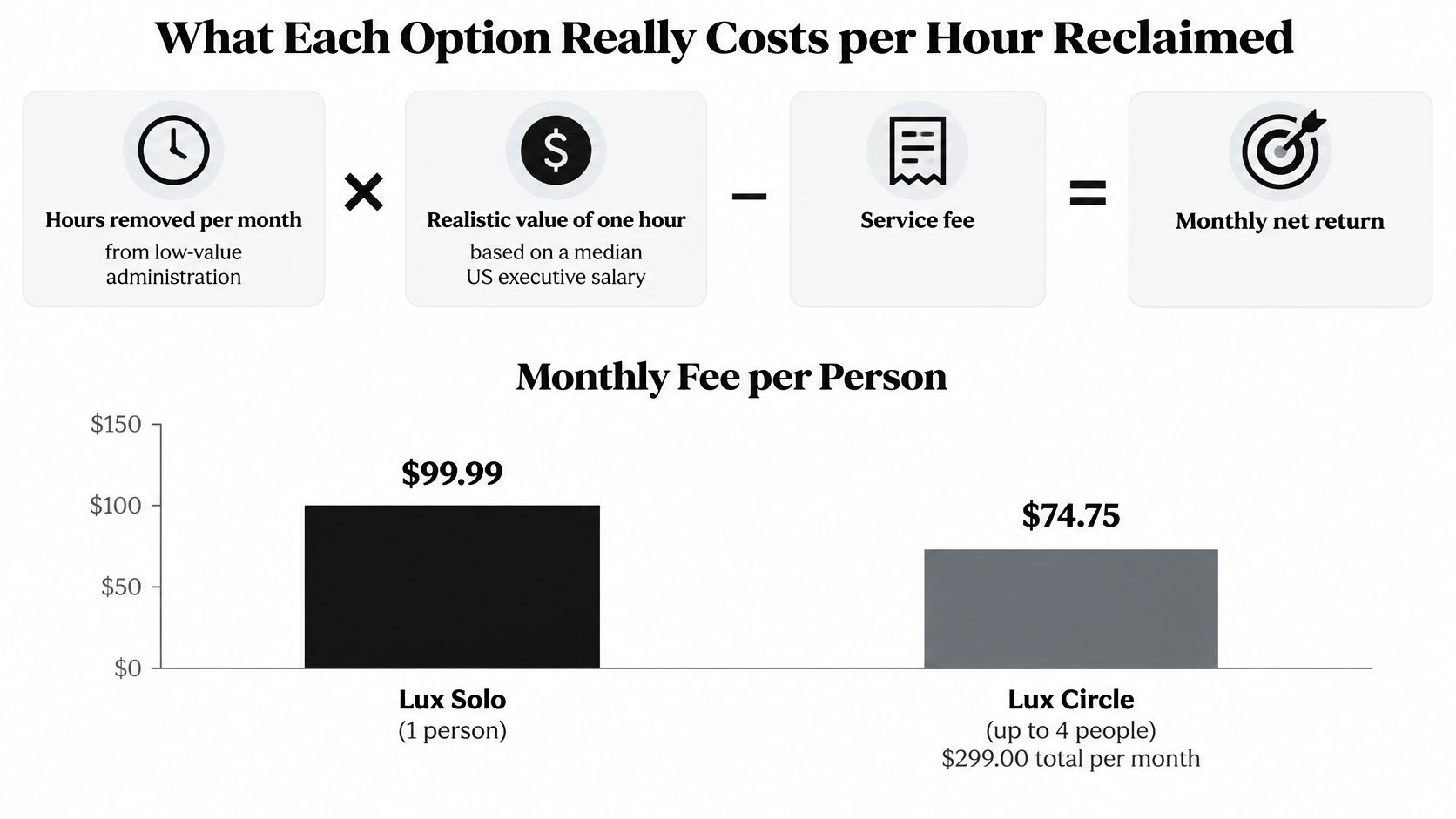
The following profiles are illustrative assumptions, not promised results. Monthly hours use weekly hours multiplied by 4.33, with rounded hours displayed for readability.
| Profile | Hours reclaimed per month | Value per hour |
|---|---|---|
| Founder, eight hours per week of logistics | About 35 | $150 assumed productive-hour value |
| Solo attorney billing $400 per hour, three hours per week reclaimed | About 13 | $400 assumed collectible billing value |
| Working-parent household, ten hours per week, $25 replacement value | 43.3 | $25 assumed replacement-cost value |
Using unrounded hours, the founder's assumed monthly capacity value is $5,196, leaving $5,096.01 after Lux Solo. The attorney's is $5,196, also leaving $5,096.01 after Lux Solo; the household's replacement-cost value is $1,082.50, leaving $783.50 after Lux Circle.
These are arithmetic scenarios, not forecasts of revenue or savings. An attorney must convert freed time into collectible work for the billing-value calculation to hold. A household's replacement-cost value isn't cash income unless it replaces spending.
Compare capacity, not salary alone
An in-house assistant's true cost runs well beyond wages once you add benefits, payroll taxes, recruiting, and equipment. Even so, that total is an employment-cost benchmark, not evidence that a subscription supplies equivalent labor capacity.
The cost of a personal assistant also needs to be matched to the work you can realistically delegate. A full-time employee may support executive relationships and internal operations beyond scheduling; a subscription shouldn't be credited with replacing responsibilities it doesn't assume.
Cost discipline: Value recovered time at what you'll realistically do with it, not your highest theoretical hourly rate.
A subscription loses when the value of net reclaimed hours falls below its fee. If your calendar needs little attention and delegation creates more checking than it removes, self-management wins. It earns its fee when it absorbs the exception loop: the reschedule, the confirmation chase, the rebooking after a cancellation.
Count completed outcomes and avoided follow-ups, not requests submitted. A high request count can describe either useful coverage or a process that still needs too much supervision.
Run a Two-Week Admin Audit Before You Subscribe
Memory undercounts administrative work because one appointment often hides a loop: find a time, compare availability, book, confirm, reschedule, then recover when a plan breaks. Measure the loop directly for two weeks before pricing any option. The audit output should be hours reclaimed, exception risk, and who owns recovery when something fails.
Use the visual as a logging prompt, then calculate from your own recorded minutes.
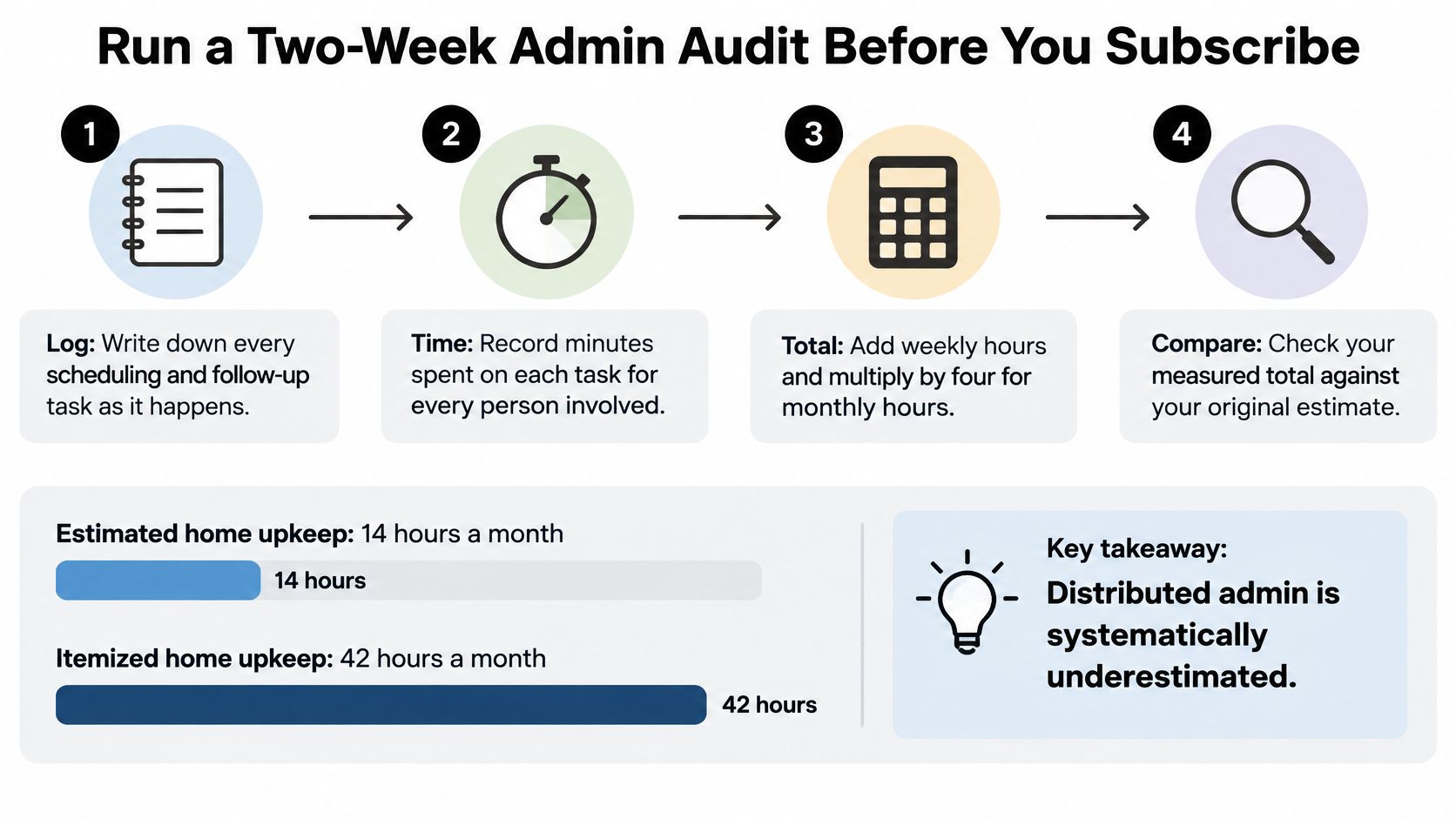
Record the whole task
- Log coordination for 14 days. Record minutes spent initiating, chasing, changing, confirming, and closing each task.
- Split tasks into research, availability comparison, booking, confirmation, rescheduling, and de-conflicting. A repair visit is several actions if you compare quotes, hold an arrival window, and rebook after a no-show.
- Tag ownership and risk. Note who notices the need, who decides, who follows up, and what failure costs if the arrangement slips.
- Total weekly hours and multiply by 4.33 for an illustrative monthly estimate. Use this convention consistently rather than the graphic's simplified four-week shortcut.
- Separate rules from judgment. Repeatable bookings can go to templates or automation; ambiguous coordination, deadline reminders, and renewal timing need human follow-through.
- Estimate briefing and checking time for each delegated task, then subtract it from gross saved minutes. The number that matters is net reclaimed capacity.
- Choose the operating model from evidence. Compare self-management, an app, an hourly assistant, an employee, Lux Solo, Lux Circle, or Lux Traveler against the tasks and exceptions you recorded.
For a booking checklist, use a checklist for scheduling appointments to identify details your log might miss. Mark rare, unusually demanding days separately so they do not become an assumed normal week.
This video offers an additional prompt for reviewing the workflow.
Start with work whose completion you can verify without rebuilding it yourself.
Delegate first where the audit shows repeatable follow-through: routine appointment coordination, home-maintenance scheduling, and travel-change recovery. If coverage risk is the issue, a team model matters because requests do not wait on one person's day off. The decision should come from measured workload and failure points, not the appeal of having an assistant.
Matching the Option to Your Situation
Start by counting scheduling and follow-up across everyone involved. If bookings are occasional and predictable, keep the operating model simple; if recurring coordination requires sustained internal ownership, evaluate an employee.
Variable work with frequent exceptions is a different buying problem. A subscription may fit when you need access to execution without committing to a full-time role, while an hourly provider may suit a bounded task queue with clear coverage.

Worked situations and verdicts
The following are hypothetical situations, not customer results.
- Founder at a $5 million company. Eight weekly hours go to travel changes and vendor follow-ups concentrated on the founder's calendar. Verdict: evaluate Lux Solo, provided the audited work is transferable and recovered capacity has a productive use.
- Solo attorney billing $400 hourly. Unbilled coordination interrupts client work. Verdict: evaluate Lux Solo, but value recovered time at collectible work, not merely the published billing rate.
- Frequent traveler facing a midnight cancellation. The requirement is help while the disruption is happening. Verdict: Lux Solo fits the individual coverage need, including car services, rentals, and rideshare coordination.
- Working parent managing interconnected family appointments. Pediatrician visits, school enrollment, and camp registration affect several people. Verdict: Lux Circle fits group coordination, rather than treating each booking as an isolated request.
- Sandwich caregiver coordinating elder care. Appointments and in-home aide schedules need one administrative owner. Verdict: evaluate Lux Circle for coordination; our Assistant team finds, vets, and schedules providers but doesn't act as an in-home caregiver.
For a separate view of the outsourcing model, outsourced scheduling from Kushan Business Solutions, published by Kushan Business Solutions LLC, provides context to compare against your own task inventory. Evaluate any arrangement by responsibility, coverage, and escalation rules rather than the outsourcing label alone.
Keep service scope separate from care delivery
Lux Traveler's Assistant team also covers household management, including school scheduling, childcare coordination, and medical appointments. Administrative help doesn't replace clinical decisions, hands-on care, or a parent's authority over family priorities.
The wrong-choice case is a small business sending two predictable bookings a month, as a hypothetical example. A booking app wins there if it handles availability and reminders without requiring meaningful recovery work; adding human support would introduce cost without enough work to remove.
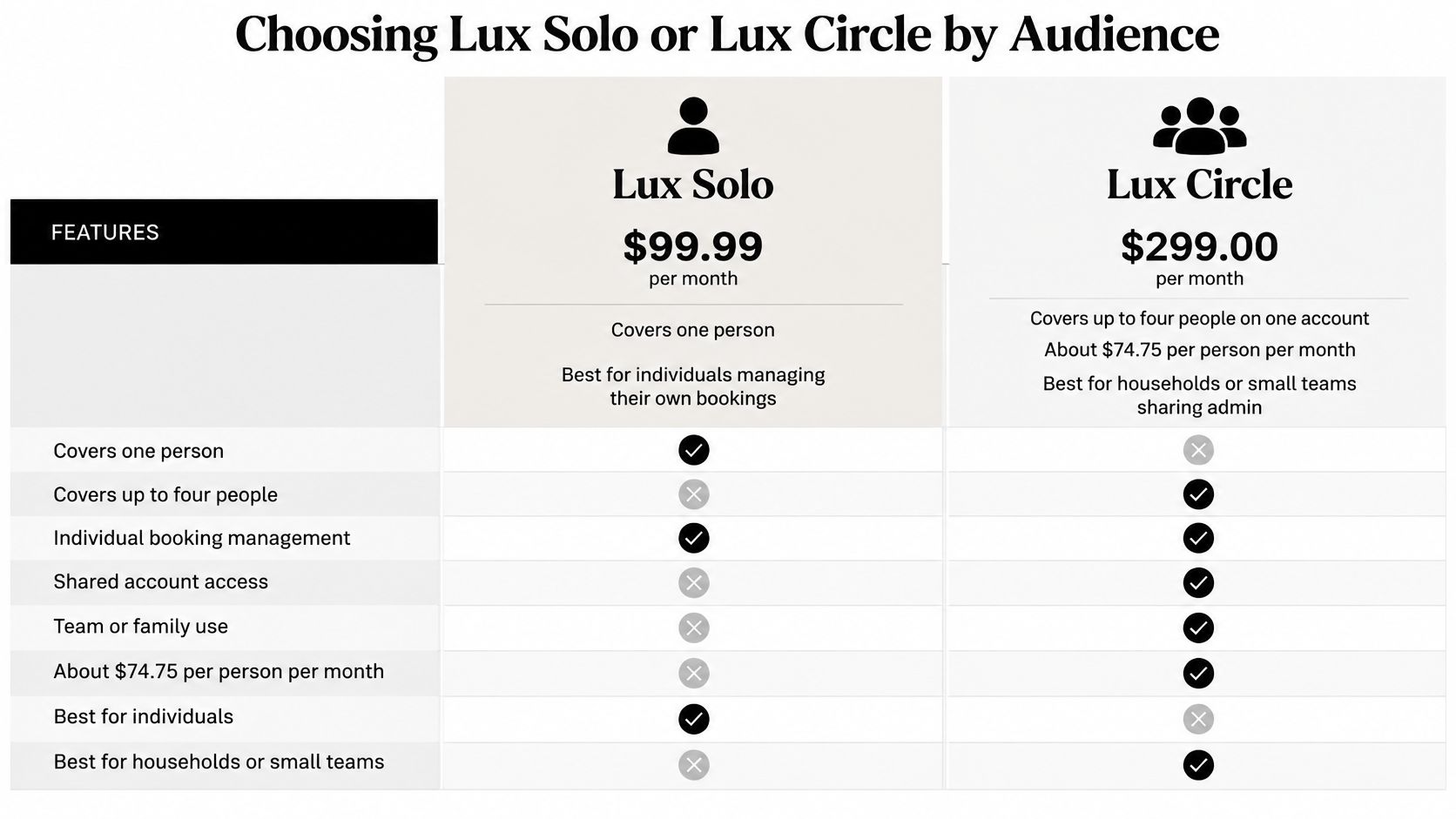
Choosing Lux Solo or Lux Circle by Audience
| Plan | Who it covers | Best-fit audience |
|---|---|---|
| Lux Solo, $99.99/month | One person | Founders, solo practitioners, frequent travelers, creators |
| Lux Circle, $299.00/month | Up to four people on one account | Working-parent households, sandwich caregivers, high-net-worth households |
Lux Solo suits people whose administrative workload belongs to one individual. Lux Circle suits households where one change affects several calendars; it handles requests for anyone on the account and books and de-conflicts appointments for the group.
Both plans include travel, scheduling, errands, and research, so the decision comes down to how many calendars genuinely need coverage.
Transfer responsibility, not just visibility
A 2025 U.S. study of 3,000 parents described by the University of Bath found mothers managed about 71% of household mental-load tasks, compared with 45% for fathers. A shared account won't relieve that imbalance if the same parent still notices every need, chooses every option, and chases completion.
For household delegation, specify who identifies upcoming needs and who confirms the final outcome. The measurable improvement is fewer decisions and follow-ups retained by the default household operator.
Price Lux Circle against separate coverage
The monthly gap between the plans is $199.01, and the honest comparison is Lux Circle against buying individual coverage for each person. Two Lux Solo subscriptions cost $199.98 a month, under one Lux Circle, yet each account covers only its own member. The group de-conflicting that makes a shared plan valuable is exactly the coordination work two separate accounts leave undone.
At three people the arithmetic flips: three individual subscriptions run $299.97 against $299.00 for Lux Circle, and the shared plan wins on price before coordination value enters the calculation. At four, the per-person cost falls to $74.75 versus $399.96 for four separate subscriptions. The useful denominator remains people truly supported, so count the calendars that regularly collide before paying for unused capacity.
Approved Lux Personal Assistant offers human scheduling support for booking, conflict resolution, reminders, and the follow-through that keeps revised plans workable. Bring your admin audit to Approved Lux Personal Assistant and compare individual or household coverage against the hours you can realistically hand off.
Want the wider view?
Ten categories. One report. Every quarter. The Approved List tracks what's rising and what's fading: data-backed signals, not opinions.
Free to join · Delivered by email