All Articles
The Journal
Administrative Assistant vs Executive Assistant: Which Fits?
October 23, 202611 min readexecutive assistantexecutive assistant salary
Administrative assistant vs executive assistant: compare duties, pay, and ROI, then see when a subscription Assistant team beats a full-time hire.

Most hiring guides treat administrative assistant vs executive assistant as a ladder. Climb one rung, pay a higher salary, and your time is supposed to come back. That advice fails a basic utilization audit.
I review support costs for founders and dual-career households. People buy the title that sounds senior, then learn the work is either too uneven for a full-time seat or too judgment-heavy for a task list. Published wages never include the hours you spend managing the person you hired.
This comparison tests both roles by scope, decision rights, and how fully the hours get used. It then prices total cost and hours reclaimed, including overhead salary tables skip, before treating a subscription Assistant team as a first hire that does not start with payroll.
Why Job Titles Are a Weak Guide to Support Needs
A senior-sounding title does not predict the support a time-starved professional needs. Founders, parents, and practitioners lose hours to logistics that spike and then go quiet. A full-time executive seat can sit half idle on Tuesday and overwhelmed on Thursday. An office-wide administrative seat can miss the one call that actually protects your afternoon.
One industry summary from Virtustant reports that 60% of executive assistants have taken on new responsibilities. The work now stretches into project management, vendor coordination, event planning, and HR-related work. The title stayed put. The job did not. Title is a weak predictor of value.
Scope, discretion, decision rights, and follow-through are the better tests. A highly capable administrative assistant may already prioritize across a team, close loops, and keep routine work off a manager's desk. An executive assistant can still be transactional, booking only what they are told to book.
Practical rule: Judge who owns the outcome, not who holds the senior title.
Three questions sort the choice before anyone drafts a job post.
- What each role owns: Repeatable office process, or judgment made on a leader's behalf.
- What it really costs: Wages plus benefits, recruiting, coverage gaps, and your own management time.
- Which model matches the workload: Fixed employment, or flexible capacity for demand that is real but uneven.
Stop asking which title is more senior. Ask which model owns outcomes without creating a second job for you.
Defining Administrative and Executive Assistant Roles
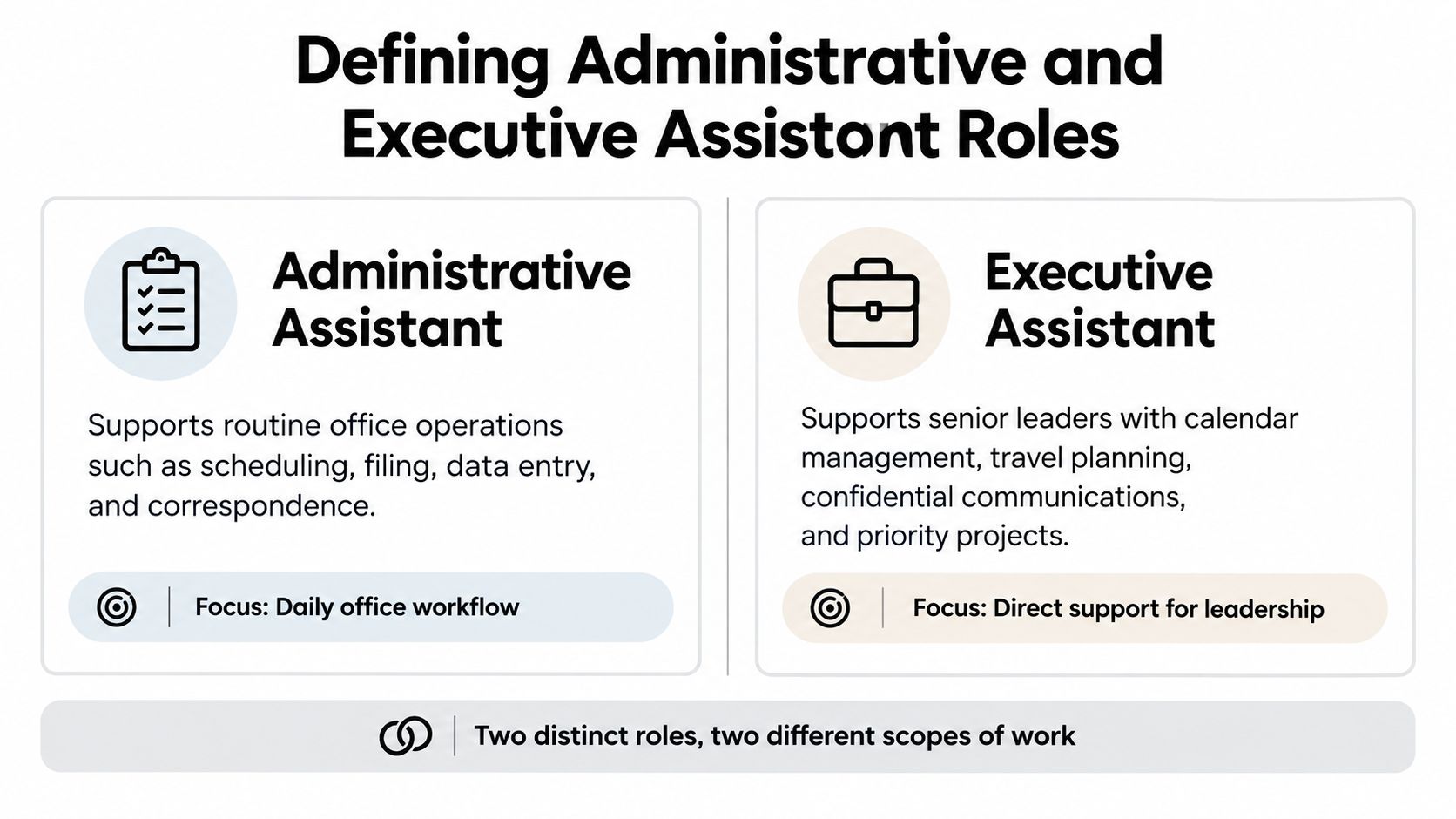
An administrative assistant supports routine office operations. The core work is drafting correspondence, scheduling appointments, maintaining paper and electronic files, and routing information to callers and staff. That profile fits when the need is dependable execution of a defined process, such as a department calendar, routine documents, or orderly records.
An executive assistant supports senior leaders at a wider scope. The work includes research, statistical reports, information requests, executive correspondence, and meeting coordination. It can extend to arranging travel, preparing reports and financial statements, coordinating budgets and personnel matters, organizing board or committee meetings, and training clerical staff. The person is close to decisions, not only to the filing cabinet.
Pay as a sizing signal, not a global rule
The U.S. Bureau of Labor Statistics estimated 483,570 executive secretaries and executive administrative assistants in May 2023, with a mean annual wage of $73,680 and a median of $70,310. The broader group of secretaries and administrative assistants, except legal, medical, and executive, held about 1,785,430 jobs, with a mean of $45,490 and a median of $44,280. The executive category was about 27% of that employment size, while its mean wage was about 62% higher. At the 90th percentile, executive pay reached $104,000, against $62,340 for other administrative assistants.
These figures are U.S.-specific. Do not export them as a benchmark for every labor market. They size the gap. They do not tell you whom to hire this month.
Where the boundary falls
On a Thursday board prep, the administrative assistant books the room, confirms the dial-in, and files last quarter's minutes. The executive assistant looks at three conflicting prep items and decides which one reaches the CEO first, then parks the other two with a note on what can wait.
That is the boundary. One role runs the office workflow. The other filters what a leader must see. For a plain account of day-to-day office support, see what administrative support covers.
Comparing Scope, Decision Rights, and Follow-Through
Duty lists overlap. Behavior under pressure does not. Read administrative assistant vs executive assistant, and a subscription Assistant team, across five operating tests.
| Criterion | Administrative Assistant | Executive Assistant | Approved Lux Assistant Team |
|---|---|---|---|
| Scope of ownership | Recurring tasks for a department or office | One or two leaders across several workstreams | Professional and personal logistics without a W-2 seat |
| Decision rights | Executes a documented process | Prioritizes competing requests for a leader | Resolves routine conflicts and escalates past the brief |
| Sensitive information | Files and caller routing | Confidential briefings and personnel matters | Confidential logistics under shared team context |
| Follow-through | Closes the assigned task | Tracks open loops after the meeting | Closes follow-ups across travel, calendar, and inbox |
| Experience and training | More often trained on the job for defined work | More often hired for prior experience and discretion | Preferences captured up front, then adapted over time |
In 2025, the Bureau of Labor Statistics requirements fact sheet shows prior work experience was required for 87.2% of executive secretaries and executive administrative assistants, and on-the-job training for 74.0%. A high school diploma was required for 57.9%. Among secretaries and administrative assistants excluding legal, medical, and executive roles, prior experience was required for 65.3%, on-the-job training for 87.3%, and a high school diploma for 79.6%.
Choose the executive profile when the seat needs context, sensitive handling, and independent interpretation. Choose the administrative profile when structured training can produce consistent work on defined tasks.
A Friday that does not wait
A flight cancels at 9 p.m. The administrative model waits for the next process window, or for you to send a new instruction. The executive model rebooks, protects Monday's board block, and sends a short note on what changed. An Assistant team can do that same executive-style work, including travel disruption, calendar conflicts, and inbox triage, without a W-2 title or a full-time job description.
Move a board deadline up by a day and the split repeats. Task execution reprints the packet. Decision rights pick the three items the leader must see and assign owners to the follow-ups before the meeting ends.
Scope and decision rights matter more than the label on the role.
Score the model by hours reclaimed, decisions delegated, open loops closed, and stakeholders coordinated. Seniority on a résumé is a weak substitute for that score.
Calculating Total Cost and Hours Reclaimed
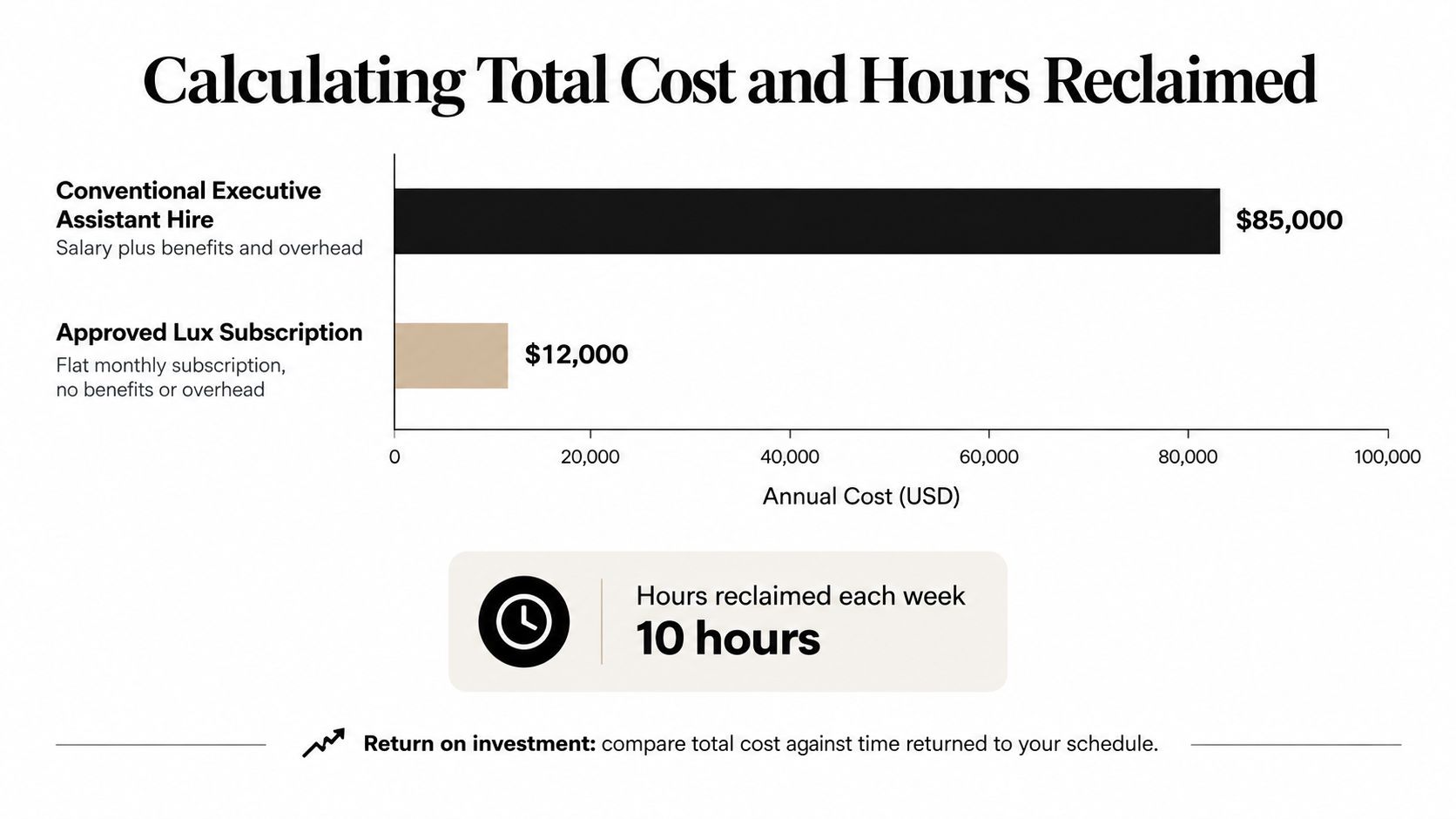
Salary is the smallest honest number in this decision. Summaries cited by FirstHR place median pay for executive secretaries and executive administrative assistants near $76,590, versus roughly $48,310 for secretaries and administrative assistants overall. Those medians exclude benefits, payroll administration, recruiting, onboarding, equipment, coverage during absence, and the executive's own time managing the hire. What wage tables leave out of an executive assistant hire is the rest of the bill.
Subscription math against a seat
Lux Solo is $99.99 per month, or $1,199.88 per year, for one person. Lux Circle is $299.00 per month, or $3,588 per year, for up to four people on one account. If you need both Approved Lux and travel benefits, take Lux Traveler at $1,799 per year. Buying Lux Circle and a separate traveler plan totals $4,487 per year. Do not stack those two purchases.
A worked return, labeled as assumptions
Assume a founder spends 8 hours a week on logistics and reclaims 6 of them. Assume those hours are worth $150 to that founder. This is a self-set value, not a market study. Six hours times 50 weeks times $150 is about $45,000 a year of time returned.
The formula stays the same for any household.
Hours reclaimed × hourly value − subscription or employment cost − management overhead.
On a subscription, subtract roughly $1,200 for Lux Solo, plus a short block of time to set preferences and review the work. On employment, start from the wage, then add benefits and the weekly check-ins, sick-day coverage, and recruiting the wage never shows. Uneven work means you are paying for idle hours.
A traditional executive assistant can be the wrong operating model even for a senior person. You may need high judgment at odd moments, a canceled flight, a family appointment, an urgent follow-up, rather than eight continuously occupied hours.
This short walkthrough shows how members hand off logistics instead of staffing a seat.
Matching Support Models to Real Workloads
Fit follows utilization, continuity, and how much judgment the week requires. Prestige of the title does not. These cases name the hours, the model, the decisions handed off, and the loops that get closed. For the handoff itself, start from how to delegate tasks without taking them back.
Four workloads that do not fill a seat
A founder at a company doing $5 million in revenue spends about 10 hours a week on travel and vendor scheduling. An $80,000 to $120,000 hire is not rational yet. Lux Solo takes vendor holds, flight changes, and calendar clashes. The founder keeps pricing decisions. Follow-ups on deposits and confirmations stop bouncing back into the founder's inbox.
A dual-career parent on Lux Circle is carrying pediatrician visits, summer camp registration, and a birthday party on top of two jobs. The household account covers up to four people. The parent delegates booking windows and vendor choices within a budget. Camp forms, party RSVPs, and appointment reminders close without a Sunday-night scramble.
An independent consultant billing $400 an hour loses unbilled afternoons to invoicing and client scheduling. Those afternoons are the expensive hours. The Assistant team drafts invoices from the consultant's numbers, proposes meeting slots, and chases unsigned agreements. The consultant still owns advice to the client. The unbilled block shrinks to a review, not a rebuild.
A sales executive hits a midnight cancellation in an unfamiliar time zone. Corporate travel desks are closed. A 24/7 Assistant team rebooks the flight, moves the hotel, and resets the morning meeting. The executive decides whether to keep the client dinner. The follow-up is a revised itinerary, not a 1 a.m. search.
When the traditional hire is the right answer
A chief operating officer with daily board packs, confidential personnel files, and a need for someone in the office is a different case. The work fills a full week, and it depends on presence. A traditional executive assistant is the better model there. Remote flexible capacity would add handoffs the role cannot afford. Use the subscription while the load is uneven. Hire when the week is full and the context has to live with one person on site.
How Approved Lux Works as a First Hire Without Overhead
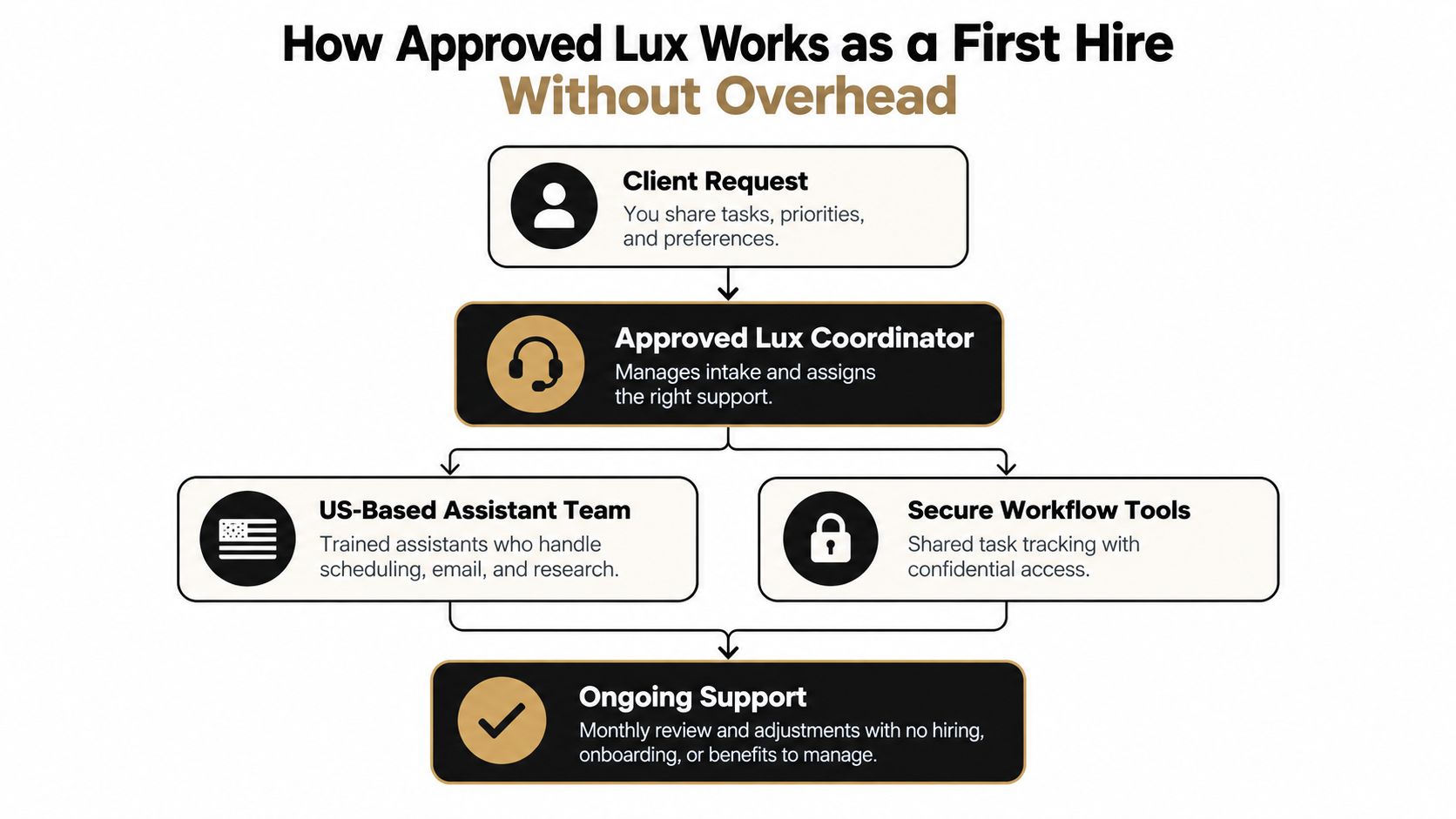
Approved Lux is a US-based Assistant team, not a single dedicated person and not a ticket queue. You reach the team 24/7/365 by phone call, SMS text, or email. Triple-channel access means all three are monitored at equal priority, so you use whichever channel fits the moment. A text at the airport and an email from your desk hit the same shared context.
The work splits into practical categories, and each one maps to time you stop spending yourself.
- Travel and logistics: Flights, hotels, ground transport, restaurant reservations, and full itinerary building, so a disruption does not become your evening.
- Scheduling: Appointments and conflict resolution, so two holds do not both survive until you notice.
- Personal errands: Gift sourcing, home services, and event planning that otherwise sit on a household list.
- Vendor work: Vetting and price negotiation before you approve a spend.
- Professional support: Inbox triage, email drafting, document formatting, expense tracking, and meeting preparation.
Onboarding records preferences and access standards. Proactive Preference Learning means the team gets better as it learns your routines, so repeat trips and repeat vendors take fewer instructions. US-based accountability is the answer to offshore trust worries. You are not standing up payroll, benefits, or a manager's weekly one-on-one to get that capacity.
O*NET's description of administrative work supports a plain operating rule. Delegation should begin with a documented task list, service standards, and escalation rules. Otherwise routine work drifts back into the decision-maker's queue, and the hours you thought you reclaimed return with it.
Write the recurring tasks and the escalation line before the first request. Shared context only works if the brief is explicit.
Choosing Your Next Step This Week
Hire a traditional executive assistant when the work is daily, crosses several domains, and depends on in-office presence, confidential context, or supervision of staff, and when that work fills a full-time schedule. You will pay the wage, the benefits, and the management time. You will also get continuity that a shifting workload does not require.
Start with Approved Lux when logistics are irregular, the load sits below a full-time threshold, or you need operational support now without a W-2 hire. Lux Solo fits founders, independent professionals, frequent business travelers, and creators. Lux Circle fits working parents, sandwich-generation caregivers, and households of up to four people. A traditional hire can follow once the workload is stable and proven. The subscription can be the bridge, not a permanent substitute.
Do three things this week.
- Log the hours. Track logistics time for seven days so the baseline is real, not a feeling.
- Write the brief. List recurring tasks, service standards, and the point where a decision comes back to you.
- Match the plan. Start on Lux Solo or Lux Circle for the solo or household need, using the Approved Lux page as the entry point.
The wrong test is which title sounds more senior. The right test is whether the hours, the judgment, and the overhead match the week you actually have.
Approved Lux Personal Assistant gives time-starved professionals a US-based Assistant team for scheduling, travel logistics, follow-ups, and the operational noise that job titles never price. If your workload is real but not yet a full-time seat, compare scope and cost the way this audit does, then start with the plan that matches a solo schedule or a household. Visit Approved Lux Personal Assistant and put the first week of tasks on a brief instead of on your calendar.
Want the wider view?
Ten categories. One report. Every quarter. The Approved List tracks what's rising and what's fading: data-backed signals, not opinions.
Free to join · Delivered by email