
←All Articles
The Journal
Small Business Efficiency: The Operational Playbook
October 6, 202613 min readoperational efficiencyprocess mapping
Boost small business efficiency with a practical playbook on process mapping, delegation, and time-reclaimed strategies. Reduce admin costs and reclaim hours.
In 2014, labour productivity in micro-enterprises was just 68% of the level recorded by large companies. Small business efficiency improves when owners stop treating every administrative task as personal responsibility and build a capable team around the work that only they can do.
That gap isn't a verdict on small-business owners. It reflects the economics of scale. A large company can distribute administration, compliance, scheduling, technology management, and coordination across specialized roles. A founder, independent professional, or small leadership team often carries all of them while also selling, delivering, hiring, and making strategic decisions.
The practical question isn't how to squeeze more activity into the day. It's how to convert scarce working hours into billable work, customer value, strategic progress, and revenue-producing output. That requires attention to the coordination layer, the invisible stream of follow-ups, scheduling changes, vendor research, household logistics, and exception handling that fragments otherwise productive days.
The Hidden Cost of the Efficiency Gap
Small companies are often told to work harder, adopt better software, or eliminate unnecessary expenses. Those recommendations miss the structural problem. The owner may already be working long hours, yet still lose productive capacity because routine coordination interrupts the work that generates income.
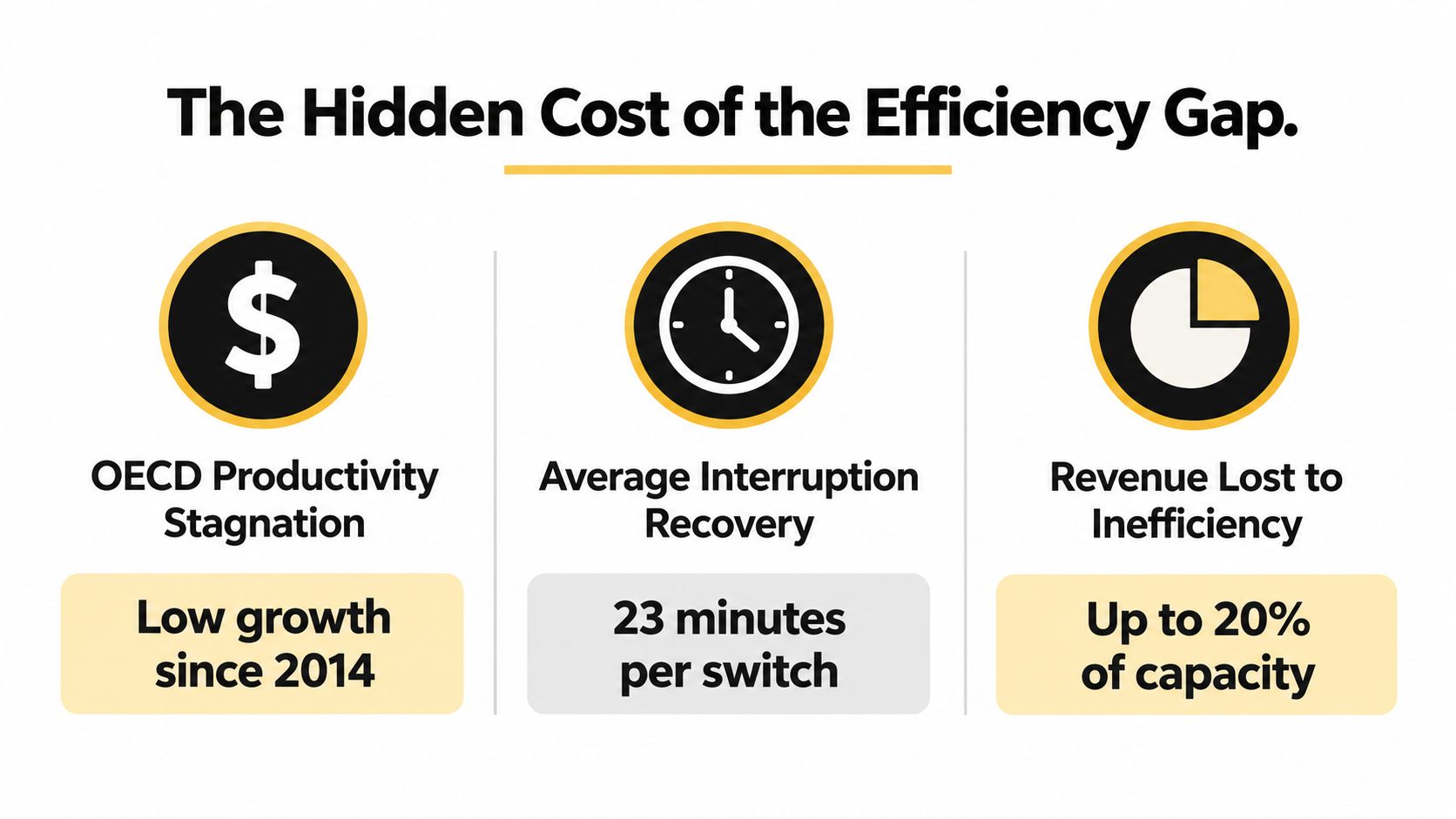
The OECD found that, in 2014, labour productivity in micro-enterprises reached 68% of the level recorded by large companies, while small firms reached 91% and medium-sized firms 111% of the large-company level (OECD analysis of SME productivity). More recent OECD comparisons found that companies with more than 250 employees produced approximately twice as much output per hour as companies employing 10 to 19 people in 2023 or the latest available year, although the gap varies by country and industry.
That doesn't mean large companies always operate better. Smaller firms can outperform larger ones in business services where specialized knowledge, strong brands, intellectual property, or intensive information-technology use create an advantage. The point is that a small company has fewer people across which to distribute essential operating work.
Scale changes the cost of distraction
For a large organization, a scheduling conflict may be handled by an assistant, department coordinator, or shared operations team. For a small firm, the owner may pause a client call, abandon a proposal, or delay a product decision to fix it personally. The direct task may take only a few minutes. The lost momentum can be much more expensive.
This is why efficiency shouldn't be defined only as lower spending. It means releasing capacity from low-contribution work and directing it toward activities that require judgment, trust, expertise, or commercial responsibility.
A useful weekly review asks:
- Where did owner attention go: List scheduling, inbox, travel, vendor, household, and follow-up work that consumed decision-maker time.
- What displaced valuable work: Note client delivery, sales conversations, strategic planning, or recovery time that moved because of those interruptions.
- Which tasks recur: Repeated coordination is a process problem, not a personal discipline problem.
- Where does judgment matter: Keep decisions with the owner, but move research, preparation, reminders, and execution elsewhere.
Practical rule: If a task needs the owner's judgment only at the beginning or end, the middle should be designed for delegation.
Small-business efficiency also intersects with broader operational design. Owners reviewing compliance, people administration, or employment processes may find how Paradigm International helps SMBs useful as a separate perspective on reducing internal administrative load. The principle is consistent: preserve scarce senior attention for work that can't be distributed easily.
Understanding Interruption Residue and Context Switching
4.5 hours of a 40-hour week can be spent on tasks that were paused and later resumed, according to an in-situ diary study of knowledge workers. That represents 11.25% of weekly work time spent reconstructing context instead of progressing new work.
The interruption itself may take only a few minutes. The operational cost continues after the request is handled. Research found that workers switched activities about every three minutes and moved between broader working spheres roughly every 11 minutes. A field study reported by Gallup recorded an average of 3 minutes and 5 seconds on one work event before interruption or switching, followed by an average 23 minutes and 15 seconds before the interrupted work resumed (Gallup workplace interruption research.
That recovery period is interruption residue. An owner may answer a travel request or resolve a calendar conflict, yet remain mentally attached to the proposal, analysis, or client issue left unfinished. Returning to the original task requires rebuilding the thread: what was in progress, which details mattered, and what action came next. That reconstruction slows delivery, increases errors, and makes postponement more likely.

Measure recovered focus, not busy time
Deloitte summarizes research reporting a 3.5% decrease in total productivity for every switch made. The same analysis notes that interruptions can require approximately 15 to 23 minutes to restore the prior level of engagement (Deloitte analysis of digital distractions). These findings do not provide a guaranteed financial loss for each interruption. They explain why an owner can remain active all day while producing less meaningful work.
For a professional billing $300 per hour, recovering one uninterrupted four-hour block each month represents $1,200 of potential billable capacity. That is a capacity calculation, not a promise that the recovered time will be billed. The value may instead appear as faster delivery, fewer corrections, or more room for commercial decisions.
Track the pattern for a month. Record how often planned work is abandoned, the longest uninterrupted focus block, the time needed to regain context, and rework or delays connected to fragmented attention. These measures expose the cost of the coordination layer, the administrative work that keeps arriving as separate decisions.
The practical response is a managed queue, supported by human assistance rather than another software layer. Vendor comparisons, draft emails, appointment searches, and follow-ups should arrive with options, deadlines, dependencies, and a clear escalation point. This gives the owner a defined decision while someone else handles preparation and tracking. It also reduces cognitive overload, which affects working attention as explained in what cognitive overload means for working attention.
Process Mapping and the Art of Delegation
Delegation fails when an owner says, “Handle my scheduling,” without defining authority, preferences, boundaries, or escalation rules. It works when recurring work is mapped as a queue with enough context for another person to execute confidently.
Start with a short process audit. Review the previous week and capture every recurring coordination task, including inbox triage, travel changes, vendor research, appointment booking, document formatting, expense tracking, and household scheduling. Then classify each item by the type of work it contains.
Separate judgment from execution
Decision work includes choosing a vendor, approving a budget, determining a client priority, or resolving a sensitive exception. Execution work includes gathering options, checking availability, preparing a comparison, sending a reminder, formatting a document, and recording the result.
| Task Type | Owner Action | Delegation Strategy |
|---|---|---|
| Decision work | Set the priority, budget, risk tolerance, or final choice | Return a concise recommendation with options and the decision required |
| Execution work | Define the desired outcome and access boundaries | Assign research, preparation, booking, follow-up, and documentation |
| Exception handling | Decide when a situation exceeds normal rules | Establish escalation triggers and require the Assistant team to pause when they occur |
| Recurring coordination | Approve the workflow once | Document preferences, deadlines, contacts, and recurring steps |
A process map doesn't need to become a rigid script. Small-business operations contain too many exceptions for that. The better format is a structured queue that preserves context, records the next action, and leaves judgment with the person accountable for the outcome.
For example, “find a contractor” is incomplete. “Find three licensed providers for a weekday repair, compare availability and review patterns, avoid appointments before a specified time, and present the options for approval” gives an execution team something usable. The owner still makes the choice, but no longer performs every preparatory action.
Financial administration benefits from the same distinction. An owner can approve a payment policy and retain oversight while another person prepares records and helps streamline accounting data entry. The aim isn't to remove accountability. It's to remove avoidable handling time.
Use this practical guide to delegating tasks effectively as a prompt for defining ownership, context, and escalation. Then test one workflow for a week before expanding. If the owner still answers the same clarification questions repeatedly, the process needs better preferences or access standards, not more reminders.
Why Technology Alone Is Not the Answer
Technology performs structured work well. It stores records, triggers reminders, routes forms, drafts standard messages, and makes information easier to retrieve. Its limits appear when a request is incomplete, priorities conflict, a customer is upset, or an exception falls outside the configured workflow. Those cases create the coordination layer, the administrative work that connects tools, people, and decisions.
The NFIB's 2025 technology survey found that 57% of small-business owners had introduced new or significantly improved technology during the previous two years. Adoption reached 51% of firms with one to nine employees and 75% of firms with 50 or more employees (NFIB 2025 small-business technology survey). The gap matters. Purchasing software is one task. Configuring it, maintaining it, checking its output, and getting people to use it consistently are separate operating responsibilities.
The survey also found that, among owners whose businesses used artificial-intelligence technology, 30% reported increased productivity, 23% reported improved product or service quality, and 8% reported lower operating costs. Smaller shares reported increased revenue or sales. These results support a measured approach. Technology can improve throughput and quality, but it does not decide which exception deserves attention or confirm that an open loop is closed.
A larger software stack may reduce data entry while adding setup, integration, maintenance, and monitoring work. A full-time employee offers continuity but brings payroll, benefits, supervision, utilization, and hiring obligations. Automation works efficiently when inputs are clean and decision rules remain stable. Human support handles the work left between those conditions: interpreting an incomplete request, asking the necessary question, resolving a scheduling or vendor problem, tracking the result, and applying remembered preferences.
The practical model is complementary. Keep records, repeatable workflows, and visibility in software. Assign prioritization, research, communication, and exceptions to accountable human assistance. That assistance is operating capacity, not a luxury layer. Small firms need fewer systems that demand owner attention and a reliable way to coordinate the work those systems cannot finish.
The First Hire Without Overhead
A full-time Executive Assistant makes sense when workload is stable, responsibilities are clear, and the business can absorb the supervision required. Before that point, many founders and practitioners sit in an expensive middle ground. Coordination has outgrown the owner's available time, yet the workload remains too variable to support a direct hire.
A subscription-based Assistant team provides flexible operating capacity without adding payroll, benefits, or a full management burden. Approved Lux provides a US-based human team through Triple-channel access, phone call, SMS text, or email. Supported work includes scheduling, travel logistics, inbox support, document formatting, research, vendor follow-up, expense tracking, and meeting preparation. Onboarding records preferences and access standards, while Proactive Preference Learning helps the team build useful operating context over time.
Business owners evaluating this model may find this practical guide to virtual assistants for small business owners helpful for structuring the hire and setting expectations.
Three users, three models of impact
The solo practitioner usually starts with unbilled administrative work. An attorney, consultant, advisor, or private-practice professional can route appointment coordination, inbox preparation, document formatting, and follow-ups into a managed queue. The owner keeps control of client judgment and sensitive decisions, while delegated coordination protects time for work that requires professional expertise.
Founders face a broader coordination problem. Travel changes, vendor research, meeting materials, reminders, and follow-ups may arrive through different channels and require different decisions. A chief-of-staff style support layer absorbs those varied requests without forcing the founder to create another layer of supervision or manage several narrow providers.
The dual-career parent needs capacity across work and home. Booking a repair, organizing a school deadline, coordinating a family appointment, or arranging travel may be manageable individually. The burden comes from tracking every open loop alongside a demanding professional role. Household time data from the Bureau of Labor Statistics American Time Use Survey shows that 81% of people performed household activities on an average day, spending about 2 hours on them. Delegation applies to the coordination around those responsibilities, not care that requires physical presence.
| Plan Name | Monthly Cost | Team Capacity | Best For |
|---|---|---|---|
| Lux Solo | $99.99 | Individual access | Solo practitioners, founders, executives, and frequent business travelers |
| Lux Circle | $299.00 | One account for up to 4 people | Dual-career households and shared family coordination |
Judge the service by the capacity it protects, not by the price of an individual request. Compare released focus time, fewer missed follow-ups, and reduced management burden with payroll and hiring overhead. Professional practices planning another coach can also prepare your practice for a second coach, because shared systems should be ready before additional people join.
Real-World Efficiency Scenarios
A solo practitioner can begin by sorting requests from email, text, and phone into one operating queue. The Assistant team handles travel changes, scheduling conflicts, vendor research, and inbox preparation through Triple-channel access. The practitioner sets decision boundaries, such as acceptable appointment windows, spending limits, and situations requiring approval. The team returns researched options and clear escalation points instead of incomplete questions that create more work.
The practical test is the time recovered for judgment, client work, and revenue-producing activity. A consultant who protects a full morning can use that uninterrupted block for client delivery, proposal work, or follow-up that would otherwise be postponed. The result is not guaranteed revenue. It gives the owner a clearer basis for comparing delegated coordination with the productive work and attention that administrative interruptions displace.

Build the queue around preferences
A founder might ask the team to compare hotels, prepare a meeting brief, or follow up with a vendor. The team records the request, checks stored preferences, completes the research, and returns the result with the remaining decision clearly marked. Proactive Preference Learning reduces repeated explanations by preserving standards such as travel times, communication style, and vendor requirements.
The same coordination layer can support a dual-career parent managing appointment coordination, school registration deadlines, home-service scheduling, deliveries, and event planning. Parents with a youngest child under age six spent an average of 2.5 hours per day caring for children and other household members as a primary activity in 2021, compared with 32 minutes for parents whose youngest child was 13 to 17, according to the BLS analysis of parents' time use. Delegation removes the logistics surrounding care while leaving care decisions and physical presence with the family.
A reliable handoff follows four rules:
- Capture the request: Send the desired outcome by phone, text, or email.
- Apply preferences: Use documented routines and access standards.
- Escalate judgment: Require approval for risk, spending, sensitive information, or competing priorities.
- Close the loop: Record the result, open items, and recurring actions.
Human assistance becomes infrastructure when it keeps these queues moving without forcing the owner to supervise every step. The owner remains accountable for important decisions while low-value coordination becomes work the business can assign, track, and improve.
Building Your Operational Roadmap
Small business efficiency starts with an honest time audit. Record interruptions, returned-to tasks, recurring coordination, and the work displaced by each one. Protect the activities that require the owner's expertise, relationships, judgment, or direct customer involvement.
Next, turn recurring noise into queues. Document preferences, access standards, decision limits, deadlines, and escalation rules. Start with one workflow, measure focus-block recovery and request completion, then expand only when the handoff works without repeated clarification.
Technology may support the process, but it shouldn't become the process. The scalable asset is flexible human capacity that can handle structured work, exceptions, and follow-through while the owner remains accountable for decisions.
Small firms do not need to imitate the staffing model of a large company. They need operational efficiency scaled to their actual workload, so growth does not bring a matching increase in administrative burden.
Approved Lux Personal Assistant provides a US-based human Assistant team for scheduling, travel and logistics, inbox support, research, vendor follow-ups, document preparation, and household coordination through phone, SMS text, or email. Visit Approved Lux Personal Assistant to evaluate whether a flexible coordination layer can reclaim focus and reduce the operational noise holding back your small business.
Want the wider view?
Ten categories. One report. Every quarter. The Approved List tracks what's rising and what's fading: data-backed signals, not opinions.
Free to join · Delivered by email