←All Articles
The Journal
Communication Management That Actually Reclaims Your Hours
September 24, 202614 min readexecutive assistantproductivity
Communication management explained with practical examples, KPIs, and templates that reclaim hours at work and home, including how a dedicated human Assistant
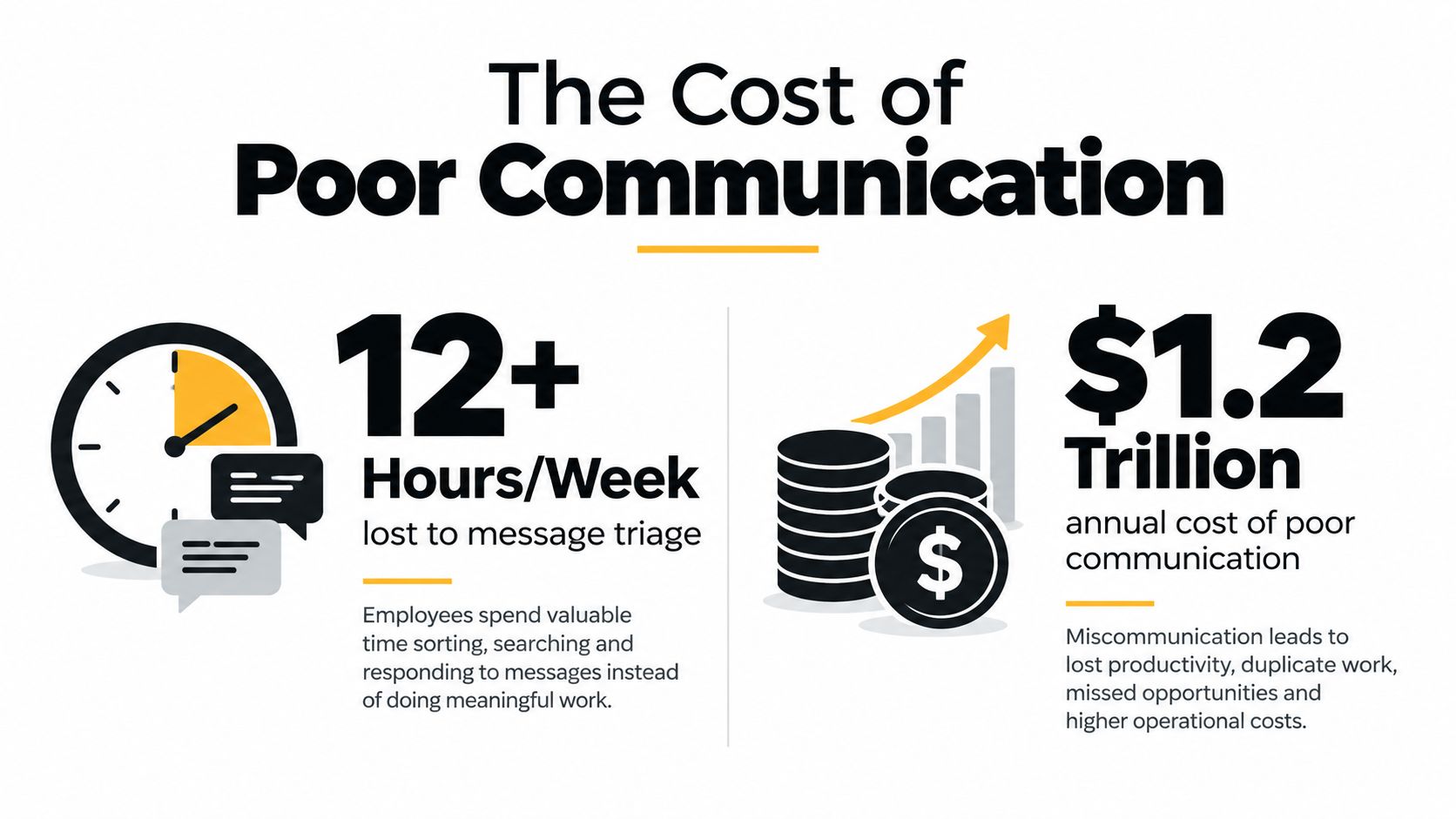
Working adults spend 12+ hours per week on life administration, and poor communication can cost U.S. businesses up to $1.2 trillion annually. Communication management reclaims that capacity by giving every message a clear channel, owner, cadence, and outcome, then delegating the coordination work that software alone can't absorb.
The issue isn't that people lack communication skills. Founders, executives, and dual-career parents already communicate constantly. The issue is that messages arrive through too many routes, demand different response speeds, and force the same person to triage, decide, draft, follow up, and remember what happens next.
That workload creates a hidden tax. A school email competes with an investor thread. A vendor voicemail sits beside a customer escalation. A family text requires a calendar change, a confirmation, and a reminder. Each item looks small, but the switching cost accumulates across the day.
Communication management is the operating discipline that removes this friction. It treats communication as a flow of work, not a personality trait or a collection of apps. The objective is straightforward: move more messages from intake to resolution while preserving attention for decisions that require judgment.
Why Communication Management Is a Capacity Problem, Not a Soft Skill
Poor communication can cost U.S. businesses up to $1.2 trillion annually. One benchmark places the average loss at $12,506 per employee per year, with approximately 7.47 hours of productive time lost per employee each week, according to workplace communication statistics. That is an operating-capacity problem, not a culture slogan.
The same constraint appears at home. Adults spend 12+ hours per week on life administration, including scheduling, follow-ups, and household coordination, according to research on the burden of adult admin. These hours arrive as small requests, reminders, and decisions that interrupt higher-value work.
Operational rule: If a message requires a decision, a follow-up, or a calendar action, put it in a managed workflow.
Treat messages like a supply chain
Communication has queues, bottlenecks, owners, service expectations, and failure points. An unanswered thread is queued work. “Someone should handle this” signals an ownership gap. A meeting called to find information buried in email reveals a routing failure.
Unresolved messages also consume working memory. This cognitive overload guide explains why open tasks continue competing for attention, reducing deep-work capacity, slowing decisions, and increasing rework.
The volume makes the problem structural. Employees spend about 88% of their workweek communicating, including meetings and email, and around 20 hours each week using digital communication tools, as summarized in workplace communication data. Fragmented communication therefore occupies the operating environment rather than creating an occasional inconvenience.
Software can sort, label, schedule, and notify. It cannot consistently interpret ambiguous requests across business and household contexts. A human Assistant team can take responsibility for that coordination layer, identifying which investor update needs an executive response, which school request requires calendar protection, and which vendor delay warrants escalation. Delegating that layer acts as a force multiplier because it removes coordination work without adding another application for the founder or household to supervise.
High-stakes messages depend on context, tone, and audience. This financial language analysis for hedge funds shows why a summary must preserve meaning, not merely shorten words. The same standard applies elsewhere: a message is complete when the right person understands its implication and acts.
Measure the system through channels, cadence, ownership, and outcomes. Track whether those decisions shorten queues, reduce avoidable interruptions, and return hours to work and personal priorities.
The Core Framework for Communication Management
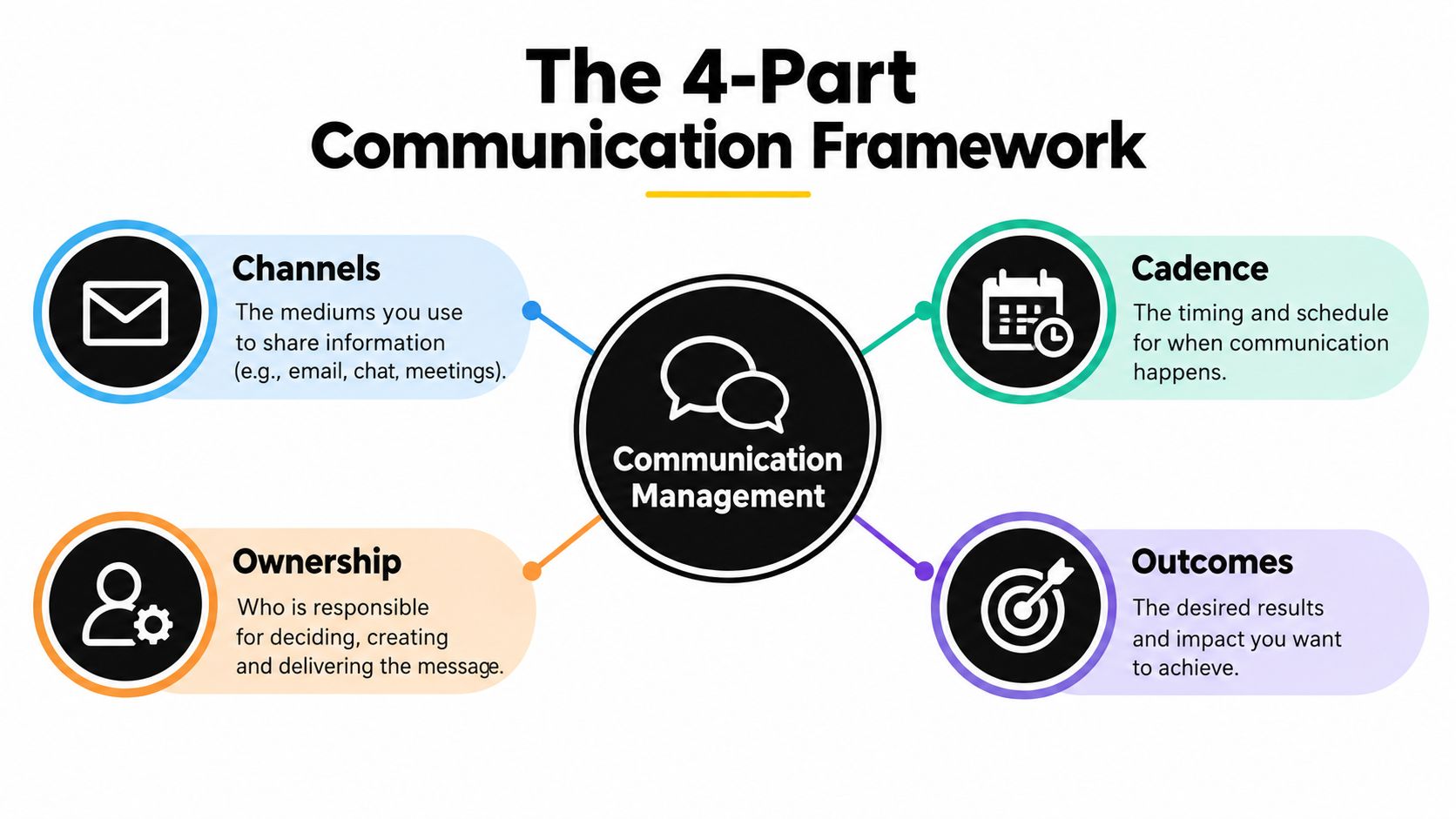
Clear communication alone does not solve the capacity problem. A workable system makes four operating decisions before messages consume more attention: channels, ownership, cadence, and outcomes. If one is missing, coordination expands into extra follow-ups, interruptions, and supervision.
Channels define the contract
A channel signals the expected type and speed of response. Phone suits urgency, complexity, or live clarification. Text works for a short update or confirmation. Email fits detail, documentation, or several stakeholders. Chat supports quick team coordination, provided decisions move into a durable record.
A customer escalation may start by phone, receive a written email summary, and close in a project log. A school pickup change may require a text followed by a calendar update. Set the channel according to the work, not the sender's habit. This reduces repeated explanations and protects focused work.
Cadence prevents constant interruption
Cadence sets when communication is reviewed and repeated. A daily standup can handle immediate coordination. A weekly digest can replace scattered status pings. A monthly review can reveal recurring bottlenecks, while on-demand escalation remains available for events that cannot wait.
A fixed rhythm turns repeated questions into a predictable information service. It also gives a human Assistant team a clear operating schedule, so the coordination layer runs without requiring a founder to monitor every route.
Ownership removes the gray zone
Every active thread needs a named person or role. Ownership does not require that person to complete every task. The owner decides who acts, identifies the next step, and confirms when the thread closes.
At work, a chief of staff may own executive requests, a project lead may own delivery decisions, and an operations manager may own vendor issues. At home, one calendar owner can coordinate school deadlines while both adults retain visibility. Clear stakeholder coordination prevents requests from becoming shared responsibility with no accountable operator.
Outcomes give communication a finish line
Each message should produce a defined result, such as a decision, confirmation, draft, booking, escalation, or documented update. Informational threads still need a storage location and a reason to remain active. Otherwise, they continue demanding attention without creating progress.
Use this mental model:
- Channel: Where should the conversation happen?
- Cadence: When should it be reviewed or repeated?
- Ownership: Who is accountable for movement?
- Outcome: What proves the thread is finished?
Apply the model to an executive update, contractor request, medical appointment, or family event. Delegating these decisions to a human Assistant team turns communication management into capacity recovery, not another application to supervise.
Pillars and KPIs That Make Communication Measurable
A framework becomes useful when it produces a scorecard. Track the flow from arrival to closure, not vanity measures such as how many messages someone sends.
| Pillar | What It Does | KPI 1 | KPI 2 |
|---|---|---|---|
| Intake | Captures inbound requests in a controlled place | Messages captured per day | Capture rate |
| Triage | Classifies urgency, topic, and required action | Percentage triaged within 15 minutes | Misclassification rate |
| Routing | Assigns a clear owner | Average handoff time | Ownership clarity score |
| Response | Applies channel-specific response expectations | Median first-response time | SLA hit rate |
| Closure | Records resolution and retires completed work | Percentage of threads closed within 24 hours | Reopen rate |
Start with intake and triage
A single intake point doesn't mean every channel disappears. It means phone, text, email, and chat requests enter a common operating view. A coordinator can then distinguish an urgent customer issue from a routine request, a decision from an FYI, and a task that belongs with someone else.
Triage quality matters more than speed alone. A fast misclassification still sends work to the wrong person and creates another handoff. Review the misclassification rate alongside the percentage triaged within 15 minutes so the system rewards accuracy as well as responsiveness.
Route responsibility before drafting
Routing is where many teams lose time. People write partial replies because they aren't sure who owns the answer, then someone else rewrites the message later. Track average handoff time and ask recipients to rate whether ownership was clear.
The response pillar should use different expectations by channel. A missed urgent call and a delayed detailed email aren't equivalent failures. Median first-response time shows actual behavior, while the SLA hit rate shows whether the agreed standard is realistic.
Close the loop
Closure means the decision is recorded, the next action is assigned, and the thread no longer needs attention. Track the share of threads closed within 24 hours and the reopen rate. A high reopen rate usually signals incomplete answers, unclear handoffs, or missing documentation.
Build a one-page weekly scorecard. Review trends, not isolated bad days. Then delegate the collection and formatting first. Measurement creates efficiency, but building a manual reporting ritual can recreate the administrative burden you're trying to remove.
Choosing the Right Channel for the Job
Channel choice is a capacity decision. Each misrouted message creates another explanation, handoff, or follow-up, so set routing rules that protect attention rather than reflecting personal preference. Use urgency, complexity, formality, and recordkeeping as the decision criteria. Guidance on choosing the right communication channel supports this approach.
Use the three-question channel check
Before sending, ask:
- Is this time-sensitive?
- Does it require complex judgment or live clarification?
- Will someone need to reference it later?
Apply the answers to the situation, not to a fixed channel preference. A distributed team member reporting a blocked release may need a call if the decision involves several trade-offs, followed by an email that records the choice. A same-day change to a child's pickup plan may need a text because the recipient can act without a discussion. A founder approving a contract revision should receive a written summary, even if the issue was resolved in a conversation, because the decision must remain available to others.
A household travel disruption can produce a different result. If a flight cancellation requires rapid coordination among several people, use a call for live problem solving, then record the revised plan in a message. If the update only confirms an arrival time, use text. The check prevents urgency from becoming an excuse to leave no record.
Avoid the channel trap
- Sending a complex request by text creates fragmented replies and repeated explanations.
- Using email for an urgent operational problem delays the decision while the inbox waits for review.
- Calling about a routine approval removes the record and forces someone to reconstruct the agreement later.
- Copying an entire group on a question with one clear owner multiplies notifications without improving the answer.
Ask the three questions before routing each case. That small pause keeps the coordination layer out of the principal's day.
Set default agreements for teams and households, then make exceptions explicit. Use calls for urgent, complex matters, text for short coordination, and email or a decision log for durable records. To rescue a fragmented inbox within 48 hours, label every item decide, delegate, schedule, archive, or delete, then send only unresolved decisions to the principal.
A broader guide to communication tools for teams can help compare platforms, but the operating rules should remain independent of any one app. A human Assistant team can apply those rules, route exceptions, and preserve the record, reclaiming capacity instead of adding another system to manage.
Communication Management in the Workplace and at Home
Communication systems earn their keep during pressure, not during calm weeks. Work and household examples reveal where coordination fails, who should absorb it, and how many hours the system returns.

The founder's owner map
A Series B founder handling investor updates, hiring loops, and customer escalations needs clear ownership, not another dashboard. The map should name the person responsible for each category, identify what requires the founder's attention, and define the evidence that closes the loop.
On Monday, the chief of staff assigns owners and records exceptions. On Friday, the team sends a concise recap of decisions, open risks, and next actions. In this scenario, the approach can remove roughly three hours of weekly status-meeting time when the recap replaces meetings instead of creating another reporting layer.
Crisis communication under pressure
A product safety recall or public relations incident requires a different operating mode. Routine updates can wait. The response lead should establish one verified fact set, approve a single external message, and route every new inquiry to named owners. Legal, operations, customer support, and leadership need the same current information before anyone publishes an update.
Set a short review cycle until the immediate risk is contained. Record what changed, who approved it, which stakeholders were contacted, and what remains unverified. This prevents conflicting statements, duplicated outreach, and executive attention being consumed by questions that already have an owner.
An AI legal assistant for business owners may help organize legal information, but it should not replace qualified legal advice.
The household needs comparable clarity without treating family life like a company. Create a shared family command channel, hold a weekly meal and logistics sync, and assign one calendar owner. That person routes school notices, appointments, contractors, and reminders to the correct adult. They do not become the only responsible parent.
A predictable agenda stops the Sunday night text avalanche. Include school deadlines, transport, meals, home services, and unresolved decisions.
The following video offers a visual example of a working parent balancing communication and execution:
Work and home should not share identical rules. Both should make routing explicit, so one overloaded person is no longer the invisible coordination system.
How a Human Assistant Team Acts as a Force Multiplier
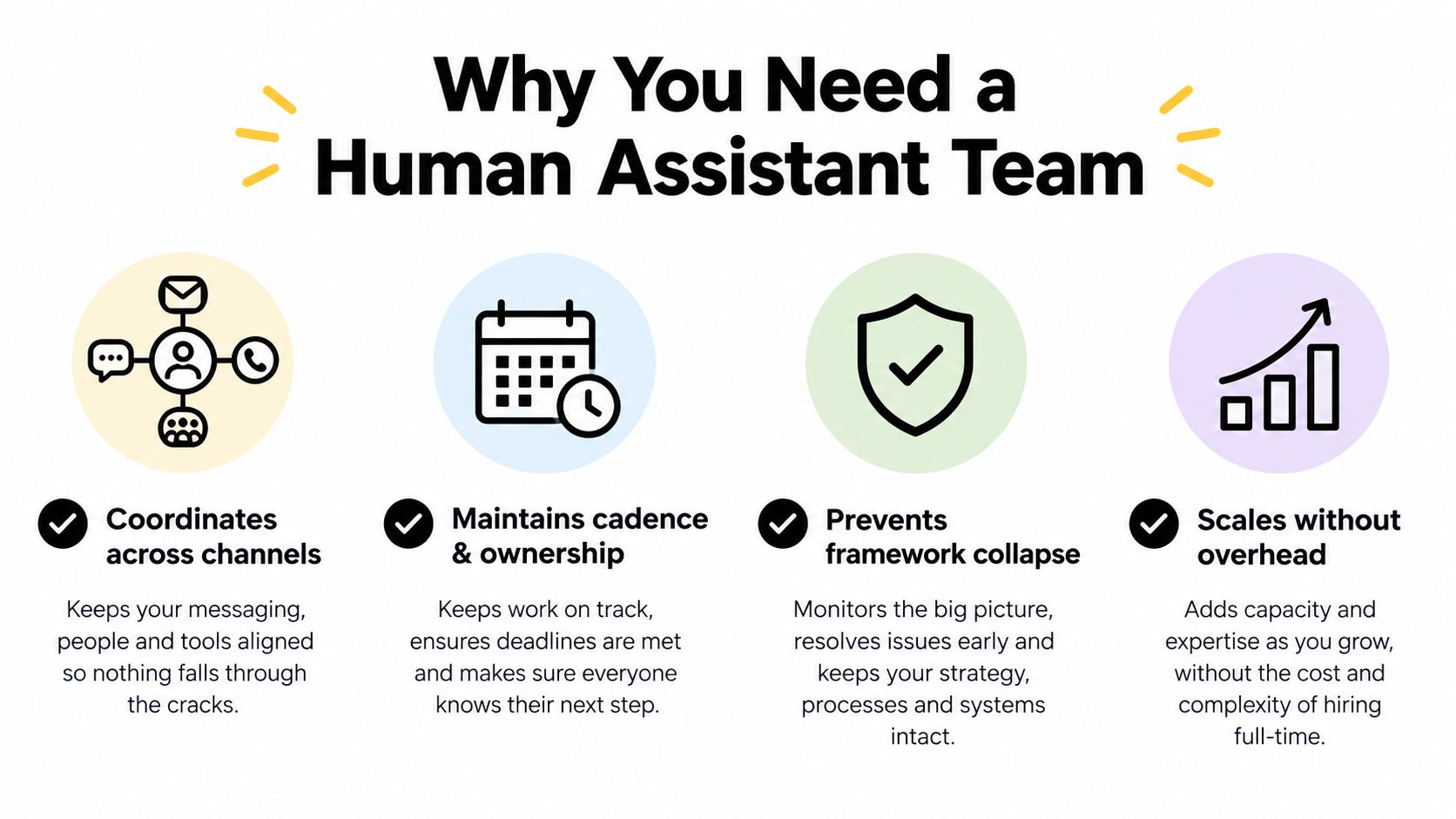
The framework collapses when nobody owns execution. A channel policy doesn't triage the inbox. A cadence doesn't chase a missing confirmation. A KPI doesn't reschedule the appointment. Someone must absorb coordination across contexts.
A subscription-based human Assistant team provides that layer without adding a full-time employee. Approved Lux Personal Assistant provides access to a US-based Assistant team 24/7/365, reachable through phone, SMS text, and email. Its Triple-channel access means the principal can use the mode that fits the situation, while the team handles inbox triage, email drafting, scheduling, reminders, vendor coordination, travel logistics, and meeting preparation.
Human judgment is the missing capacity
Software-only systems still require the principal to read the message, understand the context, choose the response, and confirm the action. Automation can accelerate a step, but it doesn't remove the coordination burden when a request crosses work, home, and stakeholder boundaries.
A human Assistant team can interpret those boundaries, ask for clarification when needed, route the task, and return a concise status update. Proactive Preference Learning allows the team to build context around communication norms, stakeholder tone, household preferences, and access standards over time. That turns support from ticket processing into an operating relationship with shared context.
The relevant comparison is capacity, not convenience. Independent compensation reporting places the mean U.S. executive assistant wage at $74,720, while a fully loaded in-house cost can reach approximately $95,000 to $130,000 per year after benefits, taxes, equipment, and office space, according to executive assistant cost reporting. A subscription model can suit someone who needs recurring administrative support without taking on that employment structure.
Delegate the coordination layer first
Start with work that consumes attention but rarely requires the principal's judgment:
- Inbox triage: Classify incoming messages, identify deadlines, and surface only decisions.
- Scheduling: Coordinate appointments, resolve conflicts, and protect focus blocks.
- Follow-up loops: Chase confirmations, vendor replies, and missing documents.
- Household logistics: Manage school reminders, home services, gift sourcing, and event details.
- Travel administration: Coordinate flights, hotels, ground transport, and itinerary changes.
- Meeting preparation: Assemble agendas, format documents, and track action items.
The goal isn't to delegate responsibility blindly. It's to delegate the movement between arrival and decision, preserving the principal's attention for judgment.
A 7-Day Plan to Reclaim Hours and Reduce Noise
Don't begin by migrating platforms. Begin by observing the work and assigning responsibility.
Day 1 creates the baseline
Spend 15 minutes listing every work and home channel, recurring sender, and communication category. Record approximate message volume, response patterns, and the requests that repeatedly interrupt deep work. The deliverable is a communication inventory, not a new system.
Day 2 assigns ownership
Choose one inbox view, one calendar, and one task list as the operating set. Assign an owner to every recurring category, including investor communication, vendors, school logistics, appointments, and household services. The checkpoint is simple: can each active request be assigned without asking who handles it?
Day 3 establishes routing
Write the channel rules. Use phone for urgent or complex matters, text for short time-sensitive coordination, and email for detailed or documentable decisions. Test the rules against real messages from the previous day.
Day 4 removes repeated drafting
Build templates for the five highest-volume message types. Include a scheduling request, a follow-up, a status update, a vendor inquiry, and a decision summary. Test whether the templates reduce drafting time by half, then revise the language so it still sounds human.
Day 5 delegates movement
Escalate anything that doesn't require the principal's judgment to a delegated coordination layer. That includes inbox sorting, appointment booking, reminders, vendor follow-up, travel research, and document preparation. The checkpoint is a written list of what the principal no longer touches first.
Day 6 measures the system
Audit hours reclaimed, response-time variance, and meetings avoided. Don't celebrate activity. Count time returned and interruptions removed. If response quality falls, tighten routing or ownership rather than adding more notifications.
Day 7 stress-tests the design
Run the system through one worst-case day, such as a travel disruption, a customer escalation, a school change, or a missed vendor deadline. Record where work stalls, then codify the adjustment in the channel agreement, owner map, or weekly scorecard.
A communication system is working when the principal can identify what needs attention without personally searching every channel. Track that outcome weekly. If the system doesn't return hours, it needs redesign, delegation, or both.
Approved Lux Personal Assistant provides a US-based Assistant team available 24/7/365 through phone, SMS text, and email for inbox triage, scheduling, travel, vendor coordination, and household logistics. Use it as the delegated coordination layer in your communication management system, then visit Approved Lux Personal Assistant to choose the support model that fits your work and home capacity.
Want the wider view?
Ten categories. One report. Every quarter. The Approved List tracks what's rising and what's fading: data-backed signals, not opinions.
Free to join · Delivered by email