
All Articles
The Journal
Snowbirds Schedule: A Practical Seasonal Planning Guide
October 16, 202612 min readseasonal travellong stay rentals
Build a snowbirds schedule that fits real life with weekly condo stays, coordinated flights, and a flexible seasonal calendar that adapts
You're looking at the calendar in October and realizing the winter plan is still half-built. The property isn't confirmed, the return date is vague, one family member wants to fly down later, and the weather may make the road trip harder than expected. That isn't a vacation itinerary. It's an operating problem.
A reliable snowbirds schedule treats the season as a flexible system. You set the return date, protect medical and household constraints, secure a stable middle stay, and leave room to change geography when transportation, weather, or border conditions make the original plan unattractive. The familiar November through April pattern still works, but only when you manage the transition periods instead of pretending they're single travel days.
What a Real Snowbirds Schedule Looks Like
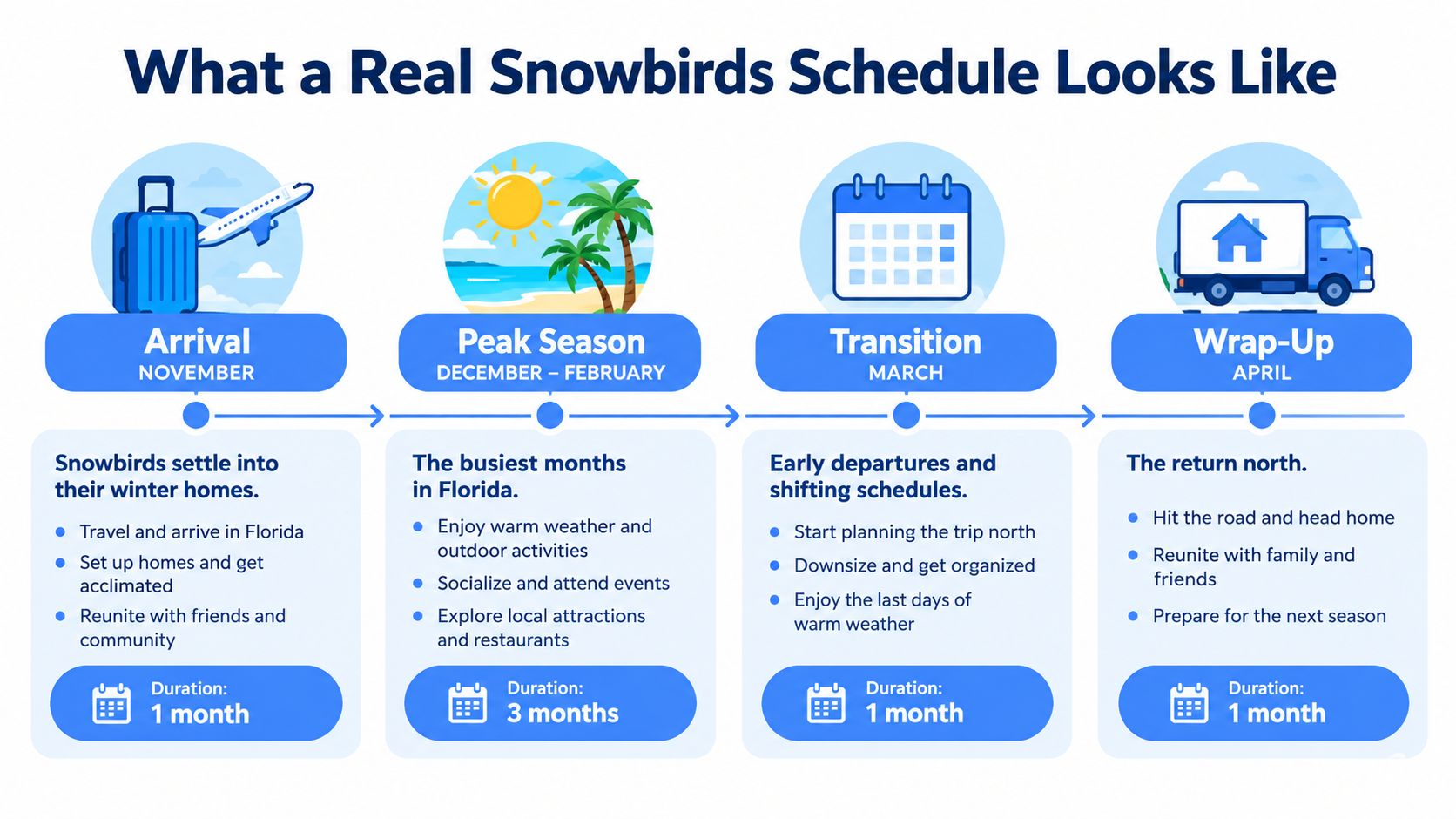
A real snowbirds schedule begins before departure. The conventional cycle runs approximately from November through April, with travelers leaving northern regions as temperatures fall and returning in spring, although some destinations now extend the seasonal window from early November through March instead of concentrating demand only in January and February (CooperatorNews explains the traditional seasonal-resident pattern).
The household calendar should have four reference dates:
- Departure date, when the household, vehicle, or first traveler leaves the northern home.
- Property check-in, which may occur after a road journey or before the full household arrives.
- Medical coverage window, including appointments, prescription refills, and insurance requirements.
- Return date, which determines how long the southern property, vehicle, and final transition inventory are needed.
Those dates rarely align perfectly. A couple might leave in late October, check into a Florida vacation home on November 1, have one spouse fly back for a January appointment, and return north in early April. The itinerary is seasonal, but the people inside it still have obligations.
The season has edges, not walls
The strongest schedule uses a flexible window. Autumn is for preparation, late fall is for southbound movement, the winter months are for the anchored stay, and early spring is for the return. That structure gives you room to shift the departure or substitute a destination without rebuilding the entire season.
Road households should also plan the departure as a cold-weather move rather than a simple holiday drive. A practical resource on planning a cold-weather move can help organize vehicle preparation, belongings, and winter travel risks before the household leaves.
The useful mental model is simple: secure the core of the season, keep the edges flexible, and decide the return before the departure. That approach holds up far better than selecting a warm destination first and trying to force every appointment, booking, and family visit around it.
The Three-Phase Seasonal Operating Cycle
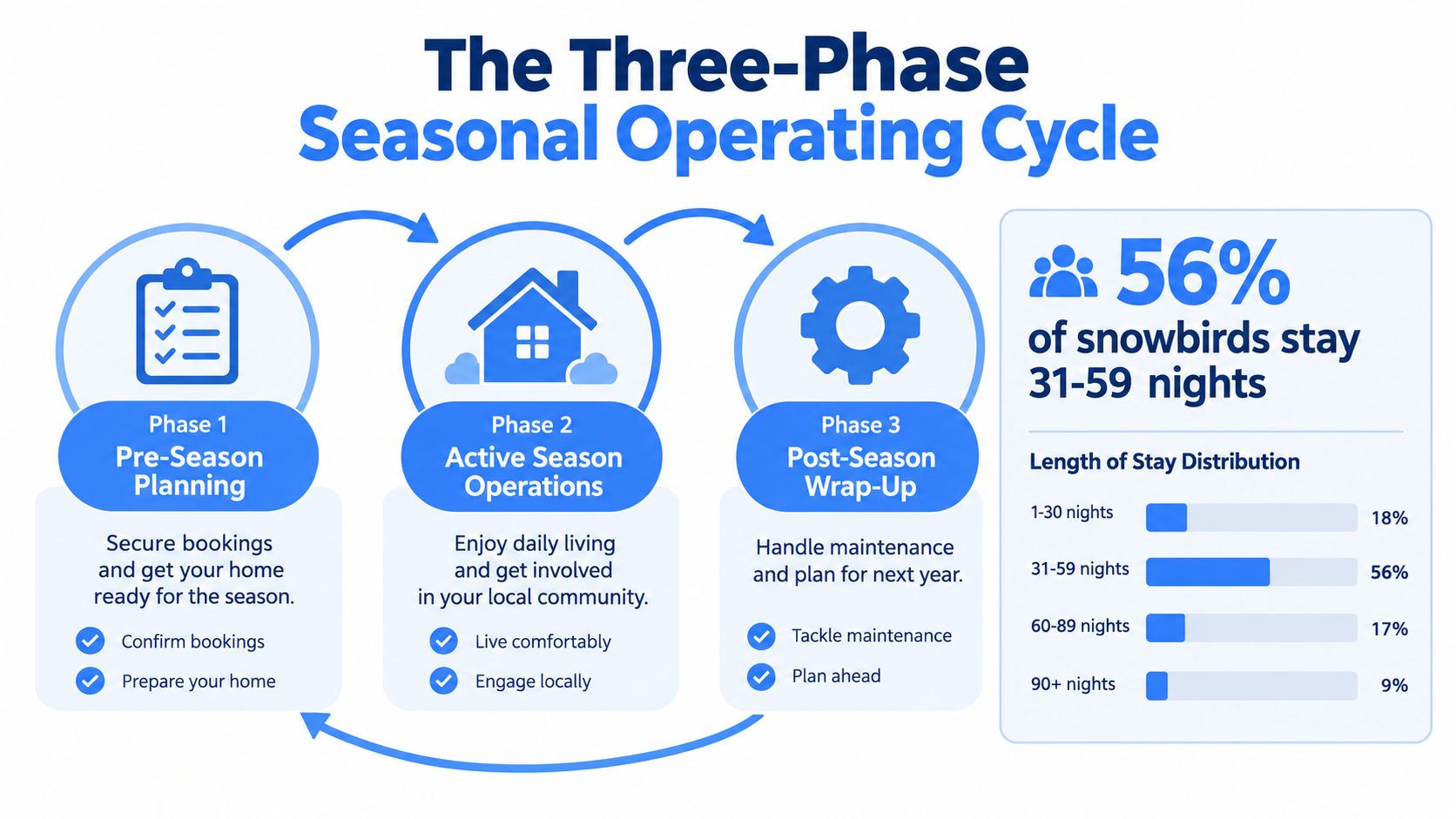
The snowbirds schedule functions as a three-phase cycle: preparation, the anchored winter stay, and the northbound reversal. Treating those phases as one operating system lets you stage weekly stays, alternate destinations, and family arrival windows around the same lodging, flight, vehicle, and household decisions.
Phase one prepares the system
Use September and October to set the season in motion. Confirm the return date, map the route, inspect the vehicle, choose a primary and alternate destination, and reserve long-stay accommodation before seasonal inventory tightens. Check medical coverage, prescription timing, household handoffs, and the dates when family members may arrive. Consolidated access to vacation-home inventory and wholesale-rate air is useful here because a change in destination should not force a complete rebuild of the calendar.
The stay usually extends well beyond an ordinary vacation. One survey reported that more than 70% of snowbird respondents spend at least three months away each winter, while 78% return to the same destination annually and 22% change destinations from year to year. The same PAX report on Canadian snowbird travel found that 31 to 59 nights represented 56% of snowbird trips, with that category growing at a compound annual rate of 8.8% since 2000. Plan for kitchens, workspaces, storage, repeat access, and room for visiting family, rather than treating the stay like a short hotel booking.
Phase two protects the middle
The active season generally covers December, January, and February, with early November arrivals and March departures becoming more common. Make this middle period the calendar's anchor. Arrange family visits, local healthcare, vehicle use, cleaning, and occasional short relocations around the main stay. Weekly staging can add variety without turning the season into a chain of disconnected reservations.
For road travel, use the 3-3-3 rule as a conservative workload benchmark: drive no more than 300 miles per day, arrive by 3:00 p.m., and remain at least three nights before relocating, as Go RVing explains in its snowbird route guidance. That limit reduces fatigue and preserves time for weather, maintenance, and delayed check-ins.
Phase three reverses the migration
March and April require a deliberate closeout. Confirm the northern home, finish the southern property handoff, schedule vehicle relocation, and separate the final accommodation night from the date the household reaches home. Someone leaving Florida on April 1 may need to check out earlier, then allow travel time and a buffer for interruptions.
Keep the season flexible at both edges, protect the anchored middle, and connect lodging, air, cars, and household logistics before confirming individual bookings.
Building the Calendar Around Fixed Constraints
Start with what cannot move. Snowbirds who begin with “Florida in November” often discover too late that a prescription refill, insurance rule, family event, or medical appointment determines the entire season.
Write down the fixed constraints before comparing properties or flights:
- Medical appointments: Place essential appointments on the calendar first, including any visit that must occur before departure or immediately after return.
- Prescription windows: Confirm when refills can be issued and whether the destination pharmacy can serve the household.
- Insurance requirements: Check out-of-area healthcare coverage before committing to a long stay.
- Family obligations: Identify weddings, caregiving duties, school breaks, and planned visits.
- Weather tolerance: Decide how much early-season storm exposure and winter road risk the household accepts.
- Travel capacity: Set the maximum number of travel days the household can safely manage.
Set the return date first. The return date is harder to improvise because it may depend on a northern medical appointment, property maintenance, or family responsibility. Once it's fixed, work backward to determine the length of the southern stay, the departure date, and the number of buffer days.
Practical rule: Add a one- to two-week buffer for weather, health, vehicle, or delayed check-in problems. A long seasonal itinerary without buffer is only a plan until the first disruption.
Air travelers should favor midweek departures and direct itineraries when the schedule allows. Fewer connections create fewer points of failure, especially when medication, mobility equipment, or checked luggage is involved. Road travelers should stop every two to three hours, avoid ambitious mileage at the beginning of the season, and schedule maintenance before the route becomes urgent.
The common failures are predictable. Booking only the outbound leg leaves the return exposed. Ignoring first-of-month demand can make a property unavailable exactly when a lease or family visit ends. Failing to confirm pharmacy access or healthcare coverage can turn a comfortable winter into an expensive relocation.
Use a simple date worksheet with four columns: fixed obligation, latest acceptable date, booking required, and fallback. That worksheet turns a vague seasonal idea into a sequence of decisions you can test before spending money.
Staging Weekly Stays Versus a Single Monthly Rental
One continuous rental is tidy, but it isn't always resilient. A staged schedule can fit households that want to test a destination, accommodate visitors, respond to weather, or avoid tying the entire winter to one property.
A practical staged model starts with an initial two- to four-week stay, moves into a longer middle stay, and ends with flexible transition inventory. The first property can serve as a landing base while the household checks healthcare access, neighborhood fit, transportation, and weather. The middle property carries the main season, while the final booking protects the return transition.
A 2025 survey of 1,282 adults aged 45 and older found that 54% stay one to three months, 31% stay four or more months, and 21% stay longer than they did previously (Emergency Assistance Plus reports the survey results). Longer stays make staging more useful because a 60- to 120-day season may need different properties for arrival, peak occupancy, family visits, and departure.
| Criterion | Staged Weekly Stays | Single Monthly Rental |
|---|---|---|
| Flexibility | Supports destination changes and shorter commitments | Keeps the household in one base |
| Family visits | Lets you match property size to arrival windows | Requires one property to fit the largest group |
| Healthcare access | Allows relocation closer to providers | Keeps care centered around one area |
| Weather response | Makes substitution easier when conditions change | A change may require breaking one large booking |
| Household routine | Requires more packing and check-ins | Provides continuity and fewer moves |
| Pricing logic | Can use shoulder-season inventory strategically | May simplify budgeting for a long lease |
Canada–U.S. travel conditions also make alternates practical. In 2025, 26% of Canadians said they planned to travel to the United States for winter, down 37% from the prior year, and only 10% of Canadians aged 61 to 79 planned to go, a 66% year-over-year decline (Durham Region reports the survey findings). Mexico, Costa Rica, Portugal, Spain, and the Caribbean become operational alternatives, not just aspirational destinations.
Use the snowbird monthly rentals planning guide when comparing one long booking with a portfolio of weekly stays. My recommendation is clear: choose one rental for a stable household that knows its destination and dates, but stage the season when family schedules, border conditions, or destination risk remain uncertain.
Coordinating Inventory, Flights, and Cars as One Booking System
The reservation system should reflect the season's structure. Searching for a property in one account, flights in another, and cars through a separate membership makes it easy to create mismatched dates, inconvenient pickup locations, and uncovered transition nights.

Approved Traveler provides consolidated access to 1,000,000+ hotels, 500,000+ vacation homes, 700+ airlines, 30,000+ car-rental locations, and 150,000+ activities. For a snowbirds schedule, the operational value is the ability to compare a weekly vacation home, a midweek flight, and a one-way or seasonal vehicle plan in one workspace, rather than treating each reservation as an isolated purchase.
Build the booking in this order:
- Place the property anchors: Reserve the initial landing stay, the main winter base, and any transition nights.
- Match the flights: Use direct, midweek options where available, then confirm that arrival and departure times work with property check-in.
- Fit the vehicle: Select a car that matches the route, luggage, mobility needs, and parking limits at each property.
- Add family inventory: Reserve additional rooms, homes, activities, or cars around the dates when relatives arrive.
- Record cancellation terms: Keep the change rules beside every reservation, not in a separate inbox.
If a household is driving its own vehicle south, arranging Miami vehicle shipping from New York may be more practical than adding a long road journey to an already demanding itinerary. The right choice depends on vehicle needs, driving capacity, and the final destination.
Reward Credits accumulate on every booking and can be redeemed toward future stays or renewal. The Boomerang Member Share program lets up to 10 household members share one account, which is useful when adult children visit at different times and shouldn't need parallel subscriptions.
For larger schedules, a documented travel inventory management system keeps property dates, flight details, car reservations, family arrivals, and cancellation terms visible together.
Check the rate after booking through the 110% Best Value Guarantee. That gives the household a defined verification step instead of relying on memory or scattered screenshots.
Operational Checklists for Healthcare, Household, and Weather
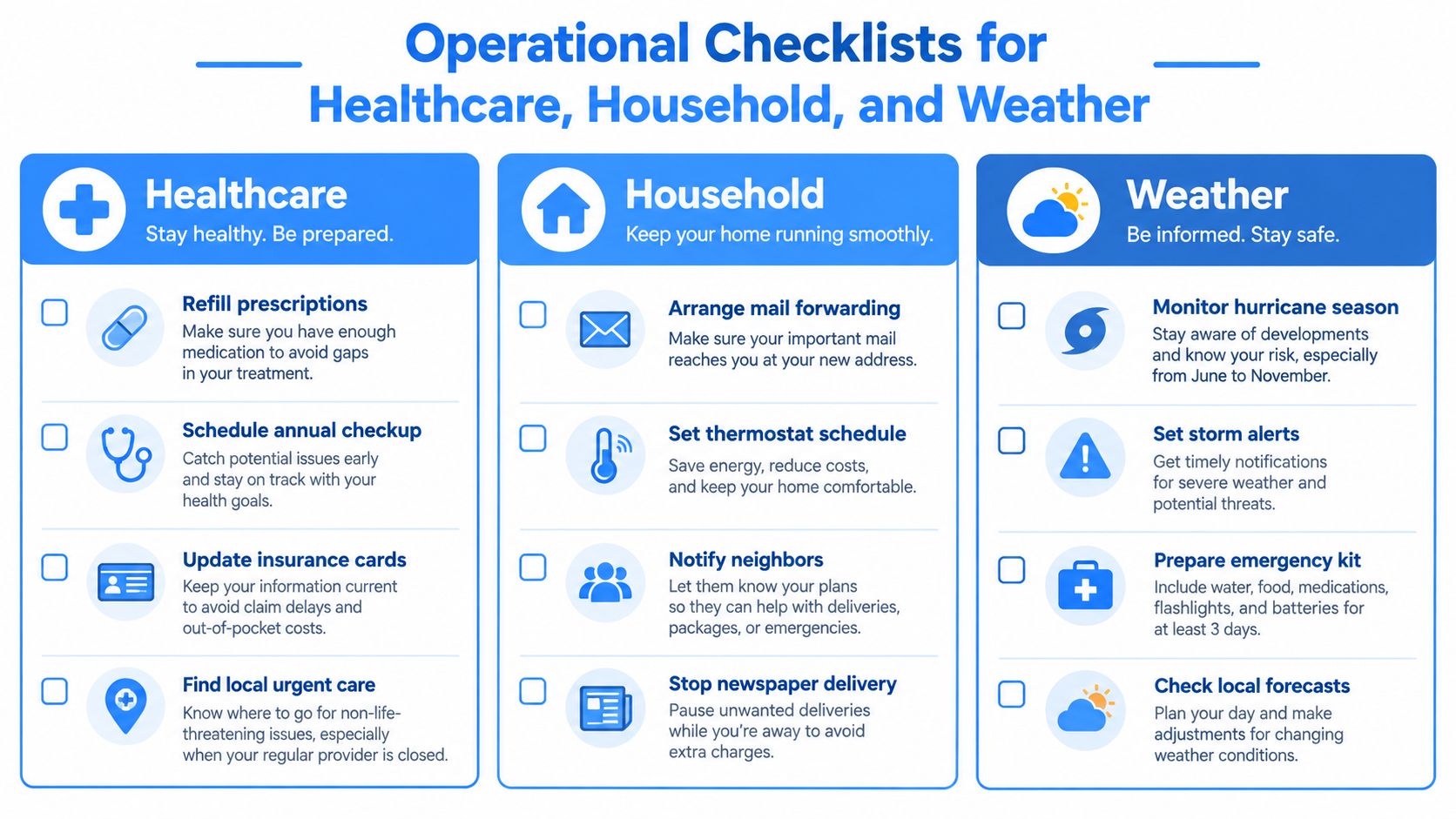
The schedule usually breaks in the operational layer. A property can be attractive and the route can be efficient, but missed prescriptions, unattended mail, or unclear storm procedures will still disrupt the season.
Healthcare continuity
Before departure, confirm out-of-area coverage, destination provider networks, pharmacy access, and prescription refill timing. Keep insurance cards, medication lists, emergency contacts, and provider details available to every adult responsible for the household.
A destination with limited local care may still work for a short visit, but it's a poor choice for a multi-month stay if routine treatment requires repeated long-distance travel. Households caring for older relatives should also review a practical guide to house call doctors for seniors before departure, especially when mobility or transportation could become an issue.
Household handoff
Use the departure week to complete the northern-home handoff:
- Mail: Arrange forwarding or collection and make sure time-sensitive notices have a responsible recipient.
- Utilities: Set thermostat, water, security, and service schedules for an unoccupied property.
- Insurance: Confirm the policy permits the planned vacancy and update contact information.
- Neighbors: Give a trusted neighbor the travel window, emergency contacts, and permission boundaries.
- Payments: Review automatic bills, account alerts, and recurring property expenses.
- Documents: Store identification, medical paperwork, and vehicle records where the traveling household can access them.
The same checklist should run in reverse before returning north. A seasonal home needs its own closeout list, including keys, utilities, maintenance, mail, and any vehicle or storage arrangements.
Weather exposure
Florida's Atlantic hurricane season officially runs from June 1 through November 30, with peak activity generally occurring from mid-August through mid-October (Florida Division of Emergency Management provides the official hurricane-season calendar). A traveler arriving in Florida on October 15 is therefore arriving during the official season and near its peak-risk period.
That booking needs weather monitoring, property emergency procedures, evacuation information, and flexible transportation terms. Confirm whether the property, flight, and car reservations can be changed or canceled before departure. A storm plan that exists only in the traveler's head is not a plan.
For family logistics, the travel with elderly parents planning resource can help coordinate mobility, medical information, pacing, and shared responsibilities before everyone arrives.
Putting Your Twelve-Month Snowbirds Calendar Together
A twelve-month calendar keeps decisions from bunching together at the last minute.
- August to September: Research properties, flights, vehicle options, primary destinations, and alternates. Start with the return date and fixed medical or family obligations.
- October: Confirm reservations, finalize the household handoff, verify healthcare and pharmacy arrangements, and monitor departure-region weather.
- November to March: Operate the active season. Recheck weather, property dates, family arrival windows, transportation, and healthcare needs each month.
- April to May: Return north, close out the southern property, relocate or store the vehicle, and record what should change next season.
- June to July: Review the completed season, inspect both homes, update the household inventory, and identify any new constraints before research begins again.
Keep three rules visible:
- Set the return date before the departure date.
- Stage inventory when geography or timing may change.
- Treat the schedule as a movable window, not a fixed November-to-April promise.
A successful snowbirds schedule is an operating rhythm. It has fixed constraints, flexible geography, a protected middle stay, and a monthly confirmation habit that catches changes before they become expensive.
Approved Experiences Traveler provides consolidated access to vacation homes, hotels, airlines, car rentals, cruises, and activities, which lets you coordinate a multi-month winter schedule through one travel infrastructure system. Visit Approved Experiences Traveler to review the membership and plan your lodging, transportation, and family travel logistics in one place.
Want the wider view?
Ten categories. One report. Every quarter. The Approved List tracks what's rising and what's fading: data-backed signals, not opinions.
Free to join · Delivered by email