←All Articles
The Journal
Task Management for Small Business: A 2026 Guide
October 4, 202612 min readsmall businessdelegation
Discover how task management for small business can streamline your operations in 2026. Get practical strategies to boost team productivity.
A 2025 survey of 251 U.S.-based entrepreneurs found that administrative tasks consumed an average of 36% of the workweek. With an average workweek of 45.5 hours, that equals roughly 16.4 hours spent on coordination, records, scheduling, and other essential work that rarely creates new revenue. (Stealth Agents research)
That's the task-management problem for a small business. It isn't that the founder needs a prettier task board. It's that the operating model still expects the owner to absorb every loose end, from vendor follow-ups to calendar conflicts, after the day's supposedly important work is finished. The fix is a system that makes work visible, plus enough flexibility to move routine execution away from the founder.
The Real Cost of Admin Drag in a Small Business
Administrative drag turns a founder into the default coordinator for everything nobody else owns. Client scheduling, inbox triage, invoice follow-up, travel logistics, vendor questions, document formatting, and deadline reminders each look small in isolation. Together, they consume the attention required for sales, hiring, delivery, and strategic decisions.
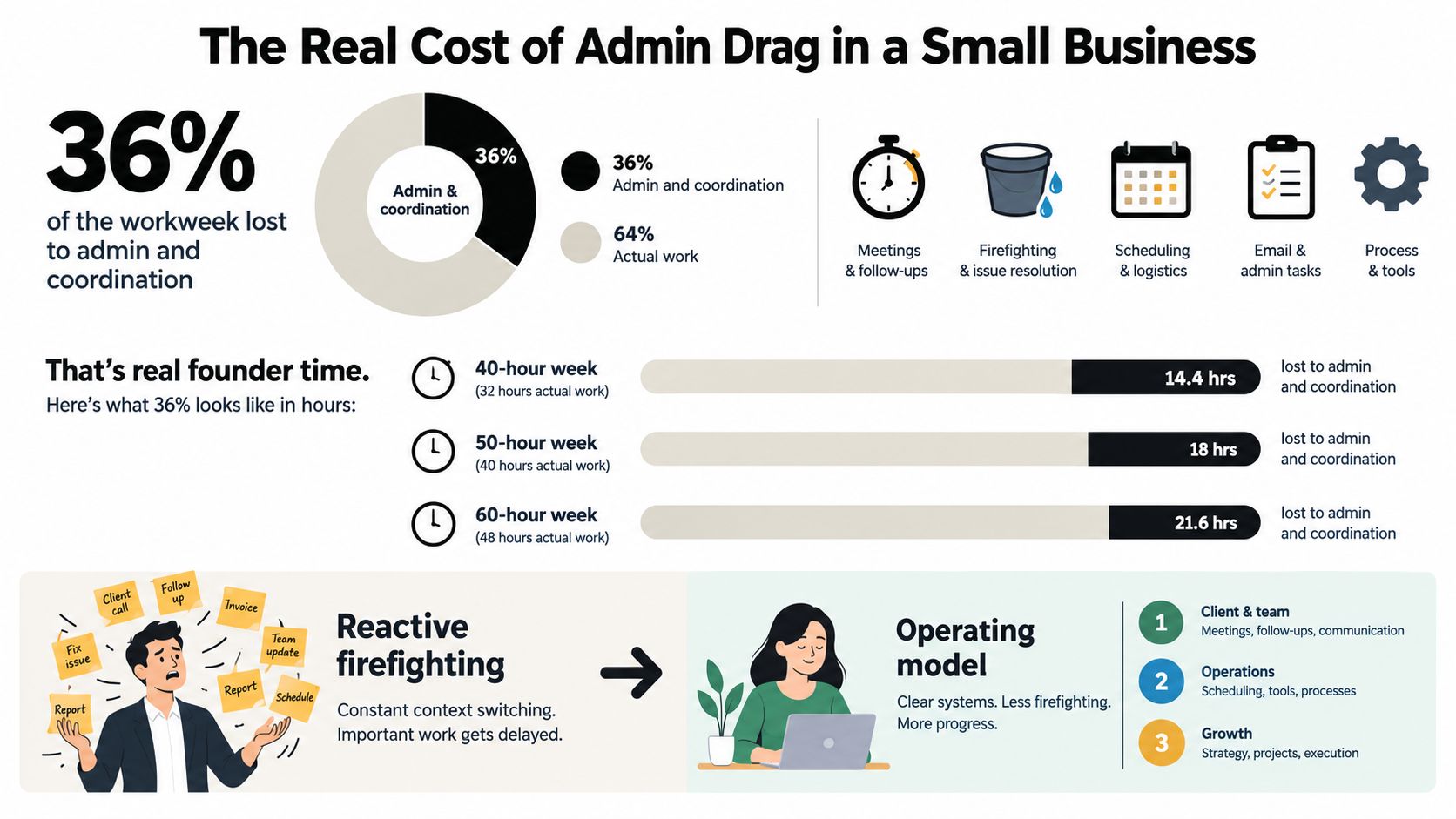
The 36% figure matters because it changes the diagnosis. A founder working a 45.5-hour week can lose about 16.4 hours to low-impact administration, according to the same 2025 entrepreneur survey. That's not a personal productivity flaw. It's an operating-model failure.
The second shift is the constraint
Consider two owners of similar five-person companies. One carries 20 hours of scheduling, chasing, inbox sorting, and logistics every week. The other routes recurring work through a shared system, assigns clear owners, and reserves personal attention for decisions only the owner can make. The second founder doesn't have more discipline. They have a better allocation of capacity.
Administrative overhead remains structurally large across small businesses. One dataset reports owners spending 23 hours per week on administrative work, while another reports that delegation or outsourcing can recover an average of 14.3 hours per week, with 71% of recovered time redirected toward sales, customer relationships, and delivery. (SMB administrative overhead research)
The practical lesson is simple:
Task management isn't mainly a software-selection problem. It's a decision about who absorbs the second shift.
Start with one source of truth, but don't stop there. A board full of unassigned tasks only gives the founder a better view of the burden. The scalable model combines a shared task system, clear triage rules, short SOPs, and a human execution layer that handles routine work without demanding a new briefing every time.
Map Your Tasks and Pick a Triage Rule
Begin with an audit, not an app comparison. Create a two-column list. Put every recurring task in the first column, including the work that happens in email, text messages, calendar invitations, accounting software, and memory. Put the current owner in the second column, even when that owner is “the founder by default.”
A design studio owner might discover that 11 hours disappear into scheduling, invoice chasing, and rebooking vendor meetings. The list should also capture the hidden steps, such as checking availability, drafting reminders, confirming details, updating the calendar, and following up when someone doesn't respond.
Use three questions to sort the work
Apply the Revenue, Recurrence, Reachability rule to every task:
- Revenue: Does this require the founder's judgment to win, retain, or deliver valuable work?
- Recurrence: Does the task follow a repeatable pattern with the same trigger and outcome?
- Reachability: Can another person access the required information, tools, and context without interrupting the founder?
The answers sort tasks into four actions. Keep work that is revenue-critical and judgment-heavy. Delegate work that recurs and can be completed with available context. Batch irregular tasks that still require owner review. Drop work that creates no meaningful customer, operational, or financial value.
| Task Example | Revenue Impact | Recurrence | Reachability | Action |
|---|---|---|---|---|
| Approve a proposal scope | High | Low | Medium | Keep |
| Schedule a client call | Medium | High | High | Delegate |
| Chase an overdue invoice | High | High | High | Delegate |
| Rebook a vendor meeting | Low | Medium | High | Delegate |
| Review an unused software subscription | Low | Low | Medium | Batch or drop |
For the studio owner, scheduling moves immediately to delegation. Invoice follow-up belongs with the person who owns receivables, with escalation rules for unusual cases. Vendor rebooking should use a defined availability window, not a fresh founder decision each time. The audit becomes useful only when it changes who does the work.
A shared task list should show status, owner, trigger, deadline, and next action. Keep it simple enough that a team member can update it without training. The practical principles in this guide to what task management means support that structure, but the tool matters less than consistent ownership.
Delegation rule: If a task survives two consecutive weeks without requiring your judgment, treat it as a delegation candidate.
Build SOPs for the Work That Recurs Every Week
An SOP should let another person execute a recurring task without sending a Slack message that says, “Can you remind me how we do this?” Keep each SOP to one screen. If the process needs a long explanation, separate the judgment calls from the routine preparation and document only the parts someone else must repeat.
Use five fields:
- Recurring task
- Trigger event
- Owner
- Deadline
- Handoff
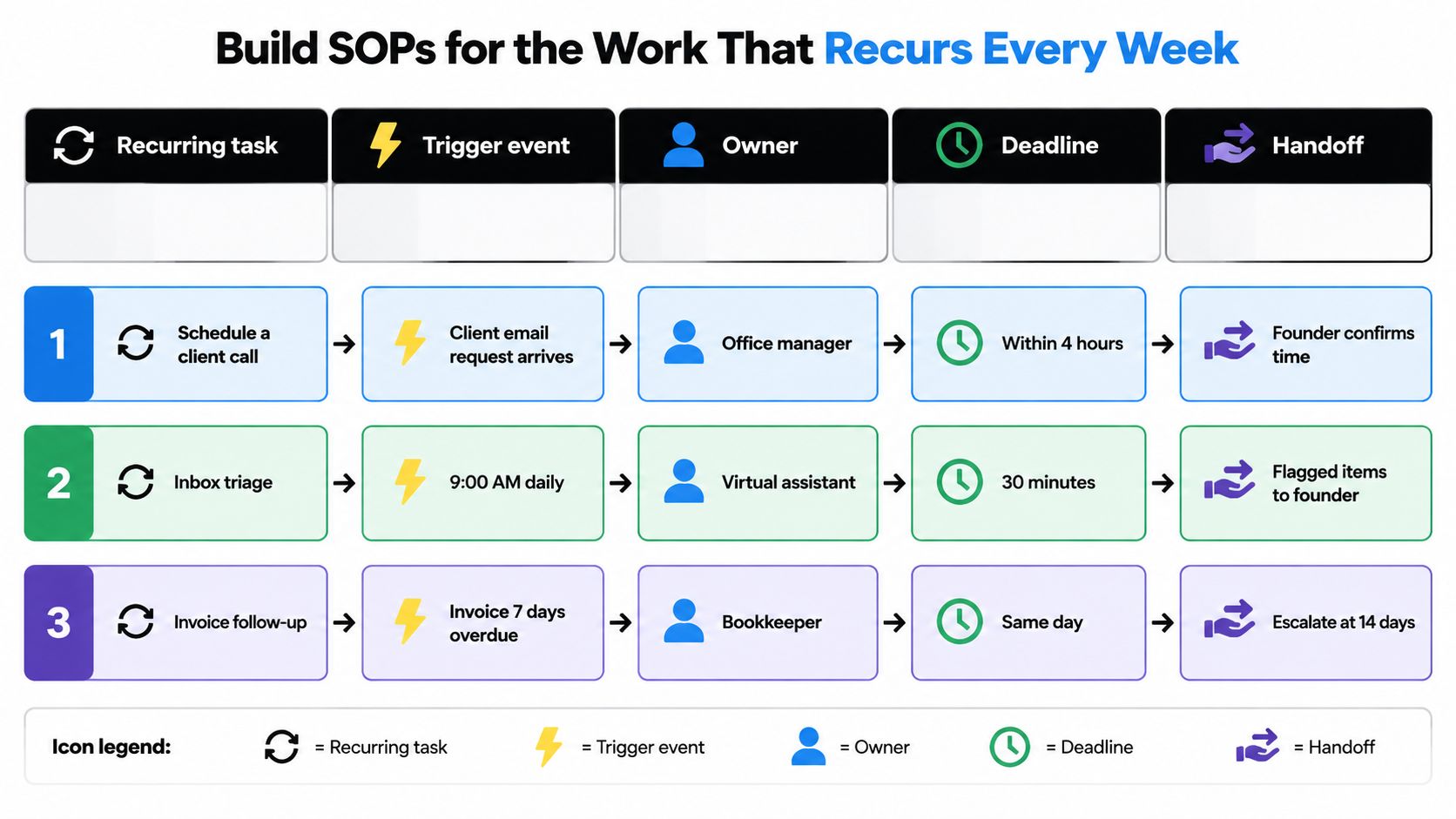
Three SOPs worth writing first
Schedule a client call
- Recurring task: Schedule a client call
- Trigger event: Client email request arrives
- Owner: Office manager or Assistant
- Deadline: Within the agreed response window
- Handoff: Founder confirms the time when a judgment call is required
The owner checks the founder's approved availability, offers suitable options, confirms the time zone, sends the calendar invitation, and records any preparation notes. The founder only receives an escalation when the request conflicts with a priority commitment or requires a relationship decision.
Inbox triage
- Recurring task: Inbox triage
- Trigger event: The daily inbox review begins
- Owner: Virtual assistant or Assistant team
- Deadline: Complete during the designated review window
- Handoff: Flagged items go to the founder with a recommended next action
The operator sorts messages into respond, delegate, archive, schedule, and escalate. A good handoff includes the relevant thread, a concise summary, and a draft response where appropriate. “Please review” isn't a handoff. It's another task.
Travel logistics
- Recurring task: Build and maintain a business trip itinerary
- Trigger event: Travel request or calendar commitment is confirmed
- Owner: Assistant team
- Deadline: Before the traveler's internal planning cutoff
- Handoff: Traveler approves choices that fall outside established preferences
Record preferred departure windows, acceptable connection patterns, hotel requirements, ground transport rules, and escalation conditions. The person executing the workflow should solve the normal case and surface only exceptions.
SOPs aren't documentation theatre. They're the artifact that lets an Assistant, contractor, bookkeeper, or future hire execute without relying on founder memory. Businesses that also manage people-related workflows can use a practical workflow for HR and People Ops as a reference for defining triggers, owners, and handoffs.
Revise an SOP when it breaks. Don't turn it into a wiki project. Over time, the library becomes the onboarding document for anyone who takes responsibility for recurring work.
Choosing How to Delegate Without Adding Overhead
Delegation fails when the owner compares hourly rates but ignores management cost. A low-cost option that requires constant task briefing, follow-up, correction, and context rebuilding can be more expensive than a higher-priced service that owns intake and execution.
A direct employee provides control and continuity, but the full cost includes more than salary. Benefits add about 29.9% to 30% of total compensation in BLS-based estimates, and one 2026 analysis places a median executive assistant salary at $76,590, with total employer cost clearing $109,000 after benefits. (Executive assistant cost analysis)
| Option | Weekly Loaded Cost | Hours Recovered / Week | Management Overhead | Best For |
|---|---|---|---|---|
| In-house executive assistant | High, including employment overhead | Potentially substantial when the role is fully utilized | Recruiting, payroll, training, supervision | A company with stable, broad support needs |
| Freelance virtual assistant | Variable hourly or retainer cost | Depends on task clarity and availability | Repeated briefing, checking, and coordination | Clearly defined repeatable work |
| DIY automation stack | Low direct cash cost | Usually limited when judgment remains with the owner | Building, maintaining, and debugging workflows | Simple rules with rare exceptions |
| Subscription Assistant team | Predictable subscription cost | Tied to the quality of intake, SOPs, and handoffs | Lower direct supervision, with preference setup required | Small companies needing flexible execution capacity |
A full-time hire only makes sense when the business can keep that person productively occupied with meaningful work. Freelance support works well for clean, bounded tasks, but it becomes frustrating when the owner must explain every exception. Automation is useful for moving information, not for handling ambiguous requests, sensitive communication, or vendor negotiation.
A subscription Assistant team sits between software and employment. The team can absorb intake, prioritize requests, execute recurring workflows, and escalate decisions. For founders comparing paths, the relevant question isn't “What's the cheapest hour?” It's “How much owner attention does this path consume per completed task?”
Use the operating logic from this guide to master delegation in your firm before selecting a provider. If the work is decision-heavy, judgment and accountability matter more than hourly rate. If it's recurring and rule-based, choose the option that creates the least management overhead, then document the workflow in a practical task-delegation system.
The option five-person companies most often under-invest in is managed execution. They buy another tool, keep the founder as the router, and wonder why the admin burden remains.
Plugging a Subscription Assistant Team Into Your System
A subscription Assistant team should become the execution layer for the system you've already built. It shouldn't create another inbox, another board, or another place where requests disappear. The team receives work through the channels you already use, applies the triage rules, follows the SOPs, and escalates only the decisions that belong with you.
A practical onboarding arc
Week 1: Export the recurring-task list and record short walkthroughs. Explain what “done” means, which sources are authoritative, and which decisions require approval. Don't attempt to document the entire company. Start with the work that interrupts you most often.
Week 2: Hand off inbox triage, calendar holds, scheduling conflicts, and vendor coordination. Review the first outputs for quality and update the rules instead of rewriting every task yourself.
Week 3: Route the SOPs into the team's workflow. Add clear owners, deadlines, and escalation triggers. A task should arrive with its context attached, not as a vague request copied from a text message.
Week 4: Review what ran without you. Tighten preferences, remove unnecessary approvals, and identify the next recurring workflow to transfer.
The operating advantage comes from Proactive Preference Learning. The team records decisions you've already made repeatedly, such as which vendor to use, what tone to take in a message, which calendar slot to protect, and what qualifies as an exception. Each preference removes context from future requests.
A client-coordination workflow shows the difference. Instead of asking the founder to assemble a meeting brief, confirm attendees, check open action items, and draft the agenda, the Assistant prepares the brief and flags only unresolved decisions. The founder reviews judgment calls rather than reconstructing the entire situation.
Travel logistics work the same way. On the first trip, the Assistant may need a detailed explanation of preferred flight windows, hotel location, ground transport, and communication style. Once those preferences are recorded, a later request can be short because the operating model is already known.
That's how task management compounds. The system becomes more useful as the team learns what the founder has already decided, while the founder spends less time repeating those decisions.
Metrics That Prove You Got Your Hours Back
A task system can make work look organized without reducing the owner's burden. Track outcomes that expose whether the founder is doing less coordination and whether the business is moving faster.
Use five measures:
- Hours reclaimed: On Friday, tally the founder minutes removed from inbox, calendar, vendor, and recurring coordination loops.
- Decisions delegated: Count choices completed without escalation. This shows whether the team has enough context to act.
- Follow-ups cleared: Review the number of unresolved threads older than the company's chosen aging threshold.
- Mental-load score: Rate the sense of coordination burden on a consistent 1-to-10 scale each week, then review the monthly pattern.
- Cycle time: Measure how long recurring work takes from trigger to completion, especially invoicing, onboarding, reporting, and scheduling.
Run one monthly operating review
Set aside a short monthly review with the Assistant team or whoever owns delegated work. Start with hours reclaimed, then inspect decisions delegated and follow-ups cleared. If the first measure improves but the others worsen, the team may be moving tasks without resolving them.
Cycle time reveals process friction. A recurring workflow that keeps slowing down probably has an unclear trigger, missing access, or an approval step that shouldn't exist. Rework points to an SOP problem. Mental-load scores reveal the cost that a standard productivity dashboard misses, especially for founders and dual-career parents managing work and household coordination at the same time.
Working parents often carry cognitive, physical, and emotional labor across both work and home, and research links that burden with work-privacy conflict. (Research on mental load and work-privacy conflict) A task system that clears business follow-ups but leaves household scheduling scattered across texts and calendars hasn't solved the full coordination problem.
Use the dashboard as proof of operational ROI, not as a productivity scoreboard. The question isn't whether everyone completed more tasks. It's whether the founder spent less attention routing work and more attention making decisions that grow the business. For a broader way to think about the value of recovered capacity, use this time-value calculation framework.
Your First 30 Days and the Bottom-Line Payoff
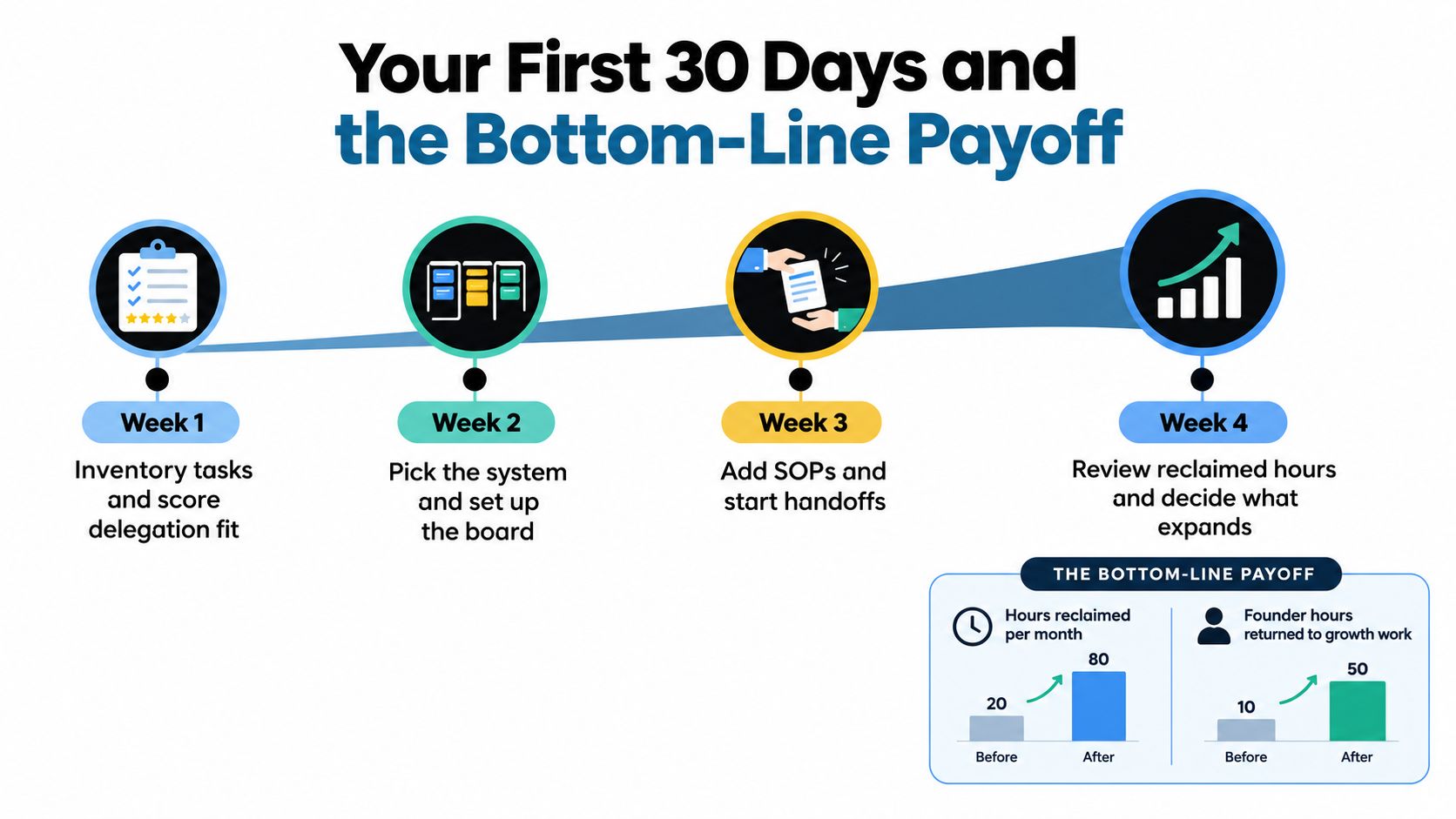
Treat the first month as an operating-model rollout, not a software implementation. In the first week, inventory recurring tasks and score each one for delegation fit. Choose work that is frequent, interruptive, and easy to explain before handing over work that depends on nuanced judgment.
In the second week, select the shared system and establish the board or task list. Every item needs an owner, status, deadline, and next action. If requests still arrive through scattered messages with no consistent capture process, the system isn't live yet.
Build the handoff in the third week
Add SOPs and begin transferring workflows. Start with scheduling, inbox triage, vendor follow-up, travel logistics, expense tracking, or meeting preparation. Keep approval thresholds explicit. The Assistant should resolve standard cases and escalate exceptions with a recommendation.
In the fourth week, review reclaimed hours, delegated decisions, aging follow-ups, cycle time, and mental load. Decide which workflow expands next based on evidence. If a process created rework, rewrite the SOP before adding more volume.
Run the ROI calculation plainly:
Recovered hours × loaded founder hourly value − subscription cost = operating return.
Loaded hourly value should reflect what the founder can reasonably earn, bill, sell, or create with the recovered time. For a solo professional billing $300 to $800 per hour, even a few hours of administrative work redirected to billable activity can outweigh a subscription cost. (Executive assistant pricing context)
Compare that result with hiring an employee, including benefits, payroll obligations, recruiting, equipment, onboarding, and management. A subscription Assistant team can function as a first hire without overhead, giving a small company flexible capacity before it commits to a full employment role.
Don't judge the model after one handoff. Send three recurring tasks to the Assistant team this week, book a 20-minute scoping call, and measure the five operating metrics at the 30-day mark. That gives you a real decision based on hours, follow-ups, delegated judgment, and mental bandwidth, not on whether a task board looks busy.
Approved Lux Personal Assistant provides a subscription Assistant team for scheduling, inbox triage, travel logistics, vendor coordination, research, document formatting, expense tracking, and meeting preparation through call, SMS text, or email. Visit Approved Lux Personal Assistant to scope the three recurring tasks that should leave your plate first.
Want the wider view?
Ten categories. One report. Every quarter. The Approved List tracks what's rising and what's fading: data-backed signals, not opinions.
Free to join · Delivered by email