←All Articles
The Journal
Time Management for Professionals: Reclaim Your Hours
October 7, 202611 min readproductivityprofessional advice
Practical time management for professionals: reduce interruptions, delegate admin, and use tools like Approved Lux to get your day back.

Workers face an interruption about every 2 minutes during core working hours, adding up to roughly 275 disruptions across the day. Time management for professionals improves when you reduce operational noise, protect focus, and delegate recurring coordination instead of trying to schedule your way out of a capacity problem.
The modern professional doesn't have a simple calendar problem. You have a throughput problem. Every message, rescheduling request, travel change, approval, reminder, and household obligation consumes attention that could otherwise support client work, strategic decisions, writing, analysis, or revenue generation.
The right question isn't, “How can I fit more into my day?” It's, “Which work deserves my attention, and which work should leave my operating system entirely?”
The Structural Chaos of the Modern Workday
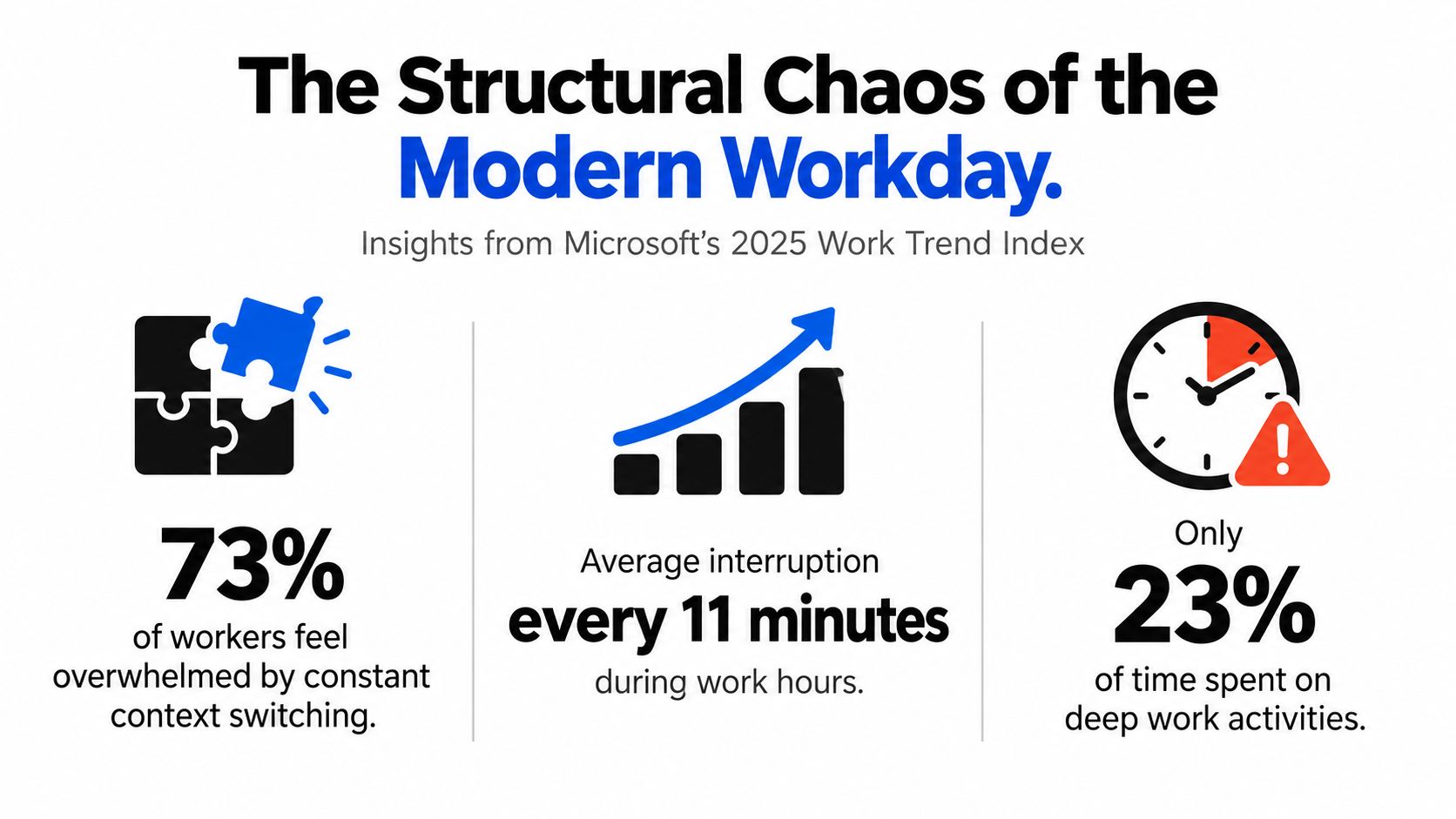
Microsoft's 2025 Work Trend Index analyzed productivity signals from Microsoft 365 users and surveyed 31,000 full-time employees and self-employed knowledge workers across 31 markets. It found that workers were interrupted by a meeting, email, or chat approximately every 2 minutes during core working hours, equivalent to roughly 275 interruptions across the day. The same analysis recorded an average of approximately 117 emails and 153 Teams messages per weekday for each worker. Microsoft's 2025 Work Trend Index
That volume changes the nature of time management. A calendar can tell you where meetings sit, but it can't show the recovery cost after a message pulls you away from a proposal or a scheduling request breaks your analysis. Nearly half of employees, 48%, said their work felt chaotic and fragmented, while 52% of leaders reported the same experience, according to the Microsoft analysis.
Why standard scheduling breaks down
Traditional productivity advice assumes that you control the inputs. You select priorities, block time, and execute. That model fails when other people, systems, and obligations can continuously inject work into your day.
The practical consequences are predictable:
- Focus becomes conditional: Strategic work happens only if nobody needs a response.
- Urgency replaces value: The newest request receives attention, regardless of its commercial or strategic importance.
- Follow-ups multiply: Every unresolved item stays active in your memory and competes with current work.
- Evenings absorb the overflow: Professionals recover lost focus after meetings and messages by extending the workday.
The objective is not maximum calendar utilization. A completely full calendar is a fragile operating model. The objective is to convert fragmented attention into reclaimed, usable hours by reducing avoidable coordination, batching communications, and routing routine logistics away from the person whose time carries the greatest value.
Operational rule: If a task repeatedly interrupts high-value work, treat it as a systems defect, not a personal discipline failure.
A useful audit starts with the work that breaks concentration most often. Track which requests arrive during priority work, how often you switch, how long it takes to resume, and whether the protected block produces a defined deliverable. That information reveals whether you need a better personal rule, a process redesign, automation, or human support.
Building Execution Rules and Focus Protocols
“Manage your time better” is not an operating instruction. Professionals need rules that tell them what to do when a predictable event occurs. Implementation intentions create that connection by pairing a trigger with one behavior, one output, and a time limit. Research on workplace habit formation supports using these rules to establish new work habits. The workplace habit research
A practical protocol looks like this:
- Choose one priority outcome: A focus block should produce something specific, such as a completed client brief, a reviewed forecast, or a decision memo.
- Batch communication: Check email, messaging, and routine approvals during scheduled windows instead of leaving every channel open.
- Protect demanding work: Mark focus blocks as unavailable and remove nonessential notifications before the block begins.
- Define the next action: Replace “work on proposal” with “draft the pricing section” or “review the client's three stated objections.”
- Review the block: Record what you completed, which interruptions occurred, and how much resumption time they required.
Deloitte's synthesis of workplace research reports that recovering from an interruption can take approximately 15 to 23 minutes, while one cited dataset found a 3.5% decrease in total productivity for every task switch. Deloitte's analysis of digital distractions The point isn't to worship an uninterrupted calendar. It's to measure the cost of switching and decide which interruptions deserve a route around your attention.
Use explicit if-then rules for recurring events:
- If a meeting ends, capture decisions, assign owners, and schedule the next follow-up before opening email.
- If a new request arrives during a focus block, record it in the task system and assess it during the next communication window.
- If a deliverable feels too large, define the smallest visible next action before leaving the task.
- If a meeting runs over, re-plan the next block rather than pretending the original schedule remains intact.
For additional practical guidance on structuring concentrated work and reducing friction, review these work efficiency tips from Madeira Remote. Availability also needs an operating policy. A clear availability management framework can help distinguish genuine access requirements from the habit of being reachable at every moment.
Run the protocol for two weeks. Count switches during priority work, minutes spent resuming, and deliverables completed per protected block. Then remove rules that are too broad, add rules for recurring failure points, and delegate coordination that keeps breaking the same block.
Comparing Internal Systems and Subscription Support
Administrative noise has a measurable capacity cost. Recent U.S. research found that 82% of professionals lose at least one productive or billable hour each week to administration, while 44% lose four or more hours. The burden increases from 24% among individual contributors to 58% among C-suite leaders, and nearly three in four respondents said administration interferes with core responsibilities at least sometimes. The administrative-work research summarized by Business Wire
Treat that lost time as a capacity-allocation problem. There are four operating choices: keep the work yourself, assign it internally, hire directly, or route it to a subscription Assistant team.
| Operating model | What it provides | Main cost or constraint |
|---|---|---|
| Retain the work | Maximum personal control | Frequent interruptions and reduced professional capacity |
| Assign it internally | Familiarity with company processes | Competing priorities and management overhead |
| Hire directly | Dedicated availability and embedded context | Employment cost, recruiting, benefits, equipment, and supervision |
| Use subscription support | Flexible access to human operational help | Clear handoffs, preferences, and quality standards are required |
A full-time executive secretary or executive administrative assistant carries a median annual wage of approximately $70,310, while the top 10% earn more than $102,000. Benefits, payroll taxes, and paid leave can add roughly 29% to 43% to base wages. The cited median wage plus the lower 29% increment produces an employment cost of about $90,700, before recruiting, equipment, software, office space, or management time. The compensation estimates summarized by ScienceDaily
Subscription support suits recurring work with variable volume. Common examples include travel logistics, inbox triage, appointment coordination, meeting preparation, and follow-up tracking. Approved Lux provides a monthly subscription with a US-based human Assistant team available through phone, SMS text, or email. Evaluate Approved Lux by the capacity it removes from your workload rather than as a substitute for headcount.
The delegation threshold
Use four tests before routing a task:
- How many hours does it consume?
- What valuable work does it displace?
- What deadline or service risk does delay create?
- Can another person complete it with defined context and authority?
Keep work that depends on your judgment, relationships, or confidential decisions. Route work that depends on persistence, coordination, research, reminders, and closure. Subscription support fits when the workload is too important to ignore, too variable for a full-time employee, and repeatable enough to document. That is the financial purpose of a subscription Assistant: convert administrative noise into a controlled operating expense and return your attention to higher-value work.
Calculating the ROI of Operational Delegation
Measure delegation through return on capacity. The calculation is straightforward:
Annual reclaimed capacity = recovered billable or productive hours per month × hourly value × 12
For a professional billing $300 per hour, recovering four otherwise lost billable hours per month creates $14,400 in annual gross capacity. Recovering eight hours per month creates $28,800. These are arithmetic results from your own inputs, not guaranteed revenue.
The figures show the maximum value of capacity that could become billable or productive work. Use realizable hours, not theoretical availability. A recovered afternoon spent on client delivery, proposal development, or strategic work has economic value. An afternoon lost to unstructured browsing does not. Delegation pays only when the reclaimed capacity has a defined destination.
A practical evaluation has three layers:
- Identify the displaced work: Name the client, deliverable, decision, or family obligation that will use the recovered block.
- Assign an honest value: Apply your actual billable rate or the strategic value of the work. Do not use an inflated internal estimate.
- Compare the support cost: Count only capacity you can consistently redeploy and verify.
The strongest targets are repetitive tasks with frequent interruptions and limited judgment requirements. Inbox triage, scheduling, expense tracking, travel changes, vendor research, gift sourcing, and meeting preparation often qualify. A subscription Assistant handles the information gathering, logistics, reminders, and follow-up needed to keep work moving. You retain decisions that depend on your judgment, relationships, or confidential context.
Capacity test: If the monthly cost of support is lower than the value of the professional hours you can consistently redeploy, the real question is whether you can afford continued self-administration.
For more complex arrangements, structuring milestone-gated pay provides a useful model for connecting payment with defined outcomes and checkpoints. Apply the same discipline to personal operations. Define “handled” precisely: a confirmed appointment, completed itinerary, organized inbox queue, or documented follow-up.
Use this time-value calculation method to set your delegation threshold. Review the decision after a month. Compare hours reclaimed, after-hours work sessions, overdue follow-ups, and completed high-value deliverables. That review shows whether operational support is functioning as a financial tool for reclaiming professional focus.
Integrating Human Support into Professional Workflows
Time blocking fails when the professional also dispatches every interruption. Human support completes the operating system by taking ownership of coordination that would otherwise consume focus-block capacity. The objective is clear: reserve judgment-heavy work for you and route operational noise to a defined support function.
A 2026 statistics roundup published by Stealth Agents, citing UCLA Anderson research, reports that traditional time management was ineffective on high-interruption days, rated 4.11 or higher on a 1-to-7 scale. Contingent planning remained associated with engagement and productivity regardless of interruption levels. The UCLA Anderson Review summary

Contingent planning puts recovery capacity and response rules into the calendar. If a client call runs over, a flight changes, or a family appointment moves, the affected work gets reassigned instead of consuming the rest of the day. An Assistant team can manage rescheduling, reminders, travel logistics, inbox triage, and follow-up queues. That turns a subscription Assistant into a capacity-allocation tool, not merely an administrative convenience.
Design the handoff
A workable handoff specifies five points:
- The desired outcome: State what finished looks like.
- Decision rights: Define what the Assistant can decide, what needs approval, and what stays with you.
- Preferences: Record vendors, timing, communication style, budget limits, and escalation rules.
- Deadline and dependencies: State what must happen first and when the result is required.
- Confirmation standard: Require a concise update when the loop is closed.
“Handle my travel” gives the Assistant no usable boundary. “Review the itinerary, identify viable alternatives after the schedule change, present the trade-offs, and wait for approval before booking” defines the workflow while keeping the booking decision with you.
A subscription Assistant team can handle requests by phone, SMS, or email. Through Proactive Preference Learning, the team can retain recurring preferences and reduce repeated explanation as operating context becomes clearer. Review virtual personal assistant services when deciding whether a workflow requires human judgment, automation, or both.
Keep priorities and decisions with the professional. Assign information movement, appointments, reminders, and logistics to the Assistant team. That division protects focus while accounting for interruptions instead of pretending they will stop.
Use the video below as a practical visual prompt for delegation, ownership, and professional coordination.
Applying the Framework Across Professional Roles
A dual-career parent may block time for school registration and still carry the actual burden of remembering the deadline, finding the form, checking requirements, following up, and confirming completion. Research involving 3,000 U.S. parents found that mothers typically manage 71% of household mental-load tasks, compared with 45% for fathers. The British Psychological Society's research summary
The fix isn't to divide visible chores more neatly. Assign complete ownership of a workflow. One person owns the school-camp process from intake through confirmation. Another owns household maintenance from identifying the need through vendor scheduling and closure. This removes open loops rather than merely moving errands between calendars.
A founder faces a different version of the same problem. Investor calls and product decisions deserve personal attention, while travel changes, meeting preparation, expense tracking, inbox triage, and routine follow-ups can move to a defined support queue. The founder's operating rule should be simple: retain decisions that change the business, route logistics that only keep the business moving.
A solo practitioner billing $300 per hour can calculate the trade-off directly. Four recovered billable hours per month represent $14,400 in annual gross capacity, provided the practitioner can sell or deliver that work. A consultant should therefore compare support cost with cleared client time, not with the hourly wage of an administrative task.
Sandwich-generation caregivers need the same ownership model at a larger coordination scale. Appointments, household repairs, family travel, and elder-care logistics create a network of dependencies. A shared intake system can assign an owner, record the deadline, identify required approval, and confirm closure, so one person isn't forced to retain every reminder.
The framework applies across roles because the underlying failure is consistent: high-value people remain responsible for low-value coordination. Protect the work that requires your judgment. Route the work that requires persistence. Measure the result in hours reclaimed, fewer open loops, fewer after-hours sessions, and more completed high-value work.
Approved Lux Personal Assistant offers 24/7 access to a US-based Assistant team through phone, SMS text, or email for scheduling, travel logistics, inbox triage, research, meeting preparation, and recurring follow-ups. If operational noise is consuming your focus, review Approved Lux Personal Assistant and choose the support model that matches your workload.
Want the wider view?
Ten categories. One report. Every quarter. The Approved List tracks what's rising and what's fading: data-backed signals, not opinions.
Free to join · Delivered by email