

Resources
Articles
Notes, guides, and editorial standards from the Approved Experiences team. Written for members, in the same voice we use everywhere else.
Resources
Notes, guides, and editorial standards from the Approved Experiences team. Written for members, in the same voice we use everywhere else.
Master the airline personal item rules. Our guide covers size limits, packing tips, and airline policies to help you avoid fees and travel smarter.

So, what exactly is an airline personal item? Let's cut through the jargon.
A personal item is simply a small bag you can bring on board for free, with one non-negotiable rule: it has to fit under the seat in front of you. Think of it as your in-flight survival kit—the one bag that keeps your absolute must-haves within easy reach. For example, this could be a backpack holding your laptop, a tote bag with your book and headphones, or a briefcase for a business trip.
That "under the seat" rule isn't just about your convenience; it's a critical part of cabin safety. A bag that fits properly ensures that aisles are clear and emergency equipment is accessible. It’s the reason gate agents are so strict about it.
It wasn't always this organized. Believe it or not, early air travel was a bit of a free-for-all. As passenger numbers exploded from just 7 million in 1955 to a staggering 32 million by 1972, the FAA had to step in. The first baggage rules in 1967 were a direct response to the chaos of bags piling up in the cabin. Today’s precise sizer boxes at the gate are a direct descendant of that effort to bring order to the skies. You can actually read the full research about historical airline baggage rules to see how far we've come.
To really get a handle on the personal item, it helps to see how it stacks up against its bigger siblings: the carry-on and the checked bag. Each one has a specific job, a different size limit, and—most importantly—a different price tag. This is especially true on budget airlines, where a simple mistake can lead to a cascade of fees.
Your personal item is your best defense against extra fees. It’s also the safest place for your essentials—medication, passport, laptop, and anything else you can't afford to lose. Getting this wrong is an expensive lesson to learn at the gate. For instance, if your checked bag gets lost, having your medication and a change of clothes in your personal item is a lifesaver.
Here’s a quick-and-dirty comparison to help you visualize the difference and pack smarter.
This table breaks down the three main types of luggage. Keep it in mind next time you’re deciding whether to pack that extra pair of shoes.
| Luggage Type | Typical Placement | General Size Guideline | Cost |
|---|---|---|---|
| Personal Item | Under the seat in front of you | Small enough to fit in that space (e.g., 18x14x8 in) | Usually free |
| Carry-On Bag | In the overhead bin | Larger, but must fit in the bin (e.g., 22x14x9 in) | Often free, but costs extra on budget airlines |
| Checked Bag | In the aircraft's cargo hold | Largest size, with weight limits (e.g., under 50 lbs) | Almost always costs a fee, unless you have elite status |
As you can see, each bag has its place. Mastering the personal item is the first step toward becoming a truly efficient traveler.
Let's get straight to the golden rule of personal items: it must fit completely under the seat in front of you. This isn’t just a friendly suggestion from the airline; it's a non-negotiable rule rooted in cabin safety and, frankly, common courtesy. A bag that’s properly stowed keeps the emergency exit paths clear and ensures everyone gets the precious legroom they paid for.
Where things get tricky, and where travelers often get tripped up, is with the specific dimensions. Every airline plays by its own set of rules. A bag that sails through security with a major carrier might get you flagged and fined by a budget airline. Those small differences in inches can lead to some seriously costly surprises at the gate.
Airlines keep it simple with their measurements: height x width x depth (H x W x D). Before you leave for the airport, grab a tape measure and get the real numbers for your bag. Make sure to include everything that sticks out—wheels, handles, and even those puffy front pockets. A common mistake is measuring an empty backpack, which can expand significantly once packed.
And here’s a crucial tip: always measure your bag after it’s packed. It's amazing how stuffing in one last souvenir can easily add an inch or two, pushing you over the limit.
Pro Tip: If you're using a soft-sided bag that's just a hair over the limit in one dimension, you might be tempted to under-pack it, hoping you can squish it into the sizer. This can work in a pinch, but it's a gamble. Trying this on notoriously strict low-cost carriers is a recipe for a stressful boarding experience and an unexpected fee. For example, a gate agent might ask you to prove it fits, and if it requires force, they can still charge you.
You might also come across the term "linear inches," which is just the total of the height, width, and depth added together. For a bag that’s 18" H + 14" W + 8" D, the linear total would be 40 inches. It's less common for personal items but good to know. Getting these dimensions right is just as important whether you're packing a backpack or figuring out complex airline pet carrier size requirements.
This chart gives you a quick visual breakdown of where different bags belong on a plane.
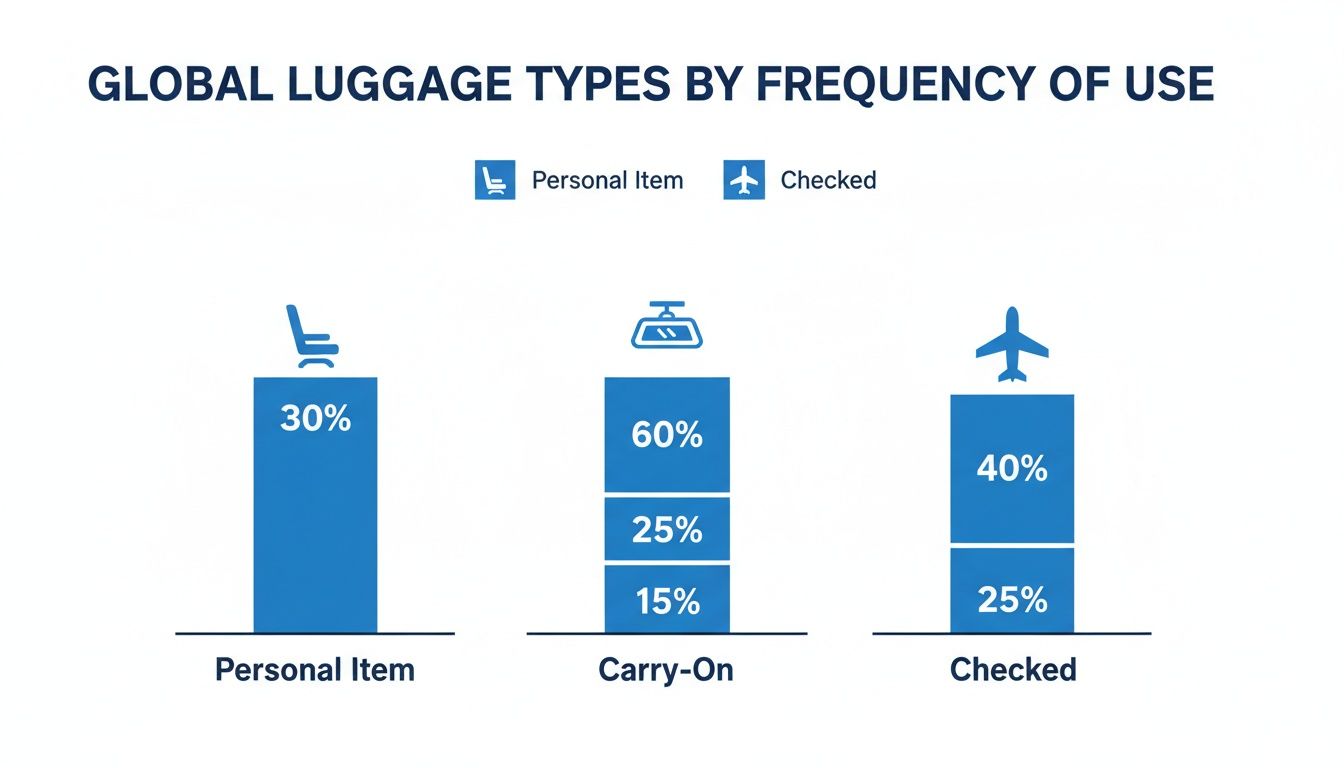
As you can see, your personal item has a dedicated spot on the floor, leaving that valuable overhead bin space for the larger carry-on bags.
For the most part, major legacy airlines tend to have fairly similar and generous personal item policies. It's the budget airlines you really need to watch out for. They often have much smaller allowances, a not-so-subtle strategy to encourage you to pay for a larger bag.
While weight limits aren't very common for personal items, some international and budget carriers do enforce them. The only way to be 100% sure is to check the specific policy for your airline right before you fly. A quick search like "Ryanair personal item size" will give you the most current rules.
To show you what I mean, I've put together a quick comparison of the rules for some of the most popular airlines. Just look at the difference between a legacy carrier like Delta and a budget option like Ryanair—it's night and day.
A comparative look at the personal item dimension limits for popular US and international airlines, helping travelers ensure their bag is compliant.
| Airline | Maximum Dimensions (Inches) | Maximum Dimensions (CM) | Notes |
|---|---|---|---|
| Delta Air Lines | No specific dimensions listed | No specific dimensions listed | Must fit under the seat |
| United Airlines | 17 x 10 x 9 | 43 x 25 x 22 | Stricter for Basic Economy |
| Spirit Airlines | 18 x 14 x 8 | 45 x 35 x 20 | Strictly enforced with sizers |
| Ryanair | 15.7 x 9.8 x 7.8 | 40 x 25 x 20 | Known for strict gate checks |
The takeaway here is pretty clear: never assume your bag will be okay. A quick check of your airline’s website before you pack can save you a lot of headache (and money) at the airport.
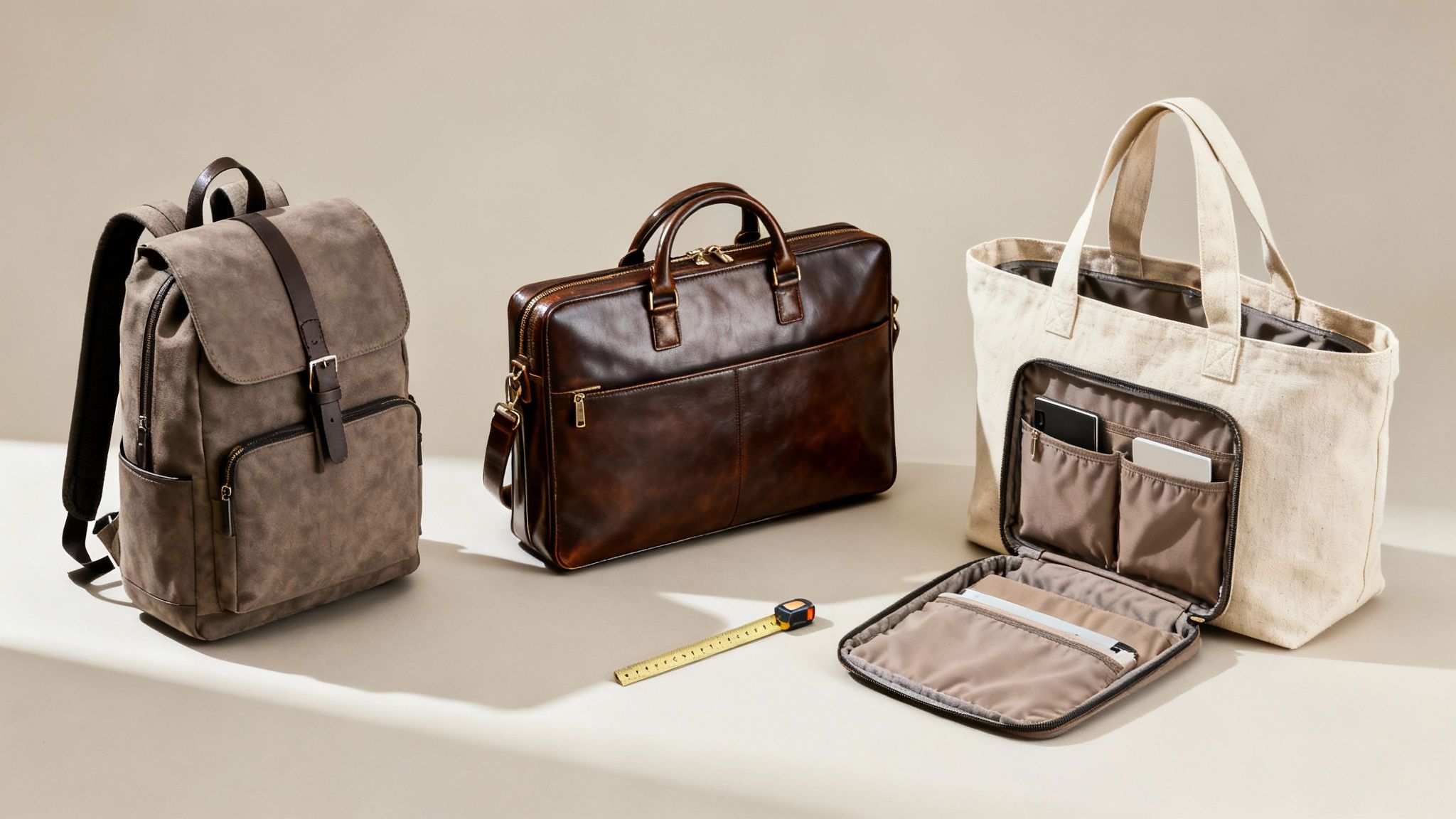
Knowing the rules is half the battle; finding a bag that actually works for you is the other. The perfect airline personal item is a magical blend of maximum packing space and airline compliance, all while fitting your personal travel style.
Are you a minimalist on a weekend city break? Or a business traveler who can't be separated from your tech? The key is to think honestly about how you move through an airport. Do you need your hands free to wrangle kids, or do you need lightning-fast access to your laptop for the security line? Answering that question is the first step toward finding your ideal bag and avoiding those dreaded gate-check fees.
Let's walk through some of the most reliable and popular options out there. Each of these has its own strengths, and seasoned travelers tend to have a favorite depending on the trip. Most of these have been proven to squeeze into even the tightest budget airline sizers.
The Travel Backpack: This is the undisputed champion of versatility. A good travel backpack has compartments for days, padded sleeves for your electronics, and the massive advantage of keeping your hands completely free. A slim, 18-liter backpack is a fantastic choice for explorers who plan to use the same bag for sightseeing once they land.
The Tote Bag: If easy access is your top priority, nothing beats a well-structured tote. The open-top design means your book, headphones, or tablet are always within reach—no frantic digging required. Look for modern travel totes that come with zippered pockets and a trolley sleeve to slide right over your rolling carry-on's handle.
The Briefcase or Laptop Bag: For business travelers, this is the go-to. A sleek briefcase or laptop bag keeps your professional gear organized and secure, projecting a polished image while ensuring your tech is protected. It makes that in-flight work session a whole lot easier.
The right bag for a week-long vacation is rarely the right bag for a 24-hour business trip. You have to match the tool to the job. For a beach getaway, a durable canvas tote might be perfect. For a tech-heavy work trip, a backpack with dedicated padded compartments is a must.
A common mistake I see is travelers choosing a bag that fits the dimensions but is a nightmare to actually use. A small duffel might technically pass, but its single, cavernous compartment turns finding your passport or keys into a frustrating mess. Look for bags with internal organization.
This gets even more specific if you’re traveling with a pet. Many airlines count a pet carrier as your personal item, so it has to fit under the seat in front of you. You can find excellent resources on choosing the right airline travel pet carriers to make sure they meet those strict under-seat rules.
Ultimately, you’re looking for a bag that doesn't just meet the airline's size requirements but actually makes your travel day better. A lightweight, durable, and thoughtfully designed bag is an investment. It makes every step, from packing at home to stowing it on the plane, feel seamless and organized.
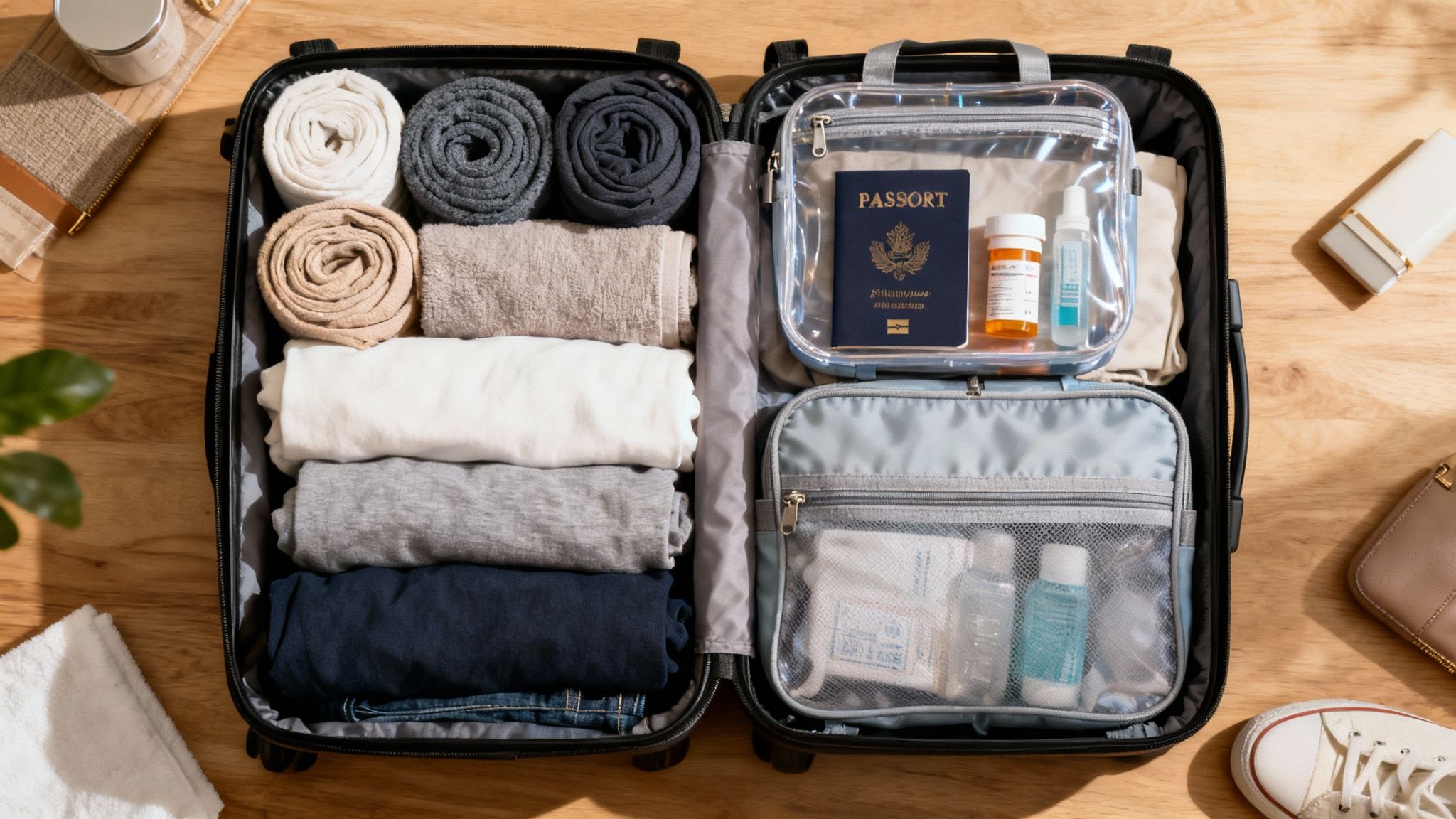
Treating your airline personal item like an afterthought is a rookie mistake. Smart travelers know this small bag is actually a strategic advantage. It's not just about cramming stuff in; it's about packing smarter, not harder, to make your entire journey smoother. Get it right, and you’ll have a compact kit with all your essentials right at your fingertips.
Think of it as your in-flight command center. It holds everything you absolutely cannot lose and anything you'll need at 30,000 feet. This isn't just for convenience—it's your safety net if your checked bag takes an unexpected detour.
Before a single thing goes in the bag, you need to identify your non-negotiables. These are the items that must stay with you in the cabin, no exceptions.
Pro tip: The key to packing a personal item is all about accessibility. Anything you know you'll need during the flight—like your headphones or a snack—should go in last, right on top. No one wants to be that person digging through their entire bag mid-flight. Using a bag with an external pocket for these items is a game-changer.
Once you've got your essentials laid out, it's time to get them all to fit. A few tried-and-true techniques can make a massive difference in how much you can pack. The oldest trick in the book is still one of the best: roll your clothes instead of folding them. It genuinely minimizes wrinkles and compresses fabric in a way that frees up a shocking amount of space.
If you really want to level up your organization, get some packing cubes. These little zippered pouches let you compartmentalize your bag, keeping your socks, underwear, and chargers from turning into a chaotic mess. For example, use one small cube for all your electronics and cables, another for toiletries, and a third for a change of clothes.
The TSA's 3-1-1 liquids rule trips a lot of people up, but it's actually pretty simple. All your liquids, gels, creams, and pastes have to be in containers of 3.4 ounces (100 milliliters) or less.
Then, all of those small containers have to fit comfortably into a single, clear, quart-sized, zip-top bag. That means your travel-sized toothpaste, shampoo, and contact lens solution all have to buddy up in one bag, which you'll need to pull out for security screening. An actionable tip is to pre-pack this bag and keep it in an easily accessible pocket of your personal item so you can pull it out quickly at the TSA checkpoint.
This rule isn't just random. Security events have directly shaped these regulations for decades. The infamous 2006 transatlantic aircraft plot, for example, is what led to these strict liquid allowances. You can learn more about how security history influences current travel rules on smartertravel.com, and it gives you a whole new perspective on why you have to put your shampoo in a tiny bag.
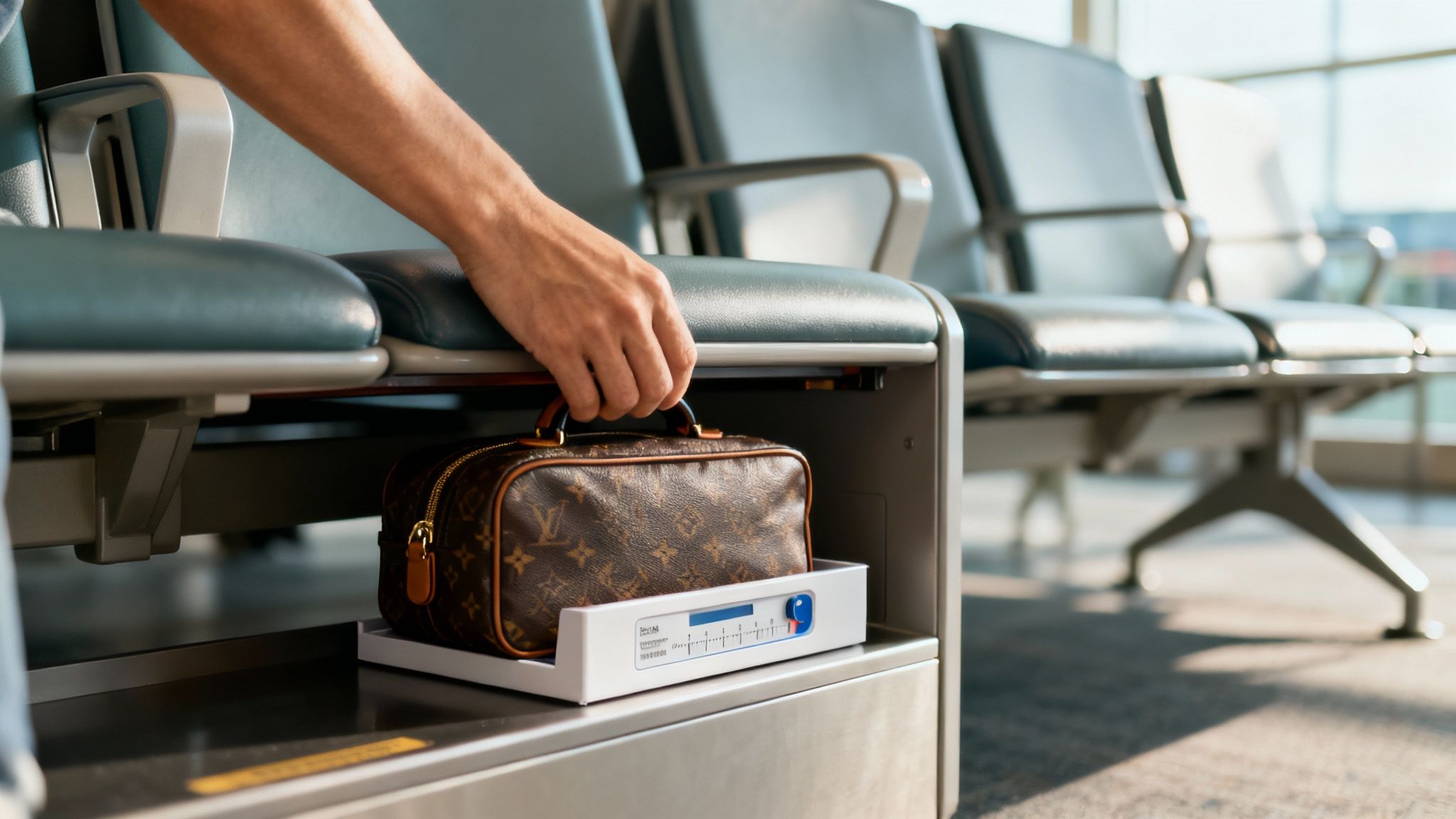
We've all felt that pit in our stomach. You're in the boarding line, and the gate agent gives your bag that look. Then they point to the dreaded sizer box. It’s the moment of truth where your slightly overstuffed airline personal item could end up costing you a fortune.
Airlines are laser-focused on enforcement right at the gate because that's where a too-big bag can throw off the whole boarding schedule. If your bag looks even a little questionable, you'll be asked to prove it fits. If it doesn't, you're paying to check it, and those last-minute gate-check fees are brutal. On a carrier like Frontier, for instance, that mistake can cost you as much as $99—way more than you would have paid to just check a bag online beforehand.
The best defense is a good offense, and that means prepping before you even call your Uber to the airport. The first thing you need to look at is your ticket. A Basic Economy ticket, for example, is notorious for having much stricter rules than a standard fare, leaving you zero wiggle room.
Once you know the rules you're playing by, a few simple checks can save you a world of hurt:
You might think it's just a cash grab, but the crackdown on bag sizes is also about operations and safety. This all really kicked into high gear after the 2008 fuel crisis, which is when carriers started rolling out bag fees and installing those sizers everywhere.
But safety is a huge part of the equation, too. A startling 2003 survey after a US Airways crash found that the actual weight of passengers and their carry-on items was, on average, over 20 pounds heavier than what the airlines were estimating. That's a massive discrepancy that highlights just how critical these rules are for safe flights. You can dig into the nitty-gritty of how passenger weight surveys impact airline safety on easa.europa.eu.
If you do get called out by a gate agent, the best thing you can do is stay cool and polite. Try pulling out a bulky jacket or scarf and putting it on. Sometimes, just showing that the bag can fit with a little strategic adjustment is all it takes to get you on board, fee-free.
For anyone who flies often, the airline personal item stops being just a bag and becomes a strategic tool. Once you get past the basic size limits, you can unlock a whole new level of travel efficiency. Seasoned travelers have this down to a science, making one-bag travel a reality even for longer trips and saving a ton of time and money in the process.
One of the smartest plays is to let your loyalty do the heavy lifting. If you have elite status with an airline or carry one of their co-branded credit cards, you often get perks that make the stingiest baggage rules simply disappear. For instance, many airline credit cards come with a free checked bag or even a carry-on, which completely cancels out the tight restrictions of a Basic Economy ticket. This means you can use your personal item for in-flight essentials and bring a full carry-on for your clothes without paying a dime extra.
Let's be honest, the ultimate travel goal for many of us is to never see a baggage carousel again. By pairing a perfectly packed personal item with a standard carry-on, you can easily pack for a week-long trip, no checked bags required.
It just takes a little discipline:
This two-bag system is a game-changer. You’ll never waste time waiting for luggage, and your most critical items are always within arm's reach.
Airlines also have a few interesting exceptions that savvy travelers know how to use to their advantage. Families flying with little ones, for example, are usually allowed to bring a diaper bag on top of their personal item allowance. That’s a huge amount of extra space for all the baby necessities.
Here's a lesser-known trick: the "personal comfort item." Things like a neck pillow or a big, puffy coat don't technically count toward your bag limit. Creative travelers have figured out you can use removable neck pillow covers to stash soft clothing like socks, underwear, or a compressible jacket, freeing up precious real estate inside your bag.
These aren't just tips; they're strategies. They transform your personal item from a simple bag into the centerpiece of an efficient travel system that gets you through the airport faster and with a lot less stress.
Let's clear up some of the confusion around airline personal items. Getting these details wrong can be a costly mistake at the gate, but once you know the unwritten rules, you can fly with total confidence.
Here are the real-world answers to the questions I hear most often.
Afraid not—you have to pick one. The rule is one personal item per passenger, period. You can't show up with a purse and a backpack and expect them both to fly for free.
The workaround? Make sure your purse is small enough to tuck completely inside your backpack. You can always pull it out after you've boarded or once you land. For example, pack a small crossbody bag inside your larger backpack. Use the backpack for boarding, then take out the crossbody for use during your trip.
Honestly, it's a gamble. If your bag is just a hair over the limit, soft-sided, and not stuffed to the gills, you can often squish it into that dreaded sizer box at the gate and get away with it.
But if a gate agent spots it and it doesn't fit, you're out of luck. They'll force you to gate-check it, and you'll get hit with a hefty fee—often as high as $99 on budget airlines.
Here's a pro tip: Always measure your bag after it's fully packed. A bag that meets the size requirements when empty can easily bulge an inch or two when full, putting you right in the danger zone for those surprise fees. A practical test is to see if it fits under your own dining room chair, which is often a similar height to an airline seat space.
Typically, no. Airlines see items you're physically wearing or carrying—like a coat, a scarf, or the book you're reading—as separate from your luggage allowance. A neck pillow wrapped around your neck falls into this category.
Savvy travelers have turned this into a brilliant packing hack: buy a neck pillow with a removable cover, ditch the stuffing, and fill it with soft clothes like socks, t-shirts, or even a packable jacket. You've just created extra storage that flies completely free.
Yes, this is one of the few exceptions to the one-item rule. For anyone flying with an infant-in-lap, most major airlines will let you bring a diaper bag on board in addition to your personal item at no extra charge.
It’s a lifesaver for parents, but policies can vary slightly. It never hurts to do a quick check of your airline’s family travel policy online before you head to the airport, just to be sure.
Ready to turn travel stress into savings? Approved Experiences Traveler offers members-only wholesale pricing on over a million hotels, cruises, and rental cars, making luxury travel more affordable. Discover exclusive travel benefits and start saving today.
From this collection
From this collection
can you bring razors on a plane
Can you bring razors on a plane? 2026 TSA rules explained for disposable, safety, and electric razors, can you bring razors on a plane in practice.

how to find cheap flights
Learn how to find cheap flights with our expert guide. Discover actionable travel hacks, timing secrets, and tools to save hundreds on your next trip.

why are hotels so expensive
Explore why are hotels so expensive and uncover the real cost drivers behind your stay plus expert tips to save on your next trip.