Renting a car often feels like navigating a maze of hidden fees, confusing insurance waivers, and surprise charges. What should be a straightforward part of your travel plans can quickly become a source of stress and unexpected expense. It doesn't have to be this way. By moving beyond generic advice and adopting a strategic approach, you can transform your rental experience from a budget-buster into a seamless, cost-effective component of your journey. This guide delivers a prioritized collection of actionable, field-tested car rental tips designed to save you money, time, and significant frustration.
We will cover essential strategies that make an immediate impact. You'll learn how to accurately assess your personal insurance needs to avoid overpaying for redundant coverage, master the art of vehicle inspection to prevent disputes over pre-existing damage, and decode confusing fuel policies to select the most economical option every time. We'll also explore often-overlooked opportunities for savings, such as understanding how to strategically choose rental locations away from airports to dodge hefty concession fees and surcharges.
Each tip is crafted with practical implementation in mind, providing clear examples and direct action steps. We'll show you how to identify and dispute common hidden fees, navigate the complexities of international rentals, and understand exactly which add-ons are unnecessary expenses. For travelers seeking maximum value, we will also highlight how to leverage loyalty programs and membership platforms to unlock exclusive rates and benefits. This comprehensive list provides the critical insights you need to take the keys with confidence and drive away with the best possible deal.
1. Review Your Insurance Coverage Before Renting
Walking up to a rental counter unprepared is a surefire way to overspend. Rental agents are trained to sell you their insurance products, often with a sense of urgency. The most crucial of all car rental tips is to understand what coverage you already have before you even book a vehicle. This single step can save you anywhere from $15 to $50 per day by preventing you from purchasing redundant and expensive policies.
Uncovering Your Existing Coverage
Most travelers have access to rental car insurance from three primary sources, often without realizing the extent of the benefits. Before you purchase any additional waiver or policy, investigate these options thoroughly.
- Personal Auto Insurance: Many standard auto policies, like those from Geico or State Farm, extend liability, collision, and comprehensive coverage to rental cars driven for personal use within the United States and Canada. Your deductible would still apply, but it's often a more cost-effective option than the rental company's daily waiver. For example, if you have a $500 deductible on your personal policy, you are only liable for that amount in an accident, whereas declining all coverage could make you liable for the car's full value.
- Credit Card Benefits: Premium travel credit cards are a powerhouse for rental car protection. For instance, the American Express Platinum Card and the Chase Sapphire Reserve offer primary rental car insurance. This means their coverage kicks in first, so you don’t have to file a claim with your personal auto insurer, which can help avoid premium increases.
- Travel Memberships & Employer Policies: Don't overlook other affiliations. Some travel clubs offer insurance benefits as part of their membership package. If you're traveling for business, your employer’s corporate policy may cover the rental entirely.
Actionable Steps for Verification
Don't assume you are covered; confirm the details with a quick but thorough check.
- Call Your Insurance Agent: Speak directly with your auto insurance provider. Ask specifically: "Does my personal auto policy's collision and liability coverage extend to a rental car in Florida?" and "What is my deductible for a rental?"
- Read Your Credit Card's Guide to Benefits: Log into your credit card account online and find the "Guide to Benefits" PDF. Search for "Auto Rental Collision Damage Waiver" to see if the coverage is primary or secondary and what vehicle types are excluded (e.g., exotic cars, large vans).
- Request Written Confirmation: For peace of mind, ask your insurance agent or credit card benefit administrator for an email or letter confirming your coverage. This can be invaluable if an issue arises with the rental agency. Practical example: Simply email your agent saying, "Please send a quick confirmation that my policy [policy number] covers rental cars for my trip from [date] to [date]."
2. Book Early and Use Comparison Websites
Just like with flights and hotels, timing is everything when securing a rental car. Spontaneously booking at the last minute is a recipe for inflated prices and limited vehicle options. One of the most impactful car rental tips is to treat the booking process with foresight, using powerful comparison tools to your advantage. Planning ahead can lock in rates that are 30-50% lower than walk-up prices, especially during peak travel seasons.

Uncovering the Best Deals Online
The digital marketplace for car rentals is vast, but leveraging the right tools can quickly narrow down the most cost-effective options. These platforms aggregate offers from dozens of providers, saving you the tedious work of checking each site individually.
- Comparison Aggregators: Websites like Kayak and Skyscanner are excellent starting points for getting a broad view of the market. They pull prices from major players like Hertz, Enterprise, and Avis, as well as smaller local agencies, giving you a comprehensive snapshot of availability and cost.
- Specialized Deal Finders: Tools like AutoSlash take comparison a step further. After you book, AutoSlash continues to track your reservation and will notify you if a lower price becomes available, allowing you to re-book and save even more. For example, you might book a car for $300, and two weeks later, AutoSlash finds the same rental for $250, prompting you to cancel and re-book at the lower rate.
- Membership & Warehouse Clubs: Don’t forget to check for exclusive rates through programs you already belong to. Costco Travel and AAA often negotiate pre-set discounted rates with major rental companies that are not available to the general public.
Actionable Steps for Verification
Finding a great deal requires a strategic and methodical approach. Follow these steps to ensure you’re not leaving money on the table.
- Start Your Search Early: Begin looking for your rental car 4 to 6 weeks before your trip. This timeframe typically offers the best balance of low prices and wide vehicle selection before demand drives costs up.
- Compare Apples to Apples: When using comparison sites, ensure you are comparing identical vehicle classes, rental periods, and insurance options. For instance, check if a low price from one company is for a "mini" car with a 100-mile daily limit, while another is for a "compact" with unlimited mileage.
- Set Price Alerts & Clear Cookies: Use the "price alert" feature on sites like Kayak to get notified of price drops. Additionally, clear your browser's cookies before finalizing a booking, as some travel sites may increase prices based on your search history.
3. Thoroughly Inspect the Vehicle Before Leaving the Lot
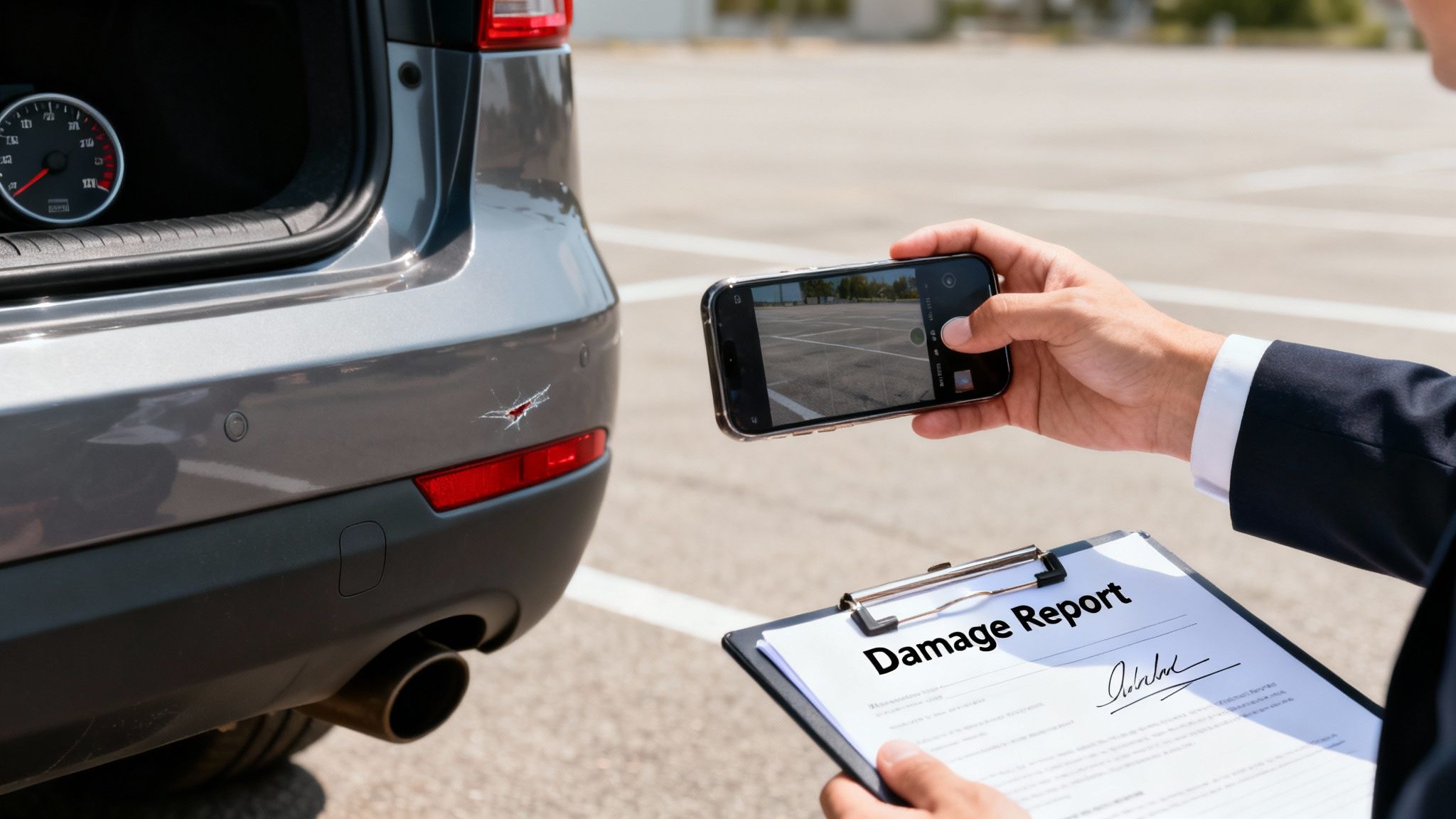
Driving off the rental lot in a hurry is a common mistake that can lead to costly and baseless damage claims later. Rental agencies process hundreds of vehicles, and pre-existing damage is often missed during their quick turnaround inspections. One of the most critical car rental tips is to conduct your own meticulous inspection and document everything before you put the car in drive. This simple 10-minute process creates indisputable evidence that protects you from being held liable for another driver’s dings, scratches, or dents.
Uncovering Your Existing Coverage
A systematic inspection ensures you catch issues that could otherwise be blamed on you upon return. Treat the vehicle like you are purchasing it, documenting every flaw, no matter how minor it seems. This documentation serves as your primary defense against unwarranted charges.
- Exterior Damage: Walk around the car multiple times, examining every panel for scratches, scuffs, and dents. Check the roof, bumpers, and even the wheels for curb rash. Pay close attention to the lower front bumper, which is often scuffed on curbs. Don't forget to inspect the windshield for any chips or cracks.
- Interior Condition: Open all the doors and inspect the upholstery for tears, stains, or burns. Check the dashboard for warning lights and ensure all electronics, including the infotainment system and charging ports, are functional. Test the air conditioning and heating.
- Mechanical and Safety Features: Verify that all essential components work correctly. Check the headlights, taillights, and turn signals. Honk the horn, test the windshield wipers, and ensure all side mirrors adjust properly.
Actionable Steps for Verification
Don't just look; actively document every imperfection to create a clear, time-stamped record. This turns your personal inspection into official evidence.
- Use Your Smartphone: Take clear, well-lit photos and a slow-panning video of the entire vehicle, inside and out. Verbally narrate what you see in the video. Crucially, capture the license plate, the odometer reading, and the fuel level. Practical tip: Start your video by showing the rental agreement in your hand with the date visible, then pan to the car to establish a timeline.
- Get It in Writing: Insist that the rental agent notes every single scratch or dent you find on the official checkout form or damage report. Once complete, have them sign it and get a copy for your records before leaving.
- Create a Digital Trail: Immediately email the photos and video to yourself. This creates an independent timestamp that proves the damage existed before you left the rental facility. For extra security, you can even email it to the rental branch's general email address.
<iframe width="560" height="315" src="https://www.youtube.com/embed/7YsvWekUkf4" frameborder="0" allow="accelerometer; autoplay; clipboard-write; encrypted-media; gyroscope; picture-in-picture" allowfullscreen></iframe>
4. Understand Hidden Fees and Additional Charges
The daily rate you see advertised online is rarely the final price you will pay. Rental car companies are notorious for tacking on a series of mandatory fees, taxes, and optional surcharges that can inflate your bill by 25% or more. One of the most critical car rental tips is to look beyond the base rate and dissect the total estimated cost before you confirm your booking. This diligence prevents sticker shock at the counter and ensures you're comparing true, all-in prices.
Uncovering Common Hidden Charges
These fees are often buried in the fine print of the rental agreement but can add up significantly. Knowing what to look for is the first step in avoiding or minimizing them.
- Airport Surcharges & Concession Fees: Renting directly from an airport is convenient, but it comes at a premium. Airports charge rental companies for the privilege of operating on-site, a cost passed directly to you as a "Concession Recovery Fee" or similar charge, often ranging from 10-30% of the base rate.
- Fuel Policies & Surcharges: The "Full-to-Full" policy is usually the most cost-effective, but if you return the car with less than a full tank, the company will refuel it for you at a highly inflated price, sometimes two or three times the local pump price.
- Additional Driver & Young Driver Fees: Adding another driver to the rental agreement almost always incurs a daily fee, typically $13-$25 per person. Drivers under the age of 25 are also hit with a "Young Renter Fee," which can be a substantial daily surcharge.
- Equipment & Tolls: Renting a GPS unit or a child seat can cost $10-$15 per item, per day. Many companies also push electronic toll passes, which come with a daily "convenience" fee on top of the actual toll costs, even on days you don't use a toll road.
Actionable Steps for Cost Control
Be proactive to keep your rental budget in check. A few simple actions can save you a considerable amount on your final bill.
- Request an Itemized Quote: Before finalizing your reservation, ask for a detailed, all-inclusive quote that lists every single tax and fee. This allows for an accurate apple-to-apples comparison between different rental companies.
- Consider Off-Airport Locations: Look for rental branches located just a short shuttle or taxi ride away from the airport. For example, a rental from an Orlando airport (MCO) location might have a total cost of $450, while the same car from a downtown location 15 minutes away could be $350 after factoring in a $25 Uber ride.
- Bring Your Own Gear: Use a smartphone app like Google Maps or Waze instead of renting an expensive GPS. If traveling with children, check if you can bring your own car seat, as many airlines allow you to check them for free.
- Review the Agreement Meticulously: Before you sign anything at the counter, read every line item. Question any charge you don’t understand and ensure the fuel level and any pre-existing damage are correctly noted on the contract.
5. Choose the Right Fuel Option Strategy
One of the most deceptive costs in car rentals is fuel. Rental companies present several refueling options at the counter, but your choice can dramatically alter your final bill. Selecting the right fuel strategy is a critical car rental tip that can easily save you 15-30% on fuel costs, preventing you from paying a hefty premium for convenience.
Uncovering the Most Economical Choice
Rental agencies typically offer three main fuel options, each with vastly different financial outcomes. Understanding the economics behind them is key to avoiding overcharges and making the smartest decision for your budget.
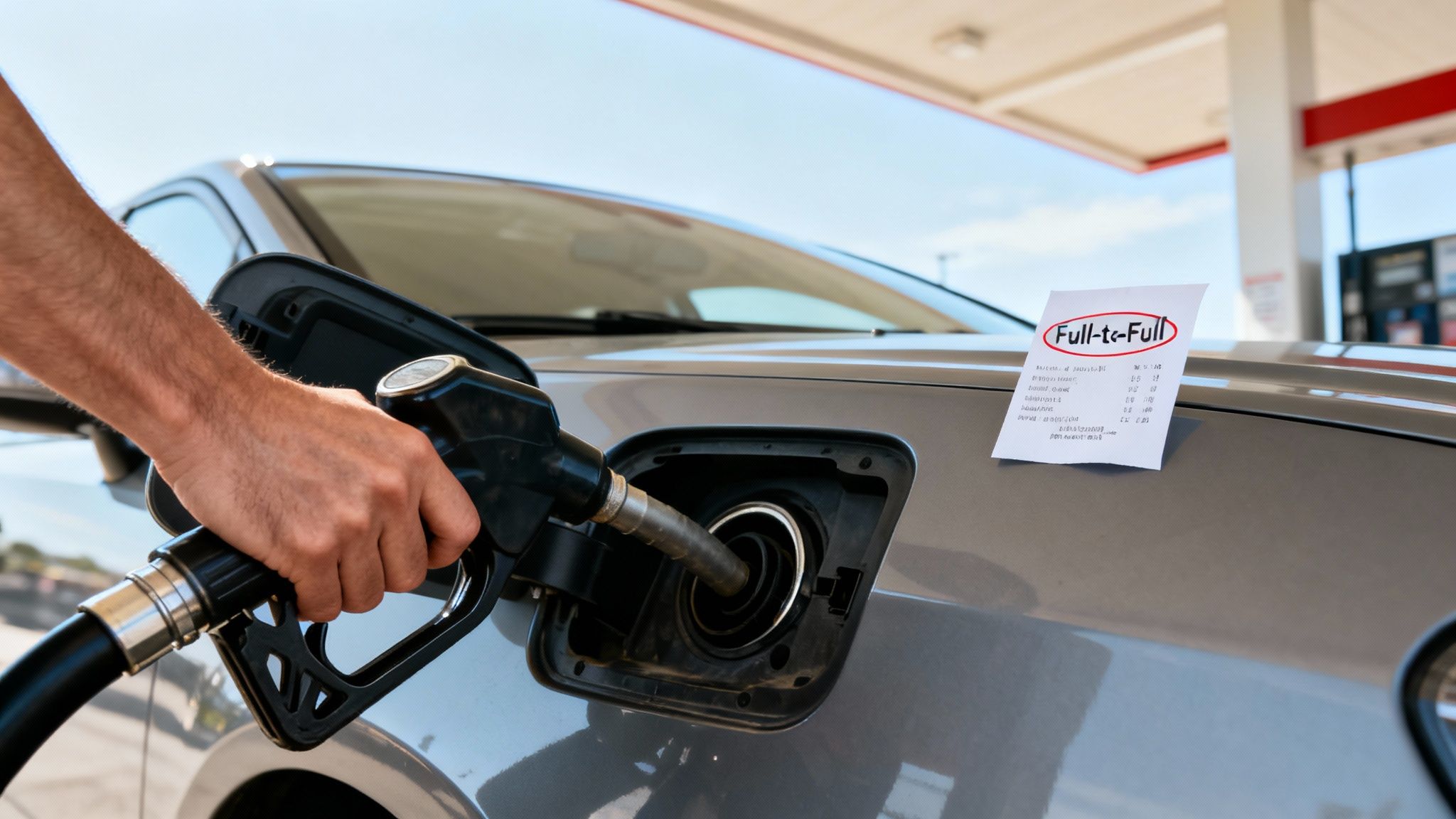
- Full-to-Full (The Best Option): You receive the car with a full tank and are required to return it with a full tank. This is almost always the most cost-effective choice, as you only pay for the gas you use at local market prices.
- Pre-Purchase Fuel (The Convenient Trap): You buy a full tank of gas from the rental company upfront. While this saves you a stop on the way to the airport, the price per gallon is often inflated. For example, you might pay $5.79 per gallon to Hertz when local stations charge $4.50. You also receive no refund for any unused fuel.
- Return Empty (The Most Expensive Option): If you return the car without refueling, the agency will refill it for you at a punitive rate. This service often includes a high surcharge on top of an already inflated per-gallon price, with some companies like Avis charging as much as $8.95 per gallon.
Actionable Steps for Fuel Savings
A few minutes of planning can lead to significant savings. Make the "full-to-full" policy work for you with a simple, proactive approach.
- Explicitly Select 'Full-to-Full': When booking and at the counter, clearly state that you will be returning the car with a full tank. Ensure this is reflected on your rental agreement before you sign.
- Locate Gas Stations in Advance: Before leaving the airport, use a map app to find gas stations near the rental car return location. Practical example: As you drive away from the rental lot, open Google Maps and search for "gas stations near [airport code]". Save one that is on your return route.
- Use a Gas Price App: Download an app like GasBuddy to find the cheapest fuel in the vicinity. The stations closest to the airport are often the most expensive, so driving an extra mile or two can pay off.
- Keep Your Final Fuel Receipt: Always get a receipt from your final fill-up and keep it with your rental documents. This serves as undeniable proof in case the rental agency mistakenly charges you a refueling fee.
6. Utilize Loyalty Programs and Membership Discounts
Renting cars without joining the company's loyalty program is like leaving money on the counter. These free-to-join programs are designed to reward repeat customers, and failing to enroll is one of the most common missed opportunities for savings. Utilizing these memberships is a simple yet powerful car rental tip that can reduce your costs by 10-30% while significantly enhancing your rental experience with perks like priority service and vehicle upgrades.
Uncovering Your Existing Coverage
Most travelers qualify for savings through multiple affiliations, often without realizing the full scope of benefits available. Before you book at the standard public rate, it's essential to explore these channels for exclusive discounts and rewards.
- Rental Company Loyalty Programs: Every major rental company offers a loyalty program, such as Hertz Gold Plus Rewards or Enterprise Plus. These programs allow members to earn points on every rental, which can be redeemed for free rental days. More importantly, they offer tangible benefits like skipping the counter, dedicated member-only lines, and exclusive email offers.
- Membership Clubs and Retailers: Organizations like AAA, AARP, and even warehouse clubs like Costco Travel have negotiated special rates with car rental agencies. A AAA membership, for example, can provide discounts up to 20% with Hertz and often includes waivers for young renter fees or a free additional driver.
- Corporate and University Codes: If you're traveling for business, your employer likely has a corporate discount code that provides a fixed, reduced rate. Similarly, many universities and alumni associations offer discount codes for personal travel, representing another layer of potential savings.
Actionable Steps for Verification
Don't just assume a rate is the best available; actively apply your affiliations to unlock better deals.
- Enroll in All Major Programs: Before your next trip, take 15 minutes to sign up for the free loyalty programs of major companies like Avis, Hertz, National, and Enterprise. This ensures you're ready to earn points and receive member benefits no matter who you rent from.
- Stack and Compare Discounts: When booking, enter all applicable discount codes you have. For example, on the Hertz website, input your AAA code, then do a separate search with your corporate code. Compare the final prices, as one code may offer a better deal than another depending on the location and rental duration.
- Link Your Travel Profiles: Many airline and hotel loyalty programs partner with car rental agencies. Check for these partnerships on the travel provider’s website and link your accounts to earn airline miles or hotel points on your car rental, adding extra value to your booking.
7. Navigate International Rental Requirements and Documentation
Renting a car abroad involves more than just booking a vehicle online; it requires careful preparation to navigate a complex web of local laws and documentation. Assuming your domestic driver's license and insurance will suffice is a common and costly mistake. One of the most critical international car rental tips is to meticulously research and prepare all necessary paperwork well in advance, as arriving unprepared can lead to denied rentals, steep fines, or significant legal trouble.
Uncovering Your Destination's Requirements
Rules of the road and rental prerequisites can vary dramatically from one country to another. What is standard practice in the United States may be insufficient or even illegal elsewhere. Understanding these nuances is key to a smooth and legally compliant international driving experience.
- International Driving Permit (IDP): An IDP is a United Nations-sanctioned document that translates your U.S. driver's license into 10 languages. It is legally required in over 150 countries, including Spain, Italy, and Japan. While not a license itself, it must be carried with your valid U.S. license.
- Mandatory Local Insurance: Your personal auto policy or credit card benefits may not be accepted as valid proof of coverage in all countries. For example, Mexico legally requires you to purchase local third-party liability insurance from a Mexican company, regardless of any other coverage you hold. Declining this is not an option.
- Proof of Coverage: Countries like Ireland and the United Kingdom may require a formal "letter of coverage" from your credit card company, explicitly stating that your benefits apply in that specific country. Failure to provide this can force you to purchase the rental agency's expensive Collision Damage Waiver (CDW).
Actionable Steps for International Preparation
Don't wait until you're at the rental counter to figure this out. A proactive approach is essential for a hassle-free international trip.
- Obtain an International Driving Permit (IDP): Visit an AAA or AATA office well before your departure. The process is simple, requiring a completed application, two passport-style photos, and a small fee, and the permit is issued on the spot.
- Verify Insurance Needs: Call the number on the back of your credit card and ask the benefits administrator specifically about coverage in your destination country. Request written proof via email that you can print and carry with you.
- Research Local Driving Laws: Use official tourism or government websites for your destination to learn about unique traffic laws, toll systems (like Italy's Telepass), and parking regulations to avoid unexpected fines. For instance, research "ZTL zones in Florence" to avoid driving into restricted areas and receiving hefty fines weeks later.
8. Decline Unnecessary Add-ons and Upgrades
The rental counter is designed for upselling. After you've agreed on a price online, agents are incentivized to boost the final cost with a menu of seemingly convenient, but often overpriced, add-ons and upgrades. Politely but firmly declining these extras is one of the most effective car rental tips for controlling your budget. Resisting the pressure to add a GPS unit, satellite radio, or a last-minute vehicle upgrade can easily save you $25 to $75 per day, protecting your wallet from impulse decisions.
Rental companies present their add-ons as essential for a smooth journey, but most travelers already have access to better, cheaper, or free alternatives. Before you agree to any additional charge, consider if you truly need what’s being offered or if a simple solution is already in your pocket.
- Navigation Systems: The most common upsell is a GPS unit, often priced at $15 or more per day. Your smartphone, with apps like Google Maps or Waze, is a far superior and free alternative. You can even download maps for offline use to avoid data charges.
- Vehicle Upgrades: Agents may offer a "deal" on a larger car or a luxury model for an extra $50 per day. For example, they might say, "For just $20 more per day, I can put you in a full-size SUV." Unless you have a specific need for more space or features, this is pure profit for the rental company.
- Roadside Assistance Plans: While peace of mind is valuable, many travelers are already covered. Your personal auto insurance, a travel credit card, or a membership like AAA often includes comprehensive roadside assistance that renders the rental company's plan redundant.
Actionable Steps for Avoiding Upsells
A little preparation and a firm mindset at the counter are all you need to avoid these unnecessary costs.
- Prepare Your Alternatives: Before you leave home, ensure your phone is ready for navigation. Bring a phone mount and a car charger, and download offline maps for your destination area.
- Bring Your Own Gear: If traveling with children, bring your own car seats. Airlines typically allow you to check them for free, saving you the $10 to $15 per day rental fee per seat.
- Be Direct and Confident: When the agent begins the upsell pitch, have a polite but firm response ready. A simple, "No thank you, I'm all set with just the car I reserved," is usually enough to stop the pressure and finalize your contract without extra fees.
9. Understand Toll Road Systems and Payment Methods
Driving into an unfamiliar city and unknowingly racking up expensive toll violations is a surefire way to sour a vacation. Rental agencies charge hefty administrative fees for unpaid tolls, often turning a $5 toll into a $50 bill. One of the most overlooked car rental tips is to understand your destination's toll systems before you get behind the wheel. This foresight prevents unexpected penalties and keeps your travel budget intact.
Uncovering Your Toll Payment Options
Most rental companies have streamlined programs to handle tolls, but they come at a cost. Your goal is to choose the most cost-effective method for your specific itinerary, which requires knowing the landscape of both the rental company's offerings and the local toll authorities.
- Rental Company Transponder Programs: Nearly all major rental companies (Hertz, Avis, etc.) offer an electronic toll-paying device or service. For example, Hertz's PlatePass costs a daily fee (e.g., $5.95) for every day of your rental, even days you don't use a toll road, plus the cost of the tolls themselves. This is convenient but can be expensive.
- Pay-By-Plate Systems: Many toll roads now use high-speed cameras to capture license plates, mailing a bill to the vehicle's registered owner (the rental company). The rental agency then bills you for the toll plus a significant "administrative" or "convenience" fee for each individual toll transaction, which can add up quickly.
- Personal Transponder or App-Based Payments: In some regions, you may be able to use your personal transponder (like an E-ZPass) in the rental car. Alternatively, some toll authorities offer smartphone apps that allow you to temporarily register a rental vehicle's license plate for direct payment, bypassing the rental agency entirely.
Actionable Steps for Toll Management
Don't leave toll payments to chance. A few minutes of research can save you a significant amount of money and stress.
- Research Your Destination's Tolls: Before you travel, do a quick search for "[City/State] toll roads." Understand if they use transponders (like Florida's SunPass or California's FasTrak), accept cash, or are entirely cashless.
- Question the Rental Agent: At the counter, ask specifically how they handle tolls. Inquire about their daily transponder fee versus their pay-by-plate administrative fee. Ask for written documentation of these charges.
- Map a Toll-Free Route: If you're not in a hurry and want to avoid the issue altogether, use a navigation app like Google Maps or Waze and select the "Avoid Tolls" option in the route settings. This can also lead to more scenic drives.
10. Master Return Procedures and Avoid Late Fees
The final moments of your car rental are just as critical as the pickup. A rushed or careless return can trigger a cascade of expensive penalties, including hefty late fees, exorbitant fuel surcharges, and even disputed damage claims. Mastering the rental company’s return procedures is a non-negotiable car rental tip that safeguards your wallet from last-minute surprises and ensures a smooth, stress-free end to your trip.
Uncovering Your Existing Coverage
Rental companies operate on tight schedules, and their policies are designed to penalize tardiness. Grace periods are often surprisingly short, and the fees for missing the deadline can be disproportionately high. For example, some agencies charge a full day's rate if you are even an hour late, while others add significant hourly penalties on top of your final bill.
- Strict Timelines: Don't assume there's a generous grace period. While some companies, like Enterprise, may offer a 29-minute window, others begin charging immediately after the contracted time. A one-hour delay could cost you an extra $50 or more.
- Fuel Surcharges: Returning the car with less fuel than required can be extremely costly. Rental companies often charge a premium rate, sometimes two or three times the local pump price, for refueling services. Forgetting to top off the tank can easily add $50 to $100 to your bill.
- Location Specifics: Returning the vehicle to the wrong lot or a different branch, even if it's nearby, can result in "wrong location" fees or require you to move the car, making you late in the process.
Actionable Steps for Verification
A little planning can completely eliminate the risk of these expensive post-rental charges. Treat the return process with the same attention to detail as the initial pickup.
- Plan Your Return: Aim to arrive at the rental location at least 30 minutes before your official return time. For example, if your contract says to return by 11:00 AM, plan your drive to arrive at 10:30 AM. This buffer accounts for potential traffic, finding the correct drop-off lane, and completing the final inspection.
- Document Everything: Before you hand over the keys, take clear, time-stamped photos of the fuel gauge (showing full), the odometer, and all sides of the vehicle's exterior. This is your definitive proof of the car's condition and status upon return.
- Get a Final Receipt: Do not leave the counter without a closed-out, itemized receipt. Review it on the spot to ensure there are no unexpected charges. If an attendant is not present at the drop-off, call the rental office immediately to confirm they have registered the return and request a receipt be emailed to you.
10-Point Car Rental Tips Comparison
| Item | 🔄 Implementation complexity | ⚡ Resource requirements | 📊 Expected outcomes & ⭐ | 💡 Ideal use cases |
|---|
| Review Your Insurance Coverage Before Renting | Moderate — review policies, call insurers | Low — documents, phone/time | Reduce duplicate coverage and liability; save ~USD 15–30/day ⭐⭐⭐⭐ | Renters with personal auto or premium credit cards; long or costly rentals |
| Book Early and Use Comparison Websites | Low — search, compare, book in advance | Low–Medium — internet, time, price alerts | Lower rates (20–40%) and better selection; price protection ⭐⭐⭐⭐ | Advance planners, peak-season travel, budget-conscious renters |
| Thoroughly Inspect the Vehicle Before Leaving the Lot | Low — 10–15 min inspection and documentation | Low — smartphone/camera, time | Prevent unfair damage charges; strong dispute evidence ⭐⭐⭐⭐⭐ | All rentals, high-value vehicles, long trips |
| Understand Hidden Fees and Additional Charges | Moderate — request itemized quotes, compare totals | Medium — contract review, calls, calculations | Reveal true total cost; avoid budget surprises ⭐⭐⭐⭐ | Airport rentals, corporate bookings, tight budgets |
| Choose the Right Fuel Option Strategy | Low — select fuel policy and plan refueling | Low — time to fill, receipts, fuel stops | Save ~15–30% on fuel; avoid expensive pre-purchase or empty surcharges ⭐⭐⭐⭐ | Road trips, remote pickups, cost-sensitive renters |
| Utilize Loyalty Programs and Membership Discounts | Low–Moderate — enroll, consolidate spend for status | Low — sign-ups, account management | Consistent 10–30% savings, upgrades, faster pickup ⭐⭐⭐⭐ | Frequent renters, corporate travelers, members (AAA/Costco) |
| Navigate International Rental Requirements and Documentation | High — obtain IDP, verify local rules & insurance | Medium–High — documents, fees, research | Legal compliance, fewer fines, appropriate coverage abroad ⭐⭐⭐⭐ | International travel, unfamiliar jurisdictions, young drivers |
| Decline Unnecessary Add-ons and Upgrades | Low — decline at counter, bring alternatives | Low — own phone/GPS/child seat as needed | Save ~USD 100–200 per rental; simpler coverage | Budget travelers, smartphone users, those bringing child seats |
| Understand Toll Road Systems and Payment Methods | Moderate — learn local toll systems and liability | Low–Medium — possible transponder fees, research | Avoid violations/admin fees; predictable toll expenses ⭐⭐⭐⭐ | Driving in toll-heavy regions, cross-border trips |
| Master Return Procedures and Avoid Late Fees | Low — plan return time/location, document handoff | Low — time planning, photos, receipts | Avoid late/fuel/damage charges; clear final billing ⭐⭐⭐⭐ | Short rentals, tight itineraries, airport returns |
Driving Home the Savings
Navigating the world of car rentals can often feel like driving through a maze of hidden costs, confusing policies, and last-minute pressures. However, by embracing the strategies detailed in this guide, you transform from a reactive customer into a proactive, empowered traveler. The difference between a seamless, affordable rental and a frustrating, expensive ordeal lies in preparation and knowledge. These aren't just abstract ideas; they are a collection of the most effective car rental tips designed to put you in complete control.
The journey to mastering car rentals begins long before you arrive at the counter. It starts with a foundational understanding of your existing insurance coverage, a step that can single-handedly save you hundreds of dollars by confidently declining expensive, and often redundant, waivers. It continues with a smart booking process, where timing, comparison shopping, and leveraging off-airport locations become your most powerful tools for securing the best rates.
From Theory to Practice: Your Actionable Checklist
The most crucial takeaway is that small, deliberate actions yield significant savings and peace of mind. Let’s distill the core principles into a final, actionable checklist that you can apply to every future rental:
- Pre-Trip Preparation is Paramount: Before you even search for a vehicle, call your credit card company and auto insurance provider. Ask specific questions: "Does my policy cover rental cars for collision damage?" and "Does my credit card offer primary or secondary rental insurance?" Document the answers. This 15-minute investment eradicates guesswork at the rental desk.
- Document Everything, Trust Nothing: Your smartphone is your best defense against erroneous damage claims. Adopt a meticulous inspection routine. Take a slow-motion video of the car's exterior, narrating any scratches, dings, or scuffs you see. Zoom in on the wheels, windshield, and bumpers. Do the same for the interior, noting any stains or tears. This tangible proof is your ultimate protection.
- Become a Fee Detective: Scrutinize your rental agreement before signing. Look for line items like "Concession Recovery Fee," "Tire and Battery Fee," or "Energy Surcharge." Question anything you don't understand. Remember, once you sign, you are agreeing to every charge, so your last chance to dispute them is before you take the keys.
- Strategize Your Ancillaries: Make conscious decisions about fuel, tolls, and add-ons. The "Prepaid Fuel" option is rarely the most economical choice unless you are absolutely certain you will return the tank empty and are short on time. Similarly, bringing your own GPS (or using your phone) and child seats can eliminate daily charges that quickly add up over a week-long rental.
The Cumulative Power of Smart Choices
Individually, these car rental tips offer incremental benefits. Declining the Collision Damage Waiver might save you $25 per day. Choosing to refuel the car yourself might save you $20 on the final bill. Avoiding an unnecessary GPS rental could save you another $15 per day. But when you consistently apply all these strategies together, the cumulative impact is profound.
Consider a week-long family vacation rental. By combining smart booking, leveraging your own insurance, avoiding unnecessary add-ons, and managing your own fuel and tolls, you could easily reduce your total cost by 30-50%. That's not just pocket change; it's money that can be reallocated to a nicer dinner, a memorable excursion, or simply kept in your savings account. Mastering these skills transforms car rentals from a necessary evil into a predictable, manageable, and cost-effective part of your travel plan. You gain not just financial savings, but also the confidence and tranquility that come from knowing you've made the best possible choices for your journey.
Ready to unlock an even deeper level of savings on your next trip? By combining these expert car rental tips with a membership from Approved Experiences Traveler, you can access exclusive wholesale rates and discounts of up to 50% that aren't available to the public. Start your journey to smarter, more affordable travel by exploring the benefits at Approved Experiences Traveler.