

Resources
Articles
Notes, guides, and editorial standards from the Approved Experiences team. Written for members, in the same voice we use everywhere else.
Resources
Notes, guides, and editorial standards from the Approved Experiences team. Written for members, in the same voice we use everywhere else.
Struggling with the personal assistant vs executive assistant choice? Our guide clarifies roles, skills, and costs to help you hire the right strategic support.

The core difference is simple: a Personal Assistant (PA) manages your life, while an Executive Assistant (EA) manages your work. Think of a PA as the person who handles the logistics of your personal world—from your home to your family—so you don't have to. An EA, on the other hand, is a strategic partner focused entirely on making you more effective and impactful in your professional role.

Figuring out whether you need a personal assistant or an executive assistant is one of the most important first steps. While both provide support, they operate in completely different worlds. One gives you back time in your personal life; the other is hired to create leverage and drive momentum for your business.
A PA is essentially the chief of staff for your personal life. Their entire focus is on taking the tasks off your plate that build up outside of work and create mental clutter.
An EA, however, acts as your professional right hand. They're deeply embedded in your work, often anticipating your needs, managing critical information, and handling high-stakes tasks that require real business insight.
An EA is a force multiplier. They don't just manage your calendar; they protect your time, gatekeep your focus, and ensure you walk into every meeting prepared to win.
This isn't just about semantics—it completely changes the skills, mindset, and daily rhythm of the person you bring on board.
To make it even clearer, here's a quick breakdown of the key differences you'll see in practice.
| Attribute | Personal Assistant (PA) | Executive Assistant (EA) |
|---|---|---|
| Primary Domain | Personal Life & Household | Business & Professional Operations |
| Core Goal | Streamline personal logistics and reclaim personal time | Amplify executive productivity and drive business goals |
| Key Responsibilities | Booking family vacations, managing personal appointments, running errands, coordinating home maintenance | Preparing board materials, managing stakeholder communications, project management, complex calendar management |
| Required Skills | Discretion, resourcefulness, organization, adaptability | Business acumen, strategic thinking, emotional intelligence, high-level communication |
| Typical Investment | Generally a lower salary range | Higher salary reflecting strategic business impact |
This table should give you a clear starting point. A PA solves the "I have no time for my life" problem, while an EA solves the "I'm a bottleneck in my own business" problem. Knowing which one you're facing is half the battle.

While an executive assistant is embedded in your professional world, a Personal Assistant (PA) is the architect of your personal life. They step in to manage all the moving parts outside of the office, freeing up your mental bandwidth so you can be fully present for what matters most. Think of them as your personal operations manager, taking on the endless stream of tasks that drain your time and energy.
Their entire focus is personal. This role isn't about streamlining business workflows; it's about making sure your home life runs like a well-oiled machine. They are the ones who handle your personal obligations, often before you even have to think about them.
A PA’s responsibilities are as varied as your personal and family needs. Their work is a constant mix of planning, coordination, and execution—all designed to make your private world seamless.
Here’s a look at what a PA typically handles:
A great Personal Assistant does more than just check off a to-do list. They learn to anticipate your needs, understand your preferences, and proactively manage your life’s logistics to give you back your time.
Consider a founder putting in 80-hour weeks. Trying to plan a milestone anniversary trip while juggling school runs and parent-teacher meetings is a recipe for burnout. A PA takes over, researching destinations, booking the entire itinerary, and managing the family calendar so nothing falls through the cracks. This is the heart of the personal assistant vs executive assistant distinction—one is dedicated to your life, the other to your business.
A top-tier PA needs a unique skillset that goes beyond typical corporate experience. While impeccable organization is a must, the most crucial traits are discretion and resourcefulness. PAs are entrusted with the intimate details of your private life, so absolute trustworthiness is non-negotiable.
This difference is also reflected in their compensation. On average, PAs in the U.S. earn around $35,360 per year, with salaries starting at $29,000 for entry-level positions and climbing to $68,000 for those assisting high-profile individuals. As you can see, this is quite different from the salaries EAs command, which are higher because of their direct link to business operations. You can read more about the financial differences between assistants to get a fuller picture.
Ultimately, hiring a PA is an investment in your personal well-being. By taking the operational weight of your private life off your shoulders, they give you back your most valuable asset: time. That’s more time to focus on your professional goals and actually enjoy the life you’re working so hard to build.

Now, let’s pivot from the personal realm to the heart of the business. The Executive Assistant (EA) isn't just an administrative role; they are a strategic partner and a force multiplier for the C-suite. A great EA is the right hand of a leader, tasked with one primary mission: protecting the executive's time to amplify their professional impact.
While a PA keeps an individual’s life running smoothly, an EA is woven directly into the company’s operational and strategic fabric. Their work is tied to business goals, and they often become the central point of contact for an executive’s team, board members, and external partners.
An EA's duties require serious business acumen and foresight, moving well beyond basic administrative support. They’re trusted with sensitive information and high-stakes projects, operating with a level of autonomy that frees up their executive to focus on top-level decisions.
An Executive Assistant's day-to-day often includes:
This is a proactive role, not a reactive one. A top-tier EA anticipates needs, spots potential conflicts before they arise, and solves problems without waiting to be asked. They operate with a deep understanding of the company's priorities and the executive's overarching vision.
The skills that make an EA exceptional are fundamentally different from those of a PA. This is where the personal assistant vs executive assistant comparison becomes crystal clear—it’s a shift from organizational skill to strategic capability.
An EA doesn't just manage an executive's day; they manage the flow of business around that executive. They are a trusted advisor who provides leverage, foresight, and operational excellence.
To truly excel, an EA needs a sophisticated mix of hard and soft skills.
The financial investment in an EA reflects their high-impact nature. In the United States, an Executive Assistant's salary averages around $64,835 annually. For experienced EAs supporting top-level executives, compensation often climbs well over $100,000, a figure that acknowledges their critical role in driving the business forward.
Titles on a job description only tell you half the story. The real difference between a personal assistant and an executive assistant comes alive when you see them in action. A PA’s day moves to the rhythm of someone's personal life—unpredictable, fluid, and deeply individual. An EA’s workflow, on the other hand, is dictated by the relentless pace and strategic goals of a business.
Let’s ditch the generic task lists and walk through a few real-world scenarios. This is where you’ll see the subtle but critical differences in how they think, act, and prioritize.
Planning a trip seems straightforward, but why the trip is happening changes everything. It’s the perfect litmus test for an assistant's focus.
The Personal Assistant’s Mission: A Family Ski Trip
A founder wants to take their family of four on a week-long ski vacation. The PA’s entire focus is on personal comfort, family logistics, and creating a memorable, stress-free experience.
The Executive Assistant’s Mission: An Investor Roadshow
That same founder, in their CEO capacity, is heading out on a multi-city tour to court potential investors. An EA’s approach is surgical, focusing on efficiency, strategy, and maximizing the CEO's time and impact.
Both assistants manage communications, but they’re guarding two very different gates. One protects a person’s private life; the other protects a business leader’s focus.
The Personal Assistant: Guardian of the Social Calendar
A PA is often in charge of their employer's personal inbox and social commitments.
The Executive Assistant: Guardian of Executive Time
An EA manages a high-stakes, high-volume professional inbox.
At its core, the difference is intent. A PA manages communication to enrich a personal life. An EA manages it to protect an executive’s focus and amplify their business impact.
Finally, let’s look at event planning. The gap between a personal dinner party and a corporate board meeting is massive, perfectly illustrating the different worlds these two roles inhabit.
A Personal Assistant organizes a private dinner party. Their world revolves around the guest experience. They're sending beautiful invitations, tracking down dietary restrictions, coordinating with caterers, and making sure the home looks perfect. Success is measured in laughter and happy guests.
An Executive Assistant orchestrates a quarterly board meeting. Their world is one of precision and protocol. They're compiling and distributing highly confidential board decks, setting up secure video conferencing, taking official minutes, and arranging complex travel for board members. Success is a smooth, productive, and legally compliant meeting that moves the business forward.
As these scenarios show, while both roles demand incredible organization, their purpose couldn't be more different. One is a life-logistics expert; the other is a strategic business partner. The demand for both is huge. The U.S. Bureau of Labor Statistics reported 1,825,980 administrative assistants and 466,910 executive assistants working full-time back in May 2021. You can find more data about the administrative field and its growth by exploring insights on the assistant job market. These numbers make it clear: there’s a massive need for both types of support.
Deciding between a personal assistant and an executive assistant is one of a leader’s most important decisions, directly shaping your productivity and your sanity. To get it right, you have to look past the job titles and honestly assess where your real bottlenecks are. The goal isn’t just to offload tasks; it's to strategically reclaim your time where it matters most, whether that's in the boardroom or at home.
Before you can make a smart choice, you need to figure out exactly where your time and energy are being wasted. It starts with asking yourself a few direct questions. Your answers will give you a clear roadmap to the kind of support you actually need.
First things first: pinpoint the source of the most friction in your day. Is your professional momentum grinding to a halt under a mountain of administrative tasks, or is your personal life a mess because you just don’t have the hours to manage it?
Start with this core question: Are my biggest challenges in my business operations or my personal life logistics?
Answering that question honestly is the single most critical step you can take.
This simple decision tree can help you visualize that first choice.
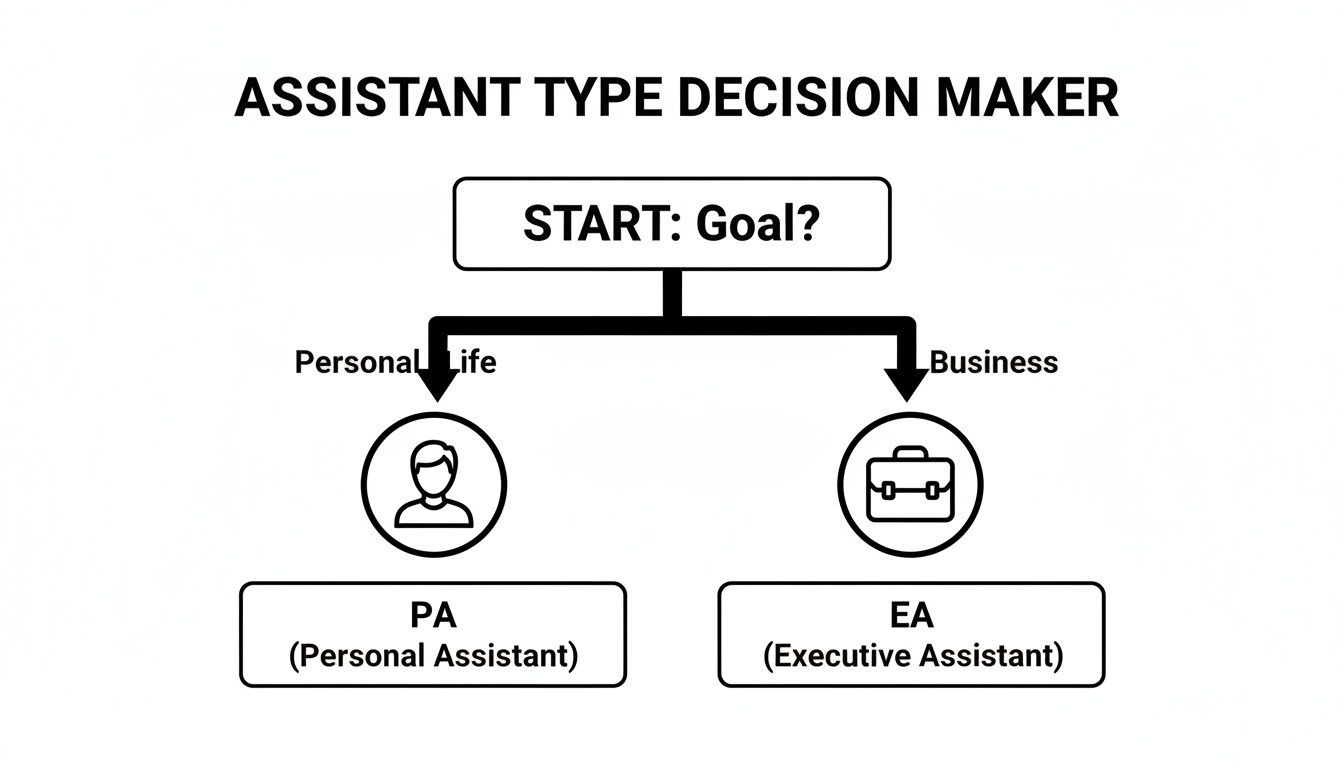
As you can see, the path splits right away depending on whether you’re trying to grow your business or just get your life back on track.
Once you know where the problem is, define what success actually looks like. What are you really trying to accomplish by hiring help? The answer will sharpen your focus.
Ask yourself this: Is my main objective to increase company revenue or to reclaim personal time?
An Executive Assistant is, at its core, an investment in business growth. By protecting your time, prepping you for high-stakes conversations, and managing important projects, a great EA makes you more effective—and that drives revenue. You hire an EA when your time has become the company's most valuable, and limited, asset.
A Personal Assistant, on the other hand, is an investment in your own well-being. Their work won't show up on a P&L statement, but you'll measure the value in recovered weekends, less stress, and the simple ability to be present with your family. You hire a PA when the administrative burden of your life is keeping you from actually living it.
Hiring an EA is about ROI—Return on Investment. Hiring a PA is about ROL—Return on Life. Knowing which return you need most is everything.
Finally, you have to get real about the money. The cost of an assistant is much more than just their salary, and you need a complete financial picture to make a sustainable hire.
Ask this final, practical question: What is my total budget for support, including salary, benefits, taxes, and tools?
Executive Assistants command higher salaries—often starting around $65,000 and easily topping $100,000 for senior roles—because their work is tied directly to business outcomes. This cost is usually a business expense, but it has to include payroll taxes, potential bonuses, health benefits, and any software they'll need.
Personal Assistants typically have a lower salary range, but remember, this is an out-of-pocket personal expense. You have to factor in not just their hourly wage or salary but also employer taxes and any resources they need to do their job. Getting the math wrong on these "hidden costs" can turn a helpful solution into a new financial headache.
Even after you know the difference between a personal and an executive assistant, the practical questions start to bubble up. The right hire is about more than just a job description; it’s about navigating the real-world nuances of blending roles, understanding the full financial picture, and figuring out where remote help fits in. Let's tackle the questions I hear most often from founders and busy professionals.
The quick answer is yes, but it’s a risky move. When you ask one person to juggle your high-stakes business needs and the complex details of your personal life, you're creating a perfect storm for burnout. The mental gymnastics required are enormous—one minute they’re prepping confidential board documents, the next they’re trying to find a last-minute pediatrician appointment.
Inevitably, this dual role means something has to give. Either a critical professional deadline slips because of a family emergency, or your personal life takes a backseat to a sudden business crisis. For a hybrid role to have any chance of success, you need to set brutally clear expectations and be realistic about the workload.
Blending PA and EA duties might seem efficient on paper, but in practice, it often just dilutes focus. An assistant stretched between two completely different worlds—personal and professional—can rarely give their best to both at the same time.
At the end of the day, a hybrid assistant is a compromise. If your needs in both areas are fairly light, it might be a workable short-term solution. But if you need serious, high-level support in either your business or personal life, a dedicated specialist is almost always the better, more effective choice.
One of the biggest mistakes I see people make is only budgeting for the salary. The actual cost of an assistant, whether PA or EA, is always much higher once you factor in everything else. These aren't really "hidden" costs—they're just the standard, non-negotiable expenses of having an employee.
Think about all the other financial commitments that come with a hire:
All told, these overheads can easily add 20-30% or more to an assistant's base salary. Factoring them in from day one is the only way to make a financially sound decision.
The term Virtual Assistant (VA) tends to muddy the waters, but it really shouldn’t. A VA isn't a separate type of assistant; it's simply a term that describes how they work—remotely. It’s not a third option in the personal vs. executive assistant debate.
You can hire a virtual PA to manage your personal life from another city or a virtual EA to support your business from another country. The core duties don't change, just their location. The U.S. alone currently has over 1.8 million administrative assistants and 466,910 full-time EAs. The number of remote VAs is growing fast, swelling those ranks and changing how support works. To get a better sense of how these roles are evolving, you can explore detailed employment statistics and trends.
When the demands of your personal life are too complex for just one hire, Approved Lux Personal Assistant offers a different kind of solution. We act as a dedicated operations team for your life, managing travel, scheduling, reservations, and lifestyle logistics so you get your time back without the overhead of managing staff. Discover how Approved Lux can streamline your life.
From this collection
From this collection

operations support services
Discover how operations support services streamline your life by managing complex tasks, reducing mental load, and freeing up your time for what matters most.

personal wellness center
Personal wellness center - Build your personal wellness center to combat burnout. This guide covers planning, design, & management strategies for peak
concierge in los angeles
Unlock time with a concierge in Los Angeles. Discover services, pricing, and how Approved Lux offers unique options for busy professionals.