

Resources
Articles
Notes, guides, and editorial standards from the Approved Experiences team. Written for members, in the same voice we use everywhere else.
Resources
Notes, guides, and editorial standards from the Approved Experiences team. Written for members, in the same voice we use everywhere else.
Discover how virtual personal assistant services help you reclaim time and reduce stress. This guide covers what they do, the benefits, and how to choose one.

Feel like you're constantly drowning in scheduling conflicts, travel planning, and the never-ending logistics of a busy life? It's a common problem. Virtual personal assistant services are the modern answer to getting your time and sanity back.
Think of it this way: you get a personal "air traffic controller" for your life. They manage all the moving parts, clearing your runway so you can focus on what truly matters.

Picture a day where your complicated travel itineraries just appear, dinner reservations are confirmed, and your calendar is managed perfectly—all without you lifting a finger. This isn't some far-off dream reserved for the ultra-wealthy. It's the practical, accessible reality that virtual personal assistant services deliver.
These services essentially provide a remote operational backbone for your personal life. To get started, it helps to understand the core idea of an outsourced personal assistant. Unlike a traditional assistant who sits in an office, a virtual one works from their own location. This setup brings incredible flexibility and is far more cost-effective, allowing you to hand off all those time-sucking life-admin tasks that drain your focus and lead to decision fatigue.
The need for this kind of help has absolutely exploded. What was once a niche tool has become a must-have for busy people everywhere. The global market for virtual personal assistant services is on track to hit USD 44.25 billion by 2027, growing at an impressive 20.3% each year.
This massive growth is powered by the shift to remote work, with an estimated 40 million virtual assistants now working across the globe.
So, what do they actually do? A great virtual personal assistant smooths out the friction points in your daily life. They become your go-to for things like:
By handing off these operational duties, you're doing more than just buying back a few hours. You're freeing up precious mental energy. This is the bandwidth you can redirect toward your most important professional goals, creative passions, or simply being more present with family and friends.
At the end of the day, these services give you a system to run your personal life with the same efficiency as a well-oiled business. That’s the real prize: the freedom to focus on what you do best.

So, what does a virtual personal assistant really do? It's easy to talk in hypotheticals, but let’s get down to the brass tacks of what you can actually hand off. While the list of potential tasks is long, most of the work falls into a few key buckets, all designed to manage the operational side of your life so you don’t have to.
Think of it this way: your virtual assistant isn't just a helper; they're your personal operations manager. Their mission is to take over the logistical headaches that steal your time and mental bandwidth, freeing you up for what truly matters. We can group their responsibilities into three main areas of support.
This is where you'll feel the impact first. A great virtual assistant acts as the gatekeeper of your calendar, making sure your time is spent wisely and your priorities are protected. It’s so much more than just dropping appointments into a schedule—it’s about strategically shaping your day.
They’ll handle all the tedious back-and-forth emails to schedule a meeting across three time zones or find a time for a group dinner that works for everyone. Suddenly, dozens of tiny, distracting decisions disappear from your inbox every single week.
Common scheduling tasks include:
We’ve all been there: spending hours on a Sunday afternoon comparing flight prices and hotel reviews. Planning travel is a notorious time-drain. A virtual assistant takes this entire process off your hands, from research to booking. Instead of you drowning in options, your assistant can come back with three perfectly curated itineraries that meet your preferences and budget.
And it doesn't stop at flights and hotels. They'll arrange for a car to pick you up at the airport, build a detailed day-by-day itinerary with all your confirmation numbers, and even make dinner reservations for your trip. When it comes to events, they can manage the guest list, coordinate with vendors, and send out invitations, turning a massive project into something you can actually enjoy.
The real value here is the reduction in decision fatigue. Your assistant does the heavy lifting of research and vetting, presenting you with clear, well-defined options. All you have to do is make the final choice, saving countless hours of logistical work.
Top-tier virtual personal assistant services don’t just stop at your professional life; they step in to simplify things at home, too. This is where an assistant truly becomes an indispensable partner in your day-to-day. They tackle the never-ending list of personal tasks that, while small, add up to a mountain of work.
This could mean finding and scheduling a reliable plumber, handling your online shopping and returns, or even planning your kid's birthday party from start to finish. They function as your personal project manager, making sure everything gets done right and on time. To get a better feel for just how much they can take on, it helps to review the typical tasks of an executive assistant, as the skill sets often overlap.
By offloading these crucial but time-intensive responsibilities, you can finally run your life with a sense of ease and control. You get to be fully present for the moments that count, both at work and at home. The result? A calmer, more organized life where you're back in the driver's seat of your own time.
Knowing what a virtual assistant does is one thing, but truly understanding their impact on your day-to-day life is something else entirely. The advantages run much deeper than just ticking off a to-do list; they fundamentally reshape how you work and live. When you hand off your personal logistics, you unlock powerful, positive changes that let you focus on what really matters.
The core benefits aren't just about saving time, though that's certainly a huge piece of the puzzle. It’s about cutting down on the mental noise, sharpening your focus, and hitting your goals more effectively—all while being an incredibly smart financial move.
What would you do with an extra 10-15 hours every single week? That’s not just a hopeful number; it’s a realistic outcome when you offload the relentless stream of administrative tasks that clog up your schedule. Every hour you spend comparing flight options, playing email tag to book a meeting, or finding a trustworthy plumber is an hour you can't invest in your business, your family, or yourself.
Think about a typical week. Before a virtual assistant, you might burn hours researching travel, coordinating schedules, and managing household appointments. After, those tasks just… disappear from your plate. You send a quick request and, a little while later, you get a curated list of options or a calendar invite. The time you get back is immediate and significant.
Your brain only has so much bandwidth. Every small decision—which flight to book, what restaurant to pick for a client dinner, when to schedule the car service—eats away at your mental energy. This steady drip of minor choices leads to decision fatigue, making it much harder to think clearly about the big-picture stuff.
A virtual assistant acts as a powerful filter for all these low-stakes decisions. By handing over the research, vetting, and coordination, you save your cognitive resources for creative problem-solving, strategic thinking, and simply being present in the moments that count.
The real superpower of a virtual assistant service is its ability to clear your mind. It’s not just about getting to inbox zero; it’s about creating the mental space to think, create, and lead without being bogged down by operational noise.
This diagram shows how these key benefits all work together, creating a more streamlined and effective life.
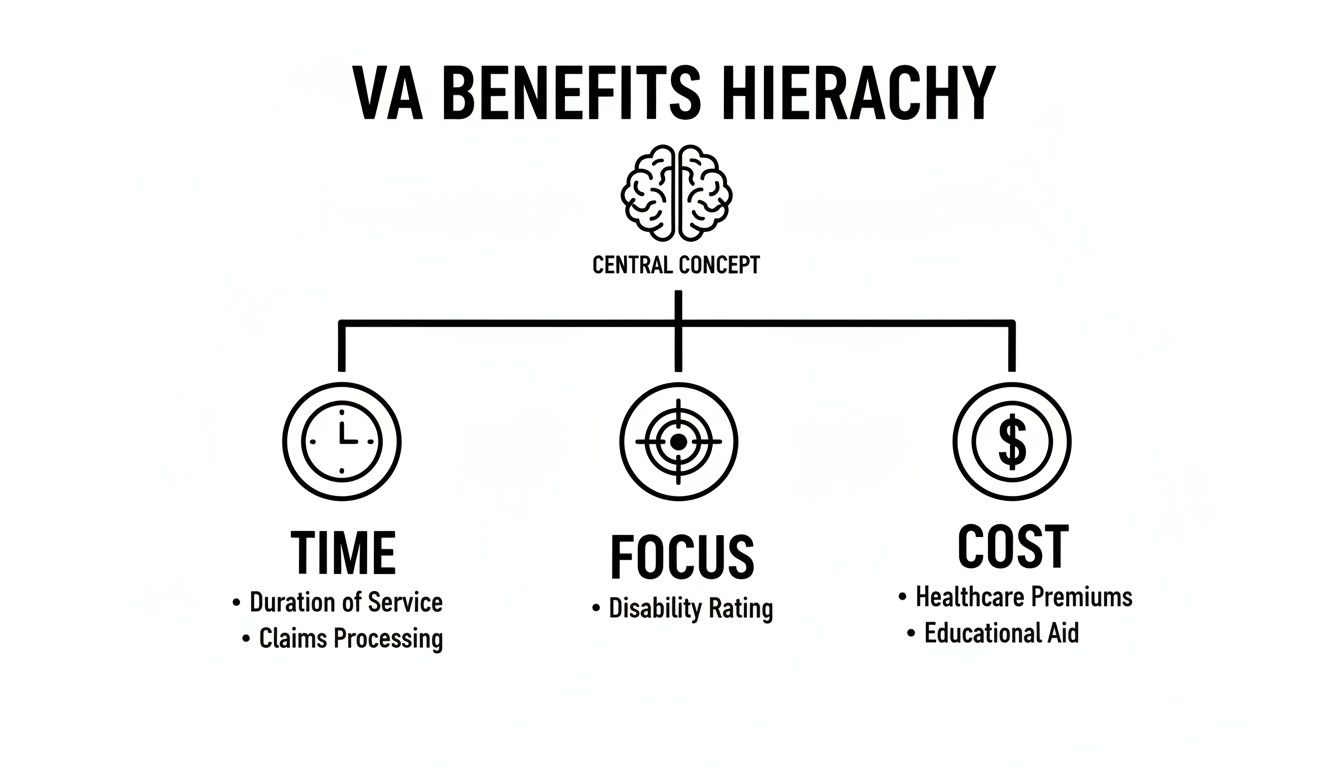
As you can see, managing your time, focus, and costs is the foundation for reducing your mental load and hitting new levels of productivity.
Constant interruptions are the arch-nemesis of deep, meaningful work. Every time you stop to answer a scheduling email, take a call to confirm an appointment, or deal with a personal logistical issue, your concentration is broken. A virtual assistant creates a protective buffer around your time.
While you're leading a critical meeting or zoned in on a major project, your assistant is quietly handling those disruptions in the background. This allows you to carve out and protect large, uninterrupted blocks of time for your most important work. The result? A massive improvement in both the quality and quantity of what you produce.
Let's be realistic: hiring a full-time, in-person personal assistant is a huge financial commitment. You're looking at a salary, benefits, payroll taxes, and office space, which can easily add up to $60,000 to $80,000 per year or more. That's simply not feasible for most people.
Virtual personal assistant services offer a much smarter, more flexible path. Instead of the high overhead of a direct employee, you pay a predictable monthly fee for the exact level of support you need. This model gives you access to professional-grade help without the cost and complexity of being an employer. For a deeper dive into the numbers, this ROI guide for AI voice assistants offers some great perspective.
This cost-effective approach is fueling explosive growth in the market. The global smart virtual personal assistants market, valued at USD 14.00 billion in 2024, is projected to skyrocket to an incredible USD 288.65 billion by 2034. The demand for efficient, accessible support is undeniable.
Not all virtual personal assistant services are built the same. Once you’ve decided to hand off some of your tasks, you'll discover a few different ways to get that help. Each model has its own flavor, and understanding the differences is key to finding a solution that actually fits your life, not one you have to manage.
The options really boil down to three main paths: hiring a freelancer directly, going through a traditional agency, or using a modern, platform-based service. The right choice hinges on what you value most—is it a personal one-on-one connection, a safety net, or pure, hands-off efficiency?
Hiring a freelancer is often the first stop for many. You can jump on a marketplace like Upwork or Fiverr, find someone you like, and get started. This direct, one-to-one relationship is the biggest draw. Over time, that person can get to know you and your preferences inside and out.
But that’s also its biggest risk. You’re not just hiring help; you’re becoming a manager. You have to handle the vetting, the interviews, the payroll, and the training. And what happens when your go-to person gets sick, takes a vacation, or just has a bad day? Everything stops. You're left with no backup plan.
An agency feels like a safer bet. They do the initial recruiting and vetting for you, then match you with one of their assistants. This solves the reliability issue—if your main assistant is out, the agency can usually swap in a replacement to keep things moving.
While you get a safety net, it can feel a bit more corporate and less personal. You're working with the agency's employee, not necessarily your person. Communication can sometimes get routed through an account manager, adding a layer of bureaucracy between you and the person doing the work. The costs are also typically higher, since you're paying for the agency's overhead.
The real catch with both freelancers and agencies is that you're still stuck managing a person. For busy people looking to lighten their mental load, directing and overseeing someone else's work can feel like trading one job for another.
A newer, smarter approach is the platform-based service. Instead of hiring a person, you’re plugging into an operational system for your life. With a service like Approved Lux, you submit requests through a simple, central hub, and a coordinated team of specialists gets it done behind the scenes.
This model is built from the ground up for total reliability and efficiency. There's no single point of failure because a whole team has your back. The focus shifts from managing an individual to simply getting things done. You never have to think about training, sick days, or performance reviews—the platform handles all of that seamlessly.
This shift toward reliable, human-powered execution is what’s fueling the market’s explosive growth. Valued at USD 8,660.43 million in 2023, the human virtual assistant services market is projected to skyrocket to USD 29,000.3 million by 2031. This trend highlights a massive demand for more dependable and efficient support systems.
Choosing the right model comes down to what you're trying to achieve. The table below breaks down the key differences to help you decide which approach is the right fit for your goals and lifestyle.
| Feature | Freelance VA (Marketplace) | Agency VA | Platform Service |
|---|---|---|---|
| Reliability | Low (single point of failure) | Medium (backup usually available) | High (team-based, always-on coverage) |
| Management | High (you manage everything) | Medium (you co-manage with the agency) | Low (the platform handles all operations) |
| Consistency | Varies by individual | Generally consistent | Highly consistent & standardized |
| Onboarding | DIY, often slow and manual | Structured but can be rigid | Fast, streamlined, and system-driven |
So, what’s the verdict? If you want a dedicated, one-on-one relationship and don’t mind the hands-on management that comes with it, a freelancer or an agency could work for you.
But if your main goal is to truly offload your personal operations with maximum efficiency and zero headaches, a platform service is in a league of its own. For a deeper dive into how these roles function in different contexts, check out our guide on the differences between a personal and executive assistant.

Picking the right virtual personal assistant service is a big deal. The whole point isn’t just to find someone to check off boxes on a to-do list; it's about finding a genuine partner who can seamlessly integrate into your life and truly lighten your mental load. A bad fit can actually create more work, turning the solution into just another problem you have to manage.
To make the right call, you need a solid game plan. Think of it like you're hiring a Chief of Staff for your personal life. You wouldn't bring someone into a key role without some serious vetting, and the same logic applies here. This is all about matching a provider’s systems, security, and communication style to what you actually need.
By working through a simple checklist, you can cut through the marketing fluff and focus on what really counts: reliability, security, and a user experience that feels completely effortless. Let's walk through the key questions that will make sure you land a service that delivers on its promises right from the start.
Before you even start Googling providers, the most critical step is to look in the mirror. You have to get brutally honest about what you're willing to hand over. A fuzzy goal like "I want to be more organized" just won't cut it.
Get practical. For one week, grab a notepad and write down every single task that pulls you away from what you do best or eats into your personal time. This list might include anything from scheduling dentist appointments and researching vacation spots to coordinating with the plumber or dealing with online returns. This list becomes your "delegation blueprint"—a clear scope of work to evaluate providers against.
When you have that clarity, you can ask laser-focused questions during your search, like:
Without this blueprint, you're basically shopping in the dark. With it, you can instantly filter out services that aren't built for your specific needs, saving yourself a ton of time and potential headaches.
How a company welcomes you into their system tells you almost everything you need to know about them. A clunky, confusing, or overly manual setup is a huge red flag. It’s often a clear sign that their internal operations are just as messy, a problem that will eventually trickle down to you.
Look for a provider with a polished and well-documented onboarding process. Do they have an efficient way to capture all your preferences, key contacts, and critical details? Is their technology intuitive? The initial setup should make you feel confident and supported, not like you've just been assigned a new project.
Communication is the absolute backbone of a successful delegation partnership. A provider's communication style has to mesh with yours. If you prefer to send quick, asynchronous requests but they insist on scheduled phone calls, that friction will become a major roadblock.
Ask direct questions about how they manage the flow of information. Is there a central dashboard to submit and track tasks? What are their guaranteed response times? How do they flag and handle urgent requests? A professional virtual personal assistant service will have clear, consistent protocols that ensure nothing ever gets lost in translation. This structure is what builds trust and lets you achieve that truly hands-off feeling. For more on this, our guide on how to hire a personal assistant is a great resource.
Let’s be clear: in this day and age, you can't be too careful about data security. You’re about to hand over some of your most sensitive personal information—credit card numbers, passport details, private calendar events. It is absolutely non-negotiable that you understand exactly how they protect that data.
Don’t be shy about asking tough questions about their security policies. How do they store and share sensitive files? Do they use encrypted platforms? Are their assistants rigorously trained in data privacy and confidentiality? A trustworthy provider will be upfront and transparent with this information. If a company gets cagey or dismissive about security, that's your cue to leave.
Finally, put their pricing model under a microscope. Hidden fees, confusing surcharges, and surprise bills are common frustrations in this industry. The price you see should be the price you pay—period. Look for a provider with simple, transparent, and all-inclusive pricing. That kind of financial clarity is a powerful signal of an honest, well-run company, ensuring your partnership starts and stays on solid ground.
Even when the benefits are clear, it's natural to have a few practical questions before jumping into the world of virtual personal assistant services. Let's tackle some of the most common ones to help you move forward with confidence.
This is usually the first thing people want to know, and the answer really depends on the model. If you hire a freelancer from a marketplace, you could be looking at an hourly rate anywhere from $20 to over $75, based on their experience and where they're located. Agencies, on the other hand, tend to offer monthly packages with a set number of hours.
A modern platform service, however, usually works on a predictable, flat-rate monthly subscription. This takes all the guesswork out of hourly billing. You get an all-inclusive cost for a defined level of support, which makes budgeting a whole lot easier. It's a model built for consistency and value.
The trick is to look past the sticker price and think about the total value you're getting. A subscription often comes with better reliability and operational backup than a simple hourly rate, saving you the hidden costs of managing everything yourself.
Security has to be the top priority. Period. You’re handing over sensitive information—from credit card details to private travel plans—so you need absolute certainty that it’s protected. Any virtual assistant service worth its salt takes this incredibly seriously.
They should have ironclad security protocols in place, like:
Don't hesitate to ask a potential provider to walk you through their security measures. If they can't give you a clear, confident answer, that's a huge red flag.
Handing things over can feel a bit strange at first, but a good service will make it feel completely natural. The best way to start is small. Offload a few low-risk tasks to build a rhythm and get comfortable with the whole process.
For instance, you could start with something simple, like asking them to book a dinner reservation or find three highly-rated plumbers nearby. Once you see how smoothly that goes, you can start handing over more involved tasks, like planning a multi-city business trip or taking over your entire family calendar.
The best providers have a seamless onboarding process where they learn all your preferences right from the start. This makes delegating feel easy from day one. Before you know it, your virtual assistant team will understand your habits so well they can anticipate what you need, making the entire system run almost on its own.
Ready to offload your personal operations and reclaim your focus? Approved Lux Personal Assistant provides a seamless, reliable platform to manage your life's logistics. Learn how Approved Lux can give you back your time.
From this collection
From this collection
executive assistant services
Discover how executive assistant services reclaim your time and reduce mental load. This guide covers use cases, ROI, and how to choose the right provider.
virtual assistant software
Discover how virtual assistant software helps busy professionals reclaim their time and focus. Learn how it works, its key features, and if it's right for you.

operations support services
Discover how operations support services streamline your life by managing complex tasks, reducing mental load, and freeing up your time for what matters most.