All Articles
The Journal
Day to Day Business Operations: A Founder's Guide
October 13, 202612 min readfounder productivityadmin delegation
Master your day to day business operations with practical steps for founders. Streamline workflows, cut costs, and keep every team aligned as you grow.

Employees using Microsoft 365 are interrupted every 2 minutes and receive 117 emails plus 153 Teams messages during an average workday. Day to day business operations improve when you reduce that fragmentation, route routine coordination elsewhere, and protect your attention for revenue-critical decisions.
The problem isn't a lack of productivity apps. It's that founders, executives, and independent professionals keep acting as the operating system for every calendar change, follow-up, vendor question, travel disruption, and household request. That design guarantees context switching.
A better model treats operations as a capacity problem. First, separate work that requires your judgment from work that merely requires persistence. Then document the repeatable parts, delegate the coordination loops, and measure what comes back: uninterrupted work blocks, closed follow-ups, fewer overdue items, and hours redirected to clients, revenue, or family.
The Hidden Cost of Operational Noise
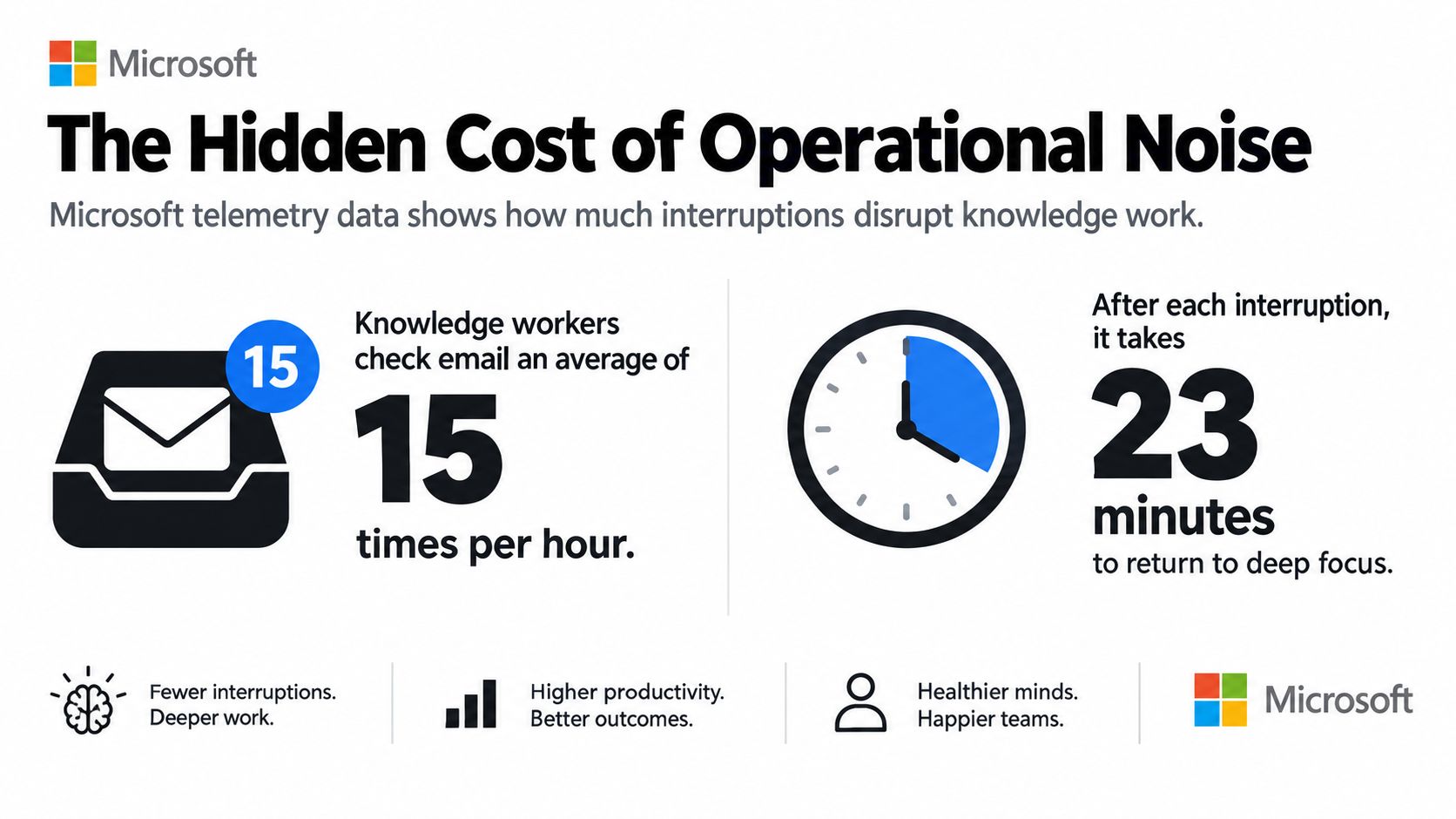
Microsoft's telemetry makes the interruption problem difficult to dismiss. Employees using Microsoft 365 were interrupted, on average, every 2 minutes by meetings, emails, or notifications. The same research recorded 117 emails and 153 Teams messages per workday, while 48% of employees and 52% of leaders described work as chaotic and fragmented. 80% of global workers said they lacked enough time and energy to complete their work. Microsoft Work Trend Index data
That is not a scheduling inconvenience. Each interruption creates a resumption lag, the time and effort required to reconstruct what you were doing, where you stopped, and what comes next. Research on workplace interruptions connects switching with disrupted procedural place-keeping, omissions, duplicated steps, and occasional failure to resume the original goal. Research on task interruption and resumption
Treat interruptions as capacity leakage
Suppose you're preparing a client proposal when a travel change arrives. You open the message, compare alternatives, confirm a new option, update the calendar, and answer a follow-up. The request may take only a few minutes, but the proposal now competes with a partially rebuilt mental context. Repeat that sequence throughout the day and your available attention shrinks without your calendar showing the loss.
The remedy isn't another color-coded calendar. It's an operating rule: routine coordination should enter a controlled queue, not interrupt the principal directly. A team can acknowledge the request, gather missing details, complete the low-risk steps, and escalate only the decision that needs authority.
Practical rule: Measure interruptions avoided and follow-ups closed, not just minutes spent on individual tasks.
The same logic applies to technology decisions. For a useful discussion of how automation and algorithmic systems can introduce new operational exposure, read Big Moves Marketing's analysis of AI risk. For a related look at why administrative work becomes a business constraint, see this analysis of administrative burden in modern work.
Why Administrative Labor Is a Structural Necessity
Administrative work isn't a side issue reserved for disorganized companies. The U.S. Bureau of Labor Statistics counted approximately 18.5 million office and administrative support jobs in May 2023, representing 12.2% of total U.S. employment and making the group the country's largest occupational category. Secretaries and administrative assistants held about 3.5 million jobs in 2025, and the BLS expects approximately 1.7 million openings per year on average from 2025 to 2035, largely because workers leave and must be replaced. Bureau of Labor Statistics administrative support data
Those figures reveal a basic operating truth: scheduling, records, documentation, communications, and coordination don't disappear because software improves. Someone still gathers the details, checks the dependency, follows up with the vendor, updates the calendar, and confirms completion.
A founder usually has three choices. Keep the work personally, hire a permanent employee, or acquire flexible capacity from an external team. The first choice consumes high-value attention. The second adds payroll, benefits, supervision, recruiting, and management overhead. The third can fit better when workload fluctuates or when the company needs operational scalability before it needs a full-time role.
Buy capacity before you buy headcount
A subscription Assistant team works as a first hire without W-2 overhead. It can handle recurring logistics, research, scheduling, travel coordination, inbox support, and follow-ups while the owner retains authority over sensitive decisions. That arrangement is not a replacement for qualified legal, medical, financial, or tax professionals. It is a way to remove coordination work that doesn't require the principal's expertise.
Founders should also separate operational efficiency from HR administration. If you're evaluating payroll, benefits, compliance, and broader people processes, this guide to HR solutions for founders provides useful context. The core decision remains straightforward: calculate the value of the hours you can recover, then compare that value with the cost and management burden of the capacity you acquire.
A good operating model doesn't eliminate administrative labor. It puts the labor at the right level, gives it the right context, and stops routine work from competing with strategic work.
An Operations Audit and Triage Your Day to Day Business Operations
Don't delegate from memory. Memory overweights the task that annoyed you yesterday and undercounts the small follow-ups that consume every week.
Run a two-week operations audit. Record every recurring request, interruption, follow-up, and administrative task. Include work and personal coordination if both systems compete for the same attention. A message asking you to confirm a meeting, a vendor renewal, an expense receipt, and a school registration deadline all belong in the same operational inventory if they draw from your limited capacity.
KfW found that small and medium-sized businesses spend an average of 7% of working time on administrative processes, equal to about 32 hours per month per business, and collectively devoted roughly 1.5 billion hours to legally required compliance work. KfW analysis of bureaucracy and administrative processes
Use four filters
For every item, record four judgments:
- Revenue impact: Does this directly create, protect, or deliver revenue?
- Discretion required: Does the task need your authority, relationship, expertise, or approval?
- Deadline sensitivity: What happens if it waits until later today or tomorrow?
- Handoff complexity: Can another person complete it from documented preferences and accessible information?
Then classify each task as automate, document, delegate, or retain. Automation fits predictable rules. Documentation fits repeatable workflows. Delegation fits coordination that needs human persistence and judgment within defined boundaries. Retention fits decisions where your authority or expertise is the actual value.
| Task Type | Revenue Impact | Discretion Required | Delegate? |
|---|---|---|---|
| Calendar coordination | Indirect | Low to moderate | Yes, with availability rules |
| Client strategy decision | High | High | No |
| Vendor research and follow-up | Indirect or protective | Moderate | Yes, with approval limits |
| Compliance document preparation | Protective | Moderate | Yes, while qualified professionals handle regulated judgment |
| Inbox sorting and routine drafts | Variable | Low to moderate | Yes, with escalation rules |
The highest-value delegation target isn't always data entry. Exception management and follow-up often create more disruption because unresolved items keep returning to your attention. Use a shared queue with an owner, deadline, next action, and escalation rule.
For a broader process-improvement perspective, review LeaveWizard's guide to optimizing business processes. You can also use this operations triage framework to turn the audit into a repeatable decision process.
Real-World Examples of Delegated Operations
The value of delegation appears in the loops, not the isolated tasks. A calendar change requires finding a time, checking conflicts, communicating options, updating the event, and reminding the right people. A travel disruption requires research, selection, booking, confirmation, and sometimes another adjustment. Remove only one step and the owner still carries the open loop.

Scheduling
Before delegation, the founder handles every exchange: “Does Tuesday work?” “Can we move the call?” “Which meeting should take priority?” After delegation, an Assistant team works from defined availability, meeting priorities, buffer preferences, and escalation rules. The team can propose times, resolve routine conflicts, prepare background materials, and return only exceptions that need the founder's decision.
The founder doesn't merely save the duration of the emails. The founder stops carrying the unresolved question between meetings.
Travel logistics
Travel creates high-cost interruptions because changes happen outside normal office hours. A flight cancellation can trigger a search for alternatives, hotel adjustments, ground transport changes, calendar updates, and messages to colleagues or family.
A team available around the clock can manage the research and coordination while the traveler states the constraint that matters, such as arrival time, budget boundary, or preferred airport. The operator stays in control of the trade-off without personally managing every transaction.
Inbox triage
An inbox is a queue with poor prioritization. A practical Assistant workflow separates messages requiring a decision from routine requests, drafts replies for repeatable questions, surfaces deadlines, and tracks follow-ups until someone confirms closure.
The important distinction is authority. The Assistant team can prepare and organize. The member decides on sensitive commitments, client strategy, regulated matters, and communications where personal judgment carries the relationship.
A subscription service such as Approved Lux Personal Assistant can provide this type of professional support alongside scheduling, travel coordination, research, and follow-up administration through phone, SMS text, and email. The operating value comes from structured handoffs and shared context, not from adding another inbox.
Vendor coordination
Vendor work usually begins as a small request and becomes a project. The operator must identify providers, compare availability, review options, schedule the service, confirm access details, monitor completion, and follow up on unresolved issues.
A delegated workflow turns “find someone to handle the repair” into a controlled sequence. The Assistant team gathers options, records the trade-offs, seeks approval where required, schedules the provider, and closes the loop after completion.
For a visual example of how schedule management fits into this operating model, see the calendar image above. The broader principle is simple: delegate the monitoring and follow-through, not just the first action.
Subscription Assistants vs. Traditional Hiring
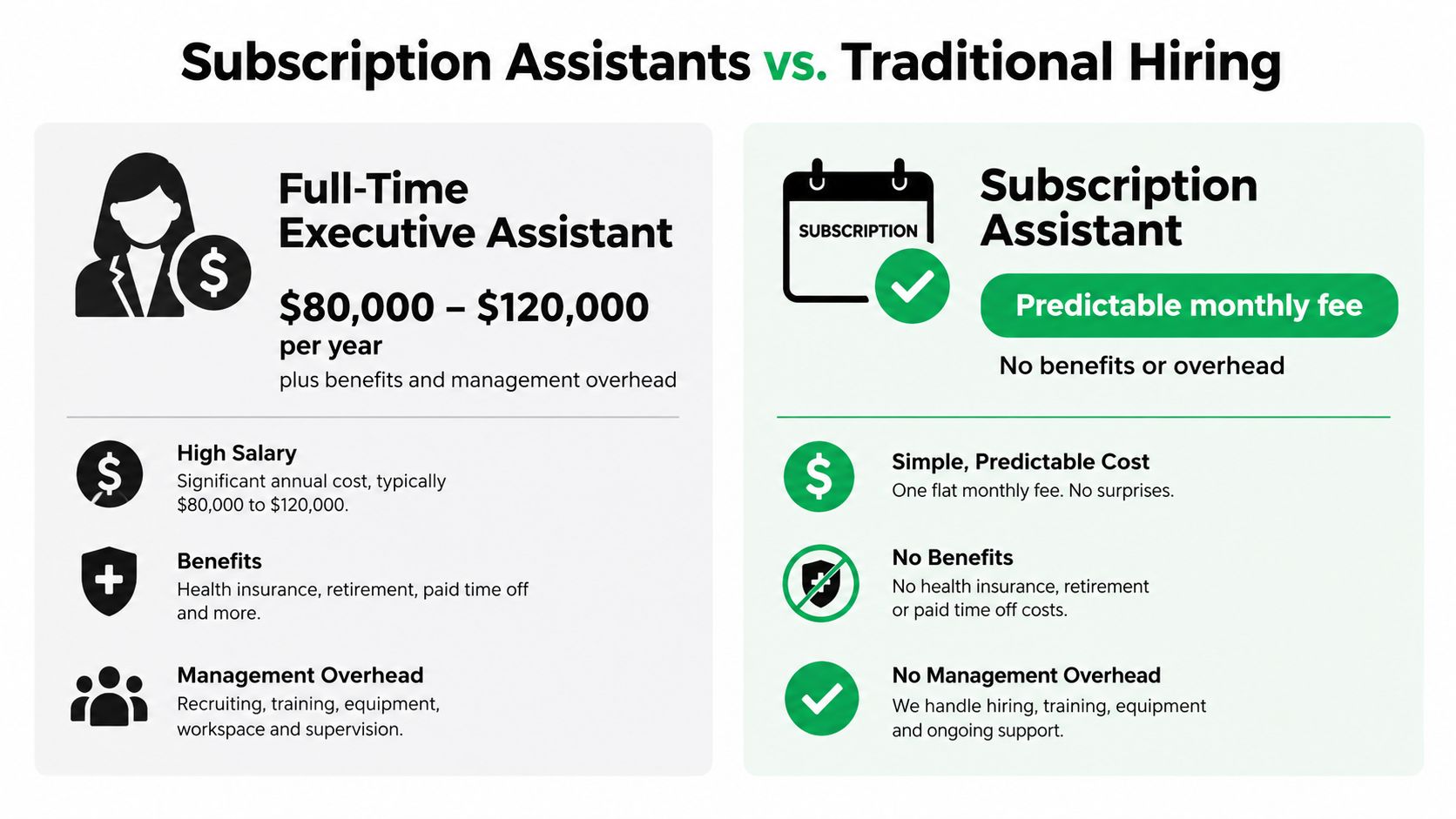
A full-time executive assistant can be the right answer when the workload is stable, the role requires deep internal integration, and the business is ready to manage an employee. It can also be the wrong first move for a founder whose needs fluctuate between travel, scheduling, inbox support, and personal logistics.
The stated full-time EA benchmark in this market is $80,000 to $120,000 per year plus benefits and management overhead. That figure belongs to the hiring comparison provided for this decision, not to a promise about every candidate or market. Hiring also requires recruiting, onboarding, supervision, performance management, coverage planning, and replacement when the role changes.
Compare the operating models
| Model | Capacity pattern | Management burden | Best fit |
|---|---|---|---|
| Full-time employee | Dedicated working capacity | Payroll, benefits, supervision, and continuity management | Stable, sustained workload |
| Independent contractor | Flexible individual capacity | Direct coordination and availability management | Defined specialist or project work |
| Subscription Assistant team | Shared team capacity with documented context | Preference setup, escalation rules, and quality feedback | Variable recurring coordination |
The subscription model makes the most sense when you need reliable operational capacity but don't need a full-time employee's entire working week. Triple-channel access lets members use phone call, SMS text, or email, while US-based accountability supports consistent communication and discretion. A team structure also creates shared context rather than depending on a single person's availability.
The BLS expects approximately 1.7 million annual openings in office and administrative support occupations from 2025 to 2035, even as overall employment in the group is projected to decline. BLS occupational outlook data That replacement demand makes hiring an operational project in its own right.
Choose for the constraint you actually have
If the constraint is sustained internal ownership, hire. If the constraint is specialized project work, contract. If the constraint is recurring coordination that arrives unevenly and still needs human judgment, a subscription team can provide flexible capacity without W-2 benefits, payroll, and direct employee management.
Documented preferences matter because the service should improve as the team learns how you make decisions. Proactive Preference Learning captures routines, communication standards, recurring vendors, and approval boundaries so future requests require fewer explanations. See this overview of subscription model advantages for a broader comparison of flexible capacity models.
Reclaiming Your Cognitive Load
Delegation isn't a luxury when the work being delegated repeatedly interrupts paid work, leadership, or family responsibilities. It's a capacity decision.
The hidden burden is the second shift of coordination. You may not spend long physically completing a task, but you still remember the deadline, search for the information, compare the options, send the reminder, and check whether someone finished. That invisible ownership keeps work open after the visible task ends.
Working parents experience this collision directly. KPMG reported that 54% of working parents frequently experience clashes between work schedules and parenting duties, 57% reported time-management difficulties, and 43% experienced guilt related to work or family time. KPMG Working Parents Survey
Transfer ownership of the workflow
Household coordination is part of operational capacity. The BLS reported that U.S. adults spent an average of 2.01 hours per day on household activities in 2024, including paperwork, household management, planning, maintenance, and organizational work. Women averaged 2.34 hours, compared with 1.67 hours for men. BLS American Time Use Survey
For households with children under age 6, adults spent 2.15 hours per day on household activities and 2.57 hours caring for or helping household members, totaling 4.72 hours per day across those categories. BLS data on households with young children
The practical answer isn't to assign one more app to the parent already monitoring everything. Transfer the whole loop: research, deadline tracking, scheduling, reminders, and completion confirmation. A Chief of Staff clears the runway so the pilot can fly. A well-designed Assistant team can perform the same operational function across work and home without taking over decisions that belong to the household.
The deliverable isn't convenience. It's fewer open loops competing for the same brain.
Getting Started and Your First Steps
Start with a two-week operations audit. Record interruptions, recurring requests, follow-ups, deadlines, and the time required to close each loop. Include both business and household work if one person is carrying both systems.
Then rank the inventory using the triage matrix:
- Select the top three time sinks. Choose tasks with high recurrence, low discretion, and costly follow-up.
- Write the handoff. Document preferred vendors, communication standards, approval limits, calendar rules, and escalation triggers.
- Choose capacity. Lux Solo fits an individual account. Lux Circle covers up to four people on one account, making it suitable for a team or household.
- Measure the result. Track requests received, decisions escalated, follow-ups closed, overdue items, and hours returned to client-facing or revenue-producing work.
Don't judge the arrangement by whether every request feels effortless immediately. Judge it by whether the system needs fewer explanations over time, whether exceptions reach you cleanly, and whether your uninterrupted work blocks become easier to protect.
The compounding benefit comes from Proactive Preference Learning. As shared context improves, the Assistant team can handle more of the recurring operating pattern while you retain judgment over the decisions that matter.
Approved Lux Personal Assistant provides 24/7/365 access to a US-based Assistant team through phone, SMS text, and email for scheduling, travel logistics, inbox support, research, and follow-ups. If your day to day business operations are consuming attention that should go to clients, growth, or family, review Approved Lux Personal Assistant and choose the capacity model that fits your workload.
Want the wider view?
Ten categories. One report. Every quarter. The Approved List tracks what's rising and what's fading: data-backed signals, not opinions.
Free to join · Delivered by email