←All Articles
The Journal
Do Errands or Run Errands How to Use and Delegate Smartly
September 23, 202614 min readrun errands meaningdelegation for errands
Do errands or run errands — learn which phrase is correct, how to use it naturally, and when to delegate errands to reclaim hours each week.
You're halfway through school pickup, a dry-cleaning reminder is flashing on your phone, and an inbox message asks you to confirm tomorrow's meeting. You search “do errands or run errands” because you need the right phrase, but the more useful question is already sitting underneath it: why are you still carrying every small logistical task yourself?
The language answer is simple. Run errands is the natural modern expression. The operations answer takes more thought. Some errands should stay with you, some should be grouped into a single route or time block, and others should be handed to an Assistant team because the cost includes planning, follow-up, and lost concentration.
That distinction matters for a working parent, founder, traveler, or solo professional. A grocery pickup, return shipment, appointment request, or car-service booking may look small in isolation. Together, they create a recurring stream of operational noise. This guide starts with correct usage, then turns the phrase into a practical decision framework for reclaiming time and mental bandwidth.
"Introduction Why This Phrase Matters Beyond Grammar"
At 4:15 p.m., a parent may be deciding whether to leave work early for school pickup, stop at the pharmacy, collect a repaired item, and answer a message from a home-services provider. A founder may be doing the same mental juggling with a flight change, a package return, a restaurant reservation, and three unfinished emails. None of these tasks seems difficult. The problem is that each one demands a decision, a transition, and often another follow-up later.
That's why the difference between do errands and run errands opens a larger conversation. Grammar tells you which phrase sounds natural. Operations tells you whether the activity belongs on your own calendar in the first place.
The noun errand once referred to a message or mission. Today, it covers practical tasks such as shopping, dry cleaning, postal trips, pickups, returns, and service coordination. The modern phrase bundles many small movements and decisions into one category. That makes it useful language, but it also hides the amount of work inside the category.
The question behind the question
Suppose you need to return shoes, collect a prescription, and arrange a plumber visit. You can:
- Do them yourself: Handle every call, trip, and confirmation.
- Batch them: Group physical stops or schedule related calls together.
- Delegate them: Give the outcome to an Assistant team and let someone else coordinate the details.
The right choice depends on urgency, proximity, complexity, and the value of the time you'd interrupt. A ten-minute request can consume much more than ten minutes when it breaks a writing session, delays a client call, or creates a new reminder that stays in your head.
Time-use research treats running errands as a measurable domestic activity for both women and men, rather than an occasional nuisance. Research on mental load also describes the invisible work of thinking about, organizing, and managing household responsibilities as a genuine workload mechanism, not merely a feeling. Independent research on mental load provides useful context for why delegation should include planning and follow-up, not just physical trips.
The practical aim is straightforward: use the phrase correctly, identify the work it represents, and decide whether each errand deserves your attention.
"Do Errands or Run Errands Which Phrase Is Correct"
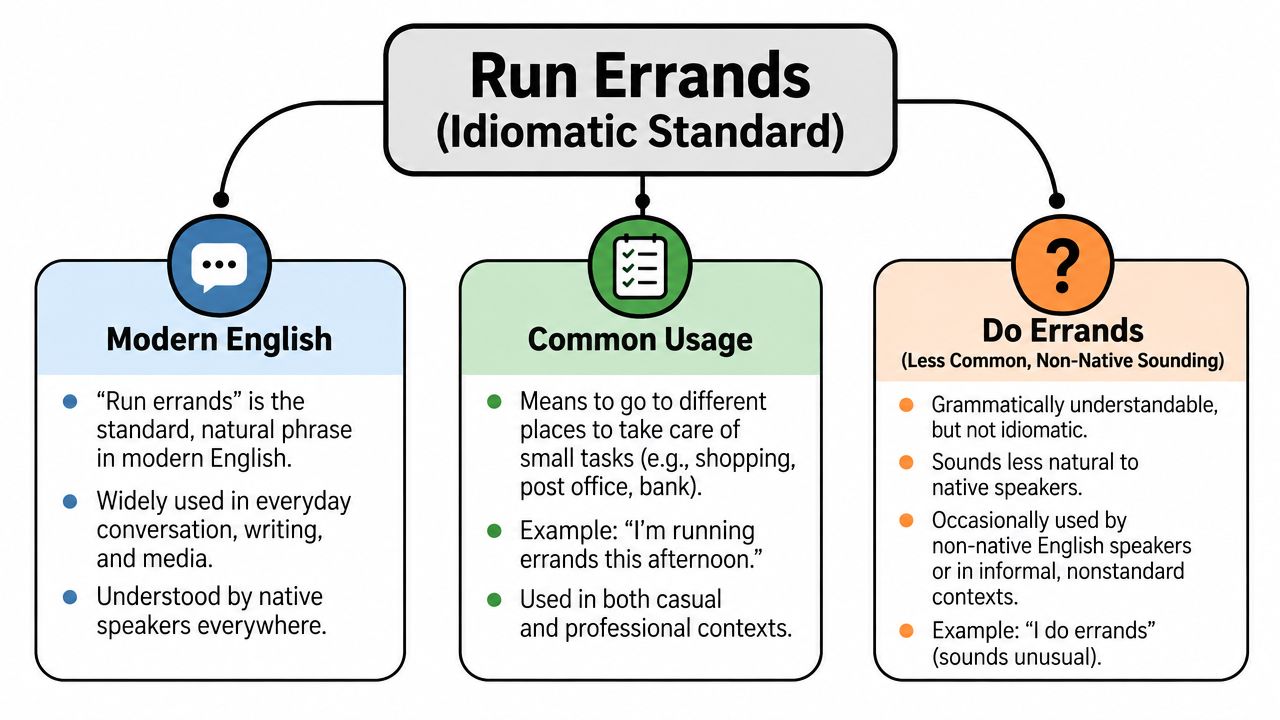
Both do errands and run errands can be understood, but run errands is the idiomatic standard in modern English. It's the phrase native speakers most commonly use for completing short practical tasks, especially tasks that involve going from place to place.
Use it in sentences such as:
- “I need to run errands after work.”
- “She's running errands before school pickup.”
- “Can you run a few errands for me?”
- “We'll run errands on Saturday morning.”
Do errands isn't impossible to understand. It can sound less natural or non-native, especially in everyday conversation. A speaker might say “I have errands to do,” which sounds perfectly normal, but “I need to do errands” usually lacks the natural rhythm of “I need to run errands.”
Why “run” sounds right
English pairs certain verbs with certain nouns in conventional ways. You do homework, do laundry, and do paperwork. You run errands, run a program, and run an organization. The verb doesn't always describe literal movement. In “run errands,” it signals carrying out a series of practical missions, often with several stops or actions.
Compare these examples:
- Natural: “I'm running errands before dinner.”
- Less natural: “I'm doing errands before dinner.”
- Natural: “He has a few errands to run.”
- Less natural: “He has a few errands to do.”
The expression also works when no running is involved. You can run errands by walking, driving, using public transport, ordering online, or asking someone else to handle them. The phrase describes the category of work, not your speed.
A quick usage test
If you're describing a group of small practical tasks, choose run errands. If you're describing a specific chore, choose a more precise verb:
- “I need to pick up the dry cleaning.”
- “I need to return this package.”
- “I need to buy groceries.”
- “I need to schedule a service visit.”
- “I need to mail these documents.”
You can also use errand as a noun:
Natural phrasing: “I have three errands to run before lunch.”
That sentence makes the distinction easy to remember. You run the errands, but you may do the individual tasks inside them. Once you use the standard collocation, you don't need to overthink the grammar.
"How Run Errands Evolved From Messages to Modern Logistics"
The word errand started with a broader and more formal meaning. Linguistic evidence indicates that in Old English, an errand was a message or mission, something a person carried from one place or person to another. The task was defined by its purpose, not by shopping bags, traffic, or a list of household stops.
The meaning gradually moved closer to everyday practical work. The modern sense of a short task outside the home began emerging in the mid-17th century, and the phrase “running errands” didn't really take off until around 1800. It became especially common in the 20th century, as urban services, consumer economies, and more fragmented daily schedules created more reasons to leave home for small tasks. This history of the word “errand” connects the older messenger meaning with the modern household meaning.
A simple timeline
- Old English: An errand means a message or mission.
- Mid-17th century: The word begins shifting toward short practical tasks.
- Around 1800: “Running errands” becomes increasingly established.
- Modern usage: Errands describe recurring logistics such as shopping, postal trips, dry cleaning, pickups, and service coordination.
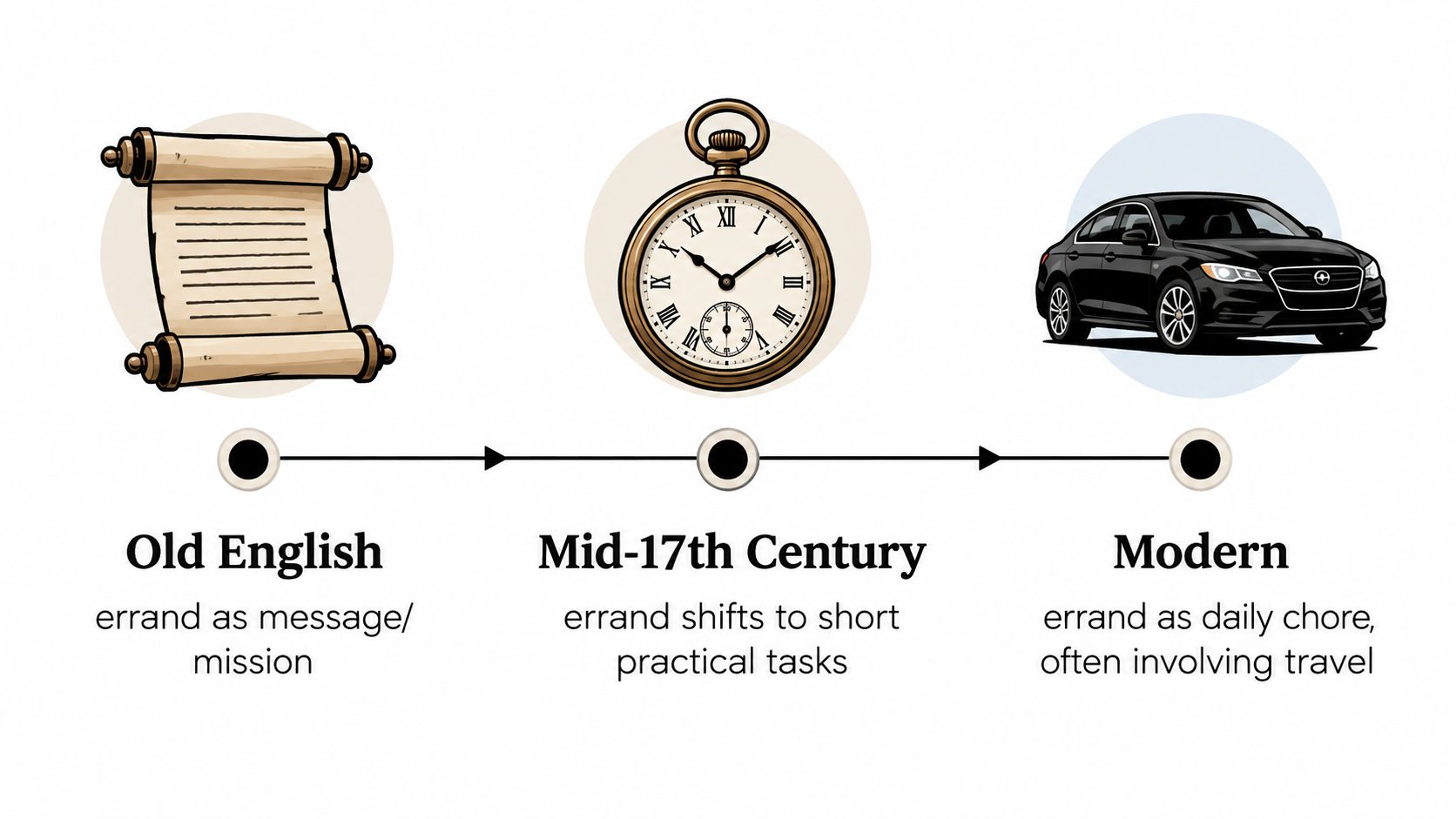
This history explains why the phrase feels so broad today. A message once required a person to carry information. A modern errand may require a person to compare options, book a time, travel, wait, collect an item, confirm completion, and remember what comes next. The underlying pattern is the same: a practical mission must move from intention to completion.
That pattern also explains why running errands is useful operational language. It bundles low-value but necessary work into a recognizable category. Once grouped, the work can be delegated, batched, or systematized instead of competing for attention throughout the day.
For households, this may mean combining school-related pickups, returns, and service appointments into one coordinated plan. For professionals, it may mean handing off travel changes, personal shopping, or vendor research so work hours remain available for clients and decisions. A modern digital concierge services overview can help clarify how personal logistics are increasingly treated as an organized support function rather than a collection of unrelated chores.
The Cost of Errands in Hours and Mental Bandwidth
A grocery pickup can take fifteen minutes at the counter, yet the task may begin long before you leave home. Someone notices the shortage, checks options, builds a list, confirms availability, chooses a time, arranges transport, waits, collects the order, and verifies that nothing else remains. The visible trip is only one link in the chain.
Time-use research treats running errands as measurable domestic work for women and men. In the cited sample, participation rates were 43.3% for females and 45.0% for males, while participants devoted several hours per week to the activity. The time-use methodology document supports counting errands as workload rather than dismissing them as incidental overhead.
Weekly Errand Load by Context
| Group | Estimated Weekly Errand Time | Source Context |
|---|---|---|
| Females in the cited time-use sample | 43.3% participation rate | Source: UN Women time-use methodology (linked above) |
| Males in the cited time-use sample | 45.0% participation rate | Source: UN Women time-use methodology (linked above) |
| Women with children under 16 in Germany | About 41 more minutes per day than comparable men | Source: UN Women time-use methodology (linked above) |
| Adult men in urban settings | About 3 hours per week | Source: UN Women time-use methodology (linked above) |
| Adult men in rural settings | About 7 hours per week | Source: UN Women time-use methodology (linked above) |
The German household-labor research shows how this workload can become uneven in dual-career families. Women with children under age 16 spent 41 more minutes per day running errands than comparable men, which equals roughly 3.5 extra hours per week, based on the cited research. The figure does not describe every household. It does show how repeated logistics can form part of a second shift alongside paid work and childcare.
The attention cost sits beside the clock
A founder who pauses a proposal to call a repair company loses more than the call's duration. They must remember where the proposal stopped, restore the context, and regain the reasoning needed to continue. The American Psychological Association's summary of multitasking research reports that complex task switching can create brief mental blocks costing as much as 40% of productive time in complex, unfamiliar work.
The effect matters most during writing, analysis, judgment, and problem-solving. Batching errands limits the number of context resets. Delegation can reduce them further when another person owns the coordination, follow-up, and completion check instead of returning questions to you at every stage.
Mental load operates alongside travel time. You may remain at your desk while tracking reminders, comparing vendors, coordinating schedules, checking whether someone followed through, and remembering to ask again. Delegating only a physical pickup leaves the planning burden with the household if one person still has to direct every detail.
Operational rule: Measure an errand as execution time plus coordination time plus the value of the focus it interrupts.
Routine care shows why the full chain matters. Options such as in-home care with Bornbir can reduce travel and coordination around appointments. The relevant saving includes preparation, transport, waiting, and follow-up, not only the minutes spent with a provider.
A practical audit takes one week. For each errand, record the request, preparation, travel or communication, waiting, follow-up, and interrupted work block. Then compare the total with your professional hourly value, family priorities, or the cost of a service that can own the task from start to finish. A structured time value calculation turns that comparison into an operating decision: handle the task, batch it, or delegate it based on hours reclaimed and attention preserved.
"When to Do Errands Yourself and When to Delegate"
The best choice isn't always delegation. Some errands are close, simple, enjoyable, or sensitive enough that handling them yourself makes sense. The mistake is treating every errand as if it deserves the same response.
Use four filters: time available, urgency, cost sensitivity, and complexity. A task that takes little time and requires your personal judgment may stay with you. A task that needs several calls, depends on business hours, or creates repeated follow-up belongs in a batch or delegation queue.
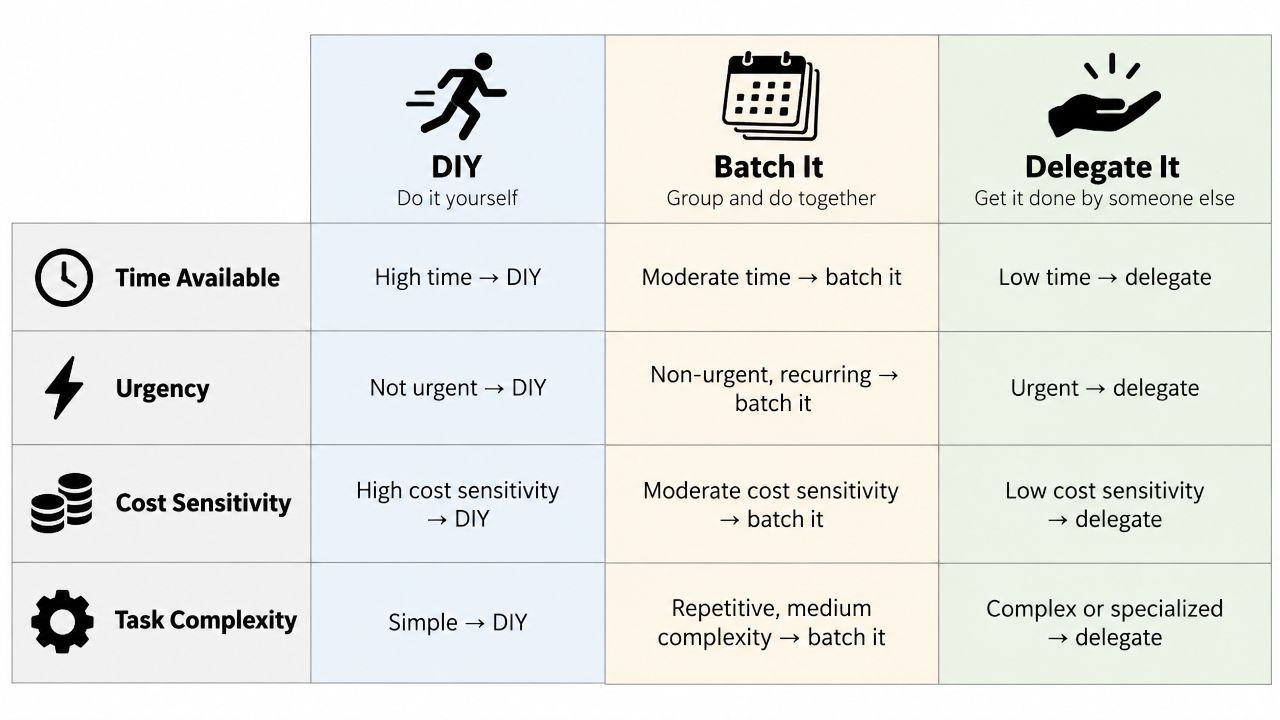
A practical decision matrix
| Approach | Time available | Urgency | Cost sensitivity | Task complexity |
|---|---|---|---|---|
| Do it yourself | You have a convenient gap | Immediate action is needed | Avoiding a service fee matters | Low, familiar, and personal |
| Batch it | You can wait for a planned block | Flexible deadline | Several tasks share one route or order | Moderate, but predictable |
| Delegate it | Your calendar is full | Someone else can coordinate quickly | Your interrupted time costs more than the service | Multiple steps, follow-ups, or judgment calls |
Consider a dry-cleaning pickup. If the shop is on your route and the order is ready, doing it yourself may be efficient. If you need groceries, a return, and a postal drop at nearby locations, batching them can protect the rest of the week. If the task also involves finding a replacement item, checking delivery options, and coordinating a deadline, delegation becomes more attractive.
Apply the five-minute sort
At the start of the week, place each errand into one of three lists:
- Keep: You need to do it, it's nearby, and it doesn't interrupt valuable work.
- Batch: It can wait and shares a route, vendor, or time window with other tasks.
- Hand off: It requires research, calls, scheduling, comparison, or repeated follow-up.
The cash cost of assistance should be compared with the value of the time released, not with the apparent size of the errand. A 2026 Taskrabbit cost guide reports that U.S. errand-running services average $28 per hour, while another 2026 marketplace dataset found general errand posts around $30 and delivery-focused errands around $50. These figures come from the cited Taskrabbit errand cost guide, and they're reference points, not universal prices.
If the task is cheap to outsource but expensive to interrupt, delegation is a productivity decision, not a luxury purchase.
"Practical Playbooks to Reclaim Hours With an Assistant Team"
Delegation works when you transfer ownership of an outcome, not when you send someone a vague list of chores. Start with the result, deadline, preferences, budget limits, and any information the Assistant team needs to act without reopening the same questions.
For Lux Circle households
A Lux Circle account covers up to 4 people, making it suitable for a household where logistics cross multiple calendars. One parent can ask the Assistant team to coordinate a pediatrician appointment, check school dates, arrange a home-service visit, and confirm the final schedule. The other parent doesn't need to repeat the request because the household context remains available to the team.
A useful weekly workflow looks like this:
- School logistics: Gather registration requirements, track deadlines, and organize reminders.
- Family appointments: Request suitable times, resolve calendar conflicts, and confirm details.
- Home maintenance: Find suitable providers, compare options, schedule access, and follow up.
- Personal errands: Source gifts, arrange dry cleaning, coordinate returns, or organize shopping.
Triple-channel access lets family members use a phone call, SMS text, or email, with each channel monitored at equal priority. Proactive Preference Learning helps the Assistant team adapt to routines and preferences over time, so future requests require less explanation.

The payoff isn't having another person make a booking. It's removing the reminder loop and the second-shift coordination that often follows.
For Lux Solo professionals
A founder, frequent traveler, or solo practitioner can use Lux Solo to route personal and professional logistics away from revenue-producing work. The Assistant team can handle travel changes, inbox triage, personal shopping, appointment scheduling, and research through call, text, or email.
A traveler might send a text about a disrupted itinerary and ask the team to review alternatives, coordinate ground transport, and update the relevant schedule. A solo practitioner might delegate vendor research, appointment requests, and document formatting while reserving client-facing hours for billable work.
The scale of the opportunity is visible in admin benchmarks. One University of Melbourne-referenced summary estimates that the average adult spends 12.5 hours per week on life admin. A separate 2021 poll reported 21 hours and 36 minutes per week on administrative tasks at work and 8 hours and 48 minutes per week on personal admin. The figures come from the cited life-admin summary and administrative-work poll.
A direct hire also carries more than wages. Salary benchmarking places an Executive Assistant I in the United States at $62,557 per year, or about $30 per hour, with 75th-percentile pay of $69,811 and highest reported pay of $76,415, according to Salary.com's Executive Assistant I benchmark. A subscription can therefore function as a first hire without overhead for someone who needs capacity but isn't ready to manage a direct employee.
Use the same ownership principle for recurring creative or marketing administration. A documented content creation workflow can clarify which research, scheduling, and formatting tasks should leave your personal queue. For a fuller view of delegation scope, review what Assistants do.
"Conclusion Turn Correct Phrasing Into Smarter Operations"
The natural phrase is run errands. You run errands because the category originally described practical missions, and modern life still turns those missions into a series of movements, decisions, and follow-ups.
The more valuable lesson is operational. An errand isn't only the time spent in a shop, car, queue, or phone call. It includes the planning that precedes the task and the mental residue that follows it. For households, that can contribute to the second shift. For founders and independent professionals, it can interrupt the work that creates revenue.
Use a simple rule this week:
- Keep errands that are personal, nearby, and easy.
- Batch tasks that share a route, vendor, or deadline.
- Delegate tasks that require research, coordination, repeated communication, or schedule management.
Start with one low-risk batch. Give an Assistant team a clear outcome, such as coordinating a dry-cleaning pickup, arranging a home-service appointment, or handling a return. Note the time you would have spent, the follow-ups removed, and the work or family attention that remained available.
That is the force-multiplier mindset. You aren't paying someone to make a small trip for you. You're removing operational noise so a scattered collection of minor tasks stops consuming the shape of your week.
Approved Lux Personal Assistant provides 24/7 access to a US-based human Assistant team through Triple-channel access by phone call, SMS text, or email. Use it to delegate errands, scheduling, travel logistics, research, and follow-up, then start with one recurring task batch and measure the hours and attention you reclaim.
Want the wider view?
Ten categories. One report. Every quarter. The Approved List tracks what's rising and what's fading: data-backed signals, not opinions.
Free to join · Delivered by email