
All Articles
The Journal
Personal Assistant Remote: The ROI Your Time Deserves
October 3, 202613 min readremote assistanttime management
Personal Assistant Remote. Learn what a remote personal assistant is and why it beats hiring W-2 staff. See how subscription teams reclaim 8-15 hours weekly
Working adults spend about 12.5 hours per week on life admin, and delegating even part of that routine workload can turn scattered interruptions into reclaimed blocks of focused time. The practical question isn't whether you need help with every task, but whether a remote personal assistant can remove enough recurring coordination to change how your week feels.
You probably know the pattern. A calendar conflict appears while you're drafting a proposal. A hotel needs changing while you're walking into a meeting. Your inbox contains three messages that require action, but none deserves your attention right now. Then a school form, home repair appointment, travel detail, or follow-up joins the queue.
The work looks small in isolation. Together, it becomes a second operating system you maintain after your actual workday ends. The right personal assistant remote model doesn't just complete errands. It reduces the number of decisions, reminders, and handoffs you have to carry.
The Hidden Cost of Admin for Busy Professionals
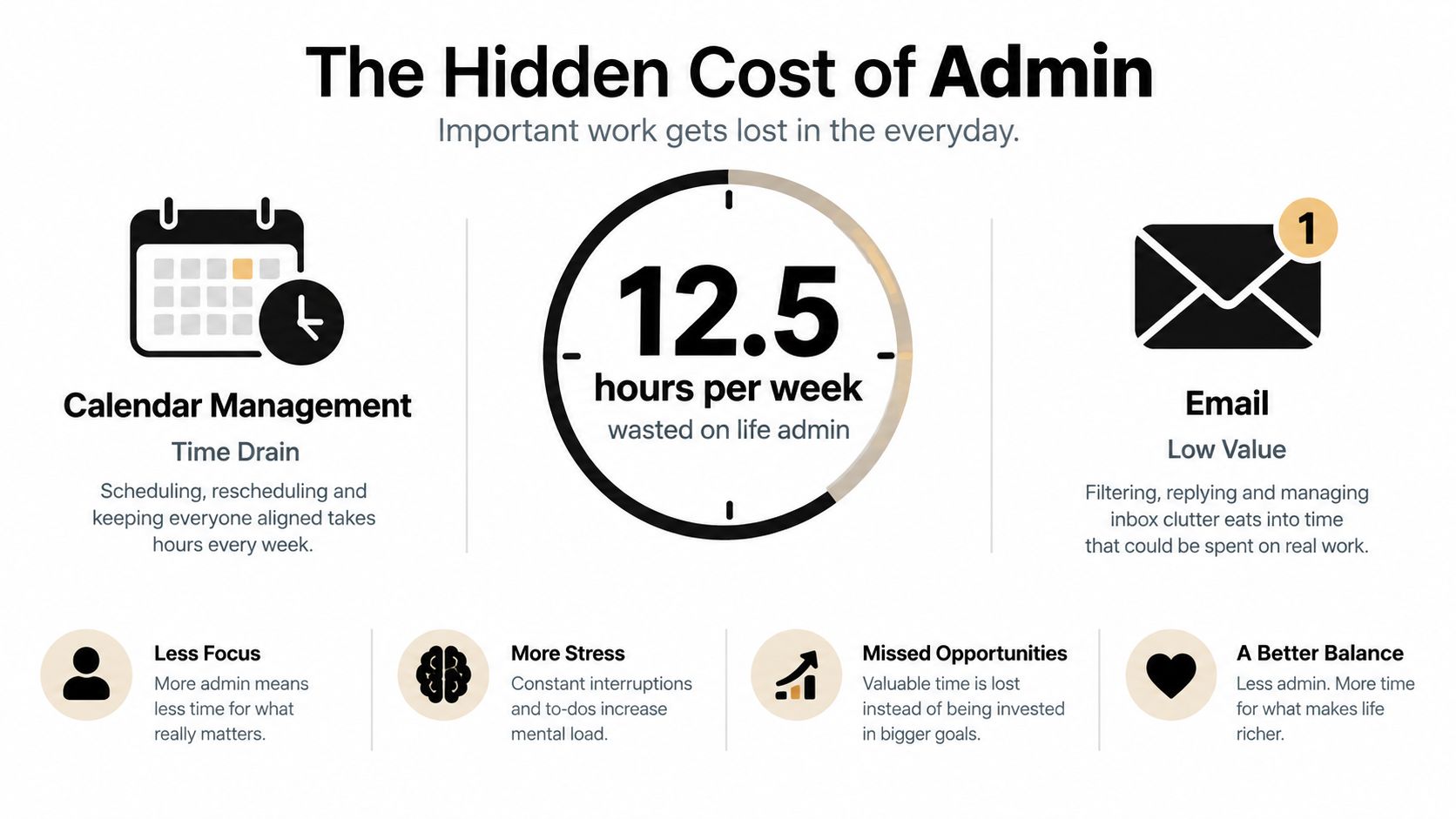
The average working adult spends about 12.5 hours each week on life admin, including scheduling, follow-ups, errands, travel coordination, and household logistics, according to research on the hidden time cost of life admin. That number is easy to underestimate because the tasks arrive in fragments. You answer one email between meetings, move one appointment during lunch, and compare one vendor after dinner.
The minutes aren't the whole cost. Every interruption forces you to remember where you were, decide what matters next, and rebuild concentration. A five-minute scheduling task can disrupt a much longer block of valuable work when it lands at the wrong moment.
The interruption is more expensive than the task
A founder may spend the morning preparing for an investor conversation, pause to resolve a hotel change, then return to an inbox that now contains new questions. A parent may leave a client call to schedule a pediatric appointment, then spend the evening remembering which household vendor still needs a response.
A 2021 survey of 2,000 adults found that people spent an average of 21 hours and 36 minutes per week on work admin and 8 hours and 48 minutes on personal admin. The researchers framed the combined burden as five years and five months of life spent on disliked administrative work, and found that adults handled about 204 admin tasks per month. Forty-four percent said work admin regularly ate into free time, as reported in Brightpearl's survey release.
Those figures explain why delegation feels more valuable after a few weeks than it does on day one. The return comes from removing repeated context switches, not from making one isolated task disappear.
Practical rule: Delegate work that repeats, interrupts, and requires little of your personal judgment before delegating work that feels merely annoying.
Approved Lux is designed as a force multiplier for that category of work. A US-based Assistant team can handle scheduling, inbox triage, travel logistics, research, personal errands, and follow-ups through phone, SMS text, or email. The objective is operational noise reduction. You stop tracking every calendar invite yourself and start reserving your attention for decisions only you can make.
Subscription Services Versus Traditional Hiring
A direct executive assistant hire can make sense when the workload is constant, the role is clearly defined, and you have the management capacity to support it. It becomes harder to justify when you need reliable help with a part-time or fluctuating workload.
The U.S. Bureau of Labor Statistics median annual pay for executive assistants is $76,590, equivalent to about $36.82 per hour across a 2,080-hour year, according to executive assistant compensation guidance. That wage is only the starting point. Employers also absorb payroll obligations, recruiting time, equipment, supervision, paid leave, and the cost of keeping capacity available even during a light week.
The real comparison is capacity, not hourly rate
Executive assistant compensation commonly includes health insurance, retirement plans, disability coverage, paid time off, and sometimes bonuses or profit sharing, as outlined in independent executive assistant salary benchmarks. Employer benefits can raise total compensation by roughly 30% on top of wages, according to the compensation analysis cited above.
That structure creates a practical break-even question. If your needs consist of travel changes one week, inbox sorting the next, and household logistics after that, paying for a full-time employee may purchase capacity you don't consistently use. You also become responsible for setting priorities, reviewing work, covering absences, and maintaining the role.
A subscription model changes the commitment. You pay for access to a managed Assistant team rather than building every employment function yourself. Approved Lux provides Lux Solo at $99.99 per month for individual access and Lux Circle at $299.00 per month for up to four people on one account. Those prices come from the publisher's current offering and may change, so verify the live terms before subscribing.
The calculation shouldn't be, “Is this cheaper than an hourly freelancer?” It should be, “What recurring work can leave my week, and what would it cost to keep doing that work myself?”
For a founder, the answer might include flight research, calendar coordination, meeting preparation, and follow-up tracking. For a solo practitioner, it could be inbox triage, document formatting, appointment scheduling, and expense organization. For a household, it might be home service appointments, event planning, gift sourcing, and school logistics.
Subscription support doesn't replace a full-time EA in every situation. It works best when you need flexible capacity without W-2 overhead, while a direct hire becomes more appropriate when the assistant role is continuous, firmly embedded, and large enough to justify dedicated management.
Why US-Based Teams Change the Quality Equation
A lower hourly rate isn't automatically a lower total cost. If a request requires several clarifying messages, repeated explanations, or extensive review, the apparent saving can become context-reset debt.
A US-based team changes the operating equation through five practical pillars. Human judgment matters when a request has competing priorities or incomplete information. Triple-channel access lets you call, text, or email instead of forcing every request through a ticketing workflow. Proactive Preference Learning allows recurring choices, approval thresholds, and vendor preferences to inform future work.
Domestic accountability adds another layer. High-stakes personal coordination often involves family schedules, travel changes, sensitive inboxes, or vendors who need clear direction. The goal isn't just to find someone who can execute a checklist. It's to create a support relationship with enough shared context to make sensible decisions within agreed boundaries.
Comparing support models
| Feature | Marketplace VA | US-Based Team |
|---|---|---|
| Human judgment | Depends on individual availability and experience | Team-based human support with shared operational standards |
| Communication | Often centered on one platform or ticket queue | Triple-channel access through call, text, and email |
| Context | May need to be reintroduced when support changes | Shared context and captured preferences support continuity |
| Accountability | Varies by freelancer and marketplace | Domestic team structure and defined service expectations |
| Capacity | Usually tied to one person's schedule | Flexible subscription access across recurring needs |
The distinction is not that every offshore Assistant performs poorly or every marketplace freelancer creates friction. Some are excellent. The issue is operational variance. A lower-cost arrangement can work for clearly documented, low-sensitivity tasks, while a team model is better suited to work where judgment, discretion, and fast clarification matter.
For a deeper look at the operating differences, see how a US-based virtual assistant model works. The premium, when one exists, should pay for fewer misunderstandings and less supervision, not for status.
That matters particularly for dual-career parents and founders. The value isn't a polished response to one request. It's the gradual removal of decisions that otherwise return to your desk, your phone, or your weekend.
The Mechanics of Proactive Preference Learning
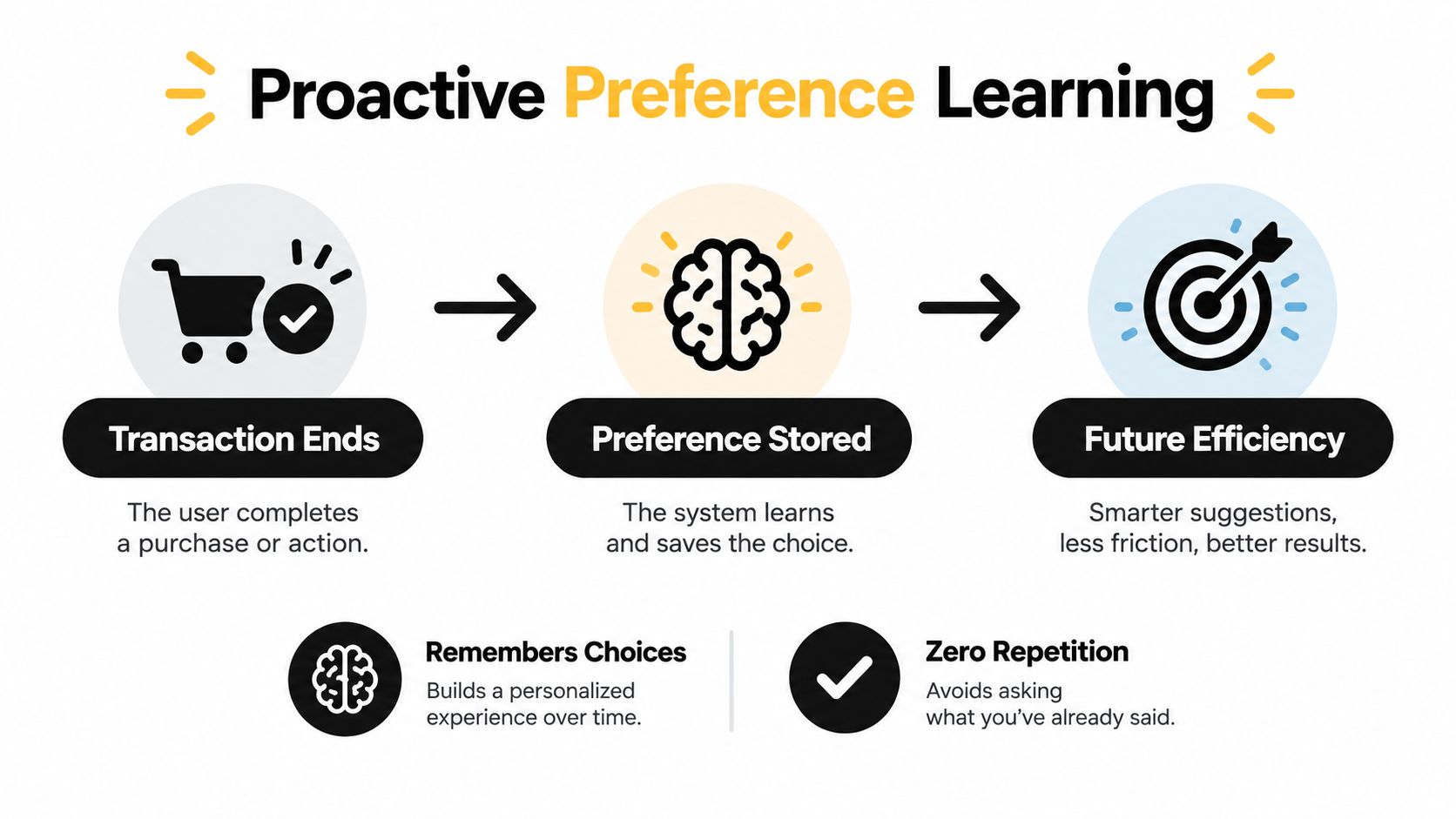
Most temporary support ends when the transaction ends. You ask for a restaurant recommendation, explain your dietary preferences, clarify the neighborhood, and answer the same questions again the next time you travel.
Proactive Preference Learning changes the unit of value from a completed task to an improving operating relationship. The Assistant team captures useful preferences and access standards, such as preferred airlines, acceptable travel times, appointment windows, approval limits, favorite vendors, and the format you want for updates.
Triple-channel access removes communication drag
Call, text, and email should be treated as equal working channels, not as different service tiers. You might text a quick request while leaving a meeting, email a document for formatting, or call when a flight disruption requires immediate discussion.
The operational pattern works like this:
- A request enters through the channel that fits the moment. You don't need to open a portal or reconstruct the entire situation in a formal ticket.
- The Assistant identifies the decision boundary. It determines what can proceed using existing preferences and what requires your approval.
- The result becomes useful context. A successful choice, correction, or exception can improve future handling.
- Recurring work requires less explanation. The team can apply known standards instead of starting from a blank page.
A remote personal assistant becomes more than a task-completer here. The service starts to reflect how you operate, while still leaving consequential approvals with you.
Preference capture also needs discipline. A team shouldn't guess about sensitive decisions. It should record what you have explicitly approved, distinguish firm rules from soft preferences, and ask when the consequences are material.
The payoff is cumulative. Each clear preference reduces future channel switching, clarification, and rework. The assistant doesn't need to become invisible. It needs to become predictable.
Real-World Use Cases That Reclaim Hours
The strongest use cases begin with a recurring bottleneck, not a vague desire to be more productive. Identify the task that repeatedly interrupts valuable work, then give the Assistant enough authority and context to move it forward.

Founders
Start with travel coordination and follow-up management. Send the dates, destination, preferred flight conditions, hotel standards, and approval limits. The Assistant can research options, assemble an itinerary, track confirmations, and prepare the next actions after meetings.
The founder still makes strategic decisions. The team removes the browser tabs, vendor emails, calendar conflicts, and forgotten follow-ups surrounding those decisions.
Solo practitioners
Protect billable or client-facing time by moving inbox triage and scheduling out of the workday. An Assistant can sort messages by urgency, draft routine replies for approval, coordinate appointments, format documents, and organize expense information.
The important distinction is between judgment that earns revenue and administrative handling that merely keeps the practice moving. Keep the former. Delegate the latter when standards are clear.
Frequent travelers
Give the Assistant a standing travel profile before the next trip. Include preferred departure windows, seating preferences, hotel requirements, ground transportation choices, and the conditions under which you want to be contacted immediately.
When a cancellation or last-minute change occurs, call or text rather than waiting for a corporate desk to reopen. The team can research alternatives, coordinate the surrounding itinerary, and present the decision you need to make.
Working parents
The second shift is often a coordination problem rather than a single large chore. An Assistant can schedule home services, track school dates, source gifts, coordinate appointments, manage event details, and follow up with vendors.
The household should decide who can request work and which decisions require joint approval. That prevents one parent from becoming the only person who knows what has been delegated.
Care coordinators and creators
Care coordinators can use support for appointment logistics, transportation research, household communication, and sibling coordination. The Assistant shouldn't provide medical, legal, financial, or tax advice, but it can help organize the administrative work around professional guidance.
Creators can hand off sponsor scheduling, travel planning, document formatting, and routine correspondence. The aim is to protect the uninterrupted time required to write, record, perform, or publish.
The common thread is frequency. A task doesn't need to be difficult to deserve delegation. It needs to recur often enough that removing it changes the shape of your week.
Overcoming the Trust Barrier in Remote Delegation
Delegation fails when the person delegating can't predict what will happen next. Will the Assistant understand the context? Will a sensitive detail be exposed? Will you have to correct the same mistake repeatedly?
Those concerns are reasonable, especially when support touches family logistics, travel, personal inboxes, or business relationships. Remote doesn't have to mean anonymous, but the service needs clear standards for access, escalation, approvals, and information handling.
Trust comes from controlled discretion
A useful remote support arrangement separates tasks into three groups:
- Proceed independently: Routine work governed by an established preference, such as scheduling within an approved time window.
- Prepare and ask: Work where the Assistant can research and narrow the options, but you should make the final choice.
- Escalate immediately: Sensitive, expensive, urgent, or ambiguous situations that require direct confirmation.
This structure protects privacy without forcing you to approve every small action. It also gives the team a consistent response when circumstances change.
For dual-career parents, shared context prevents one household member from carrying every explanation. For founders, it reduces the risk that travel, inbox, and calendar support depend on a single freelancer remembering informal instructions.
A team model can also reduce quality drift because knowledge is maintained across the service rather than stored only in one person's memory. That doesn't eliminate the need for oversight. You should still review early work, correct assumptions quickly, and avoid granting access that the task doesn't require.
The practical standard is not blind trust. It's bounded trust with visible accountability. The trust and accountability model for remote assistance is useful because it frames delegation as an operating system, not a personality test.
Start with reversible work. Give the team a small set of scheduling, research, and follow-up tasks. Observe how they handle uncertainty. Then expand access as the process proves reliable.
Choosing the Right Subscription Structure
Choose a plan by counting people and recurring workflows, not by guessing how much help you might need someday.
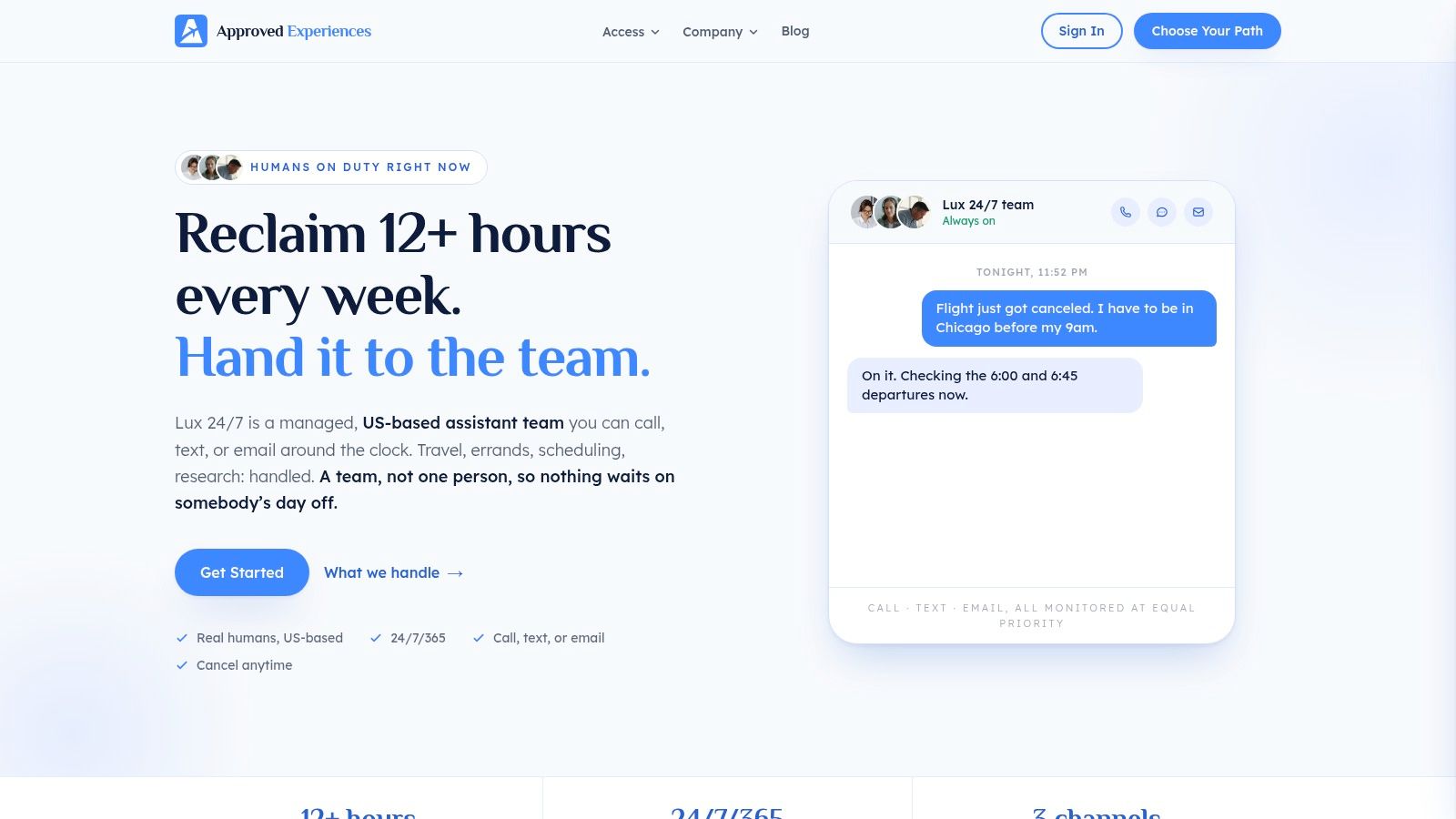
Lux Solo is built for one individual, such as a founder, independent professional, frequent traveler, or creator. It costs $99.99 per month and suits work that stays centered on one calendar, one inbox, one travel profile, and one set of operating preferences.
Lux Circle costs $299.00 per month and covers up to four people on one account. It fits a household where scheduling, errands, vendor coordination, and family logistics need to be visible across more than one person.
Match the account to the operating load
Use this quick test:
- One primary calendar and one decision-maker: Start with Lux Solo.
- Two working adults sharing household coordination: Consider Lux Circle.
- Parents or caregivers coordinating across several people: Lux Circle provides the more natural structure.
- A fluctuating founder workload: Begin with Lux Solo and document which requests recur before expanding the scope.
Keep the financial administration clean from the start. If the subscription supports business activity, review how to track software expenses so recurring costs are categorized consistently with your bookkeeping process.
The subscription model works when you define the first workflows clearly. List the tasks that interrupt you most, identify which requests can proceed without approval, and note the preferences the team should retain. The advantages of a subscription model become practical only when access is connected to a real operating routine.
Don't choose a larger structure to feel prepared. Choose the smallest account that lets the right people delegate without creating another coordination problem.
Building Your First Week of Operational Leverage
Your first week should focus on removing friction, not documenting your entire life. Begin with a short list of recurring tasks that already have clear outcomes.
Send the Assistant your calendar rules, travel preferences, common vendors, communication style, and approval boundaries. Then assign a few concrete workflows, such as resolving a scheduling conflict, researching a service provider, organizing an itinerary, or preparing routine inbox follow-ups.
Create a fast feedback loop
For each completed request, answer three questions:
- What did the Assistant get right?
- What required clarification or correction?
- What preference should be recorded for next time?
Use Triple-channel access deliberately. Text quick instructions, email supporting details, and call when the issue involves urgency or judgment. That variety helps the team understand how you want to work, not just what you want completed.
By the end of the first week, you should know which tasks are safe to delegate, which still need approval, and where your instructions are too vague. Keep improving the standards rather than taking the work back.
The shift is simple but significant. You stop measuring productivity by how many small tasks you personally complete and start measuring it by how much important work receives your full attention.
Approved Lux Personal Assistant provides 24/7 access to a US-based human Assistant team through phone call, SMS text, and email for scheduling, travel logistics, errands, research, inbox support, and professional coordination. If you want to replace recurring admin interruptions with a managed remote support system, visit Approved Lux Personal Assistant and choose the structure that fits your individual or household workload.
Want the wider view?
Ten categories. One report. Every quarter. The Approved List tracks what's rising and what's fading: data-backed signals, not opinions.
Free to join · Delivered by email