
All Articles
The Journal
Family Vacation Home Rentals: A Practical Booking Guide
October 17, 202612 min readvacation rental guidelong-stay rentals
Learn how to find, evaluate, and book family vacation home rentals with confidence. Covers layouts, costs, long-stay strategy, and membership infrastructure.

You're probably trying to settle the dates, get a headcount from relatives, and compare homes that look similar until you reach the checkout screen. The cheapest nightly rate may belong to a property with too few bathrooms, no workable sleeping arrangement for an older parent, or fees that change the total substantially.
Treat family vacation home rentals as a logistics problem, not a listing hunt. Start with who's traveling, how long they'll stay, what the group needs to function safely, and the full cost. Then use consolidated inventory access to compare suitable options without piecing the trip together across disconnected platforms.
Why Family Rentals Break the Standard Search Model
The common mistake is filtering by headline nightly rate before checking whether the home works for the group. A reunion of ten people isn't a hotel stay with a kitchen added. It involves sleeping arrangements, shared space, arrival times, mobility needs, safety checks, and a total bill everyone can agree to split.
Start with the people and the stay, not the photos. Write down the headcount, ages, arrival and departure dates, bedroom needs, bathroom requirements, and any mobility or caregiving considerations. Then decide what the group needs to share, such as a kitchen and dining area, and where privacy matters more than gathering everyone under one roof.
Practical rule: Don't compare a property until you know its all-in cost for your actual dates and group.
A marketplace search usually leaves the organizer stitching together listings, policies, fees, and reservation records from multiple providers. That may be manageable for a solo trip. For a family group, it creates more chances for details to fall through: one property has unclear occupancy limits, another has a strict cancellation policy, and a third charges mandatory fees only at checkout.
A consolidated inventory model changes the workflow. Instead of treating each listing site as a separate destination, an access layer can bring more vacation-home options into one search and help the organizer compare them against the group's requirements. That doesn't replace verification with the property manager, but it can make the initial shortlist more coherent.
Family demand is a major part of the category, not a niche. Mordor Intelligence estimates that families represented 45.10% of the global vacation-rental market by traveler type in 2025, the largest identified segment, while the market was approximately USD 104.62 billion that year and is projected to reach USD 136.78 billion by 2031 (Mordor Intelligence's vacation-rental market analysis). The practical takeaway is simple: there's a substantial inventory ecosystem built around residential stays, but the organizer still has to match the home to the family's actual operating needs.
The Safety Screening Protocol Every Family Should Run
A polished listing photo doesn't prove a rental is safe. Ask the property manager for written confirmation of the controls that matter before you pay, and keep the response with the booking records. The U.S. Consumer Product Safety Commission recommends checking core fire and escape provisions when staying in a vacation rental (CPSC vacation-rental safety guidance).
Use this checklist:
- Confirm fire protection: Ask whether smoke alarms and carbon-monoxide alarms work, and whether the home has at least one fire extinguisher.
- Request the escape plan: Get a written plan showing two ways out of every room. Ask whether windows open easily from inside.
- Inspect pool and spa safeguards: Verify that barriers are at least 4 feet high and gates are self-closing and self-latching. Ask about compliant drain covers.
- Check elevator access: If the property has a residential elevator, confirm what prevents children from accessing it unsupervised.
- Review other hazards: Ask about balcony access, stairs and railings, grills, fireplaces, and sleeping-room exits. A large home can have several separate hazard points.
- Match safeguards to the group: If young children are coming, ask about child-access controls. If older adults or people with mobility limitations are traveling, confirm that escape routes are practical for them.
The CPSC guidance is a starting point, not a substitute for asking about the exact property. Get answers in writing rather than relying on a listing photo or a general assurance that the home is “family friendly.” If your group uses a family-safety app to coordinate check-ins or share household information, the 3rd-i app for families may be a useful addition to the trip plan. For other property features to verify, use this vacation-rental amenities checklist.
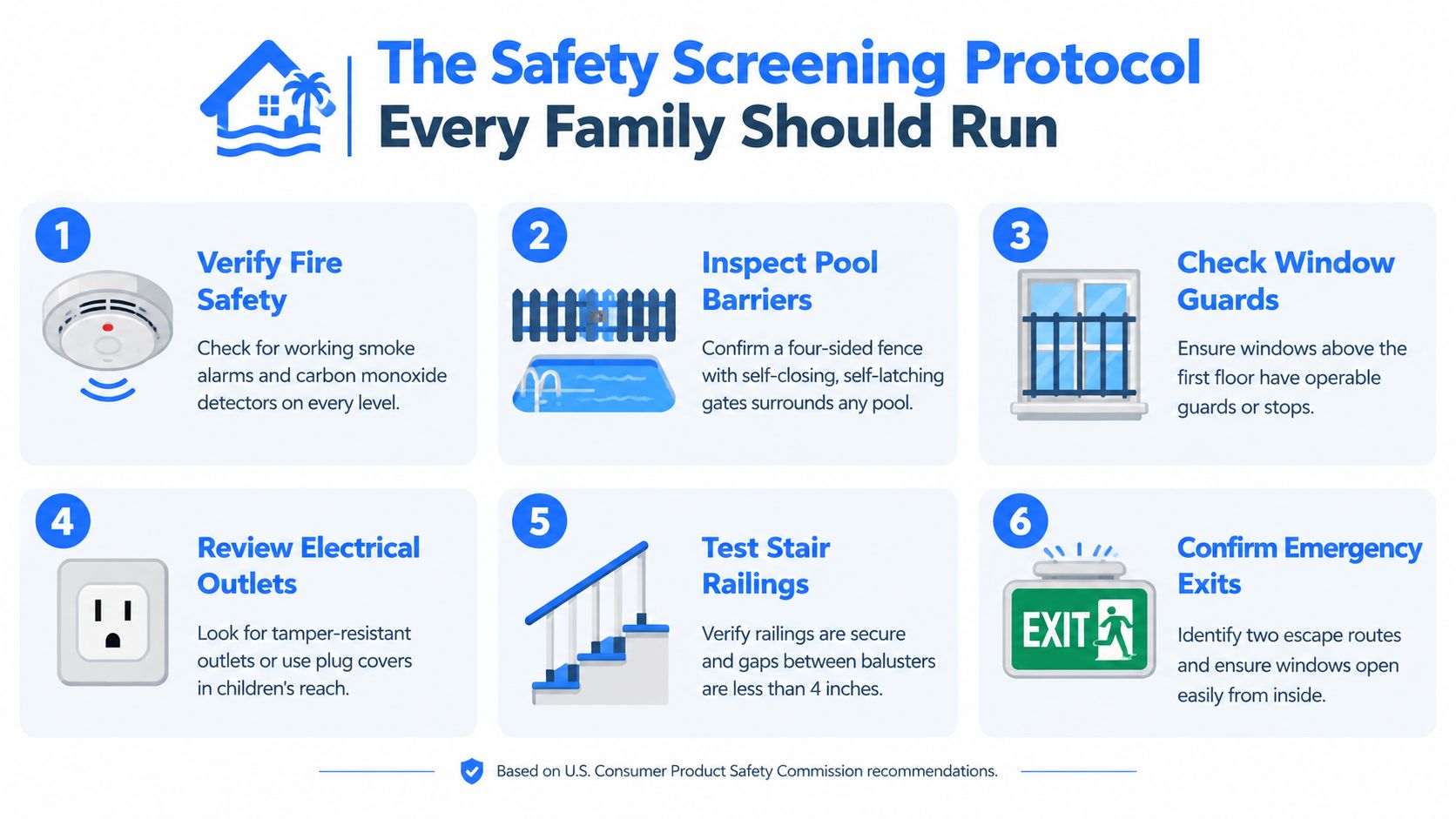
Reject the property if the manager can't verify core safety controls in writing. A great pool or view doesn't make up for missing answers.
Matching Layout to Headcount and Generations
Choose the sleeping plan before you choose the property. For family reunions, average group size is approximately 8–12 guests, with stays commonly lasting 4–7 nights; celebration travel often involves 10–15 guests (large-group rental analysis). Those groups need more than enough beds. They need a layout that lets people sleep, bathe, cook, gather, and retreat without constant friction.
For a group of ten, ask the manager to confirm the maximum occupancy and the exact sleeping configuration. A five-bedroom home might be a better fit than five hotel rooms if the group needs a kitchen and shared living space, but the bedroom count alone isn't enough. Confirm bathroom access, parking capacity, kitchen equipment, common-room seating, and whether anyone is expected to sleep on a sofa bed.
| Decision Variable | One Large Home | Multiple Connected Units |
|---|---|---|
| Social time | Everyone shares the same main spaces | The group meets by arrangement |
| Privacy | Fewer separate retreats | Easier to separate sleep and quiet time |
| Care routines | Convenient if rooms suit the person needing care | May work better when different routines need space |
| Coordination | One reservation and property manager may simplify logistics | Requires clear plans across units |
| Sleeping needs | Check every room and bed configuration | Match each household to its own unit |
Accessibility needs should be described precisely. Ask about step-free entry, which floor holds the bedrooms and bathrooms, shower configuration, door widths, distance from parking, elevator access, lighting, and whether an emergency exit can be used by the person who needs it. Don't settle for an “accessible” label without property-specific answers and current photos.
The choice between one home and separate units is a trade-off. One home makes shared meals and group coordination easier; separate units may offer quieter nights, privacy, and more manageable caregiving routines. For planning inspiration that takes different ages and needs into account, browse these multigenerational family vacation ideas for 2026.
If the home's accessibility or safety features can't be verified, choose professionally serviced lodging that can meet the group's requirements. That's a better decision than asking an older relative or young child to adapt to an unsuitable property.
The Total-Stay Cost Calculation Most Families Skip
The nightly rate is only one line in the booking decision. Ask for the complete amount for the dates you'll stay, with mandatory fees, applicable taxes, deposits, and cancellation terms identified separately. Don't ask relatives to contribute until the organizer has the full quote in writing.
Build the comparison around the whole trip:
- Base rent for the complete stay
- Cleaning, linen, amenity, administrative, and booking fees
- Local occupancy taxes and any marketplace-collected taxes
- Security deposit and refund conditions
- Parking, pool heating, or other property charges
- Groceries and local transport
- Cancellation exposure, including the amount at risk if plans change
Massachusetts guidance provides a useful example of why fee display matters: mandatory cleaning, amenity, administrative, and booking fees must be included in the advertised total price. It also treats rentals of fewer than 31 days differently for room-occupancy tax than rentals extending beyond that threshold (Massachusetts short-term rental guidance).
Tennessee offers a separate example of a jurisdiction-specific threshold. Its short-term-rental manual defines a short-term rental as 30 days or less and says local occupancy tax doesn't apply beginning on rental day 31; marketplace treatment affects who collects and remits the tax (Tennessee short-term-rental tax manual). Don't generalize either state's rule to another destination. Ask what local law and the booking platform's tax collection process mean for your reservation.
| Quote detail | What to request |
|---|---|
| Shorter stay | Itemized total for the planned duration |
| Longer stay | A second itemized quote that crosses the relevant day threshold |
| Cancellation | Deadline, refund conditions, and nonrefundable amounts |
| Deposits | Amount, collection date, and return process |
A comparison such as 28 nights versus 35 nights, or 30 versus 31 nights, can expose a change in fees or tax treatment. Use a family vacation budget planner to organize the group's estimate, then compare properties using the complete stay cost rather than the headline nightly rate.
Splitting the Bill Across Households Fairly
Agree on the cost rule before one person puts a deposit on a card. Equal shares can be simple, but they can also feel unfair when one household gets a larger bedroom, arrives earlier, or stays longer. Make the assumptions visible so relatives can agree before the reservation becomes difficult to change.
A workable starting formula is:
Household share = shared fixed costs allocated by adult-equivalent occupants + room adjustment + household-specific extra nights + household-specific expenses.
Use the same definition of adult-equivalent occupants for everyone. Then decide whether room differences justify an adjustment. For example, a household using a private primary suite might contribute more than a household sharing a smaller room, while a household arriving early can cover the extra nights it uses. Groceries and activities should go into a separate variable-cost pool rather than being folded into the housing share.
Keep a shared ledger with these entries:
- Reservation: property, dates, reservation holder, and payment deadlines
- Fixed costs: rent, mandatory fees, taxes, and parking
- Variable costs: groceries, transport, and shared activities
- Refundable deposits: amount paid, who paid it, and when it's returned
- Settlement: each household's agreed share, amount paid, and outstanding balance
Name one reservation holder, usually the organizer, and make the role explicit. That person controls the booking, handles changes, tracks the deposit, and communicates cancellation updates. If someone books through a membership account, agree in advance how any account benefits or credits will be handled. Don't leave that conversation until after the reservation has been made.
Put the payment dates, room assignments, and cancellation plan in the same message. A shared record prevents relatives from relying on different versions of the agreement.
Long-Stay Strategy for Snowbirds and Remote Workers
For a month-plus trip, search for long-stay inventory rather than chaining together short reservations. Industry reporting citing a Furnished Finder–AirDNA report says U.S. bookings for stays of 28 days or longer rose from approximately 20 million nights in 2019 to 46 million in 2025, while monthly stays represented about 19% of total U.S. rental demand (reporting on the monthly-rental shift). The point for an organizer isn't to assume every monthly listing is suitable. It's to search a category designed for longer occupancy and then verify what's included.
Consider a household planning a 35-night stay in a two-bedroom home with a kitchen and workspace. Compare that reservation with a sequence of hotel stays, including the costs and practical differences around cooking, laundry, housekeeping, checkout days, and moving luggage between properties. A home may suit the family's routines better, but the full quote and local rules still determine the actual value.
The 28-day threshold is a useful search filter for comparing vacation homes with hotels, corporate housing, or separate short-term bookings. Ask whether utilities, internet, laundry, cleaning, deposits, and cancellation terms are included, and whether the property has reliable workspace for anyone working remotely. A guide to long-stay rentals can help frame the comparison.
Consolidated inventory access is especially useful when the group needs to search across stay types and destinations without treating every reservation as an isolated purchase. Keep the same screening rules: fit the household, confirm the costs, and verify the property's operating details before paying.
Leveraging Consolidated Inventory and Membership Infrastructure
A family that travels repeatedly shouldn't have to rebuild its booking process from scratch each time. A consolidated inventory platform can bring vacation homes, hotels, flights, car rentals, and other travel components into one access layer. That doesn't remove the need to inspect property details, but it can reduce the number of separate systems the organizer has to manage.
Approved Traveler is one example of a membership built around consolidated access. It provides access to 500,000+ vacation homes, 1,000,000+ hotels, 700+ airlines, and 30,000+ car rental locations through one platform. The membership can cover up to 10 household members with full benefit parity and no per-person fees. For a family organizer, that can make it easier to coordinate access without maintaining separate accounts for each relative.
The operating details matter more than the label:
- Reward Credits are earned on bookings, don't expire, and can be redeemed toward future bookings, maintenance fees, resort usage fees, annual renewal, or eligible eGift cards. Redemption value varies, so don't assign a fixed dollar value before checking the applicable terms.
- Boomerang Member Share returns Reward Credits to the primary member on eligible hotel and car bookings made by shared family and friends.
- The 110% Best Value Guarantee provides a refund equal to 110% of the difference when a member finds a lower publicly available price, subject to the applicable terms.
- V.O.I.C.E. lets timeshare owners deposit up to 5 weeks per year for credits, exchange weeks at no fee, or list weeks on a peer-to-peer rental marketplace with no listing fee.
These features are useful only if they match the trip and the membership terms. Check which bookings qualify, who earns credits, how shared access works, and whether a timeshare week can be used through the program before relying on it.
The larger shift is operational: family travel is ongoing infrastructure, not a series of unrelated purchases. Consolidate access where it helps, keep one shared booking record, and use the same verification standards for every property.
Your Pre-Booking Checklist for the Next Family Stay
Save this checklist and assign each task to an adult in the group. The organizer shouldn't have to chase every answer alone.
- Set the trip parameters: Confirm headcount, dates, length of stay, sleeping arrangements, and any caregiving needs.
- Screen the property in writing: Request confirmation of alarms, fire protection, escape routes, pool or spa safeguards, elevator controls where relevant, and hazards such as balconies, stairs, grills, and fireplaces.
- Verify accessibility: Ask about entry, bedroom and bathroom locations, shower setup, door widths, parking distance, lighting, and emergency exits.
- Get two itemized totals: Compare the planned stay with a second duration that may cross a local tax threshold. Confirm mandatory fees, deposits, taxes, and cancellation terms.
- Agree on the money plan: Set the reservation holder, household shares, room adjustments, extra-night charges, payment deadlines, and deposit handling in a shared ledger.
- Check membership terms: Confirm whether Reward Credits, Boomerang Member Share, the 110% Best Value Guarantee, or V.O.I.C.E. applies to the specific booking.
Reject a property if its manager can't verify core safety controls or if its layout doesn't work for the people traveling. That decision is easier before deposits are paid than after relatives have planned around the listing.
Approved Experiences Traveler offers consolidated access to vacation homes and other travel inventory, with membership benefits that can support family booking coordination. Compare its access and applicable terms with your group's needs, then visit Approved Experiences Traveler to review whether it fits your next family stay.
Want the wider view?
Ten categories. One report. Every quarter. The Approved List tracks what's rising and what's fading: data-backed signals, not opinions.
Free to join · Delivered by email