
All Articles
The Journal
Special Requests for Hotels How to Get Them Honored
September 14, 202614 min readhotel booking tipshotel policies
Learn how special requests for hotels work, what hotels can honor, and how to phrase requests to boost fulfillment across any stay.
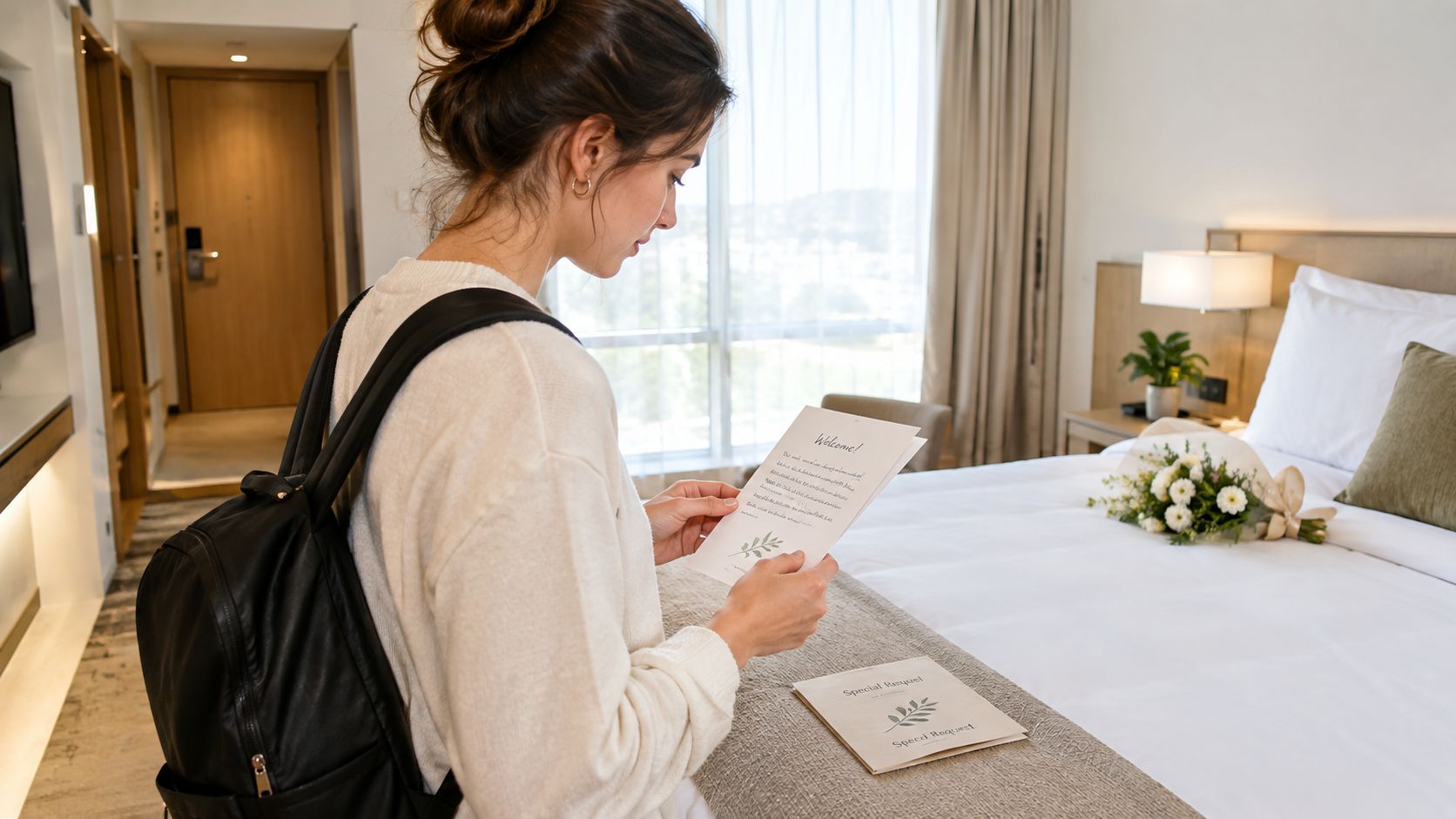
You've arrived after a long travel day with two children, several suitcases, and a confirmation email that says, “crib requested.” The room is ready, but the crib isn't. At another hotel, a simple note that included the child's age, arrival time, room number, and a request for written confirmation was handled before check-in.
That difference usually isn't luck. Special requests for hotels move through a workflow. A reservation agent records the note, the property management system, or PMS, routes it to the right team, and staff members decide whether they can fulfill it based on inventory, timing, safety, and policy.
This guide shows how to identify a request, distinguish it from a guarantee, phrase it so staff can act on it, and follow up without creating confusion. It also addresses the harder situations, including accessibility, dietary needs, long stays, families sharing multiple rooms, and requests that cross front desk, housekeeping, food and beverage, and concierge teams.
The practical principle is straightforward: the clearer the operational record, the easier it is for a hotel to deliver the right result. You control the timing, the wording, the priority order, and the confirmation trail. The hotel controls the final assignment and fulfillment.
Introduction to Getting What You Need From Your Hotel Stay
A hotel reservation often begins as a room type and a date range. The stay, however, depends on details that may not fit neatly into the room description. You might need two beds instead of one, a quiet location for a light sleeper, a crib for an infant, a step-free route, or a late arrival after a delayed flight.
Guests often experience these details as personal requests made to a person. Hotel teams experience them as work items. A front-desk agent may add a note to the PMS, reservations staff may flag the booking, and housekeeping or food and beverage teams may receive separate instructions. The request can succeed when each handoff preserves the same information. It can fail when the note is vague, buried in an online travel agency comment, or sent too late for the property to prepare.
Practical rule: Write every request so a staff member who has never spoken with you can understand what must happen, for whom, and by when.
A large academic hotel-booking dataset makes the point that request activity is measurable rather than anecdotal. Its TotalOfSpecialRequests feature had a mean of 0.62 in one data split and 0.55 in another, with a median of 0 and a maximum of 5, showing that most bookings had no request while a smaller group carried several. The dataset includes preferences such as twin beds and high-floor placement, so these notes belong to ordinary reservation operations, not only luxury stays.
The most useful mindset is to treat a request like a restaurant ticket. “Please make dinner special” gives the kitchen little to work with. “One guest has a shellfish allergy, the table is celebrating an anniversary, and dessert should arrive after the main course” creates an actionable ticket. Hotels need the same clarity.
By the end of this guide, you'll know what to ask for, when to send it, how to bundle requests across rooms, and what to do when fulfillment doesn't match the record.
What Special Requests for Hotels Really Mean
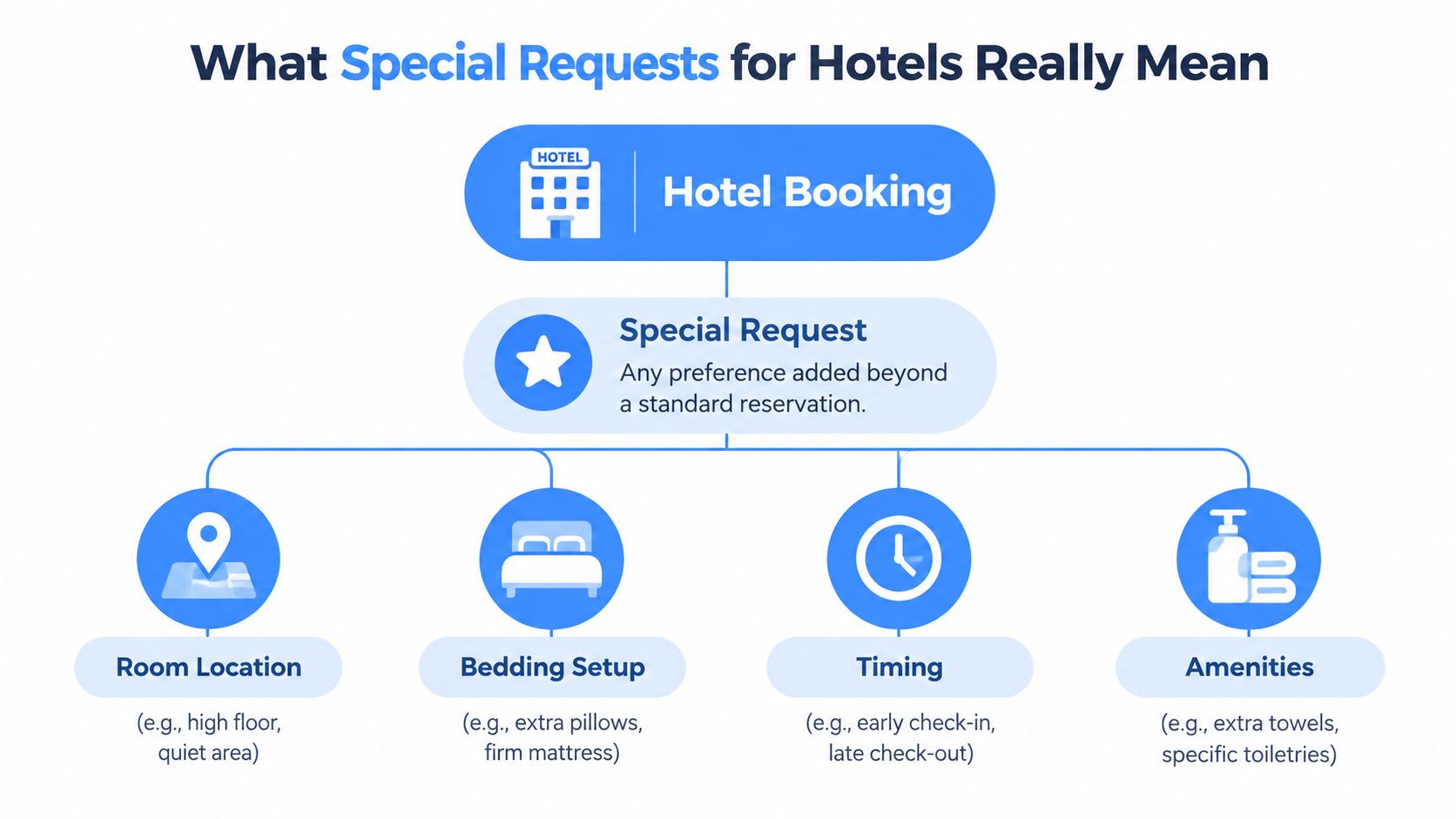
A special request is a preference added to a reservation that isn't part of the guaranteed room attribute. A high-floor room, extra pillows, early arrival, late departure, crib, celebration setup, or dietary note may all be requests. They can be accepted, prioritized, and recorded, but acceptance doesn't always mean the hotel has promised the exact outcome.
Think of the PMS as a kitchen ticket system. The reservation is the order. The request is an added instruction that must be routed to the station capable of completing it. Housekeeping may stage towels or a crib. Front office may review arrival timing and room location. Food and beverage may tag dietary restrictions. Engineering may need to verify an accessible route or room feature.
The ticket works best when it contains the guest name, room number, request type, urgency, preferred completion time, and a unique request ID. Hotel-management guidance also recommends photographic confirmation for visual work such as decorations or furniture moves, because a picture gives the next team a shared reference point. These practices are described in hotel housekeeping guidance for handling special guest requests.
Request, guarantee, and paid add-on
These three ideas are easy to confuse:
- Request: A preference the hotel will try to fulfill, subject to availability and operational limits.
- Guarantee: A defined property or service included in the reservation terms, often tied to a specific room category or paid product.
- Paid add-on: A service that may be available for an additional charge, such as a welcome amenity, early arrival, transportation, or a room upgrade.
A room-location request is usually not the same as booking a room category that explicitly guarantees a view or floor. Likewise, asking for early check-in isn't the same as purchasing an early-arrival product.
That distinction explains why hotels use phrases such as “subject to availability.” A property may have the right room, but it may be occupied, under inspection, assigned to another guest, or incompatible with another requirement. The PMS preserves the request, but staff still have to make a safe and workable assignment.
A stay-request report can aggregate room preferences, housekeeping requests, booking remarks, and assistance flags. That record helps teams route work, track completion time, identify bottlenecks by shift, and preserve preference history for future stays. Your request is more likely to survive the handoff when it's specific enough to become a structured record.
Common Types of Hotel Special Requests Explained
The best way to plan special requests is to group them by the team that must act on them and the amount of preparation they require. Extra towels may be fulfilled on demand. An accessible room, allergy-aware meal, or multi-room family setup needs verification before arrival.
Room and bedding preferences
These are often familiar to front-office and housekeeping teams:
- Location: High floor, quiet area, away from elevators, near another room, or close to the lobby.
- Bed arrangement: Twin beds, a crib, a rollaway, extra pillows, or a particular pillow firmness.
- Room setup: Connecting rooms, adjacent rooms, a ground-floor location, or a kitchen-ready unit for a longer stay.
A request can still conflict with inventory. Two rooms may be close together but not connecting. A crib may be available but not permitted in a particular room layout. Ask for the primary preference and a workable alternative.
Accessibility and mobility needs
Accessibility requests should describe the functional requirement, not only use a broad label. Explain whether you need a roll-in shower, grab bars, a step-free route, an accessible entrance, space for mobility equipment, or a room near an elevator.
Independent accessibility guidance notes that accessible-room ratios often range from about 2% to 5% of new-build inventory, while exact requirements vary by jurisdiction. The practical question isn't only whether a booking page has an “accessible” filter. Ask the property to confirm the room features and the route from arrival areas to the room and dining spaces. Accessibility guidance for hotels explains why property-level confirmation matters.
Timing and arrival requests
Early check-in, late checkout, late arrival, luggage storage, and airport transportation all depend on timing. A late arrival should include the expected arrival window and a request to keep the reservation active. Early check-in and late checkout should include your preferred time, but you should also ask about a backup such as luggage storage or access to facilities.
Dietary, amenity, celebration, pet, and medical notes
Dietary information should be collected at booking, reconfirmed before arrival, and tagged kitchen-side on every relevant order. Say “gluten-free due to allergy” or “halal meal required,” rather than writing “special food.” A hotel's general menu may not reveal cross-contact risks or whether the kitchen can meet the requirement.
Amenities may include extra towels, toiletries, a welcome gift, flowers, decorations, or baby equipment. Celebration notes work better when you specify what you want and what you don't want. Pet requests should identify the animal and policy question. Medical information should be limited to what staff need to provide safe service.
For transportation and communication planning, BubblyPhone to avoid hotel fees can help travelers understand how to contact hotels without relying on expensive room-phone calls. Travelers booking animal-friendly properties can also review animal-friendly hotels before sending a pet request.
Room-amenity expectations are also becoming more practical. J.D. Power reports that smart TVs appear in 74% of rooms and usage reaches 62%, so technology-related needs may feel like baseline expectations even when property capabilities differ. Confirm the actual room and hotel features rather than assuming a general amenity is universal.
How Hotels Handle Policies and Fulfillment Likelihood
A hotel policy is an operational forecast, not a promise hidden in fine print. When it says a room-location or early check-in request will be honored “as long as space allows,” the property is telling you that inventory must be assessed at assignment time. One published hotel policy lists standard check-in at 4:00 PM and checkout at 11:00 AM, while still treating location and early arrival as availability-based requests. You can review the example in this hotel policy.
The same pattern appears in other properties. The Kensington lists standard check-in at 3:00 PM and checkout at 12:00 PM, with early arrival and late departure subject to availability and possible additional charges. Its early check-in and late checkout FAQ shows why travelers should ask both questions, “Can you do this?” and “Will there be a charge?”
A practical likelihood test
Use three filters before you rely on a request:
| Filter | More workable | More uncertain |
|---|---|---|
| Inventory | Standard towels, pillows, or a documented room feature | Connecting rooms, accessible rooms, specific floor |
| Timing | Request sent before arrival with a preferred completion time | Request made at check-in for a prepared setup |
| Complexity | One team can complete it | Several teams need to coordinate equipment or food |
Standard amenities often have a shorter service target. In one housekeeping operations study, towels, water, and toiletries were expected within 15 minutes. Floral setups, honeymoon decorations, baby amenities, and extra beds had a 60-minute target, yet averaged 45 minutes, with about 20% exceeding the target and only 35% completed inside the full window. The findings are reported in this housekeeping operations study.
That gap matters because a complex request can miss not through neglect, but through staging, staffing, inventory, or a shift change. Ask whether the item can be pre-positioned, whether a fee applies, and who will confirm completion.
Handoffs create the real risk
A front-desk agent may record a note, housekeeping may prepare a room, and a supervisor may inspect the result. Each handoff can lose context unless the record includes urgency, timing, and ownership. Hotel front-office checklists specifically tell staff to record accessibility needs, late arrival, pets, anniversaries, and dietary restrictions in the PMS, as shown in this hotel reservation checklist.
If you regularly compare membership access and hotel benefits, review best hotel membership programs with the same operational question: what can be requested, what is included, and what remains subject to property availability?
How to Make Special Requests That Hotels Can Actually Fulfill
Your request should reach the hotel at three moments, and each moment has a different job.
At booking, create the record
Put essential information in the booking remarks, especially accessibility, dietary, pet, medical, mobility, and late-arrival needs. Use plain language and include the reservation name, dates, party size, and confirmation number. If you're booking through an online travel agency, remember that the request may be routed to the property and remains subject to availability. Booking guidance for adding and following up on special requests also notes that some requests may carry additional charges.
For a family booking, don't write one dense paragraph containing every detail. Use numbered items:
- Room A, grandparents, ground-floor or elevator-near location.
- Room B, parents and infant, crib required.
- Room C, children, twin-bed setup.
- Rooms A and B, adjacent if possible.
- All rooms, same arrival and departure notes.
This gives staff something they can assign and verify.
Before arrival, confirm ownership
Contact the property directly when the request affects safety, access, food, room configuration, or a celebration setup. Ask the hotel to confirm that the request is visible in the PMS and to identify any charge, limitation, or alternative. Keep the same confirmation number in the subject line so staff don't create duplicate records.
Specific wording beats emotional wording. “Please make our anniversary special” leaves the hotel to choose a standard package. “Please place a non-alcoholic welcome amenity in Room 214, and avoid public announcements because we prefer a quiet celebration” gives the team a defined task.
On arrival, verify the record
At check-in, politely ask the agent to read back the key requests. Prioritize the items that affect safety, room suitability, children, food, or connected rooms. Don't assume a request was completed merely because it appears in an email. Verify the room assignment and ask who will handle anything still pending.
For multi-property travel, centralizing reservations can reduce fragmented communication. Approved Experiences Traveler provides access to 1M+ hotels, while its infrastructure can consolidate booking information and request context. Lux Traveler adds an Approved Lux 24/7 Personal Assistant for up to 10 household members, which is relevant when one person coordinates rooms, transfers, schedules, and family details. Travelers comparing room changes can also read how to get hotel upgrades without confusing an upgrade request with a guaranteed room attribute.
Keep the priority list short. A hotel can often manage several requests, but staff need to know which ones are essential, which are preferred, and which alternatives are acceptable.
Sample Messages and Templates for Every Request
Use one message thread per reservation or family group. Replace the brackets, remove anything that doesn't apply, and ask for written confirmation.
Quiet or high-floor room
Subject: Room-location request, [guest name], [confirmation number]
Hello [hotel team],
I'll arrive on [date] for [number] guests under [guest name]. If available, please assign a quiet room on a high floor, away from elevators and service areas. If that isn't possible, a room in the quietest available location would be appreciated. Please confirm whether this can be noted in the PMS.
Thank you,
[Name]
[Phone number]
Crib and extra bedding
Hello [hotel team],
For our stay from [date] to [date], reservation [number], we'll be traveling with [child's age]. Please place one crib in Room [number or room type] before arrival, and provide [number] extra pillows or [bedding detail]. If the crib isn't available, please tell us what alternative you can provide and whether any charge applies.
Accessibility confirmation
Hello [hotel team],
The guest in Room [number] requires [roll-in shower, grab bars, step-free access, or other specific feature]. Please confirm that the assigned room includes these features and that the route from the entrance to the room and dining area is step-free. A general accessible-room label isn't enough for our planning, so please reply with the property-level details.
Late arrival or early check-in
Hello [hotel team],
We expect to arrive around [time] on [date], after [flight or travel detail]. Please keep reservation [number] active for our late arrival and note the expected arrival window. If early check-in at [time] is available, please advise whether it can be confirmed or whether luggage storage is the appropriate backup.
Dietary need
Hello [hotel team],
Guest [name] requires [halal, kosher, gluten-free, vegan, or allergy-aware] meals because of [dietary restriction or allergy]. Please confirm which outlets and menu items can safely accommodate this need, and ensure the restriction is tagged with the kitchen for each order. If the property can't guarantee the requirement, please tell us before arrival.
Celebration, pet, or medical note
For a celebration, state the occasion, desired amenity, and what to avoid. For example: “We're celebrating [occasion] and would welcome [specific item], but please avoid alcohol and public announcements.”
For a pet, include the animal type and ask about fees, permitted areas, and room restrictions. For a medical note, state only the service-related requirement, such as refrigerator access for medication or proximity to an elevator.
For multiple rooms, add a final coordination paragraph: “Please keep this request in one group record for Rooms [numbers or room types]. Our priority is [essential item], followed by [second priority]. If any room cannot meet the request, please contact [name and phone number] before arrival.”
Troubleshooting When Requests Go Wrong and How to Escalate Support
A missed request is easier to resolve when you treat it as a record and handoff problem, not a personal confrontation. At check-in, ask the agent to verify the PMS note, confirmation number, room assignment, and staff member responsible for the next action. For access, food safety, a crib, or a medical need, state the concern plainly and request a manager or department supervisor.
Keep the confirmation, email thread, photographs, receipts, and names of staff members involved. If an unexpected charge appears, ask which policy or authorization supports it before paying. A calm escalation sequence keeps the request moving through the right channel:
- Start on property: Contact the front desk or concierge and identify the exact missing item.
- Name the operational need: Explain whether it affects safety, access, children, food, timing, or comfort.
- Set a practical deadline: Ask when the team can complete it and what backup is available.
- Escalate once: If the response is delayed or unclear, request the duty manager.
- Document afterward: Ask for the final resolution in writing.
For future stays, centralized travel infrastructure can preserve preference history and keep related reservations together, reducing repeated explanations. Approved Experiences connects travel access with Reward Credits that never expire, Boomerang Member Share for family and friends, V.O.I.C.E. for timeshare weeks, and the 110% Best Value Guarantee. These features do not guarantee fulfillment. They can, however, keep the booking record, support path, and longer-term travel planning more coordinated.
Approved Experiences Traveler provides access to 1M+ hotels in one travel infrastructure, which can help consolidate reservations and special-request context for family trips. Visit Approved Experiences Traveler to review its booking access and household travel tools before your next stay.
Want the wider view?
Ten categories. One report. Every quarter. The Approved List tracks what's rising and what's fading: data-backed signals, not opinions.
Free to join · Delivered by email