All Articles
The Journal
Travel Logistics Coordinator Role and 24/7 Support
October 12, 202613 min readapproved luxpersonal assistant
Learn how a travel logistics coordinator manages flights, hotels, and last-minute problems — and how Approved Lux delivers that role 24/7 on a US-based team.
Tuesday night. Your flight is cancelled, your luggage is already checked, and you're due in a client's office at 9 a.m. The airline app offers three replacement routes, none of which accounts for the hotel's late check-in policy, the ground transfer waiting at your destination, or the presentation you still need to prepare.
Booking the original trip was the easy part. The true value of a travel logistics coordinator appears when the itinerary stops behaving like a plan and starts behaving like an incident. Someone has to decide what matters most, take ownership of the recovery chain, update every affected supplier, and give the traveler one clear next move.
What Most People Misunderstand About the Role
A travel logistics coordinator is not just the person who searches for flights and clicks confirm. That description covers the visible transaction while ignoring the operational work that follows. A serious coordinator protects the purpose of the trip when a supplier, schedule, traveler, or connection changes.

Start with the trip objective. Is the traveler trying to reach a client meeting, attend a board session, arrive for a family event, or get home safely? That objective determines whether the coordinator should prioritize the earliest arrival, the lowest-risk route, the most flexible fare, or a hotel change that preserves rest before the commitment.
Then map the dependencies. A cancelled flight can affect a hotel reservation, airport transfer, meeting arrival, baggage plan, expense approval, and the traveler's ability to communicate with colleagues. The more travelers, connections, time zones, and constraints involved, the less useful a single booking confirmation becomes.
Operational rule: “Someone booked my flight” and “someone owns my trip when something breaks” are different services.
A self-service online travel agency can display alternatives quickly, but it usually won't decide whether a tight connection is worth the risk, whether a nonrefundable hotel should be abandoned, or whether the traveler's schedule justifies a more expensive route. A traditional travel desk may have the judgment, but its business-hours limits can leave the traveler alone when the disruption occurs.
The coordinator owns four actions:
- Detect the problem: Monitor changes and identify which part of the itinerary is exposed.
- Assess consequences: Connect the flight issue to lodging, transport, meetings, policy, and traveler needs.
- Execute recovery: Rebook, cancel, amend, reroute, and document the selected path.
- Communicate decisively: Tell the traveler what's happening, what's recommended, and what happens next.
That distinction matters because travel friction isn't measured by the number of reservations made. It's measured by the number of unresolved decisions left with the traveler at the worst possible time.
Defining the Travel Logistics Coordinator Role
The role combines planning, supplier management, judgment, and communication. A coordinator may construct the itinerary, reconcile arrival times with meetings, apply company policy, confirm traveler preferences, monitor changes, and manage exceptions across airlines, hotels, car services, rail operators, and event venues.
A travel agent traditionally focuses on arranging travel through supplier relationships. A corporate travel desk adds policy controls, approved booking channels, reporting, and expense discipline. A travel logistics coordinator may perform both functions, but the defining responsibility is broader: keeping the whole trip operational when one component changes.
The role is closer to an air-traffic controller for one traveler. When the journey runs smoothly, the coordinator is almost invisible. When weather closes an airport or a carrier cancels a connection, the coordinator makes sequencing decisions quickly, keeps the traveler informed, and prevents one problem from spreading through the itinerary.
The capabilities that matter
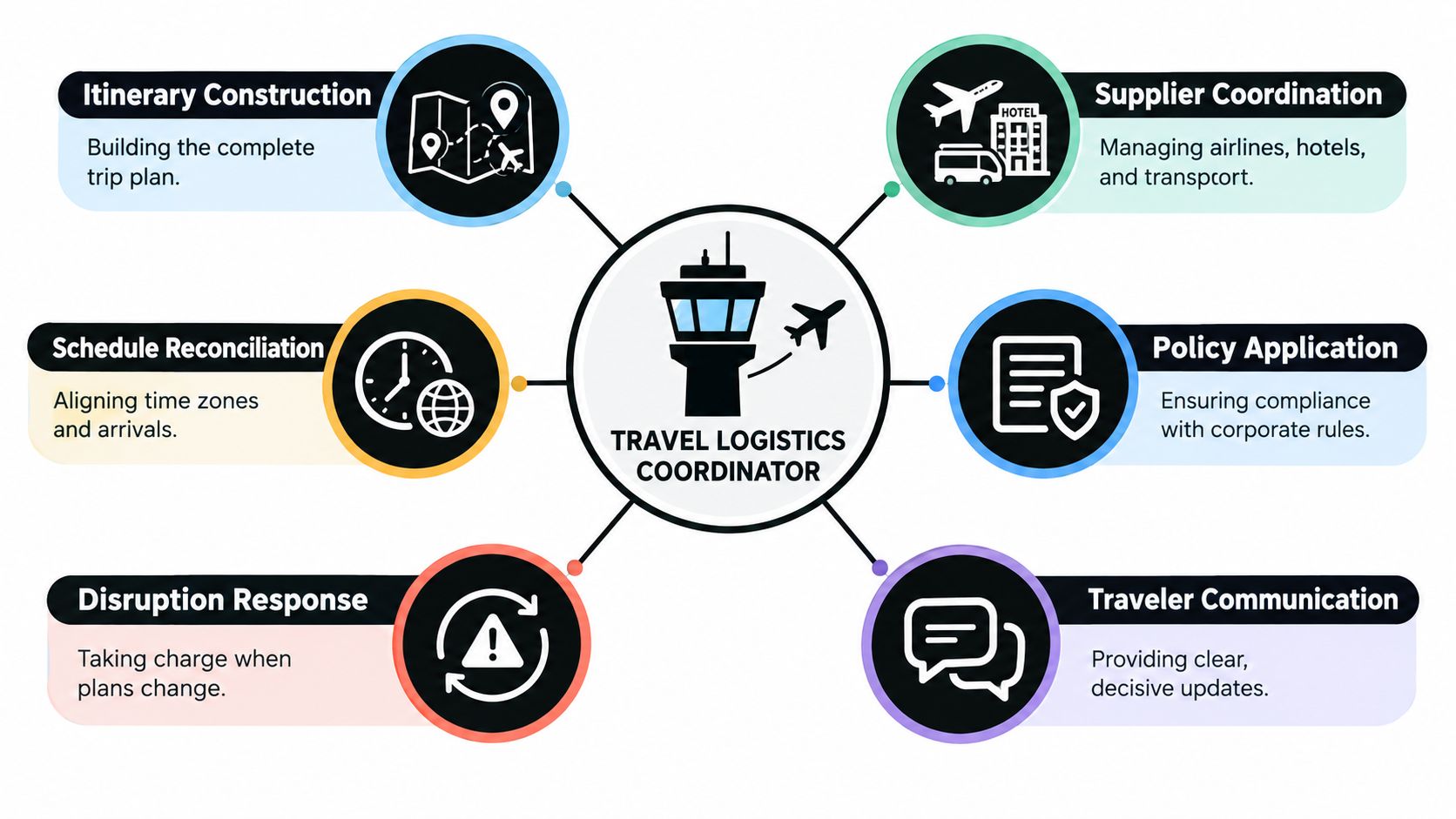
The strongest coordinators combine detailed administration with practical judgment:
- Itinerary construction: They build the full journey, not isolated reservations.
- Supplier coordination: They manage airlines, hotels, transport providers, venues, and local contacts.
- Schedule reconciliation: They account for time zones, check-in windows, transfer times, and meeting commitments.
- Policy application: They understand when a rule is mandatory and when an exception needs approval.
- Disruption response: They evaluate alternatives under pressure instead of forwarding a list of links.
- Traveler communication: They write short, clear updates that help someone act immediately.
Discretion matters as much as speed. A coordinator may handle executive schedules, personal preferences, passport details, family arrangements, or sensitive business travel. They need to know what to document, what to escalate, and what the traveler shouldn't have to repeat.
The occupation remains established even as routine reservations become more automated. The U.S. Bureau of Labor Statistics outlook for travel agents counted approximately 61,500 travel-agent jobs in 2025, projected little or no employment growth from 2025 through 2035, and still forecast about 5,900 openings per year on average. That pattern points to replacement demand and continuing need for human coordination, especially when itineraries become complex or disrupted.
A useful measure of performance isn't bookings completed. It's missed connections prevented, exception-handling time reduced, and traveler hours reclaimed. For a broader view of the operational side of business travel, see this guide to business travel management.
Itineraries as Connected Systems, Not Booking Lists
Treat an itinerary as a risk-control artifact, not a shopping cart. ISO 31030:2021 frames travel risk around preparation, pre-trip assessment, in-trip communication and incident response, post-trip follow-up, and program review. That approach applies to a founder arranging one critical trip as much as it applies to a large organization.
A coordinator evaluates six connected elements:
- Flight timing: Departure, arrival, connection length, airport changes, and rebooking flexibility.
- Hotel access: Check-in windows, late-arrival procedures, cancellation terms, and distance from the meeting site.
- Ground transportation: Transfer availability, pickup timing, vehicle requirements, and backup providers.
- Meeting schedule: Arrival buffer, venue access, presentation obligations, and consequences of lateness.
- Traveler preferences: Seat, room, loyalty, accessibility, dietary, privacy, and communication requirements.
- Emergency alternatives: Alternate airports, later departures, flexible lodging, and pre-vetted transport pathways.
Consider a traveler scheduled to arrive at 6 p.m. after a 4 p.m. flight, check into a hotel with a 3 p.m. cutoff, and attend an 8 a.m. meeting the next morning. The flight may be technically viable, but the plan is already fragile. A delay could create a late arrival, an unattended hotel booking, a long nighttime transfer, and inadequate rest before the meeting.
The coordinator should document at least one viable fallback for every high-consequence connection. That might mean an alternate airport, a later departure with a different routing, a refundable hotel option, or a pre-vetted driver who can handle a changed arrival time. The fallback needs more than a name. Record the change conditions, cancellation rules, contact details, and decision threshold.
Make the dependency visible
A strong itinerary shows what happens if one element fails. If the flight moves, which hotel booking changes? If the hotel becomes unavailable, which transport route still works? If the meeting moves, can the traveler accept a later arrival or should the entire trip be rebuilt?
This is particularly important for specialized movements. For travelers combining aviation with time-sensitive ground transfers, a practical reference on private jet arrival logistics can help clarify the handoff between arrival planning, vehicle coordination, and hotel access.
The booking is only the starting state. The coordinator's real work begins when the system is tested.
How a Coordinator Handles a Disruption in Real Time
At 11 p.m., an airline cancels a flight scheduled to carry a consultant to a critical morning meeting. The coordinator shouldn't begin by sending every available replacement. First, they capture the facts that determine the recovery path.
Capture the incident
The working record should include:
- Flight number and operating carrier
- Ticketing carrier and connection structure
- Cancellation or delay timestamp
- Official reason category, when available
- Rebooking inventory and fare conditions
- Baggage status
- Hotel arrival exposure
- Ground-transport status
- Meeting arrival requirement
The cause matters. The U.S. Department of Transportation Air Travel Consumer Report provides monthly airline service-quality data and distinguishes airline-controlled operational problems, such as maintenance or crew issues, from external causes. A carrier-controlled problem may call for immediate airline re-accommodation and documented expense follow-up. Weather or air-traffic constraints may require broader rerouting, overnight planning, and destination-side changes.
The coordinator then scores the realistic alternatives against five factors:
- Arrival time
- Connection risk
- Transfer complexity
- Changeability
- Total cost
The score isn't meant to create false precision. It forces the coordinator to compare the whole recovery chain rather than choosing the cheapest visible seat. One option might arrive earlier but require a risky airport transfer. Another might cost more but offer a nonstop route and a refundable hotel. The recommendation should identify the best operational outcome, not merely the lowest fare.

The coordinator presents one recommended option and one fallback. They rebook the flight, update the hotel, cancel or amend the ground transfer, check baggage implications, and send a concise message. The traveler needs to know what was chosen, why it protects the meeting, what action they must take, and when the next update will arrive.
The traveler shouldn't have to become the incident manager at midnight.
A clear explanation of connection mechanics can help travelers understand why a particular route has more recovery risk than another. The Passport Premiere flight connection guide is a useful reference for that context. For broader support during urgent changes, see travel emergency assistance.
Document the preference learned from the incident. If the traveler won't accept a short connection after a previous failure, or always prefers a refundable hotel before an early meeting, record that standard. The next recovery should start with better context, not the same questions.
Comparing Three Models for Travel Logistics Support
No support model wins every situation. The right choice depends on travel frequency, disruption exposure, tolerance for friction, number of travelers, and the value of the commitments at stake.
| Dimension | Self-Service OTA | Corporate Travel Desk | US-Based Assistant Team |
|---|---|---|---|
| Availability | Usually available through an app or website, with automated support limits | Often tied to business hours and company procedures | Designed for 24/7/365 human access |
| Channel | App, website, automated messaging, or call queue | Approved channels, often phone or portal | Triple-channel access, by call, SMS, or email |
| Judgment source | Algorithmic search and traveler choice | Human agents within policy and supplier rules | Human Assistants using shared context and preferences |
| Accountability | Traveler manages the outcome | Desk owns policy-compliant processing | Assistant team owns follow-up across the trip |
| Cost structure | Transactional fares, fees, and traveler time | Internal staffing and operating overhead | Subscription capacity without direct employment overhead |
| Best fit | Simple, low-stakes trips | Structured corporate programs with clear policy | Frequent, personal, executive, and mixed logistics |
The self-service model works well when the itinerary is simple and the traveler has time to solve exceptions. It becomes weak when a cancellation affects several reservations or when the traveler can't afford to spend an hour comparing routes.
A corporate travel desk is stronger when policy enforcement, reporting, negotiated suppliers, and centralized approval matter most. Its limitation is often timing. A desk that closes before the disruption begins cannot own the midnight recovery unless an after-hours process is truly staffed and supported.
An Assistant team is a different operating model. It can combine travel planning with personal scheduling, household coordination, and professional follow-up, which matters when the same person is managing business trips, family commitments, and appointments. For teams coordinating multiple vehicles or event movements, this corporate event transportation guide offers useful context on why ground transport needs to be planned as part of the wider program.
The practical test is simple. If you travel rarely and the consequences of delay are minor, an OTA may be enough. If you travel frequently or carry several dependencies, compare the cost of your own recovery time against a model with continuous human ownership. An overview of 24-hour support can help clarify what after-hours coverage should mean in practice.
How Approved Lux Replicates the Coordinator Function
Approved Lux Personal Assistant applies the coordinator model beyond flights. Its operating structure maps to the same five requirements: judgment, access, context, accountability, and capacity.
Human judgment stays in the loop
A real US-based Assistant team handles flights, hotels, ground transportation, restaurant reservations, and full itinerary building. The team can also manage scheduling, household errands, research, professional support, and follow-ups that sit beside the trip. That matters because a travel disruption rarely stays inside the travel category.
Triple-channel access means members can reach the team by call, SMS, or email, with all three channels monitored at equal priority. A traveler can send a short text from an airport, call when speaking is faster, or email a detailed itinerary request. The channel follows the situation instead of forcing the traveler into a portal.
Onboarding captures preferences and access standards. Proactive Preference Learning allows the team to build on that shared context over time, so a future disruption can reflect known standards around connection length, room type, transfer preferences, or communication style.
Capacity without another employment layer
US-based accountability addresses a common concern with outsourced administrative support. The model provides a team rather than claiming the same individual will handle every request, and shared context helps preserve continuity across handoffs.
The subscription structure also avoids the direct payroll, benefits, and management overhead of hiring a personal or executive Assistant. The relevant benchmark is recovered capacity, not a vague promise of convenience. A commercial estimate places scheduling, travel booking, expense reporting, document filing, and routine correspondence at 10% to 20% of a 60-hour CEO workweek, or approximately 6 to 12 hours weekly, as described in this executive administration research benchmark. Treat that as a planning benchmark, not a universal result.
Track your own week. Count itinerary changes, calendar coordination, expense work, follow-ups, and routine messages. If the total is eight hours, the decision is whether delegation converts part of those hours into client work, sales, product decisions, or recovery time.
Two Snapshots of the Same Coordinator Logic
A management consultant spends roughly 100 nights a year on the road. That figure is a representative scenario, not a general benchmark. During a late connection failure in a city she's never visited, the coordinator doesn't just search for another flight.
The Assistant team checks the operating carrier, available routes, arrival time, airport transfer requirements, hotel exposure, and the morning meeting location. It recommends a route that protects the meeting, confirms a practical transfer, updates the hotel, and sends the consultant one action-ready message. The outcome isn't a promise that disruption disappears. It's fewer decisions, calls, and follow-ups competing with sleep before the meeting.
The same operating logic works outside corporate travel.
A dual-career parent manages pediatrician appointments, school enrollment, summer camp registration, and household maintenance. The travel problem and the household problem look different, but both involve multiple people, deadlines, preferences, vendors, and consequences when one appointment moves.
With Lux Circle, up to four people can share one account. The Assistant team can coordinate appointments, registration tasks, service visits, and travel while preserving the household's shared context. The measurable outcome is not a polished lifestyle image. It's the number of decisions removed from one parent, the follow-ups no longer sitting in one inbox, and the administrative hours returned to the family.
These examples show why the coordinator function is better understood as operational noise reduction. The work is valuable when someone else can absorb the monitoring, sequencing, documentation, and escalation that otherwise remains invisible until it becomes urgent.
When a Coordinator Pays for Itself and When It Doesn't
Self-service booking has replaced routine reservation work. It hasn't replaced responsibility for complex recovery.
A coordinator adds real value when you travel frequently, manage several people, face high-consequence meetings, or lose meaningful professional value each time a disruption consumes an evening. Dual-career households can reach the same threshold through appointments, school administration, vendors, and family travel.
Use this checklist:
- Disruption exposure: How often do plans change after booking?
- Recovery cost: What does one hour of late-night coordination displace?
- Trip complexity: How many suppliers, travelers, destinations, and constraints are involved?
- Human preference: Do you want a person to synthesize options, or are you comfortable navigating an app?
- Accountability need: Who follows up when the airline, hotel, or driver doesn't?
A coordinator may add overhead for one low-stakes vacation with generous flexibility. It can pay back quickly when one missed connection threatens revenue, sleep, family coverage, or a critical commitment.
Start by logging your administrative work for a week. Then compare the recovered capacity and decision relief against a traditional travel desk, self-service tools, or a subscription Assistant model. Choose the system that owns the failure points, not merely the one that issues the cheapest confirmation.
Approved Lux Personal Assistant provides 24/7/365 access to a US-based Assistant team through Triple-channel access for travel planning, disruption recovery, scheduling, and follow-ups. If your trips or household logistics leave too many decisions with you, evaluate the operating model through Approved Lux Personal Assistant.
Want the wider view?
Ten categories. One report. Every quarter. The Approved List tracks what's rising and what's fading: data-backed signals, not opinions.
Free to join · Delivered by email