
All Articles
The Journal
Universal Family Scale Explained: One Account, 10 Members
October 26, 202610 min readApproved Travelerfamily travel membership
Universal family scale explained: how one Approved Traveler account covers up to 10 members with full benefits, no per-person fees, and real use cases.

You're staring at a group thread that won't settle. Two grandparents want a ground-floor room. Your brother's family lands Thursday, not Saturday. The condo invoice is in your name, and three adults still haven't sent their share.
That's the job universal family scale is built to shrink. One Approved Traveler account can cover up to 10 household members, each with full benefit parity and no per-person fee. The annual fee is a single number. The useful number is that fee divided by the people on the roster, plus a clear line on where the model stops: separate itineraries, a hard cap of 10, and assistant access that depends on the tier.
What Universal Family Scale Means in Practice
Universal family scale is the feature that lets one Approved Traveler account extend full benefits to up to 10 household members, with no per-person fee for any of them.
Treat it like a family key that opens every room in the house. A per-person membership is closer to buying a separate ticket for each guest at the door. The key doesn't force everyone into the same room. It only means they don't each pay a new admission fee to use the house.
Families are already traveling this way. In 2024, 49% of surveyed parents said they were replacing solo trips with multigenerational travel, while 50% preferred a multigenerational vacation to a trip with only their children, according to Beaches Resorts and Censuswide. One organizer is often holding lodging, air, and cars for people who don't share a last name or a bank account.
How the two models split cost and control
| Factor | Universal family scale | Per-person membership |
|---|---|---|
| Who holds benefits | Every household member, at full parity | Only the individual who holds the membership |
| Fees | One membership fee per account | One fee for each person |
| Booking view | One account across hotels, air, cars, cruises and activities | Separate accounts to reconcile after the trip |
| Reward Credits | Earned on bookings into one account balance | Earned by each account holder separately |
| Group limit | Up to 10 household members per account | Set by each provider; no shared roster |
Practical rule: When one organizer books and pays for several people, a per-person model adds cost and coordination work at every booking, while a single account keeps both in one place.
Say four adults each hold their own membership and book their own flights. You then spend the week matching four confirmations and four credit balances. On one account, those bookings land in one view, and Reward Credits accrue to that account rather than scattering across logins.
Relatives who don't share a language still need a way to talk before dates lock. Multilingual conversations while traveling abroad from Translate AI can keep that chat usable. The account consolidates access. It doesn't merge their calendars.
How the 10-Member Account Structure Works
The structure is a hub. One primary member owns the account and sits at the top. Up to 10 household members sit beneath that owner. Each of them holds full benefit parity, and none of them pays a per-person fee.
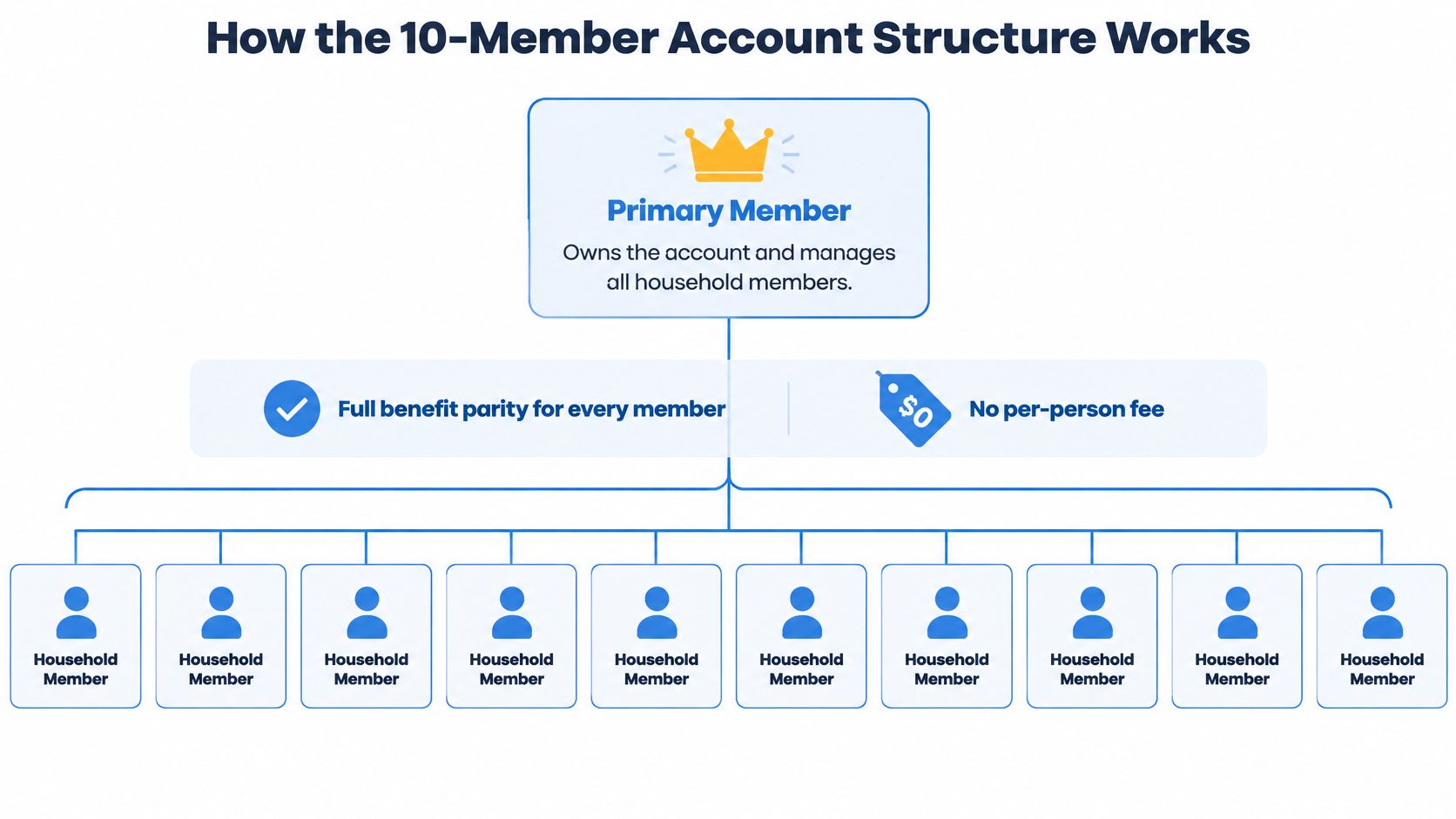
Under the roster is the inventory any enrolled member can book from the same wholesale marketplace: 1,000,000+ hotels, 700+ airlines, 44+ cruise lines with 30,000+ itineraries, 30,000+ car rental locations, 500,000+ vacation homes, 5,500+ tour packages, and 150,000+ activities. A cousin books a car. A parent books a condo. Both draw on that inventory without a second membership.
Why 10 fits most gatherings
The cap lines up with how large family groups already book. In 2024, nearly 20% of U.S. family Thanksgiving bookings included 10 or more guests, according to Airbnb. A roster of 10 covers a typical reunion on one account. A group past that line needs a second account before anyone checks out. Shared lodging choices for big groups are covered in this guide to the benefits of group travel.
Traveler and Lux Traveler side by side
| Feature | Traveler ($899/year) | Lux Traveler ($1,799/year) |
|---|---|---|
| Household members covered | Up to 10 | Up to 10 |
| Marketplace access | Full wholesale marketplace access | Everything in Traveler |
| Approved Lux 24/7 Personal Assistant | Not included | Included, US-based |
| Per-person fees | None | None |
| Reward Credits on every booking | Yes | Yes |
Boomerang Member Share sits outside the household roster. When shared family and friends book hotels and car rentals, the primary member earns Reward Credits on those bookings. The relative who booked doesn't receive that credit.
Reward Credits redeem toward future bookings, maintenance fees, resort usage fees, annual renewal, and eGift cards in listed markets (US, Mexico, Canada, Costa Rica, Australia, UK). Redemption rates aren't fixed, so track the balance. Don't budget it as cash.
Benefits Versus Per-Person Fees by Group Size
For a family organizer comparing plans, the key cost question is the fee per traveler. Divide one Traveler account's $899 annual fee, or one Lux Traveler account's $1,799 fee, by the group size. Neither tier adds a per-person fee within the 10-member cap.
Per-traveler cost by group size
The table compares account costs with a worked example of a separate plan charging $150 per person. That example shows both the fee per traveler and the total for the group.
| Travelers in group | Accounts needed | Traveler cost per person | Lux Traveler cost per person | Example at $150 per person |
|---|---|---|---|---|
| 2 travelers | 1 account | $450 | $900 | $150 each, $300 total |
| 4 travelers | 1 account | $225 | $450 | $150 each, $600 total |
| 6 travelers | 1 account | $150 | $300 | $150 each, $900 total |
| 8 travelers | 1 account | $112 | $225 | $150 each, $1,200 total |
| 10 travelers | 1 account | $90 | $180 | $150 each, $1,500 total |
| 11 travelers | 2 accounts | $163 | $327 | $150 each, $1,650 total |
Account costs per traveler are annual fees divided by headcount, rounded to the nearest dollar. At 11 travelers, the group needs two accounts, so the annual account fee is counted twice. The $150 column is a comparison example, not a quoted rate.
An eight-person reunion
For eight travelers, one Traveler account works out to about $112 per person for the year. Lux Traveler comes to about $225 per person and includes the assistant. A separate $150-per-person plan would total $1,200 for the group, compared with $899 for Traveler or $1,799 for Lux Traveler.
Compare the group totals at each size, then consider what the account model does and does not combine. A shared account fee can lower the per-person cost as more people join, but it does not merge separate itineraries. The account cap also means an 11-person group needs two accounts. Assistant access is another tier distinction: it is included with Lux Traveler, not Traveler.
At two travelers, Traveler averages about $450 per person, so the difference from a modest per-person fee is smaller. One account still puts bookings in a shared view and keeps one Reward Credits balance. At 11 travelers, two Traveler accounts average about $163 per person across the group. To organize the split, use this guide to planning a family vacation on a budget.
Compare account totals with the full per-person charge, and include the coordination involved in managing separate logins.
Multi-Generational and Snowbird Households in Practice

A ten-person reunion across two lodging units
Two grandparents, two adult children with partners, and four grandchildren make a ten-person reunion. The organizer owns the account, and each adult can book lodging through the same roster. In 2024, 46% of parents on multigenerational trips had booked or would book a second room for children to stay with grandparents, according to Beaches Resorts and Censuswide. For a group of this size, plan around at least two units, such as a vacation home and a condo or two neighboring condos.
Set the cost split before checkout. 60% of grandparents share trip costs with their children, while 40% personally plan and organize multigenerational trips, according to the Family Travel Association survey. Put the arrangement in writing: the organizer maintains the account, each adult pays for their own lodging and activities, and the group names who covers shared expenses such as the vacation home or car. The roster gathers bookings in one place, while the written split clarifies who pays each bill.
A snowbird stay with a mid-season arrival
A retired couple spends two months wintering in Arizona, booking a condo in monthly rentals. Their daughter's family joins for the second month. The couple remains the account owner, and the daughter enrolls as a household member and books her week under that roster. For rental options suited to a longer seasonal stay, see this guide to snowbird monthly rentals.
On Lux Traveler, the Approved Lux 24/7 Personal Assistant can arrange a transfer or medical appointment for a parent during the stay. Traveler does not include the assistant. If the household does not need scheduling help, Traveler still provides the same 10-member roster and marketplace.
In both examples, one account holds the roster, but the group can use several lodging units. Name who is responsible for each booking and who pays for it before reservations begin.
Where Family Scale Stops Working
Parity gives each enrolled member access, but it does not create a shared itinerary. Each person still chooses dates, rooms, and activities, so the account cannot move a grandparent onto the children's schedule or coordinate everyone's plans automatically.
The 10-member cap sets the account's limit. An 11th traveler needs a second account and a second annual fee, set up before the first checkout. The extra account is not just another name on the roster.
Assistant access depends on the tier, not the household size. Traveler does not include the Approved Lux 24/7 Personal Assistant. Lux Traveler includes the assistant for up to 10 household members.
Reward Credits have no fixed dollar value because redemption rates vary by use. A balance may not cover the renewal amount you expected, so track credits after each stay and keep them separate from the cash budget.
Booking credits follow a different rule. Boomerang Member Share credits go to the primary member, not the relative or friend who booked the hotel or car. If a sibling expects the credits in their own name, agree on that before booking. Otherwise, the credit goes to the account owner.
Family scale works best when rooms, transfers, and downtime can be planned separately. A grandparent who needs a rest day should be able to skip the group excursion, even when everyone uses the same account.
One shared account provides one place to access inventory and see who booked what. It does not combine separate plans into one itinerary.
Confirm Your Household Roster Before You Book
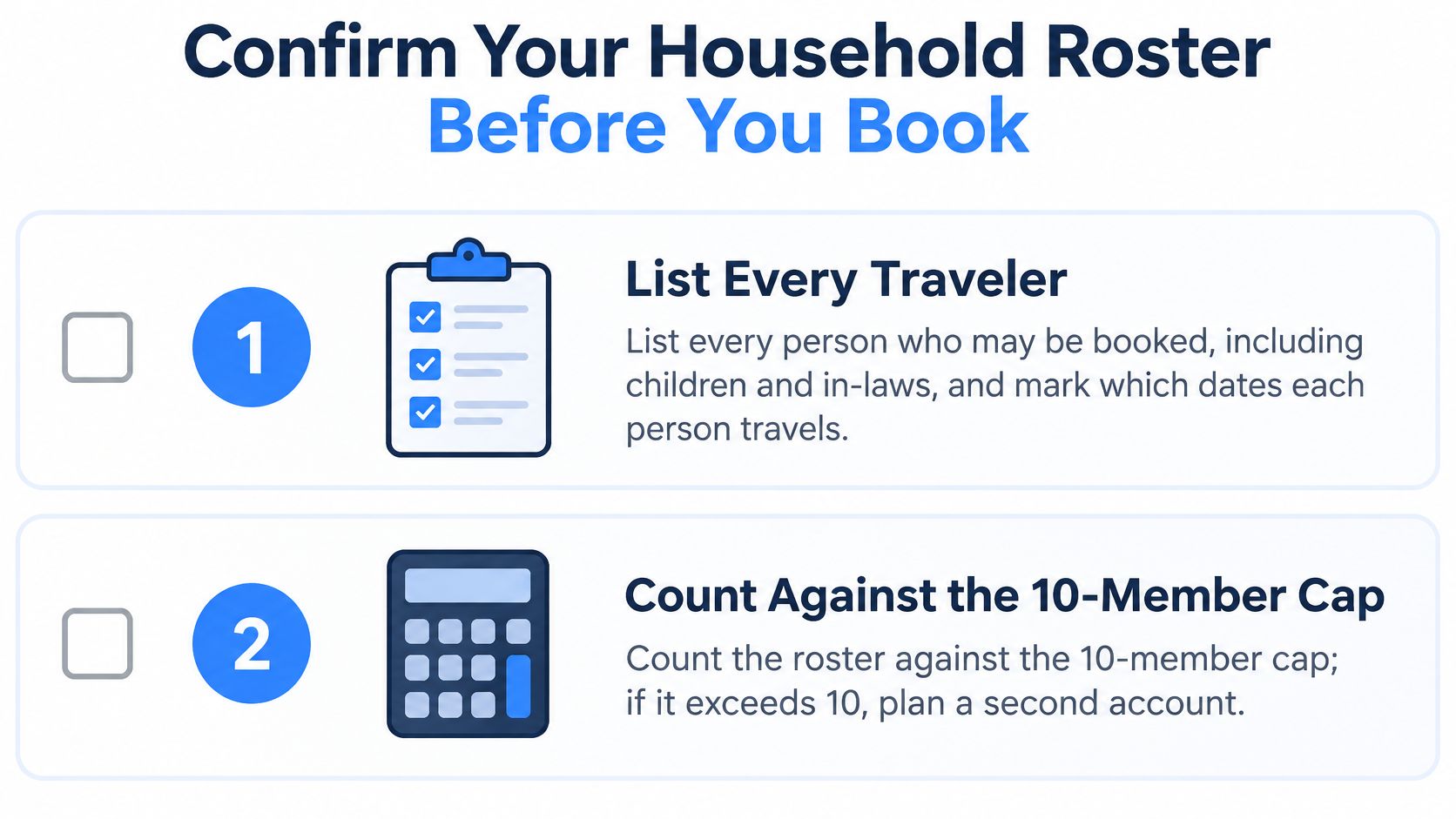
- List every person who may be booked, including children and in-laws, and mark which dates each person travels. A name you add after checkout is how rosters blow past the cap.
- Count that list against the 10-member cap. If it exceeds 10, open a second account before any booking, so you aren't splitting a half-paid reservation later.
- Name the primary member who owns the account, approves bookings, and receives Boomerang Member Share credits. One owner prevents two people from paying the same condo.
- Choose the tier. Pick Traveler for marketplace access alone, or Lux Traveler if you want the Approved Lux 24/7 Personal Assistant for scheduling, childcare, or medical appointments.
- Enroll each household member so benefit parity applies from the first booking. A person who isn't enrolled can't use the member rate on that stay.
- Split the trip into lodging units, such as rooms, condos, and vacation homes, and assign one owner to each unit.
- Book through the account, keep every booking in one shared list, and review Reward Credit activity after each stay.
The roster count is the deciding test. Ten or fewer, one account is enough. Eleven or more, plan the second account first.
Approved Experiences Traveler is an annual membership that consolidates wholesale access to hotels, air, cruises, cars, vacation homes, and activities for up to 10 household members on one account, with no per-person fee. If you're the person coordinating a reunion or a long stay, start by counting the roster, then compare Traveler and Lux Traveler against a real per-person quote. Visit Approved Experiences Traveler when you're ready to set up the account.
Want the wider view?
Ten categories. One report. Every quarter. The Approved List tracks what's rising and what's fading: data-backed signals, not opinions.
Free to join · Delivered by email