All Articles
The Journal
What Is a Fractional Executive and Do You Need One
September 26, 202614 min readfractional CFObusiness leadership
Discover what is a fractional executive, how they compare to consultants, and how to measure ROI. Plus, explore daily operational alternatives.

A fractional executive is a senior C-suite leader who embeds in your company on a part-time basis, typically around 10 to 30 hours per week per client, to own strategy and outcomes without the payroll overhead of a full-time hire. Unlike a consultant, they join the leadership team, make decisions, attend board meetings, and carry accountability for execution.
You may be a founder spending mornings on cash flow, afternoons resolving team conflicts, and evenings coordinating vendors, travel, or family logistics. The company needs senior judgment, but a permanent CFO, COO, CMO, or CTO would create more fixed cost and management weight than the business can justify.
That gap is where fractional leadership earns its place. But the best operating model doesn't stop with a part-time executive. It combines high-level strategic ownership with reliable daily execution support, creating an operational framework that protects leadership attention.
Defining the Fractional Executive Model
The simplest answer to what is a fractional executive is this: a fractional executive is a senior leader who works part-time, remains embedded in the business, and owns a defined function. They aren't a temporary pair of hands or an outside expert who delivers recommendations and disappears. They operate inside the company's leadership rhythm.
A fractional CFO might own forecasting, cash planning, investor readiness, and financial controls. A fractional COO might take responsibility for operating cadence, cross-functional execution, and process discipline. The exact remit varies, but the principle remains constant: the executive owns decisions and outcomes within a clear domain.
Startups.com's explanation of the fractional executive model describes the arrangement as part-time executive work across multiple companies, often within a practical range of 10 to 30 hours per week per client. Other structures may involve 4 to 25 hours weekly or 1 to 3 days per week, depending on the mandate and stage of the company.
Why companies use the model
The trigger is usually predictable. A founder or leadership team needs senior oversight now, but the organization isn't ready to justify a full-time C-suite salary, benefits, equity package, and permanent organizational commitment.
A fractional leader solves that mismatch by supplying executive capacity without full-time permanence. The company gets a leader who can establish priorities, challenge weak assumptions, manage internal teams, and create operating systems that continue working after the engagement changes.
The model gained notable momentum in the 2010s among small and mid-sized companies, particularly businesses under $10 million in revenue that needed experienced leadership but couldn't justify a full-time executive commitment, as documented in this history of the fractional executive model. That same source traces earlier versions of the idea to labor rules in the Netherlands during the mid-1970s and to part-time CFO use during the late-1990s dot-com boom. It also reports LinkedIn profiles using “fractional” alongside a C-suite title rose from about 2,000 in 2022 to more than 110,000 by late 2024, a 5,400% increase, while one placement platform estimated the global pool exceeded 500,000 professionals in 2024.
How the engagement works
A useful engagement has four parts:
- A defined mandate. Specify the business problem, the function owned, and the decisions the executive can make without founder approval.
- A leadership seat. Include the executive in relevant leadership meetings, planning sessions, and reporting routines.
- A measurable scorecard. Track decisions delegated, operating improvements, financial controls, or other outcomes that match the role.
- A handoff standard. Decide whether the engagement is designed to continue, scale down, or prepare the function for a full-time hire.
A fractional executive may work across several businesses, but that doesn't make the role casual. The leader's value comes from bringing senior judgment into the company's actual operating environment. For a more focused example, founders researching what is a fractional CFO can use that role to understand how finance leadership translates into planning, controls, and decision support.
Don't confuse this position with a chief of staff. A chief of staff typically amplifies an executive's priorities across the organization, while a fractional executive owns a specialized leadership function. The two roles can work together, but they solve different capacity problems.
Common Fractional Roles and Strategic Use Cases
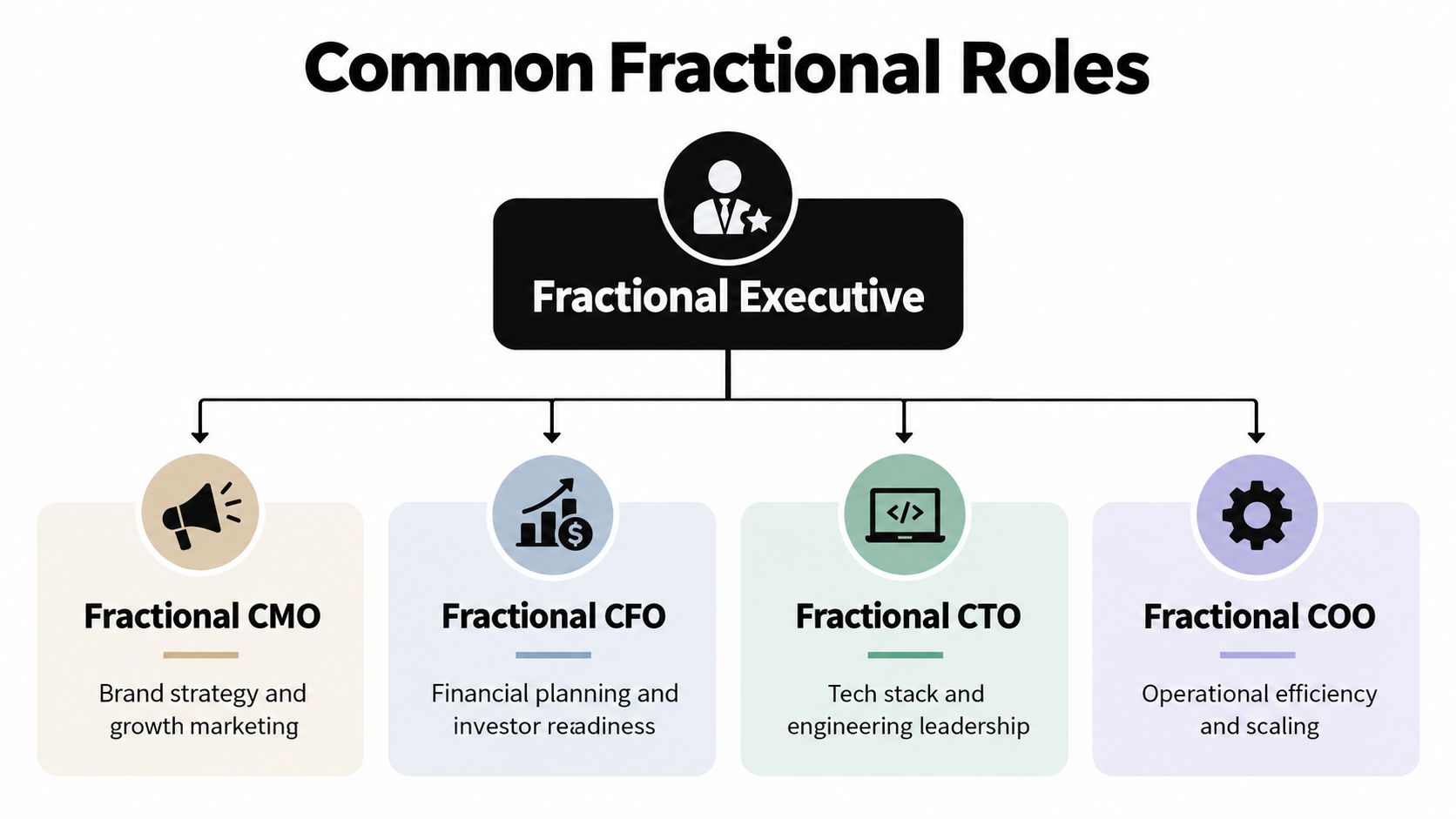
A founder rarely needs “more executive leadership” in the abstract. They need a particular bottleneck removed. The right fractional role becomes clear when you identify the decision the company can't make, the process it can't control, or the function it can't lead.
The finance trigger
A Fractional CFO fits when the company has revenue and activity but lacks financial visibility. The founder may know the bank balance yet lack a dependable view of cash requirements, forecast assumptions, margins, or investor readiness.
The CFO's work isn't limited to producing reports. They translate numbers into decisions, establish financial controls, prepare the company for diligence, and make the trade-offs between hiring, growth, and preservation of cash explicit. If the business is approaching a funding process or dealing with an unpredictable operating cycle, this is usually the first strategic gap to examine.
The growth trigger
A Fractional CMO is useful when marketing activity has outgrown marketing leadership. The company may have agencies, contractors, content, paid campaigns, and sales requests, but no one owns positioning, channel priorities, or the connection between marketing work and commercial results.
The CMO brings order to that system. They clarify the ideal customer, sharpen the message, decide which channels deserve attention, and give internal or external contributors a coherent operating brief. A company doesn't need a large marketing department to need senior marketing judgment.
The execution trigger
A Fractional COO becomes valuable when the strategy is sound but execution keeps slipping. Priorities change without clear decisions, meetings produce little follow-through, teams duplicate work, and the founder remains the escalation point for every operational issue.
The COO creates the cadence. They clarify ownership, establish cross-functional routines, identify bottlenecks, and make the company's operating system more predictable. This role is often the right response to growth that has made informal coordination unreliable.
The technology trigger
A Fractional CTO fits when technical decisions carry business consequences but no senior technology leader owns them. The company may be choosing between building and buying, managing technical debt, planning a product roadmap, or hiring engineers without a clear technical standard.
The CTO connects architecture, product priorities, security, delivery, and hiring. They don't need to write every line of code. They need to ensure technology decisions support the company's commercial direction and that the engineering team can execute against a coherent plan.
Use the practical diagnostic below:
- Cash is unclear or fundraising is approaching: Consider a Fractional CFO.
- Marketing is busy but directionless: Consider a Fractional CMO.
- Teams can't execute consistently: Consider a Fractional COO.
- Technical choices are slowing product decisions: Consider a Fractional CTO.
A fractional executive should remove a specific leadership constraint, not become an expensive generalist. For daily scheduling, follow-ups, and personal or professional administration, an effective part-time executive assistant may be a better fit.
Fractional Leaders vs Consultants and Part-Time Hires
The title matters less than the accountability attached to it. Many companies hire a consultant when they need an operator, or a part-time employee when they need someone with executive authority. Both mistakes create friction because the person lacks the mandate required to solve the problem.
A consultant diagnoses, advises, and often delivers a defined project. A part-time employee executes assigned responsibilities within an existing management structure. A fractional executive enters the leadership structure, makes decisions, manages downstream work, and owns the result of a business function.
Leadership support comparison
| Engagement Type | Accountability Level | Team Integration | Primary Output |
|---|---|---|---|
| Fractional executive | High. Owns outcomes and domain decisions. | Embedded in leadership meetings, systems, and team routines. | Strategy, decisions, execution, and durable operating capability. |
| Management consultant | Moderate. Recommends actions or delivers analysis. | Usually external, with scheduled check-ins. | Findings, recommendations, plans, or a defined project. |
| Part-time hire | Defined by assigned duties. | Integrated into the team, but typically within an existing reporting line. | Task execution and functional support. |
The distinction becomes obvious in a real situation. If sales forecasts are unreliable, a consultant might assess the pipeline and recommend a forecasting process. A part-time analyst might update the spreadsheet. A fractional revenue leader would establish the process, set expectations with sales managers, challenge the forecast, and answer for whether leadership can trust it.
Practical rule: Hire for the level of ownership you need, not for the seniority implied by a title.
Consultants remain useful when the internal team can execute and needs an outside perspective. A guide to use cases for consultants can help clarify when project-based expertise is appropriate. Don't turn a consulting assignment into a fractional role by accident. If the person is expected to manage staff, approve priorities, attend executive meetings, and answer for performance, write those responsibilities into the engagement.
The reverse mistake happens too. A company hires a part-time employee to handle a strategic problem, then becomes frustrated when that person waits for direction. The employee may be doing exactly what the role allows. If you need a leader to set the direction and make trade-offs, an executive assistant hiring guide is useful for separating administrative support from executive ownership.
Measuring ROI and Reclaiming Operational Bandwidth
Fractional leadership earns its keep through decisions and capacity, not impressive meeting attendance. Measure the engagement by asking what the founder stopped doing, what decisions moved to the right owner, and which costly sources of confusion disappeared.
The business case should start with a baseline. Record the recurring work that consumes leadership attention, then compare it with the work the fractional leader takes over.
Useful measures include:
- Founder hours reclaimed: Track time previously spent reviewing, correcting, or coordinating the function.
- Decisions delegated: Count recurring decisions that no longer require founder approval.
- Execution reliability: Monitor whether priorities, reporting, and follow-ups happen consistently.
- Avoided operating cost: Identify unnecessary vendors, duplicated work, weak controls, or preventable rework.
- Leadership focus: Note whether the founder can spend more time on product, customers, hiring, fundraising, or other high-value responsibilities.
The U.S. Bureau of Labor Statistics reports that the civilian population spent 15,738 million hours in office and administrative support activities, including 9,499 million hours by employed people, in its American Time Use Survey. That makes administrative work a capacity issue, not a minor inconvenience.
Count the hidden coordination load
The same problem appears at home. A systematic review found average household management time of about 1.64 hours per week, including planning activities and purchasing household, childcare, and financial services, as detailed in this review of household management time.
That figure doesn't capture every form of mental coordination. Research on working mothers describes the mental load as remembering, planning, tracking, and anticipating household needs, while independent coverage reports parents spend 30.4 hours per week coordinating family schedules and household tasks in this analysis of parenting mental load.
Don't treat those demands as unrelated to leadership performance. A founder or executive who spends evenings coordinating appointments, vendors, travel, and family schedules begins the next workday with less decision capacity.
Measure the second shift as operational drag. If a task repeatedly interrupts strategic work, it belongs on the capacity ledger.
A fractional executive may reduce business coordination, but they won't automatically remove household administration or every personal interruption. Build the ROI case around the entire system. The most effective strategy assigns strategic decisions to senior leadership and routes repetitive coordination to reliable execution support.
How to Evaluate and Onboard a Fractional Leader
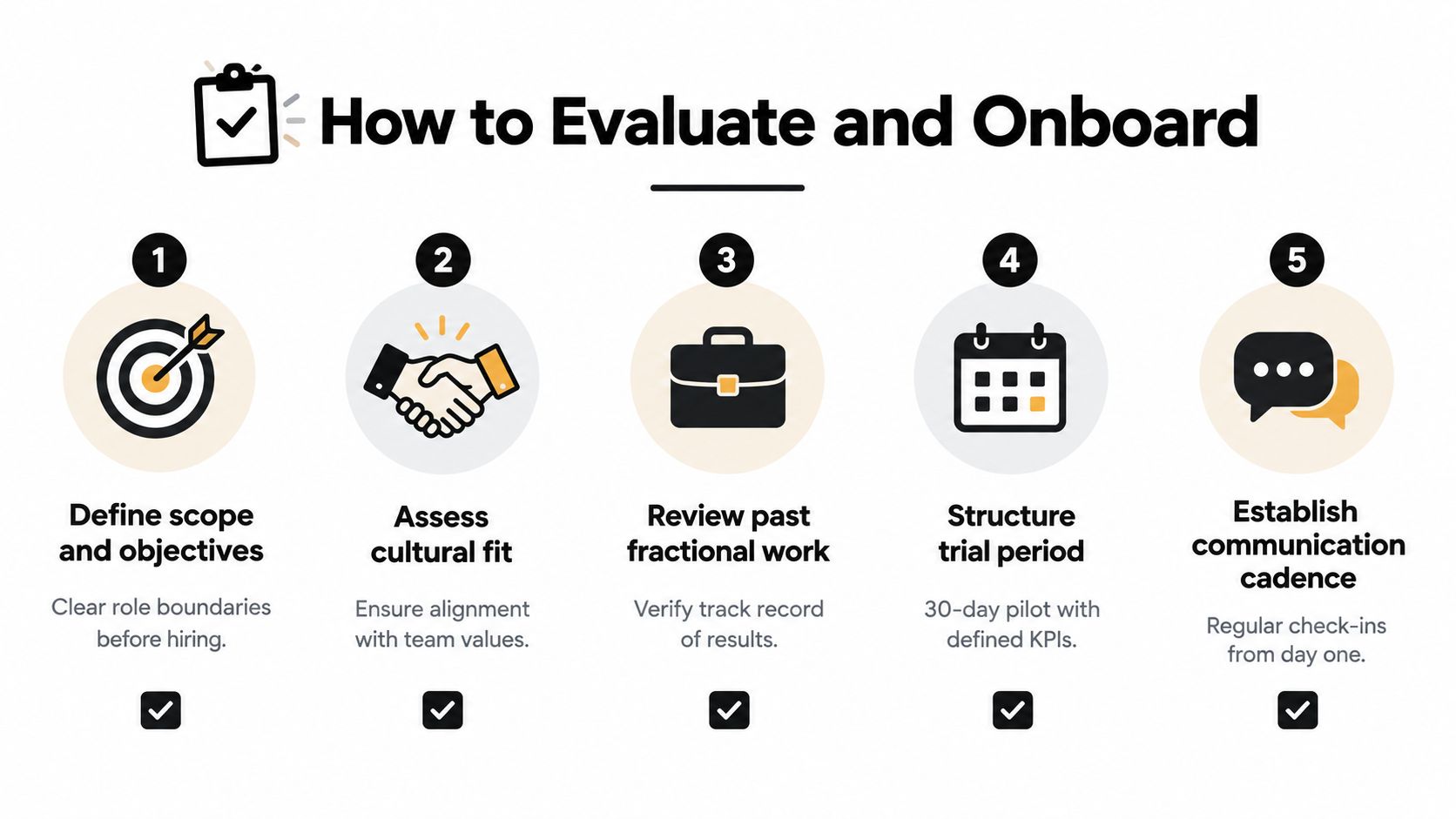
The best candidate isn't just an accomplished executive with spare availability. You need someone who can enter an unfamiliar operating environment, establish trust quickly, make decisions with incomplete information, and document enough of the system that the company doesn't become dependent on personal memory.
Start with the mandate
Write the role before you interview candidates. State the business problem, the function owned, the decisions reserved for the executive, the decisions retained by the founder, and the evidence that will show progress.
Avoid language such as “help us improve operations.” Use a mandate such as “establish a weekly operating cadence, clarify ownership across the leadership team, and create a reliable escalation process.” The more specific the mandate, the easier it becomes to evaluate candidates and prevent scope creep.
Test for fractional operating ability
Ask questions that reveal how the candidate works when they aren't present every day:
- What decisions would you expect to make without waiting for the founder?
- How do you keep teams aligned between working sessions?
- What would you document during your first month?
- Tell me about a time you inherited a function with incomplete information.
- How do you handle a leader who disagrees with your operating recommendation?
- What would make you reduce or expand your involvement?
Look for concrete answers. Strong candidates describe decision rights, communication routines, escalation thresholds, and methods for transferring knowledge. Weak candidates rely on broad promises about relationships, transformation, or “bringing energy.”
Use a structured activation period
A practical onboarding sequence looks like this:
- Days one through five, establish access and context. Provide the financial, operational, customer, team, and strategic information needed to understand the mandate. Introduce the leader to direct reports and key stakeholders.
- Days six through ten, map the current system. Identify decision bottlenecks, recurring meetings, undocumented processes, conflicting priorities, and the metrics leadership currently trusts.
- Days eleven through twenty, choose the first operating changes. Don't launch a long transformation program. Select the few changes that will improve visibility or execution immediately.
- Days twenty-one through thirty, publish the operating agreement. Confirm responsibilities, meeting cadence, reporting format, decision rights, and the next set of outcomes.
The first month should produce clarity, not an elaborate presentation. Give the fractional leader real authority early enough to test whether the relationship works in practice.
A fractional executive can't own outcomes without access, authority, and context. Grant all three before judging performance.
Meet weekly at first, but don't turn every meeting into a status recital. Ask what changed, what remains blocked, which decision needs escalation, and what the team can now handle without executive involvement. That rhythm reveals whether the leader is building capacity or just becoming another layer of reporting.
Red Flags and Common Misconceptions
The fractional model fails when companies treat part-time presence as a substitute for clear leadership design. A senior title doesn't compensate for weak authority, unclear priorities, or a team that refuses to change.
The first misconception is that any experienced executive can work fractionally. Some leaders depend on constant informal access, live in reactive meetings, or keep critical context in their heads. That approach breaks when the executive isn't available every day. Look for someone who can operate asynchronously, write clear decisions, and create systems other people can follow.
The second misconception is that fractional means “on call.” It doesn't. A fractional leader needs an agreed cadence, defined escalation rules, and protected time for strategic work. If the company expects emergency availability without paying for or structuring that responsibility, resentment will replace value.
Warning signs during selection
- No clear operating method: The candidate speaks about experience but can't explain how they prioritize, communicate, or make decisions remotely.
- Resistance to documentation: They describe themselves as the only person who can solve the problem.
- Undefined success criteria: They avoid committing to outcomes or insist that progress can't be measured.
- Excessive client load: Their availability is so fragmented that your company would receive attention only during crises.
- Authority mismatch: The founders want ownership, but the team retains veto power over every meaningful decision.
- Culture denial: The company expects a part-time executive to repair deep trust problems without changing leadership behavior.
A fractional executive can stabilize a function, but they can't make a broken business healthy through limited hours alone. They won't solve poor founder alignment, dishonest reporting, chronic underinvestment, or a toxic culture unless the owners are willing to address those conditions.
Set boundaries before the first invoice. Define response expectations, meeting participation, confidentiality, decision rights, and what happens when the engagement reaches its intended outcome. Fractional leadership works best when both sides treat the arrangement as a real operating role, not a flexible rescue service.
Operational Alternatives for Everyday Leverage
A fractional executive is designed for a high-level bottleneck. They should not spend their limited leadership capacity booking routine appointments, comparing household vendors, coordinating travel changes, drafting low-stakes emails, or chasing every administrative follow-up.
That work still matters. It belongs in a different layer of the operating system.
The complete stack has two levels:
- Strategic leadership: A fractional CFO, CMO, COO, CTO, or another senior operator owns direction, decisions, and outcomes.
- Daily execution support: An Assistant team handles recurring coordination, research, scheduling, logistics, inbox work, and follow-through.
This division protects the executive's attention. The fractional leader can focus on financial controls or operating priorities instead of becoming the founder's personal task manager. The founder can delegate administrative noise instead of pushing it into evenings and weekends.
For a dual-career household, the same logic applies. Research on working mothers identifies the invisible cognitive work of remembering, planning, tracking, and anticipating household needs as a persistent mental load, while reporting on parenting coordination describes 30.4 hours per week spent on family schedules and household tasks, as noted earlier. Strategic leadership at work won't remove that second shift by itself.
The right support model should accept requests through the channels people already use, handle judgment-heavy coordination, and preserve context over time. Travel changes, school logistics, household services, inbox triage, meeting preparation, and vendor research are execution tasks, but they require discretion and follow-through rather than another software dashboard.
This is also where specialized support can help. For example, a professional who needs legal administration may research virtual legal assistants companies separately, while keeping legal judgment with qualified counsel. The operating principle is consistent: delegate coordination, not regulated professional advice.
The best stack is therefore not “hire a fractional executive and hope the noise disappears.” It is strategy ownership above, execution capacity below, and explicit boundaries between the two. That structure gives founders and dual-career professionals more usable attention without forcing every task into a full-time hire.
Approved Lux Personal Assistant provides 24/7 access to a US-based Assistant team through Triple-channel access, phone call, SMS text, and email, for travel logistics, scheduling, household coordination, inbox support, research, and professional follow-through. Choose Lux Solo for individual support or Lux Circle for up to four people, then visit Approved Lux Personal Assistant to replace recurring administrative friction with flexible operational capacity.
Want the wider view?
Ten categories. One report. Every quarter. The Approved List tracks what's rising and what's fading: data-backed signals, not opinions.
Free to join · Delivered by email