

Resources
Articles
Notes, guides, and editorial standards from the Approved Experiences team. Written for members, in the same voice we use everywhere else.
Resources
Notes, guides, and editorial standards from the Approved Experiences team. Written for members, in the same voice we use everywhere else.
Discover charter jet cost per hour basics, what drives pricing, and smart tips to compare options and save on luxury travel.

When you start looking into private jet travel, the first question is always about the price. The charter jet cost per hour can swing wildly, from around $2,000 for a turboprop all the way up to $23,000 or more for an ultra-long-range jet.
The average hourly rate falls somewhere around $11,102, but the specific jet you choose is hands-down the biggest factor in your final quote.
The most important thing to grasp about private charter is that you're renting the entire aircraft, not just a seat. The price is based on the plane's size, its capabilities, and all the costs that go into keeping it in the air.
It's a lot like renting a car. You wouldn't expect a compact sedan for a quick city trip to cost the same as a luxury tour bus for a cross-country journey. Private aviation works the same way. A short flight for two people from San Francisco to Napa Valley is a perfect job for a cost-effective turboprop, while a transatlantic flight for a board of directors requires the range and cabin size of a heavy jet.
The market is neatly divided by aircraft type, and the prices make a lot of sense when you see what you get. The most wallet-friendly options are turboprops, which typically run between $1,700 and $2,400 per hour. This makes them a fantastic choice for shorter, regional flights when you're keeping a close eye on the budget. In fact, industry-wide data confirms that pricing scales directly with aircraft capability.
This chart gives you a clean visual breakdown of how those hourly rates climb as you move from smaller planes to the top-tier global jets.
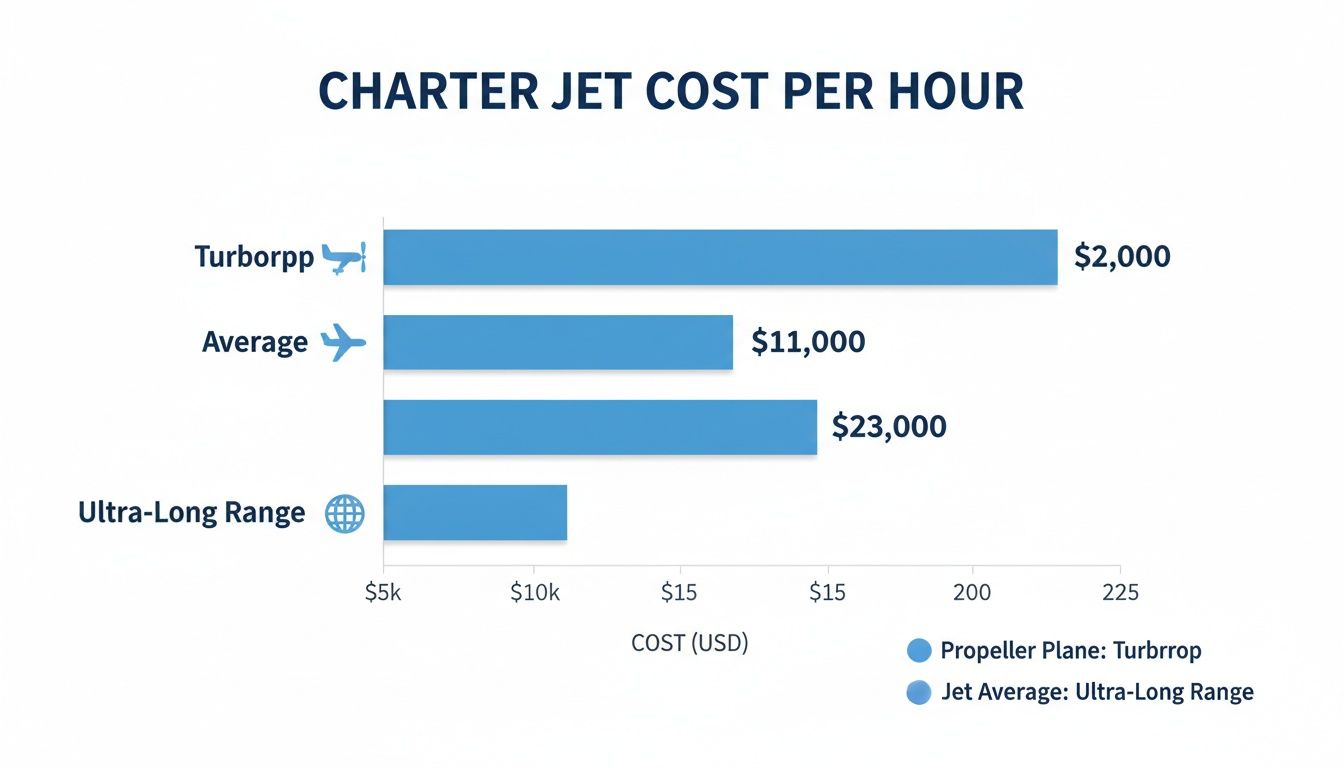
As you can see, the jump in cost directly reflects an increase in the aircraft's size, flight range, and onboard luxuries.
To give you a real-world starting point, this table breaks down the typical charter jet cost per hour by aircraft class. Think of it as a quick cheat sheet to match your travel plans with a realistic budget.
| Aircraft Category | Estimated Hourly Rate | Typical Passenger Capacity | Best For |
|---|---|---|---|
| Turboprop | $2,000 - $4,000 | 4-8 Passengers | Short regional hops (e.g., Los Angeles to Vegas) |
| Light Jet | $4,500 - $7,000 | 6-8 Passengers | Business trips up to 3 hours (e.g., NYC to Chicago) |
| Midsize Jet | $7,000 - $9,500 | 8-10 Passengers | Coast-to-coast flights (e.g., Miami to Seattle) |
| Heavy Jet | $12,000 - $18,000 | 10-16 Passengers | International travel (e.g., London to New York) |
| Ultra-Long Range Jet | $18,000 - $23,000+ | 12-19 Passengers | Global, non-stop journeys (e.g., Dubai to LA) |
Having these baseline numbers is crucial, but it’s just the first piece of the puzzle. While the hourly rate is the core of your quote, the final bill will include other necessary costs. Still, even with these figures, you can find great value, and you might find some useful tips in our guide to luxury travel on a budget.
That big charter jet cost per hour you see advertised? It’s the starting point, not the final number. Think of it like the MSRP on a new car—it’s a key figure, but it doesn't include the taxes, fees, and extras that determine your final "drive-out" price. A private charter quote is built the same way, bundling several layers of costs into a single total.
Getting a handle on these components is the secret to reading any quote with confidence. The pricing isn’t pulled out of thin air; it’s a direct reflection of what it takes to operate a multimillion-dollar aircraft at the highest possible standards of safety and service. Once you see the breakdown, you’ll understand exactly where every dollar goes.

Your quote is a lot like an itemized bill from a five-star resort. Some charges are tied directly to your stay (the room rate), while others cover the staff and constant upkeep that make the entire experience possible. In aviation, we split these into variable and fixed costs.
Variable costs are the ones that change with every flight, and they include the most obvious expenses.
These expenses are directly linked to the logistics of your specific trip, which is why they have such a big impact on the final price.
Behind the scenes, a staggering amount of work—and money—goes into keeping an aircraft safe and ready to fly at a moment's notice. These are the fixed costs, and they're spread out across every flight hour the jet operates all year long.
The hourly rate isn't just for the time you're in the air. It's a carefully calculated figure that covers the immense overhead of maintaining, insuring, and housing the aircraft 24/7, ensuring it's always prepared for your flight.
These essential background costs are baked into the hourly rate to keep the aircraft in perfect, flight-ready condition.
Key Fixed Costs Included in Your Rate:
Every single one of these elements is crucial for a safe, reliable operation. When you get a quote, you're not just paying for fuel and a pilot; you're funding an entire infrastructure of safety, compliance, and readiness. This perspective demystifies the charter jet cost per hour and reveals its true value.
The hourly rate is a great starting point, but it's not the whole story. Your final invoice can sometimes bring a few surprises if you aren’t aware of the other variables that come into play. These are the factors directly tied to the logistics of your specific trip, and understanding them is the key to mastering your charter budget.
One of the biggest line items you might see is a positioning fee. Most people don't realize this, but if the jet you booked isn't already parked at your departure airport, you'll have to cover the cost of flying it there. This is often called a "ferry flight" because it’s flying empty just to pick you up.
Actionable Insight: Always ask your broker for aircraft based at or near your departure airport. A jet that's a 30-minute flight away might have a slightly higher hourly rate but could still be cheaper overall than a "cheaper" jet that needs a two-hour positioning flight to reach you.
Think of it this way: you’re in Aspen, but the perfect jet for your trip is based in Denver. You'll be billed for that flight from Denver to Aspen before your own journey even starts. That flight time is charged at the jet's normal hourly rate, so it can add up quickly.
Where you land matters—a lot. Major international hubs are almost always more expensive than smaller, regional airports, and this comes down to a couple of key charges.
A smart move is often to choose a smaller executive airport near your destination. For example, flying into Teterboro (TEB) instead of JFK for a New York City trip usually means lower fees and a far more private, seamless experience on the ground. This simple choice could save you $1,000 or more in airport fees.
The private jet market operates on supply and demand, just like commercial airlines and hotels. If you're planning a trip during a major holiday, a big event like the Super Bowl, or peak travel season, expect to pay more. Operators often add a premium of 20% or more to their standard rates during these high-demand times.
This is a huge factor. Flying to the Caribbean the week before Christmas will be significantly more expensive than the same trip in early November. This isn't just a small bump; we see all-inclusive rates for light jets that start around $5,000 to $6,000 per hour get pushed much higher by seasonal demand. Even booking last-minute can spike costs by 10% to 15%.
It's also worth remembering that the expertise of the crew is baked into the operational costs. Pilots undergo extensive training, and the high multi-engine rating cost, for example, is a testament to the investment required to fly these sophisticated aircraft safely, which is reflected in crew expenses.
A savvy traveler knows that flexibility is the ultimate cost-saving tool. Shifting your travel dates by just a few days to avoid a peak period can save you thousands of dollars without changing your destination.
By keeping these factors in mind—positioning fees, airport choices, and timing—you can get a much clearer picture of your total cost. It’s how you move from just chartering a jet to truly managing the experience, ensuring the final price holds no surprises.
Theory is one thing, but seeing how the numbers play out on actual trips is where the charter jet cost per hour really starts to make sense. Abstract costs like positioning fees and federal taxes suddenly become tangible when you see them attached to a real itinerary.
Let's walk through three common flight scenarios. This will show you exactly how a base hourly rate gets built up into a final, all-inclusive quote.
Imagine a couple of executives needing a quick, same-day round trip from a smaller airport like White Plains (HPN) near New York City down to Washington, D.C. (DCA). The name of the game is speed and efficiency, making a light jet the perfect tool for the job.
A Citation CJ3+ is a real workhorse for this kind of regional business travel, offering a great mix of performance and cost-effectiveness.
Flight Breakdown: New York to Washington D.C.
For this quick round trip, the total comes out to about $13,625. You can see that while the hourly rate is the biggest chunk, the taxes and airport fees tack on a significant 24% to the final bill.
Now for a different mission. Let's picture a family of six flying one-way from Los Angeles (VNY) to Miami (OPF) for a week-long getaway. This longer flight means comfort, cabin space, and range are top priorities. That puts us squarely in the midsize or super-midsize jet category.
A Citation Latitude or a Challenger 350 would be a great fit here, with a stand-up cabin and plenty of room for luggage—essentials for a family trip of this length.
For coast-to-coast flights, the aircraft's efficiency at cruising altitude becomes a major factor. While a larger jet has a higher hourly rate, its speed can sometimes reduce total flight time, partially offsetting the cost.
Flight Breakdown: Los Angeles to Miami
The all-inclusive estimate for this one-way trip lands around $43,313. It's also worth noting, if the jet wasn't based in Los Angeles and had to be repositioned for your flight, that empty leg could easily add another $10,000 to $15,000 to the total. This really drives home why booking an aircraft close to home is so important.
To give you an even clearer picture, let's compare how the numbers shift for that popular New York to Miami route across different aircraft classes.
Here's a comparative look at the total estimated cost for a one-way flight from New York to Miami on three different classes of private jets.
| Aircraft Type | Base Hourly Cost | Total Flight Cost | Total All-Inclusive Estimate |
|---|---|---|---|
| Light Jet (e.g., Phenom 300) | $6,000 | $16,500 (2.75 hrs) | $20,000 |
| Midsize Jet (e.g., Citation Latitude) | $7,500 | $18,750 (2.5 hrs) | $23,500 |
| Heavy Jet (e.g., Gulfstream G450) | $13,000 | $31,200 (2.4 hrs) | $38,000 |
As you can see, the jump from a light jet to a heavy jet nearly doubles the all-in cost for the same trip, highlighting how much aircraft choice impacts the final price.
Finally, let's tackle a major international journey: a round trip from London (LTN) to Dubai (DWC) for a team of eight, including a two-day stay. This mission demands an aircraft with true intercontinental range and the amenities needed for a long-haul flight. We're talking about a heavy jet like a Gulfstream G450 or Global 6000.
International flights bring a whole new set of costs into the equation, from overflight permits and international handling fees to crew accommodation during the layover.
Flight Breakdown: London to Dubai
The total estimated cost for this international round trip is a cool $200,000. On this trip, the crew's hotel bill and complex international fees alone add up to $18,000. It's a perfect example of how non-flight factors become much more prominent on global journeys.
These real-world scenarios show that the charter jet cost per hour is just the starting point of a larger, dynamic pricing puzzle.

Knowing what goes into a charter quote is one thing, but actually using that knowledge to your advantage is where the real savings happen. If you get strategic about how and when you fly, you can bring down your charter jet cost per hour in a big way—all without compromising on the quality or safety of your flight.
Flying private is, at its core, about efficiency. The savviest travelers apply that same mindset to booking their flights, turning what could be major expenses into smart financial moves. It all boils down to being flexible and knowing where the value is hiding.
If there's one "insider secret" to saving big on private charters, it's the empty leg flight. Think of it this way: a jet drops off passengers in Miami but its home base is in New York. That plane has to fly back to New York anyway, with or without passengers. Operators would rather sell that empty flight at a steep discount than fly a vacant plane.
And the discounts are significant. It’s pretty common to see empty leg deals for 50% to 75% off the normal charter rate. For one-way trips, this is an absolute game-changer, making a high-end flight surprisingly affordable.
Actionable Example: A heavy jet that might typically run $38,000 for a one-way trip from New York to Miami could pop up as an empty leg for as little as $10,000. The catch? You have to fly on the operator's schedule, not yours. This means being ready to depart from Teterboro on a Tuesday at 9 AM, rather than from Westchester on a Friday evening.
The main trade-off here is flexibility. You can't dictate the departure time or the exact route. But if the flight happens to line up with your plans, the savings are just unbeatable. To dig deeper into this, check out our guide on how to find empty leg flights.
The world of private aviation isn't immune to the laws of supply and demand. Just like with commercial airlines, when you fly makes a huge difference in what you pay. Flying during peak times will always cost you a premium.
But by shifting your travel dates by even a day or two, you can often sidestep surge pricing and lock in a much better rate.
A few timing strategies to put into practice:
Booking well in advance also helps. It gives you a much better selection of available aircraft, meaning you have a higher chance of finding a jet based closer to your departure airport. That alone can slash those expensive positioning fees.
If you fly more than just a few times a year, a travel membership can be your key to unlocking consistent value. Programs like Approved Experiences Traveler often provide access to wholesale pricing that the general public simply can't get. This direct line can make a massive dent in your annual travel budget.
These memberships are about more than just a discount, though. They offer a whole suite of benefits that add real value to your travel experience.
What to expect from a good membership:
By combining these three strategies—hunting for empty legs, mastering your timing, and using a membership—you can completely change how you approach private travel. You’ll move from just accepting quotes to actively building a smart, cost-effective travel plan.
Even after breaking down the hourly rates and all the line items, you probably still have a few questions. That's completely normal. Let's tackle some of the most common questions we get from clients, so you can feel totally confident when planning your trip.
The goal here is to pull back the curtain on those final details, making sure there are no surprises and you understand exactly how your decisions affect the final price tag.
For short trips, absolutely. If you’re just flying out and back within a day or two, booking a round trip is almost always the smarter financial move.
Practical Example: For a same-day business trip from Dallas to Houston, the jet waits at the airport for your return flight. This costs far less than paying for it to fly home empty and then return to pick you up. You avoid paying for two extra "ferry" flights.
But if you're planning a longer stay—say, more than three days—the math flips. At that point, it’s actually cheaper for the operator to fly the jet and crew home and then fly back to pick you up later. In that scenario, you’re basically paying for two separate one-way charters.
Daily minimums are a standard part of the charter world. Think of it as the minimum number of flight hours an operator will bill you for each day you have the jet reserved. Typically, this is set at around two hours of flight time per day.
Here’s a practical example: You book a quick 45-minute hop from Los Angeles to Las Vegas and stay the night. Even though you only flew for 45 minutes, you'll likely be billed for the two-hour minimum for that day. This policy ensures the operator can cover their fixed costs—like crew salaries and the simple fact that their multi-million dollar asset is tied up with you instead of flying another mission.
Understanding daily minimums is crucial for accurately budgeting short hops or multi-day trips with little flying. It's a fundamental part of the charter jet cost per hour calculation that ensures the operator's readiness.
Yes, you do. When you charter a private jet, you're not just buying a seat; you're renting the entire aircraft for your exclusive use. The price is for the whole plane, for your specific route, whether you're flying solo or have every single seat filled.
This is the key difference between private charter and flying commercial. The total cost is fixed, which means your per-person cost drops dramatically with every passenger you add. For example, a $20,000 flight with two people is $10,000 per person. With a group of eight, that same flight costs only $2,500 per person, making it surprisingly competitive with first-class commercial tickets.
Finding a great deal comes down to two things: flexibility and being proactive. It’s not about luck; it’s about using the right strategies to cut your costs.
For frequent flyers, looking into a travel club can be a genuinely smart financial move. Our guide on private jet membership costs breaks down exactly how these programs can provide consistent savings and other valuable perks. Being strategic about how you book is just as important as the flight itself.
Ready to experience luxury travel with exclusive access and unparalleled savings? With Approved Experiences Traveler, you gain entry to a world of wholesale pricing on hotels, cruises, car rentals, and even private aviation opportunities like empty-leg flights. Stop paying retail and start traveling smarter.
From this collection
From this collection

how to charter a private jet
Learn how to charter a private jet with our complete 2026 guide. Get insider tips on pricing, booking, and choosing the right aircraft for your flight.

private jet membership cost
Understand the true private jet membership cost with our complete guide. We break down fees, compare models, and reveal what to ask before you join.

private jet membership comparison
Our detailed private jet membership comparison breaks down jet cards, fractional ownership, and charter models to help you find the most cost-effective option.